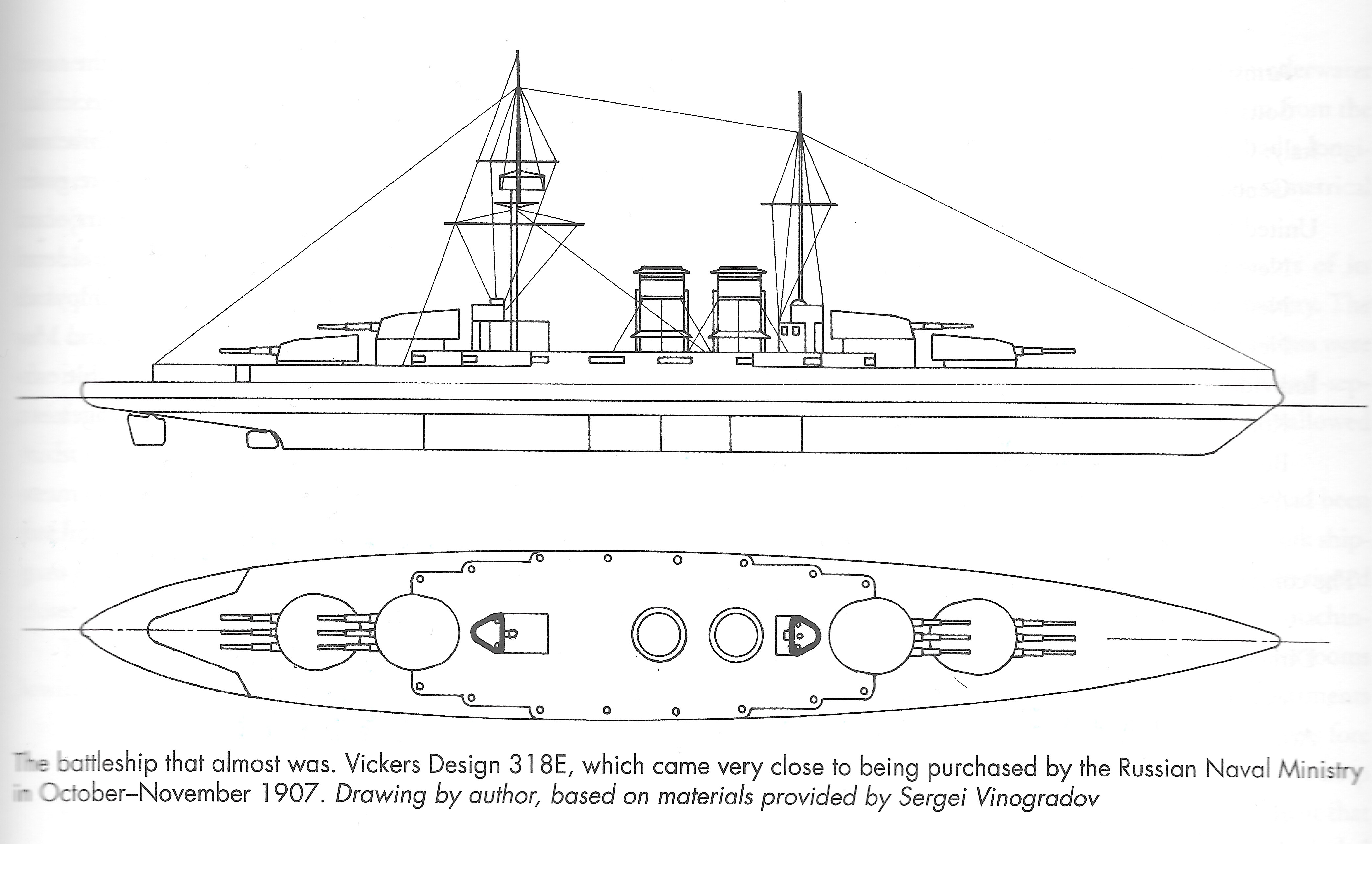
Information on Vickers 1907 Design 318 for Russia?

190X

ACCESS: Restricted
Joined
17 December 2022
Messages
4
Reaction score
3
Hello All,

I am looking for any information or leads people might have on Vickers' Dreadnought battleship Design No. 318 as nearly accepted by the Russian Naval Ministry in late 1907. I am particularly looking for information regarding the designed ships' dimensions, arrangement, and any drawings that might exist. I am particularly interested in the superimposed '318e' variant of the design.

Thank you for any help.

190X
 
Vickers%20318E.png


I think this is the only illustration that at least I have ever encountered, its from McLaughlin's Soviet and Russian battleship book.
 
Vickers%20318E.png


I think this is the only illustration that at least I have ever encountered, its from McLaughlin's Soviet and Russian battleship book.

That's the only illustration that I've ever some across too.

Does anyone know the basic dimensions of the design? Even just the beam and length would be dreadfully helpful for what I'm working on.

Cheers,

190X.
 
Somehow I missed this thread.
I don't have data of Design 318E only for the base 318:

Dimensions: 155,5 (pp) x 25,3 x 7,77 meters
Displacement: 20.200tons (standard)
Engines: 26.000shp likely Vertical Triple Expansion engines, 4 shafts
Speed: 39km/h (21knots)
Range: 10.100km (5.500nm)
Armour: 203mm Belt
Armaments:
4x3 12"/50 (305mm/50) likely Vickers Mark C Cannons,
8x2 4,7"/50 (120mm/50) likely Vickers Mark A Guns
2x1 457mm Underwater torpedo tubes

From Friedman:
As the Russians recovered, they asked for more powerful ships. Vickers provided a new series of designs in October 1907. By now it had a design for a triple mounting, so its Design 318 mounted four triple 12in plus sixteen 4.7in in twin mountings and two submerged torpedo tubes, on 20,200 tons.22 In at least one version (318E) ‘B’ and ‘X’ turrets were superimposed over ‘A’ and ‘Y’. This design was nearly purchased by the Russian Naval Ministry in October-November 1907.23 However, the purchase of the armoured cruiser Rurik from Vickers had caused a public outcry. The agent for John Brown reported that Vickers had spent too much money and was thought to have bribed its way to a contract. In November 1907 the Council of Ministers opted instead for an international competition, which was announced late in December. The ship was to be armed with twelve 12in/52 and sixteen 120mm (4.7in) guns plus four submerged torpedo tubes. Speed was not specified, but length was not to exceed 565ft.

22 -
Dimensions of Design 318 were 510ft x 83ft x 25ft 6in; speed was 21 knots (26,000 IHP). As in earlier designs, this one had a thin but extensive belt (maximum 8in). A smaller Design 319 (19,350 tons, 590ft x 82ft 6in x 25ft 9in, 21 knots on 26,000 IHP) would have had ten 12in (two triples, two twin turrets) and the same battery of sixteen 4.7in in twin mountings, with a 9in belt amidships. Design 363 offered ten 13,5in and sixteen 6in (in twin mountings) on the 510ft hull (20,700 tons). Waterline belt armour was 10in thick amidships. This design might be compared to that of HMS Orion (22,200 tons), with a thicker belt but shorter 13.5in guns and less powerful secondaries. Yet another alternative (Design 364) had fourteen of her 6in in the citadel and eight in twin mountings. Design 367 (18,500 tons, 490ft x 83ft x 25ft) was armed with ten 12in and sixteen 6in; Design 368 had twelve 12in on a 520ft hull (no displacement given), Design 370 had twelve 12in and twentyfour 6in in a 550ft hull (22,000 tons, 550ft x 85ft x 25.9ft, 35,300 IHP for 23 knots rather than the 21 knots of earlier designs), Design 373 carried eight 12in on 18,000 tons (490ft x 82ft x 25ft 6in, 26,000 IHP for 22 knots) and Design 374 carried ten 12in and sixteen 6in on 19,700 tons (525ft x 83ft 6in x 25ft 6in; 28,000 IHP for 22 knots). These designs are all undated.

23 -
Stephen McLaughlin, Russian and Soviet Battleships (Annapolis: Naval Institute Press, 2003), p 210. The modified Design 218E was prepared by Vickers’ chief constructor George Owens, who was in St Petersburg; it was presented to the Russian Marine Technical Committee (MTK) on 29 October 1907. An alternative Design 319 (19,350 tons) described in Russian documents but not in the Vickers notebook, had ten 12in in two triple and two twin turrets, with 9in rather than 8in belt armour.
 
Somehow I missed this thread.
I don't have data of Design 318E only for the base 318:

Dimensions: 155,5 (pp) x 25,3 x 7,77 meters
Displacement: 20.200tons (standard)
Engines: 26.000shp likely Vertical Triple Expansion engines, 4 shafts
Speed: 39km/h (21knots)
Range: 10.100km (5.500nm)
Armour: 203mm Belt
Armaments:
4x3 12"/50 (305mm/50) likely Vickers Mark C Cannons,
8x2 4,7"/50 (120mm/50) likely Vickers Mark A Guns
2x1 457mm Underwater torpedo tubes

From Friedman:
As the Russians recovered, they asked for more powerful ships. Vickers provided a new series of designs in October 1907. By now it had a design for a triple mounting, so its Design 318 mounted four triple 12in plus sixteen 4.7in in twin mountings and two submerged torpedo tubes, on 20,200 tons.22 In at least one version (318E) ‘B’ and ‘X’ turrets were superimposed over ‘A’ and ‘Y’. This design was nearly purchased by the Russian Naval Ministry in October-November 1907.23 However, the purchase of the armoured cruiser Rurik from Vickers had caused a public outcry. The agent for John Brown reported that Vickers had spent too much money and was thought to have bribed its way to a contract. In November 1907 the Council of Ministers opted instead for an international competition, which was announced late in December. The ship was to be armed with twelve 12in/52 and sixteen 120mm (4.7in) guns plus four submerged torpedo tubes. Speed was not specified, but length was not to exceed 565ft.
Friedman means superfiring, not two turrets on the same barbette/axis of rotation, right?
 
Is there any information on previous Vickers projects for Russia with two-gun artillery turrets?
By the way, the 318E is remarkably reminiscent of the Fisher project during the development of the Dreadnought, only with 4x3 turrets instead of 6x2 and a Russian armor scheme with thin armor over a larger area.
 
As shown on the drawing, superfiring pairs forward and aft. Apparently on the E variant they used regular casemates rather twin mountigs/turrets
According to the competition requirements, firms had to submit two projects, one with anti-mine caliber in the turrets, the other with casemates.
 
As shown on the drawing, superfiring pairs forward and aft. Apparently on the E variant they used regular casemates rather twin mountigs/turrets
By the way, the 10-12" project is similar to the 1907 F project. Probably, the Vickers company used the developments for the English navy as commercial projects for export.
 
Is there any information on previous Vickers projects for Russia with two-gun artillery turrets?
By the way, the 318E is remarkably reminiscent of the Fisher project during the development of the Dreadnought, only with 4x3 turrets instead of 6x2 and a Russian armor scheme with thin armor over a larger area.
Twin turreted Vickers designs for Russia:
Armoured Cruiser:
Design 179 -1906 6x2 10"

Coastal Monitors:
Design 709 -1914 1x2,1x1 6"
Design 718 -1914 1x2,1x1 8"
Design 719 -1914 1x2,1x1 8"
Design 720 -1914 2x2 8"
Design 740 -1915 1x2 12"/15

Batlecruisers:
Design 474B -1911 4x3,2x2 12"
Design 526 -1911/12 4x2 14"

Battleships:
Design 163 -1905 2x2 12"
Design 166 -1905 2x2 12"
Design 207 -1906 6x2 12"
Design 207A -1906 6x2 12"
Design 218 -1906 4x2 12"
Design 250 -1906 5x2 12"
Design 251 -1906 4x2 12"
Design 252 -1906 6x2 12"
Design 253 -1906 2x2 12"
Design 254 -1906 ??? 12"
Design 255 -1906 ??? 12"
Design 256 -1906 6x2 12"
Design 257 -1906 5x2 12"
Design 257B -1906 5x2 12"
Design 257C -1906 5x2 12"
Design 257E -1906 5x2 12"
Design 258 -1906 4x2 12"
Design 259 -1906 5x2 12"
Design 260A -1906 5x2 12"
Design 260B -1906 5x2 12"
Design 319 -1907 2x3,2x2 12"
Design 346B -1907 2x3,4x2 12"
Design 363 -1907 2x3,2x2 13,5"
Design 364 -1907 2x3,2x2 13,5"
Design 367 -1907 2x3,2x2 12"
Design 373 -1907 4x2 12"
Design 374 -1907 2x3,2x2 12"
Design 651 -1913 4x2 16"
Design 652 -1913 4x2 16"
Design 726A -1914 4x2 15"
Design 726B -1914 4x2 16"
Design 726C -1914 4x2 14"
Design 727A -1914 4x2 15"
Design 727B -1914 4x2 16"
Design 727C -1914 4x2 14"
Design 728A -1914 4x2 15"
Design 728B -1914 4x2 16"
Design 728C -1914 4x2 14"
 
Twin turreted Vickers designs for Russia:
Armoured Cruiser:
Design 179 -1906 6x2 10"

Coastal Monitors:
Design 709 -1914 1x2,1x1 6"
Design 718 -1914 1x2,1x1 8"
Design 719 -1914 1x2,1x1 8"
Design 720 -1914 2x2 8"
Design 740 -1915 1x2 12"/15

Batlecruisers:
Design 474B -1911 4x3,2x2 12"
Design 526 -1911/12 4x2 14"

Battleships:
Design 163 -1905 2x2 12"
Design 166 -1905 2x2 12"
Design 207 -1906 6x2 12"
Design 207A -1906 6x2 12"
Design 218 -1906 4x2 12"
Design 250 -1906 5x2 12"
Design 251 -1906 4x2 12"
Design 252 -1906 6x2 12"
Design 253 -1906 2x2 12"
Design 254 -1906 ??? 12"
Design 255 -1906 ??? 12"
Design 256 -1906 6x2 12"
Design 257 -1906 5x2 12"
Design 257B -1906 5x2 12"
Design 257C -1906 5x2 12"
Design 257E -1906 5x2 12"
Design 258 -1906 4x2 12"
Design 259 -1906 5x2 12"
Design 260A -1906 5x2 12"
Design 260B -1906 5x2 12"
Design 319 -1907 2x3,2x2 12"
Design 346B -1907 2x3,4x2 12"
Design 363 -1907 2x3,2x2 13,5"
Design 364 -1907 2x3,2x2 13,5"
Design 367 -1907 2x3,2x2 12"
Design 373 -1907 4x2 12"
Design 374 -1907 2x3,2x2 12"
Design 651 -1913 4x2 16"
Design 652 -1913 4x2 16"
Design 726A -1914 4x2 15"
Design 726B -1914 4x2 16"
Design 726C -1914 4x2 14"
Design 727A -1914 4x2 15"
Design 727B -1914 4x2 16"
Design 727C -1914 4x2 14"
Design 728A -1914 4x2 15"
Design 728B -1914 4x2 16"
Design 728C -1914 4x2
I never knew about the existence of 70 percent of the ship designs on this list before
 
Twin turreted Vickers designs for Russia:
Armoured Cruiser:
Design 179 -1906 6x2 10"


Battleships:
Design 163 -1905 2x2 12"
Design 166 -1905 2x2 12"
Design 207 -1906 6x2 12"
Design 207A -1906 6x2 12"
Design 218 -1906 4x2 12"
Design 250 -1906 5x2 12"
Design 251 -1906 4x2 12"
Design 252 -1906 6x2 12"
Design 253 -1906 2x2 12"
Design 254 -1906 ??? 12"
Design 255 -1906 ??? 12"
Design 256 -1906 6x2 12"
Design 257 -1906 5x2 12"
Design 257B -1906 5x2 12"
Design 257C -1906 5x2 12"
Design 257E -1906 5x2 12"
Design 258 -1906 4x2 12"
Design 259 -1906 5x2 12"
Design 260A -1906 5x2 12"
Design 260B -1906 5x2 12"
Excuse me, is there anything about these projects, especially about the armored cruiser?
By the way, after 1905, if the project has guns of 6" caliber, then it is not for the Russian fleet. After 1905, the Russian fleet abandoned this caliber.
 
Will provide more data later on the Armoured cruiser.
All of these designs are for Russia.
And if a navy abandons a calibre it does not means anything if it was not stated in the tender's requirments for a new ship.
 
Vickers Design 179 for Russia:

Dimensions: 146,3 (pp) x 22,86 x 7,77 meters
Displacement: 14.550tons (standard)
Engines: 19.700shp Vertical Triple Expansion engines, 2 shafts
Speed: 39km/h (21knots)
Armour: 152mm Belt
Armaments:
6x2 10"/45 likely Vickers Mark B Guns
20x1 3"/50 likely Vickers Mark A Guns
5x1 457mm Underwater torpedo tubes
 
The BB designs I've listed:
163 had 2x2 12", 6x2 8", 20x1 3" and 8x1 47mm
166 had 2x2 12", 6x2 10", 20x1 3" and 8x1 47mm
The 25x, 31x, 34x series all had 120mm secondary guns
The 36x and 37x series had 6" secondary guns:

363 had 2x3,2x2 13,5", 8x2 6"
364 had 2x3,2x2 13,5", 4x2,14x1 6"
367 had 2x3,2x2 12", 8x2 6"
373 had 4x2 12" and unknown secondary guns
374 had 2x3,2x2 12", 16x1 6"
The 65x series had 6" secondary guns:
651 had 4x2 16", 16x1 6"
652 had 4x2 16", 16x1 6"
The 72x series had unknown secondary guns


Note that by WW1 the Russian navy returned to the 6" secondary guns.
The Putilov Shipyard Designs all featured 6" guns in large numbers (24-28)
The 1914 Ultimate Battleship Design and Vladimir Polievktovich Kostenko's 1916 designs too featured 6" guns

Before then, Skvortsov's 1906 Design (Whatever his full name was) too featured 6" secondary guns in 7 twin mountings.

Also there was an export design by the New York Shipyard when the Sevastopols were considered and that design featured 4 triple 12" elevated turrets (The centreline barrel was located in an elevated position in the turrets), but the secondaries I do not know, likely 5"
 
The BB designs I've listed:
163 had 2x2 12", 6x2 8", 20x1 3" and 8x1 47mm
166 had 2x2 12", 6x2 10", 20x1 3" and 8x1 47mm
The 25x, 31x, 34x series all had 120mm secondary guns
The 36x and 37x series had 6" secondary guns:

363 had 2x3,2x2 13,5", 8x2 6"
364 had 2x3,2x2 13,5", 4x2,14x1 6"
367 had 2x3,2x2 12", 8x2 6"
373 had 4x2 12" and unknown secondary guns
374 had 2x3,2x2 12", 16x1 6"
The 65x series had 6" secondary guns:
651 had 4x2 16", 16x1 6"
652 had 4x2 16", 16x1 6"
The 72x series had unknown secondary guns


Note that by WW1 the Russian navy returned to the 6" secondary guns.
The Putilov Shipyard Designs all featured 6" guns in large numbers (24-28)
The 1914 Ultimate Battleship Design and Vladimir Polievktovich Kostenko's 1916 designs too featured 6" guns

Before then, Skvortsov's 1906 Design (Whatever his full name was) too featured 6" secondary guns in 7 twin mountings.

Also there was an export design by the New York Shipyard when the Sevastopols were considered and that design featured 4 triple 12" elevated turrets (The centreline barrel was located in an elevated position in the turrets), but the secondaries I do not know, likely 5"
Starting with the first modernization of the Andrei Pervozvanny-class battleships in 1905, where the Kane 75 mm/50 anti-torpedo guns were replaced by Vickers 120 mm/50 guns, to the second version of the 1915 model battleship, where 16 130 mm/55 guns were replaced by 12 6"/50 guns, there were no 6" guns in Russian battleship projects. The only exception could be the plan, not implemented, of 1912, about the emergency construction or purchase of ready-made, a division of battleships (4 ships) for the Baltic Fleet. It was supposed to be built as quickly as possible without making changes to the finished projects. Information about 6" guns in the Skvortsov battleship of 1906 is an obvious mistake.
 
Vickers Design 179 for Russia:

Dimensions: 146,3 (pp) x 22,86 x 7,77 meters
Displacement: 14.550tons (standard)
Engines: 19.700shp Vertical Triple Expansion engines, 2 shafts
Speed: 39km/h (21knots)
Armour: 152mm Belt
Armaments:
6x2 10"/45 likely Vickers Mark B Guns
20x1 3"/50 likely Vickers Mark A Guns
5x1 457mm Underwater torpedo tubes
This project is mentioned in books on the construction of Rurik 2. But in passing. It is also mentioned that the Vickers company also proposed this project and a project with mixed armament to build with turbines and an increased speed of 24-25 ushlov.
There is no information about the turbine version?
 
Starting with the first modernization of the Andrei Pervozvanny-class battleships in 1905, where the Kane 75 mm/50 anti-torpedo guns were replaced by Vickers 120 mm/50 guns, to the second version of the 1915 model battleship, where 16 130 mm/55 guns were replaced by 12 6"/50 guns, there were no 6" guns in Russian battleship projects. The only exception could be the plan, not implemented, of 1912, about the emergency construction or purchase of ready-made, a division of battleships (4 ships) for the Baltic Fleet. It was supposed to be built as quickly as possible without making changes to the finished projects. Information about 6" guns in the Skvortsov battleship of 1906 is an obvious mistake.
Your knowledge is wrong about Russian battleship projects lacking 152mm guns.
Here are the 1914 Black Sea Battleship projects, the Putilov Shipyard designs and Kostenko's designs:
https://www.gwpda.org/naval/irn16bb.htm
 
Your knowledge is wrong about Russian battleship projects lacking 152mm guns.
Here are the 1914 Black Sea Battleship projects, the Putilov Shipyard designs and Kostenko's designs:
https://www.gwpda.org/naval/irn16bb.htm
С.Е. Виноградов

ПОСЛЕДНИЕ ИСПОЛИНЫ

РОССИЙСКОГО ИМПЕРАТОРСКОГО ФЛОТА

The question of the possibility of modernizing the auxiliary artillery of the "battleship of 1915" also deserves study. The experience of the actions of the linear forces during the naval operations of the world war showed that the placement of auxiliary artillery in casemates under the upper deck on deck mounts no longer meets the task of its effective use. The main advantage of this type of mount - ensuring a higher rate of fire than in the turret, no longer compensated for the shortcomings of such an arrangement. They consisted of a low distance of the gun axes from the waterline (4.85 m), which worsened their use in fresh weather and made it impossible in heavy seas, as well as the limited sectors of fire, which led to the need to create the required density of fire by increasing the number of barrels. Accordingly, a larger number of guns and supply lines for their ammunition increased the likelihood of defeating these elements of the battleship's structure that were vulnerable to explosions and fires. The reduced "utilization coefficient" of the anti-mine guns resulted in a non-optimal load consumption. In addition, the improvement of the destroyer type required a transition to a heavier projectile with increased muzzle energy, which entailed the need to increase the caliber of the anti-mine guns. Calculations show that when switching from a 130mm/55 gun to a 6"/50 gun (OSZ model "model 1908"), its projectile with more than half the explosive charge content could be provided with almost 30% more muzzle energy. The destructive effect of such a 6" projectile was 40% greater than the effect of a 130mm projectile.
Thus, when upgrading the artillery section of the "battleship of 1915", its original 24 130mm/55 guns in casemates could be replaced with a smaller number of 6" guns in turrets around the middle 16" mount, which in such a case required raising it by 2-2.5 m. The optimal placement of these 6" guns in four three-gun mounts (two on each side) seems to be, with the mounts located at the stern exceeding the forward ones, which made it possible to develop a greater density of fire at the forward course angles. The ammunition magazines of the 6" guns with such a re-equipment were allocated to the compartments of the 130mm/55 gun magazines, as well as the third pair of abolished torpedo tubes. From the calculation of the weights according to the project it is clear that, if the original balance of the load falling on the auxiliary artillery was observed, four three-gun 6"/50 mounts with their armor protection, feed system, artillery magazine equipment and ammunition could weigh about 920 tons with a thickness of the frontal armor plates of the turrets of 150 mm, and the plates of the roof and sides - 100 mm. Reducing this thickness to 100 and 50 mm, respectively, made it possible to do without exceeding the load on the auxiliary artillery at all, as envisaged by the 1914 project (683 tons), and in general corresponded to the level of armor of the 6" mounts of cruisers and battleships built in the 20s - 30s.
 
It might be in either the Vickers or Russian archives
 
It might be in either the Vickers or Russian archives

It might be in either the Vickers or Russian archives
Unfortunately, the Russians don't have it. Or it ended up in a completely unrelated folder. As was the case with the 7,000-ton cruiser project. It was stuffed into correspondence about the emergency construction of destroyers for the Black Sea. There are Russian projects and there are letters from which it is clear that the proposal for turbines was perceived as an attempt to extract more money for risky and unnecessary things.
 

Similar threads

Back
Top Bottom