Hypothetical Curtiss P-36N — A P-40N Returning to Radial Power

PabloSniper

ACCESS: Confidential
Joined
16 June 2024
Messages
78
Reaction score
98
Hello everyone!
I believe everyone here should know the history of the P-36.
What if Curtiss had insisted a little more on its development?
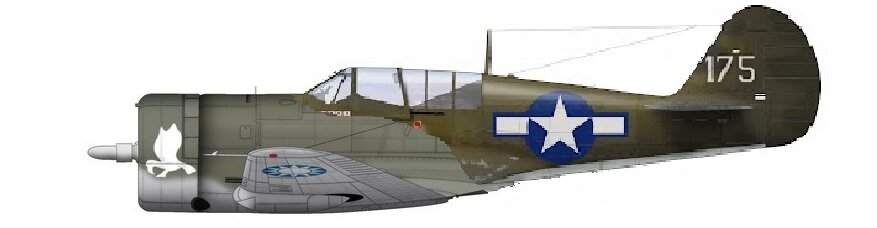
When I think of the development of the P-36, I imagine this.
A P-40N with an R-2600 radial. (Same as the XF6F-1 Hellcat prototype, the B-25 and the TBF Avenger)

p36-018 - Copia.jpg

The R-2600 is about 600 pounds heavier than a V-1710, but I think with the right tuning it could have extended the life of the Curtiss fighters.
And since the P-40N had a larger tail than the P-36, perhaps it would be possible to balance the weight.
I'm not sure how much the V-1710's liquid cooling system weighs, but since it would be unnecessary, it would probably save about 200 pounds.
In short, we are talking about something around 400 pounds more weight, and 450 to 500 more Hp.
 
Last edited:
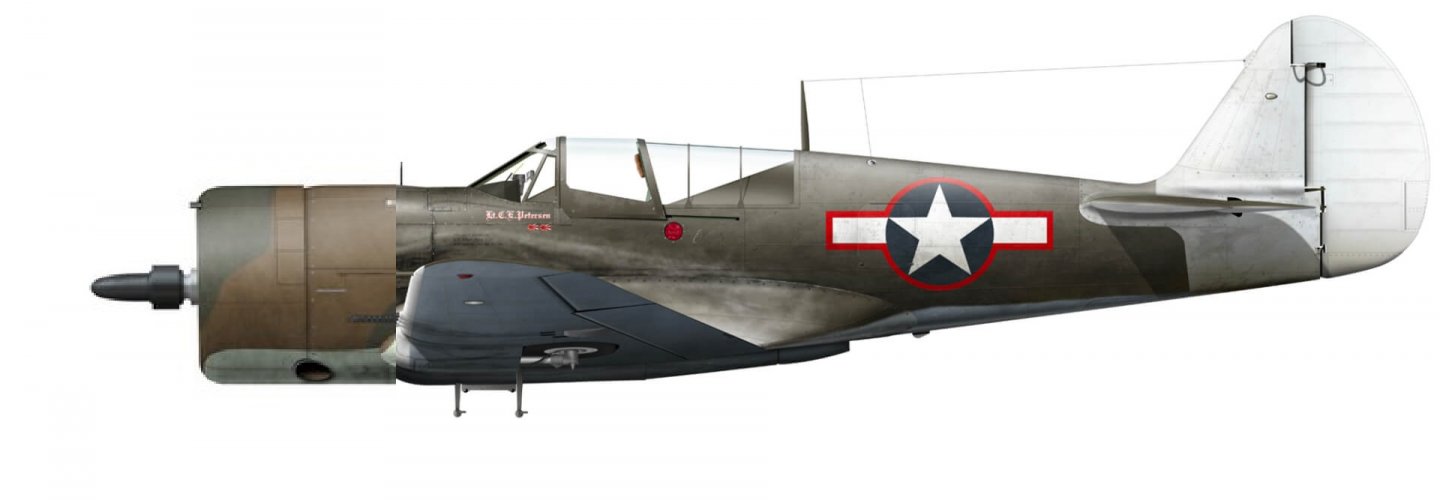
You have a number of issues with your image. First is a mismatch between the P-40N rear fuselage and the Hawk 75A-5 forward section. Obviously, the R-1820 Cyclone 9 is the wrong engine for this discussion. More importantly, the wing placement is too low - necessary because the Hawk 75 had a deeper fuselage than the later Warhawk.

If you substitute the slightly larger-diameter R-2600 under discussion, you will immediately see that correcting wing placement puts the engine far too high in that shallow Warhawk fuselage. As a result, you will need to greatly deepen that fuselage. In effect, you are then following the pattern of development from Curtiss' XP-60 to XP-60E.

The irony here is that Curtiss began their XP-53/XP-60 series to rid themselves of Don Berlin's multi-spar wing and rearward-retracting main undercarriage. And, realistically, those holdovers are all that you would have left from the original P-40N airframe in your design (again, following the pattern of the RW XP-60 family). In the end, the RW XP-60E/YP-60E proved to be mediocre performers compared with already-available US-designed fighters - despite their new, laminar-flow wings.

So, the conclusion is: lots of redesign work involved, plenty of production-line disruption, with little or no return in performance.

Attached is an image of the concept roughly to scale. I have based the fuselage depth on the XP-60E but played with a more Warhawk-ish tailplane. Not addressed here is the need for the P-40N main undercarriage to be modified to extend upon lowering (to allow for a propeller with 1.1 feet of additional diameter).

_______________________________________

BTW, my base P-40N image was credited to 'Platinum Fighter Sales' (alas, no artist's name was given). In your image, the rear fuselage should be credited to Vernon Rabbetts while the Hawk 75A-5 bits were rendered by 'Gaëtan Marie' (Bertrand Brown).
 

Attachments

  • Hypothetical-R-2600-powered-P-40.jpg
    Hypothetical-R-2600-powered-P-40.jpg
    54.2 KB · Views: 80
Last edited:
Aliás, minha imagem base do P-40N foi creditada como ‘Platinum Fighter Sales’ (infelizmente, nenhum nome de artista foi dado). Na sua imagem, a fuselagem traseira deve ser creditada a Vernon Rabbetts enquanto os bits do Hawk 75A-5 foram renderizados por 'Gaëtan Marie' (Bertrand Brown).
Your edit was very good, congratulations!
 
6de96-39dc-499f-af1a-2329b37dc38d.jpg

It has been quite some time, and I decided to revisit and update this thread.

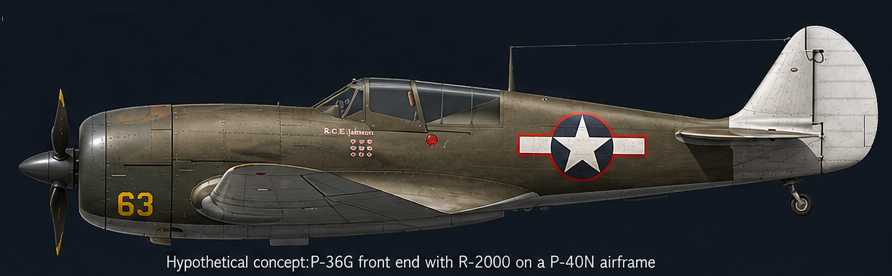
When I originally created it, I was thinking about the R-2600, but after giving it more thought, I believe the R-2000 used on the DC-4 would be a much more suitable choice.
In this edited image, I am using the cowling from the P-36G, which was designed around the Wright R-1820 Cyclone 9. I slightly stretched the image because the R-1820 is only about 2.2 cm smaller in diameter than the R-2000.

a3f18494-b661-439a-a281-e3b719d4b656.png
So, essentially, this would be something like a P-40N powered by a 1,450 hp radial engine.
Interesting idea, perhaps?
P.S.: A detail worth mentioning: an R-2000 weighs approximately 1,587 lb, while an Allison V-1710 installed with its cooling system weighs approximately 1,543–1,720 lb.
 
Last edited:

Similar threads

Back
Top Bottom