Hypersonic Propulsion News and Developments

Successful test flight of an Anglo-German private development reaching Mach 6 and a range of over 300km.

One should add they bought the rocket motor from outside (likely MBDA Red Kite). That said its one of the first but good steps into the right direction
 
Last edited:
One should add they bought the rocket motor from outside (likely MBDA Red Kite). That said its one of the first but good steps into the right direction

Are there any threads on this forum discussing the Red Kite rocket-motor?
 
Red Kite is a one tonne (1176kg) two-stage sounding rocket with a 13 second burn time to put a 400kg gross payload to a ballistic apogee of around 260km, their brochure says if used as a hypersonic booster it would have a ballistic range of about 70km with an apogee of around 40km.
 
Last edited:

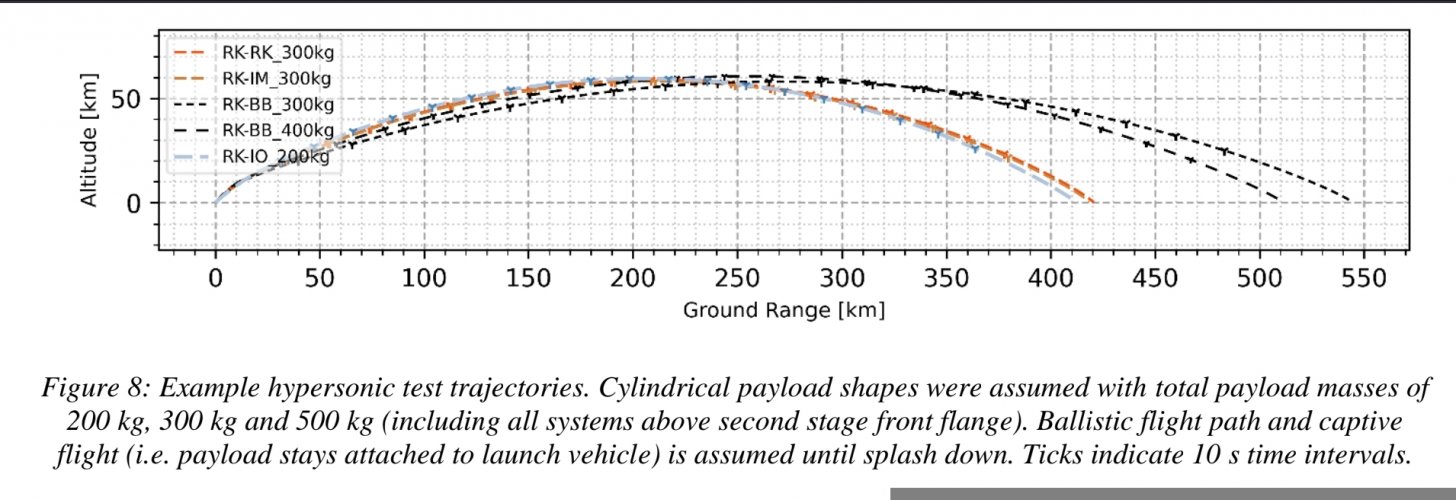
Stacking two Red Kites on top of each other they do predict would have a range of about 400km with a 300kg spherical payload, the other long ranges are by stacking Red Kite with various alternate additional booster stages (Black Brant, Improved Malemute, Improved Orion).

Though quite obvious from the Hypersonica video that they are only using one booster stage and one missile stage.
 
Last edited:
Red Kite is a one tonne (1176kg) two-stage sounding rocket
Red Kite is actualy a single stage motor commonly offered in a 2 stage solution with different sounding rockets as second stage tho up too 3 Red Kites can be stacked together. we know its only 1 motor from the test as we only see 1 array of fins.
with a 13 second burn time to put a 400kg gross payload to a ballistic apogee of around 260km, their brochure says if used as a hypersonic booster it would have a ballistic range of about 70km with an apogee of around 40km.

20715.jpg
 
Red Kite is actualy a single stage motor commonly offered in a 2 stage solution with different sounding rockets as second stage tho up too 3 Red Kites can be stacked together. we know its only 1 motor from the test as we only see 1 array of fins.


View attachment 801674

Yes One Red Kite booster would have an apogee of about 40km and a ground range of about 70km it says. The chart is for using alternate pairs of boosters and payload weights. The first booster is doing most of the work getting it up to altitude and speed.
 
The French missile range instrumentation ship BEM Monge was present in Norway during the Hypersonica launch, which has led to speculation that it may have played a role in the event.

My personal theory is that since the ship was recently modernized (2024), tracking Hypersonica may have offered France a valuable opportunity validate the performance of the upgraded sensor ...
Especially since a M51 test is expected to take place soon from the SSBN Le Téméraire, which returned from completing its decennial maintenance/overhaul a couple of month ago.

View: https://x.com/WarshipCam/status/2020132239451852837
 
Last edited:
It's also possible this is France making an offer of the ship's capabilities for future testing and future French involvement in such developments.

Lot's of interesting things going on in this.
 
More News

Britain accelerating hypersonic missile development

By George Allison

February 13, 2026

The Ministry of Defence has awarded a new £12 million contract aimed at accelerating development of a sovereign UK hypersonic missile capability, as part of wider efforts to field a long-range hypersonic strike demonstrator by the end of the decade.

The contract has been awarded to Warrington-based engineering contractor Amentum UK, supported by SME partners Ebeni and Synthetik, based in Wiltshire and London respectively. According to the MOD, the companies will provide engineering expertise to develop the design for a hypersonic system, which is expected to be demonstrated through flight testing before being adapted into prototype missiles capable of operating at the extreme speeds and temperatures required for hypersonic flight.

The announcement was made on 13 February 2026, with the MOD describing the investment as part of the delivery of conclusions from the Strategic Defence Review, which highlighted hypersonic missiles as increasingly central to modern warfighting and NATO deterrence.

Luke Pollard, Minister for Defence Readiness and Industry, said the contract reflected the need to move faster in developing cutting-edge military technology. “In this new era of threat, we need a new era for defence. This means moving quicker to develop and buy the cutting-edge technologies our Armed Forces need for modern warfighting.”

Armed forces careers

Pollard added that the award was intended to strengthen national security while supporting industrial growth. “This contract will accelerate the UK’s development of sovereign hypersonic missile capability, strengthen our national security and back British workers.”


The MOD said the contract was awarded only 31 days after the invitation to tender, presenting this as evidence of a shift toward faster procurement and reduced bureaucracy. The department said its Commercial X team was working to modernise acquisition processes and deliver innovation at pace.

Officials said the new deal builds on progress made since July 2024, when the hypersonics programme began awarding contracts through the Hypersonics Technologies & Capability Development Framework. Since then, 124 suppliers have reportedly been involved, with over half classed as small and medium enterprises, and 22 contracts issued across multiple technology areas.

The MOD stated the total estimated value of contracts awarded since July 2024 is now £48 million, with a “notable proportion” flowing to SMEs.
 
More News

Britain accelerating hypersonic missile development


By George Allison

February 13, 2026

The Ministry of Defence has awarded a new £12 million contract aimed at accelerating development of a sovereign UK hypersonic missile capability, as part of wider efforts to field a long-range hypersonic strike demonstrator by the end of the decade.

The contract has been awarded to Warrington-based engineering contractor Amentum UK, supported by SME partners Ebeni and Synthetik, based in Wiltshire and London respectively. According to the MOD, the companies will provide engineering expertise to develop the design for a hypersonic system, which is expected to be demonstrated through flight testing before being adapted into prototype missiles capable of operating at the extreme speeds and temperatures required for hypersonic flight.

The announcement was made on 13 February 2026, with the MOD describing the investment as part of the delivery of conclusions from the Strategic Defence Review, which highlighted hypersonic missiles as increasingly central to modern warfighting and NATO deterrence.

Luke Pollard, Minister for Defence Readiness and Industry, said the contract reflected the need to move faster in developing cutting-edge military technology. “In this new era of threat, we need a new era for defence. This means moving quicker to develop and buy the cutting-edge technologies our Armed Forces need for modern warfighting.”

Armed forces careers

Pollard added that the award was intended to strengthen national security while supporting industrial growth. “This contract will accelerate the UK’s development of sovereign hypersonic missile capability, strengthen our national security and back British workers.”


The MOD said the contract was awarded only 31 days after the invitation to tender, presenting this as evidence of a shift toward faster procurement and reduced bureaucracy. The department said its Commercial X team was working to modernise acquisition processes and deliver innovation at pace.

Officials said the new deal builds on progress made since July 2024, when the hypersonics programme began awarding contracts through the Hypersonics Technologies & Capability Development Framework. Since then, 124 suppliers have reportedly been involved, with over half classed as small and medium enterprises, and 22 contracts issued across multiple technology areas.

The MOD stated the total estimated value of contracts awarded since July 2024 is now £48 million, with a “notable proportion” flowing to SMEs.
Fixed font to avoid blindness.
 
Rather struggled to change the colour.
 

Similar threads

Back
Top Bottom