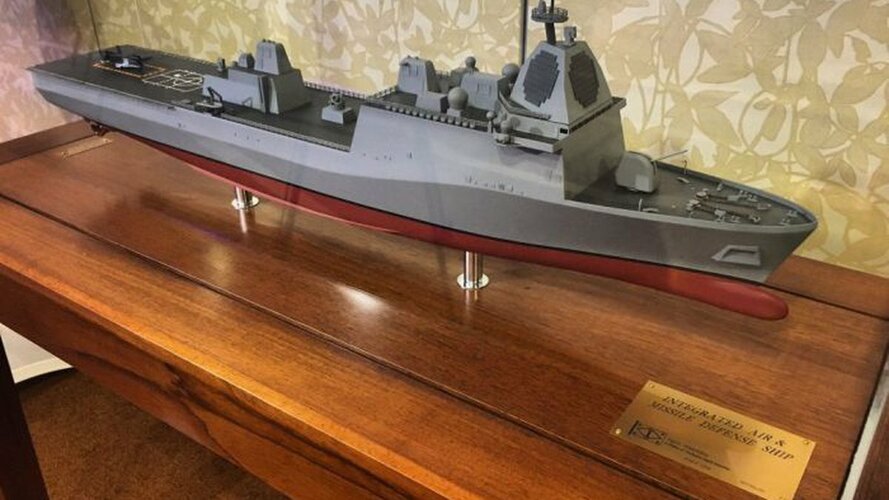
Those are interesting, thank you. The version they've shown at the most recent trade shows still has 4 volume-search arrays, a railgun on the bow, and a reat deal more VLS. That they're floating more affordable, BMD-only concepts is perhaps an indication that the Navy isn't keen on the cost of the full kit.
 
All that ship and radar and only 16 lousy cells? (And not even Mk57s at that.) Now a couple Burkes (at least) will have to be tasked to escort it anywhere it goes. A shame they killed KEI. Would have been the perfect match.
 
sferrin said:
All that ship and radar and only 16 lousy cells? (And not even Mk57s at that.) Now a couple Burkes (at least) will have to be tasked to escort it anywhere it goes. A shame they killed KEI. Would have been the perfect match.

I agree 100% I see all that deck space and think everything up to conventionally converted C4 SLBMs ;D
 
SPY+45 dB (for the 3 x 30ft arrays) is monstrous compared to the SPY+17 db for SPY-6.

Even the largest (21 ft) array envisioned for DDG-1000 was ~ SPY+30 dB.
 
probably a typo, but you likely meant +15 dB for SPY-6 AMDR...

---

do you have a reference for the +30 dB AMDR array which would fit on a DDG-1000 ?

according to the GAO report on the DDG-51 flight III (ie. report no. GAO-12-113) which used data from the Navy MAMDJF AOA and Radar/Hull studies, the largest proposed array for a modified DDG-1000 was a +25 dB array:

... the SPY+30 radar considered in the MAMDJF AOA could only be carried by a newly designed cruiser or a modified San Antonio class ship, and only a modified DDG 1000 could carry the approximately SPY+25 radar.
 
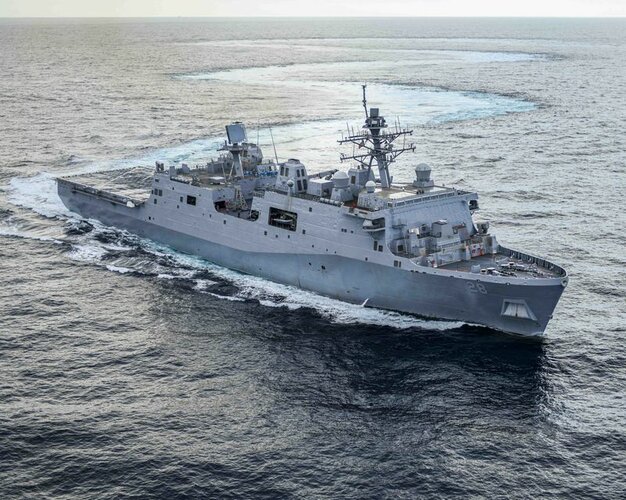
The Navy will christen its newest amphibious transport dock, the future USS Fort Lauderdale (LPD 28), during a 10 a.m. CDT ceremony Saturday, Aug. 21, at the Huntington Ingalls Industries (HII) Ingalls Division shipyard in Pascagoula, Mississippi.

Ingalls Shipbuilding launched the future USS Fort Lauderdale (LPD 28) in April 2020. It is the 12th San Antonio-class amphibious transport dock ship for the U.S. Navy. It features a number of modifications compared to earlier ships of the class. For example it is fitted with a simple mast (similar to the DDG 51 class mast) in place of the “stealth mast” design, for affordability reasons. Ingalls Shipbuilding is also in production on the future USS Richard M. McCool (LPD 29) and Harrisburg (LPD 30). LPD 28 and 29 will serve as transition ships to LPD 30, the first LPD 17 Flight II ship.

https://www.navalnews.com/naval-new...phibious-transport-dock-ship-fort-lauderdale/https://ingalls.huntingtoningalls.com/lpd28christening/https://www.defense.gov/Newsroom/Re...phibious-transport-dock-ship-fort-lauderdale/
 
https://m.facebook.com/BMD-Ship-1573737666263862/Another BMD ship alternative
88210279_2262103874093901_1918415879415005184_n.jpg
 
Last edited:
SPY+45 dB (for the 3 x 30ft arrays) is monstrous compared to the SPY+17 db for SPY-6.

Even the largest (21 ft) array envisioned for DDG-1000 was ~ SPY+30 dB.
What kind of range would we be looking at with that kind of radar.

I also wonder if there adding gaN to this.
 
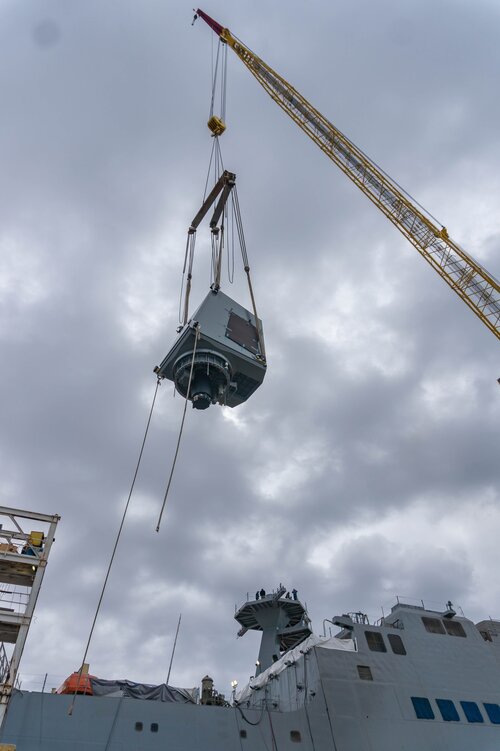
https://www.navsea.navy.mil/Media/N...mccool-jr-successfully-installs-easr-antenna/
The Enterprise Air Surveillance Radar (EASR) antenna landed on the future USS Richard M. McCool Jr. (LPD 29), Jan.16, 2023.

This marks the completion of EASR system deliveries for what will be the first LPD 17 Class ship and the first U.S. Navy install and activation of the SPY-6(V)2, rotating variant, S-Band radar.

“The progress made is a testament to the collaboration across multiple organizations in bringing this next-generation radar to the LPD program. The Navy and our industry partners look forward to systems activation and testing as LPD 29 continues on the path to sea trials later this year,” said Capt. Cedric J. McNeal, Amphibious Warfare Program Manager, Program Executive Office (PEO Ships).
 
That radar looks off. I feel like it needs to have a wider anteana bit like the 49 does to make it feel balanced...
 
https://news.usni.org/2017/07/24/26994
Amphibious transport dock USS John P. Murtha (LPD-26) is ready to turn its attention to crew training and fleet operations, having completed its final post-delivery test last week.

Murtha commissioned into the Navy in October 2016 and has spent the last nine months working through post-delivery test and trials with the Navy’s Board of Inspection and Survey (INSURV). The amphib returned to its homeport at Naval Base San Diego on July 21 following the final post-delivery test event, Final Contract Trials.

“USS John P. Murtha and her crew have proven with every test that she is capable and ready for deployment,” Capt. Brian Metcalf, LPD-17 class program manager at Program Executive Office for Ships, said in a Navy news release.

During the Final Contract Trials, INSURV spent five days evaluating Murtha’s in-port and at-sea performance. At-sea testing included full-power runs, steering checks, key combat and communications systems checks, self-defense detect-to-engage exercises, rapid ballast and de-ballast operations, and anchor handling demonstrations.

With post-delivery tests completed, Murtha can now focus on crew training and other activities leading up to an eventual first operational deployment.

Murtha is the 10th San Antonio-class amphib to join the fleet. These LPDs transport and deploy combat and support elements of Marine Expeditionary Units. San Antonio-class ships carry surface connects such as amphibious assault vehicles and landing craft, and vertical lift connectors such as the H-1 and CH-53E helicopters and MV-22 Osprey tiltrotor.

Two additional San Antonio-class ships, Portland (LPD-27) and Fort Lauderdale (LPD-28), are currently under construction at Ingalls Shipbuilding yard in Pascagoula, Miss. The Navy awarded Ingalls Shipbuilding a contract for long lead time material and advance procurement last month in support of LPD-29, meant to bridge planned LPD production with the follow-on LX(R) production, which has not yet been awarded to any shipyard.

Amphibious ships, such as the LPD and the next-generation LX(R), are playing an increasingly important role in meeting anticipated combatant commander demands for expeditionary forces around the globe. Marine Corps leadership now regularly says more than 50 amphibs will be needed, while the Navy plans to have 34 amphibs by 2022.

Huntington Ingalls Industries wants to keep its production line hot to support an efficient transition from LPD to LX(R) or to retain the ability to build both ship classes at the same time. What that transition will look like is still unclear – though the Navy stated last year in a revised Force Structure Assessment that it needs a 355-ship fleet, the details of building up to that sized fleet remain uncertain, pending a defense strategy review by Defense Secretary James Mattis, expected to be completed this summer.

 

Similar threads

Back
Top Bottom