How will lasers change warfare?

exclaimedleech8

ACCESS: Top Secret
Joined
30 September 2024
Messages
826
Reaction score
1,001
Laser weapons are finally being deployed. Today's versions are only able to stop drones and cruise missiles, but as AI allows us to get around thermal bloom and pulsed versions reduce the necessary dwell time, it won't be long before we have ones powerful enough to defend cities from ICBMs. So how will they change the way wars are fought?
 
I think the biggest impact in the medium term will be to drastically drop the price of air defence. Now, cheap and nasty drones are killing us not by their effectiveness but by their low cost compared to defending against them. Lasers will change that and make only expensive, sophisticated weapons viable again.
 
I think the biggest impact in the medium term will be to drastically drop the price of air defence. Now, cheap and nasty drones are killing us not by their effectiveness but by their low cost compared to defending against them. Lasers will change that and make only expensive, sophisticated weapons viable again.
I think the opposite is true. Lasers will favor swarms of cheap weapons instead of small numbers of expensive ones, more aim points.
 
I think the opposite is true. Lasers will favor swarms of cheap weapons instead of small numbers of expensive ones, more aim points.

Getting big, sophisticated weapons won't be done with cheap plentiful lasers that are proliferating now. That will need more powerful lasers that will by necessity be less plentiful and cover more important targets.
 
Scaling likely matters significantly.

What is the smallest laser that is efficient
What is the largest laser before it runs hard into diminishing returns

And it is the particulars of the changing technology would determine that.

The other question is defenses against lasers, just how much of a effectiveness multiplier is there for lasers against soft targets (sensors, locomotion) relative to armored, protected parts.
 
Essentially, it would be the ultimate standstill. The frontlines would become static around laser-protected areas, exiting which (especially for the purpose of the assault of enemy laser-protected areas) would be extremely expensive. Powerful, megawatt-grade lasers would be able to efficiently kill missiles, drones and even projectiles en mass - especially if the problem of phased optical array would be solved. But this means that advancing against laser position would be very complex; the attacker air assets would be swapped out of the sky, while the defender would enjoy total air dominance.
 
It is unclear if even MW class lasers can defeat masses of anti-laser projectiles. People in the "Children of a dead earth" space sim (with pretty good physics/economics model) community manage to defeat very powerful lasers in space, where lasers is much more effective with no atmosphere and infinite horizon, with dedicated missile designs.

There is also the possibility of lasers on a plane, if it can be scaled that way. A laser on a plane is a power projecting tool that'd impose heavy threat to all areas not covered by an AA laser, and planes can naturally avoid artillery, MRLS and other massed anti-laser projectile fire.

Finally, there is battle mirrors, where lasers go beyond the horizon. I'll have to spend some time thinking about the implications first....
----
Finally, lasers is a reason for MECHA! Consider muvluv and posleen~~~~~
 
The cynic in me would look at the smaller end of the market too. One possible would be a wider proliferation in their deployment.
One can easily envision lasers being used as autonomous 'security' to protect sites (initially 'state', then privately owned 'infrastructure') from trespassers either in blinding or potentially more lethal form
 
Last edited:
The laser revolution (1, 2) is a good intro. Effective anti-air lasers reward tanks and ground-hugging drone swarms. Given modernity, the drones are more economical and superior scouts.
 
The laser revolution (1, 2) is a good intro. Effective anti-air lasers reward tanks and ground-hugging drone swarms. Given modernity, the drones are more economical and superior scouts.
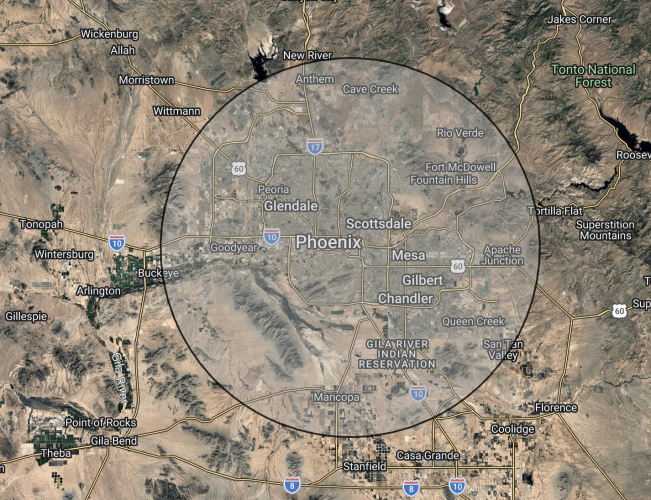
Neat. It says that a 1 MW laser could intercept 7-13 ICBM warheads at a range of 53 KM, with the only limit being target switching time (which can be solved with the use of phased arrays). That means only one turret will cover a large city. Here's Phoenix (where I live) as an example: a turret located at Sky Harbor Airport will cover the entire valley, protecting obvious targets like Luke AFB, the Intel plant in Chandler, the new TSMC fab in Deer Valley, the General Dynamics plant in Scottsdale, and the airport itself. We probably would need a second one, perhaps of lower power, to defend the Palo Verde Nuclear Power Plant.

Screenshot 2026-06-10 at 4.21.13 PM.png
With that, the obvious move by the enemy would be to spread the explosive payload over many cheaper missiles.
 
Neat. It says that a 1 MW laser could intercept 7-13 ICBM warheads at a range of 53 KM, with the only limit being target switching time (which can be solved with the use of phased arrays). That means only one turret will cover a large city. Here's Phoenix (where I live) as an example: a turret located at Sky Harbor Airport will cover the entire valley, protecting obvious targets like Luke AFB, the Intel plant in Chandler, the new TSMC fab in Deer Valley, the General Dynamics plant in Scottsdale, and the airport itself. We probably would need a second one, perhaps of lower power, to defend the Palo Verde Nuclear Power Plant.

View attachment 815007
With that, the obvious move by the enemy would be to spread the explosive payload over many cheaper missiles.
And just as Russia is placing Pantsirs on the roofs of skyscrapers in Moscow, in a time of heightened tension, additional turrets could be deployed on the rooftops of buildings.
 
Screenshot 2026-06-14 at 12.27.05 PM.png
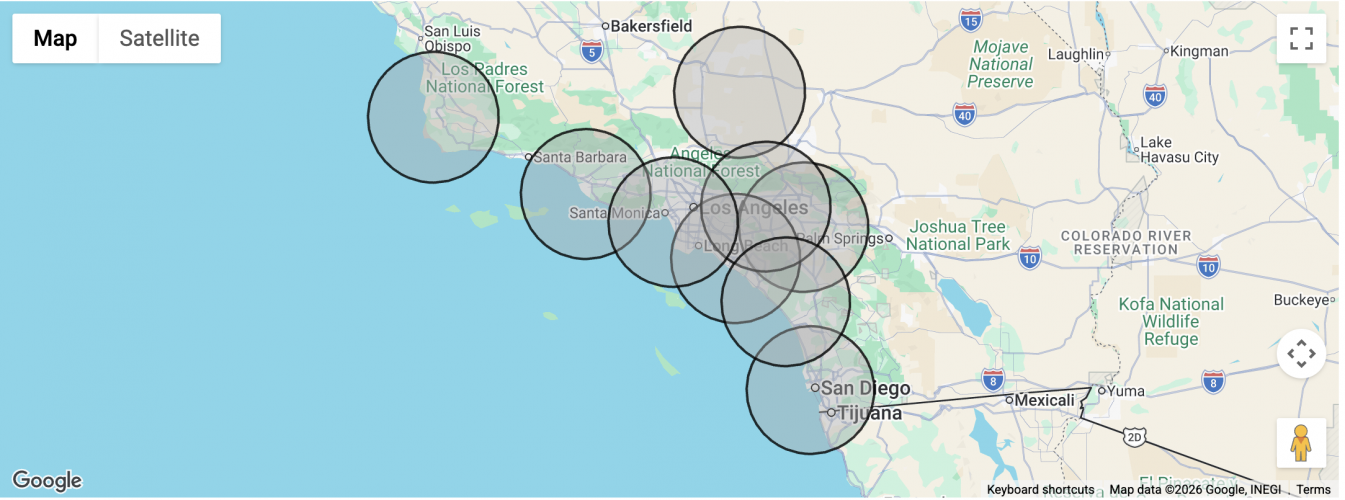
Here's how Southern California might be covered with lasers at:
Los Angeles International Airport
Vandenberg Space Force Base
Edwards Air Force Base
Port Hueneme (Oxnard)
John Wayne International Airport (Santa Ana)
Ontario International Airport
March Air Reserve Base (Riverside County)
Camp Pendleton (Northern San Diego County)
North Island Air Station (Coronado)
 
Reminder:
  1. The horizon distance from the top of an AFV is roughly 6km. The horizon range from a 200ft tower is a little under 30km (a horizon calculator will tell you 27.7km, but then there's however far the target is above ground added on the far side of the horizon).
  2. Any laser will make about twice its rated beam power in raw heat, so you'd better figure out how to deal with a couple megawatts or more of heat for those fixed-emplacement AA lasers.
  3. A ~20kw laser mounted on every ground vehicle as the AA/anti-drone "pintle" weapon is likely to happen as soon as tanks have enough spare power. Dealing with ~40kw of heat is no big deal for a vehicle, it's about like having a 60kw-APU's radiator and cooling system extra.
  4. Related to point 1, any ship-borne laser will want to be mounted as high as possible. At a bare minimum on the top of the superstructure, and I'm sure someone will try to mount lasers up on the masts, as high as they can put a 1m+ diameter mirror for targeting.
 

Similar threads

Back
Top Bottom