How does fin mixing work for cruciform rocket fins?

isso

ACCESS: Restricted
Joined
7 July 2025
Messages
1
Reaction score
1
Hi all,

I'm trying to understand how control input mixing works for rockets that use a cruciform fin layout (4 fins at 90° angles).
Specifically:
  • How are the usual aircraft-style control commands (aileron, elevator, rudder or roll/pitch/yaw) mapped or mixed into the 4 fin deflections?
  • Are there standard mixing equations or strategies?
  • Do systems apply any gain scaling (like 1/√2) to avoid control saturation when multiple channels contribute to the same fin?
  • Are all fins always active in all axes, or is there any axis-specific allocation?
I’ve seen this setup in sounding rockets and some guided missiles, but I’m not clear on whether each fin contributes equally to all 3 axes or if there's some prioritization or redundancy.

Any technical insight, references, or examples would be super helpful!
 
Hi all,

I'm trying to understand how control input mixing works for rockets that use a cruciform fin layout (4 fins at 90° angles).
Specifically:
  • How are the usual aircraft-style control commands (aileron, elevator, rudder or roll/pitch/yaw) mapped or mixed into the 4 fin deflections?
  • Are there standard mixing equations or strategies?
  • Do systems apply any gain scaling (like 1/√2) to avoid control saturation when multiple channels contribute to the same fin?
  • Are all fins always active in all axes, or is there any axis-specific allocation?
I’ve seen this setup in sounding rockets and some guided missiles, but I’m not clear on whether each fin contributes equally to all 3 axes or if there's some prioritization or redundancy.

Any technical insight, references, or examples would be super helpful!
The easy way to set that up is to have some kind of gyroscope or autopilot to keep the missile from rolling and leave the fins vertical or horizontal, + configuration. Sidewinders did it the easiest way with a rolleron airflow-driven gyro on the tailfins. A sounding rocket, however, would need a gyroscope in the autopilot/guidance to keep one fin vertical. No airflow to start the rollerons before launch when you're doing a surface launch.

X-configuration is what I think you're really asking about, and the answers get complicated. Assuming that each fin can only move in one direction, you'd need to do the control surface mixing at the guidance computer to have it give the correct signals to each individual fin. For a pure movement in any direction, say pulling up: The upper "rudders" need to move trailing edge together, the lower "rudders" need to move trailing edge apart.
 
X-configuration is what I think you're really asking about, and the answers get complicated. Assuming that each fin can only move in one direction, you'd need to do the control surface mixing at the guidance computer to have it give the correct signals to each individual fin. For a pure movement in any direction, say pulling up: The upper "rudders" need to move trailing edge together, the lower "rudders" need to move trailing edge apart.

I'd like to see how this control-fin servo signal mixing for the AIM-7A, C, D, and E Sparrow were implemented in sub-miniature valve analogue circuitry.
 
I'd like to see how this control-fin servo signal mixing for the AIM-7A, C, D, and E Sparrow were implemented in sub-miniature valve analogue circuitry.
I don't believe that Sparrows flew that way. All in-flight footage of Sparrows I've seen has shown them flying with fins vertical and horizontal. So they'd need a gyro providing vertical reference and control (mostly) like a plane with paired fins both moving the same direction. If the missile needs to turn left, the vertical fins move the trailing edges left. If the missile needs to climb, the horizontal fins move the trailing edges up. really simple. The only time you'd need the fins to move differentially is to stop a roll.

But hey, we have a couple of missile nerds on the forum. Paging @Dilandu and @MissileMan for details!
 
I'd like to see how this control-fin servo signal mixing for the AIM-7A, C, D, and E Sparrow were implemented in sub-miniature valve analogue circuitry.
The AIM-7, AFAIK, used "Plus" configuration (relating to the scheme zjz linked to):

1754076532590.jpeg

If you are interested about "X" configuration, the RIM-8 Talos missile used it. And the idea essentially looked like that:

1754076629580.png

Each pair of interferometer antennas controlled its own pair of wings for maneuvers in this antennas specific plane. Essentially, signals weren't "mixed" so much as missile was controlled in two planes separatedly, and maneuvers in one plane could be performed without the others.
 
Interesting points although I gather from Ed Thelen's Nike website that the "X" configuration is more manoeuvrable than the "+" configuration. As for blending control inputs I do recall briefly reading a patent years ago where IIRC this was described (IIRC it was a Raytheon patent).
 
The AIM-7, AFAIK, used "Plus" configuration (relating to the scheme zjz linked to):

View attachment 779958

If you are interested about "X" configuration, the RIM-8 Talos missile used it. And the idea essentially looked like that:

View attachment 779960

Each pair of interferometer antennas controlled its own pair of wings for maneuvers in this antennas specific plane. Essentially, signals weren't "mixed" so much as missile was controlled in two planes separatedly, and maneuvers in one plane could be performed without the others.
You should note that the missile also has an "up" orientation that doesn't change letting it know when it is rolled from level. Otherwise, it wouldn't be able to maneuver as commanded.
 
Another thing you find on the earlier missiles from the late 40's to the 60's is some use mid-body wings for control, some nose mounted, while others use tail placed surfaces for it. The USN found--first--that tail control was superior to mid-body or nose and went that direction. Everybody pretty much followed.

Elimination of mid-body wings in favor of strakes (see a Standard missile for example) with tail control turned out to be probably the best configuration using wings. This isn't always possible with missiles that are 'legacy' designs where you're largely stuck with the original wing configurations.

The worst of the bunch, and least maneuverable tend to be ones like Bloodhound or Wasserfall using a single pair of mid-body wings both for some lift and maybe control. Larger surfaces also tend to reduce maneuverability limits making the missile less capable of engaging a maneuvering target. They're fine against a high-flying, non-maneuvering bomber and usually that was the intended target, so the lack of good maneuverability was acceptable.
 
The AIM-7, AFAIK, used "Plus" configuration (relating to the scheme zjz linked to):

View attachment 779958

If you are interested about "X" configuration, the RIM-8 Talos missile used it. And the idea essentially looked like that:

View attachment 779960

Each pair of interferometer antennas controlled its own pair of wings for maneuvers in this antennas specific plane. Essentially, signals weren't "mixed" so much as missile was controlled in two planes separatedly, and maneuvers in one plane could be performed without the others.
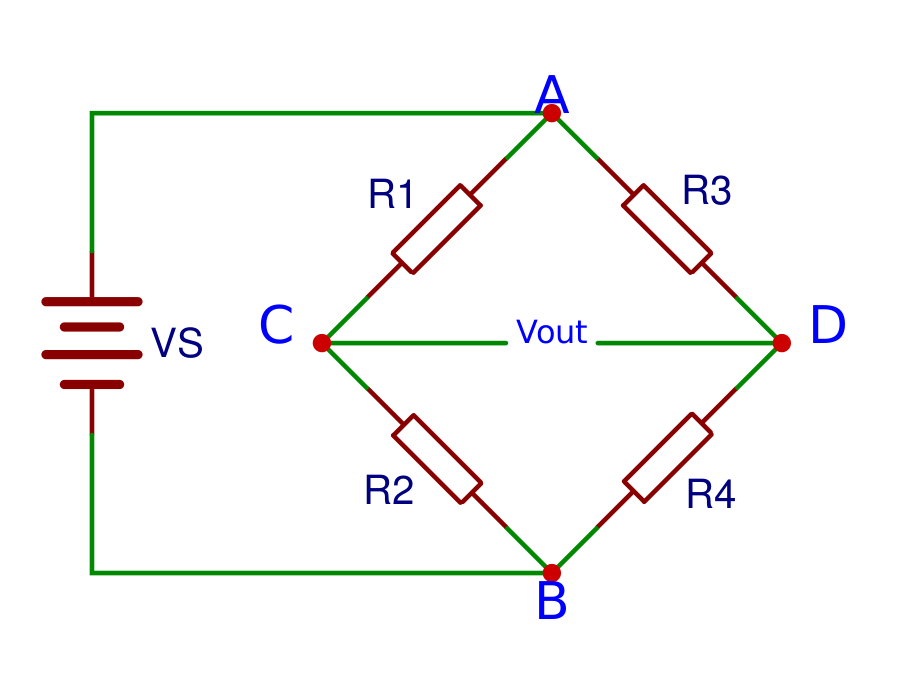
The interferometer works on the same principle as a Wheatstone bridge.

wheatstone-bridge.png

When Vout is zero, the circuit is balanced. In the missile this means the missile is pointed directly at the target. As the circuit becomes unbalanced, you'd have two variable resistors that you can trim to bring it back into balance. In the missile guidance system, this equates to turning the missile towards one or the other of these values until the circuit balances back out.
 
Another thing you find on the earlier missiles from the late 40's to the 60's is some use mid-body wings for control

I read somewhere that mid-body wing-control as used by the RIM-8 Tacos and AIM-7 Sparrow where while less manoeuvrable were more aerodynamically efficient which is what you want for a long-range AAM/SAM.

some nose mounted,

I assume you're referring to the AIM-9 Sidewinder, there were very good, logical reasons why canard-control instead of tail-control was used, Ron Westrum's excellent book Sidewinder: Creative Missile Development at China Lake. goes into detail as to why.
 
Interesting points although I gather from Ed Thelen's Nike website that the "X" configuration is more manoeuvrable than the "+" configuration. As for blending control inputs I do recall briefly reading a patent years ago where IIRC this was described (IIRC it was a Raytheon patent).
Essentially yes, because in X configuration the lifting force on all wings are the same, and for pitch and yaw maneuvers all four could be used, not only two of the pair corresponding to direction.
 
Interesting points although I gather from Ed Thelen's Nike website that the "X" configuration is more manoeuvrable than the "+" configuration. As for blending control inputs I do recall briefly reading a patent years ago where IIRC this was described (IIRC it was a Raytheon patent).
In the case of the Nike Hercules, the flying in the 'X' configuration produced less load on the fins/wings (Where does the crossover lie?), allowing the missile to pull 1.44 (sqrt(2)) more Gs without any structural changes. Pitch and Yaw acceleration may have improved, but I can't say if that had any practical effect.
 
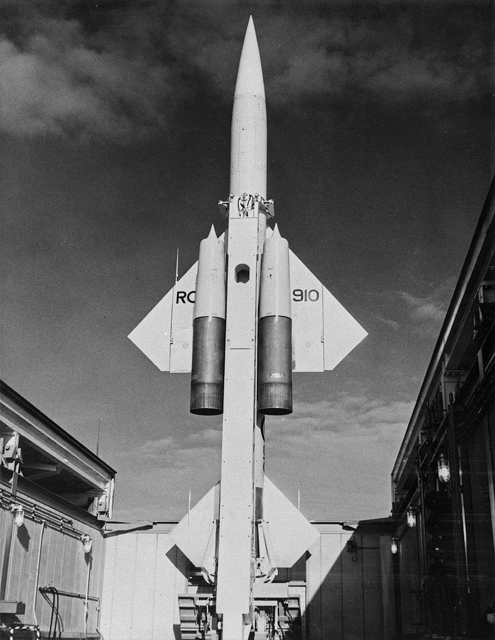
An interesting control variant was BOMARC. It used movable wingtips for maneuvering.

aircraft_bomarc_2.jpg


It's a Boeing variant of Bloodhound twist steer as Boeing had a good relationship with Bristol at the time. The problem with this design is that the maneuvers can be very violent and abrupt at very high G. The other thing to note, and this was common at the time, is the trapezoid configuration of the wing tips on all the surfaces. This cutback angle matched the Mach number the missile was expected to fly at, so the sonic shock wave didn't flow over the wing. This made a serious reduction in drag and was a common feature on mid-50's to 70's missiles in particular.
 
Another advantage to ahving the missiles fly in the 'X' configuration is that the launch rails can be mounted in the '+' configuration on the airframe, i.e. hanging vertically from the wing underside, or attached horizontally to a wingtip.

cheers,
Robin.
 

Similar threads

Back
Top Bottom