
As various aircraft manufacturers began to develop multigun monoplane fighters during the second half of 1930s, their engineers had to come up with ways to feed wing-mounted weapons as easily and as quickly as possible, without compromising the structural integrity of the wings.
Ground crews responsible for loading all the ammunition had a problem of their own. They could not leave ammunition belts on the ground for fear that some gravel got carried away and interfere with the operation of the machine guns in combat.
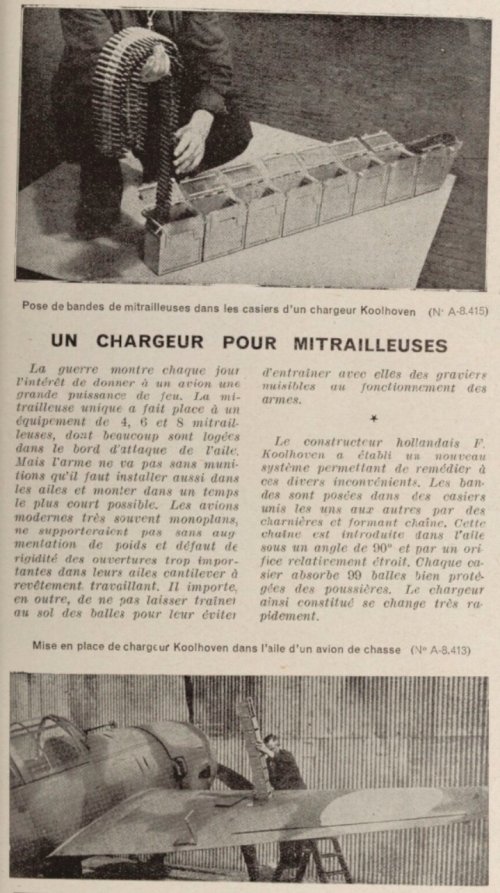
The founder of NV Vliegtuigenfabriek Koolhoven, Sytse Frederic Willem "Frits" Koolhoven, or else people working for him developed an ingenious magazine system to deal with these issues, and this no later than 1938. This magazine system consisted of (a varying number of?) small metal boxes with lids joined to each other by hinges, forming a chain. This chain, one per machine gun, was inserted into a wing at a 90° angle, through a relatively narrow opening. Each box held 99 bullets.
The illustrations were extracted from the May 18, 1940 issue of the French weekly magazine L'Air.
Ground crews responsible for loading all the ammunition had a problem of their own. They could not leave ammunition belts on the ground for fear that some gravel got carried away and interfere with the operation of the machine guns in combat.
The founder of NV Vliegtuigenfabriek Koolhoven, Sytse Frederic Willem "Frits" Koolhoven, or else people working for him developed an ingenious magazine system to deal with these issues, and this no later than 1938. This magazine system consisted of (a varying number of?) small metal boxes with lids joined to each other by hinges, forming a chain. This chain, one per machine gun, was inserted into a wing at a 90° angle, through a relatively narrow opening. Each box held 99 bullets.
The illustrations were extracted from the May 18, 1940 issue of the French weekly magazine L'Air.
Attachments
Last edited:


