Harrier 21 and MiniCAS - hanging on my wall now!

stever_sl

ACCESS: Secret
Joined
31 August 2010
Messages
221
Reaction score
1,451
My wife, being an aviation history nut herself as well as a Boeing and USAF retiree, had these pieces of wall art made for me to honor 2 of my favorite STOVL projects that never made it past the preliminary exploration stage - Harrier 21 (supersonic AV-8B replacement, a study done in conjunction with BAe and Rolls-Royce) and MiniCAS (an idea pitched to the Marines in answer to their request for the "smallest, hardest AV-8B derivative technologically feasible by the year 2000"). They turned out great!

1779909087969.jpeg
 
Very nice! I still can’t work out the Harrier 21 rear lift system from that but it’s great to see conformal fuselage AMRAAMs. I wasn’t expecting the intake mounted pair :)
 
Very sharp, whoda thunk, a modern Gnat

Very nice! I still can’t work out the Harrier 21 rear lift system from that but it’s great to see conformal fuselage AMRAAMs. I wasn’t expecting the intake mounted pair :)
Oh, but you were so close last August!

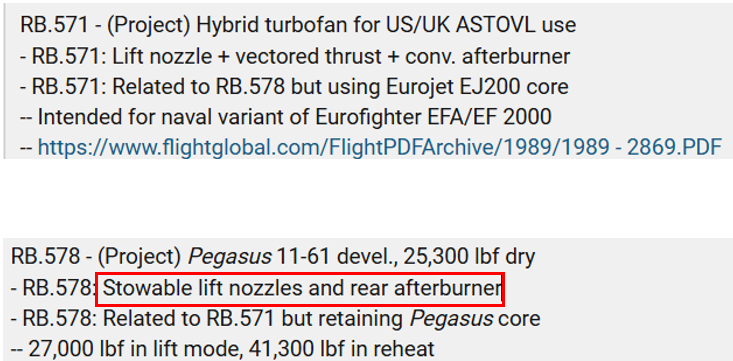
I was really surprised to learn that the Rolls Royce Heritage Trust had no details on the RB.578 (Pegasus core) or RB.571 (EJ200 core.) So this morning I dug out the MCAIR H21 data package and had a closer look, and the engine page for the Pegasus version calls it "Pegasus 21-02R Mixed/Unmixed STOVL Engine." where "R" means "reheat" as usual. I'm going to see if the RR Heritage Trust has anything under that designation. It also calls the other one "RB-571-13" so I'll check that as well. And I've often wondered why the prototype demonstrator's Pegasus-based engine would have a later number (578) than the production version would have had (571) and today it occurred to me that RR might well have been working on the 571 for some other project before joining us on H21. In that case they would have been adapting that concept backward to the Pegasus core, which would explain the numbering oddity.
 

Attachments

  • 1779979292678.png
    1779979292678.png
    185.2 KB · Views: 209
Last edited by a moderator:
Very nice! I still can’t work out the Harrier 21 rear lift system from that but it’s great to see conformal fuselage AMRAAMs. I wasn’t expecting the intake mounted pair :)
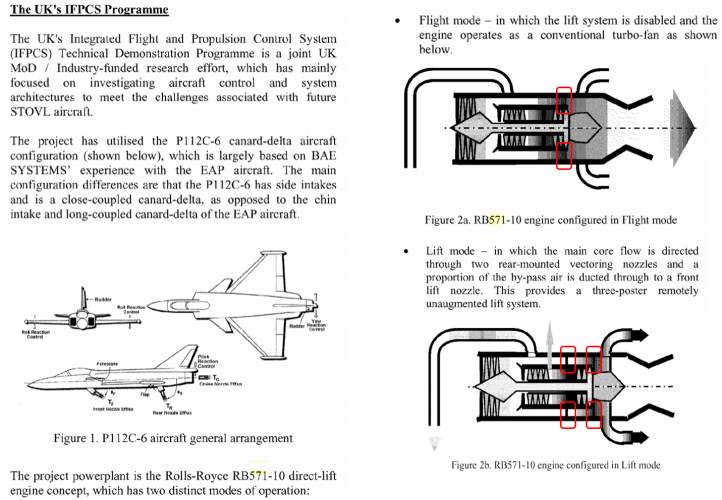
Got a source - For RB571 anyway, and RB578 was the same functionally but with the Pegasus core. This is for a different BAe study aircraft but it should be everything you need to understand the same engine in H21. It's not obvious at first glance what's going on inside the engine "assembly" (core plus case plus flow control valve) so I added some red boxes to highlight the differences between the Lift and Flight mode configurations. Honestly it's still not the best illustration but it's all I could find. Just know that there was a block-and-turn valve mechanism that let part of the "cold" (pre-combustion) flow go forward and "hot" exhaust go to Harrier-style swiveling nozzles for Lift mode, and closed those paths off (and retracted the nozzles) for Flight mode. I distinctly recall the chief RR guy visiting with a model of that mechanism, and being amazed at how simple it was, mechanically.
Link to entire paper: https://apps.dtic.mil/sti/tr/pdf/ADP011121.pdf
 

Attachments

  • 1779985805816.png
    1779985805816.png
    724.2 KB · Views: 189
Last edited by a moderator:
I wonder if a cooling system like in the D-30F6 was concidered the VTOL system.

https://www.secretprojects.co.uk/threads/secrets-of-the-d-30f6-turbofan.44489/

This ""cooling of the cooling air" would help to compensate the loss of airflow to the high pressure compressor during vertical take off and at the same time the cold flow would become a slightly more powefull ""warm flow"" (not really hot).
 

Similar threads

Back
Top Bottom