
You are using an out of date browser. It may not display this or other websites correctly.
You should upgrade or use an alternative browser.
You should upgrade or use an alternative browser.
Grumman F11F Super Tiger
- Thread starter Pioneer
- Start date

BlackBat242
OK, I changed my personal text ;)
- Joined
- 10 April 2013
- Messages
- 1,620
- Reaction score
- 5,024
Thank you very much.

- Joined
- 22 April 2012
- Messages
- 2,274
- Reaction score
- 2,848
Never heard of that before... what was the context (for which nation, and when)?
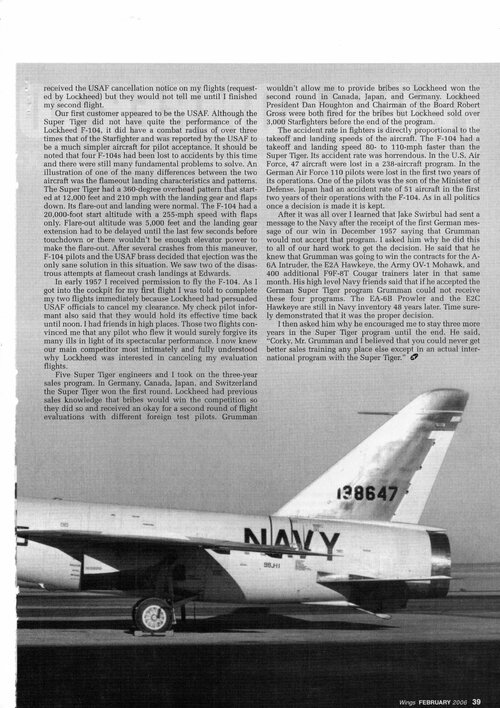
This was reported in the trade press in 1958, specifically that Grumman were offering the F11F-1 with the RA.24, with the RB.133 as an option for later aircraft, to the Luftwaffe. It was reported in Aviation Daily first and then picked up by other publications such as Flight. The German publication Der Flieger also reported it.
Ronald Harker, was Rolls Royce's Military Adviser from 1957, states in his 1979 book The Engines Were Rolls-Royce: An Informal History of that Famous Company that:
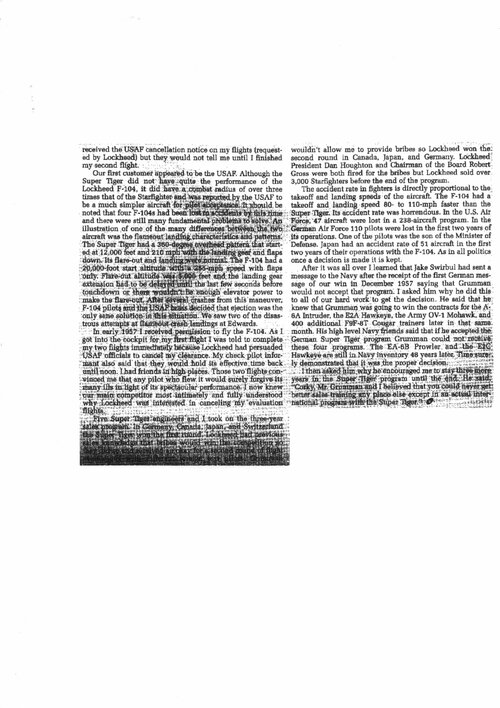
Corky Meyer of Grumman and I tried our best to sell the Grumman F-11-F Tiger with the Avon engine but we were no match for the Lockheed team, who had their top directors and lots of finance available to back their submission; the hotel in Bonn was nicknamed the "Lockheedshoff".
Caryina2642
ACCESS: Top Secret
- Joined
- 17 September 2022
- Messages
- 593
- Reaction score
- 316
I've got a few questions about the F-11F-1F Super Tiger
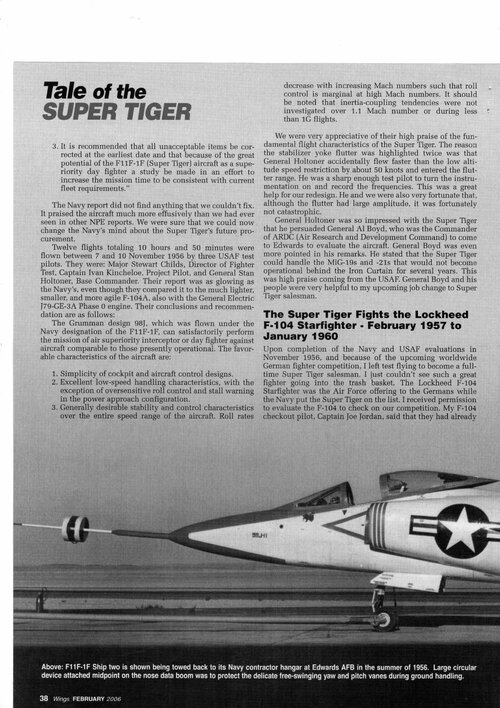
- Was the F11F-1F going to be AIM-7 capable? If not was it possible to make it AIM-7 capable?
- Would HMAS Melbourne have been able to operate the F11F-1F with how she was, or would she need a 8 degree angle flight deck? Larger Elevators? Longer 145' BS4A Catapult?
- How many F11F-1F could HMAS Melbourne operate? 4? 8? 10?

GK. Dundas
ACCESS: Confidential
- Joined
- 22 July 2025
- Messages
- 122
- Reaction score
- 210
And now someone else has been bitten by the Super Tiger bug.I've got a few questions about the F-11F-1F Super Tiger
- Was the F11F-1F going to be AIM-7 capable? If not was it possible to make it AIM-7 capable?
- Would HMAS Melbourne have been able to operate the F11F-1F with how she was, or would she need a 8 degree angle flight deck? Larger Elevators? Longer 145' BS4A Catapult?
- How many F11F-1F could HMAS Melbourne operate? 4? 8? 10?
- Joined
- 21 May 2006
- Messages
- 3,262
- Reaction score
- 2,885
Caryina2642, may I suggest the following:
https://www.secretprojects.co.uk/threads/grumman-xf11f-2-super-tiger.455/#post-178797
Note Post#10
I think also relevant to your questioning:
Grumman offered the F11F-1 with the Rolls Royce RA.24, with the RB.133 as an option for later aircraft, to the Luftwaffe.
As for it's ability to employ Aim-7 Sparrow....
Whether this was the beam-riding Aim-7 Sparrow I or the radar-guided Aim-7 Sparrow III, I don't know.
Regards
Pioneer
https://www.secretprojects.co.uk/threads/grumman-xf11f-2-super-tiger.455/#post-178797
Note Post#10
I think also relevant to your questioning:
Grumman offered the F11F-1 with the Rolls Royce RA.24, with the RB.133 as an option for later aircraft, to the Luftwaffe.
As for it's ability to employ Aim-7 Sparrow....
Whether this was the beam-riding Aim-7 Sparrow I or the radar-guided Aim-7 Sparrow III, I don't know.
Regards
Pioneer
Attachments

Last edited:
Caryina2642
ACCESS: Top Secret
- Joined
- 17 September 2022
- Messages
- 593
- Reaction score
- 316
Thxs MateCaryina2642, may I suggest the following:
https://www.secretprojects.co.uk/threads/grumman-xf11f-2-super-tiger.455/#post-178797
Note Post#10
I think also relevant to your questioning:
Grumman ooffered the F11F-1 with the Rolls Royce RA.24, with the RB.133 as an option for later aircraft, to the Luftwaffe.
As for it's ability to employ Aim-7 Sparrow....
Whether this was the beam-riding Aim-7 Sparrow I or the radar-guided Aim-7 Sparrow III, I don't know.
Regards
Pioneer
You would think if it was to employ the AIM-7 it would be the AIM-7 Sparrow III. I wonder how the RR Avon engine would effect the Super Tiger
- Joined
- 21 May 2006
- Messages
- 3,262
- Reaction score
- 2,885
I'm not sure if it would effect the Super Tiger in terms of the negative.Thxs Mate
You would think if it was to employ the AIM-7 it would be the AIM-7 Sparrow III. I wonder how the RR Avon engine would effect the Super Tiger
But given the Australian governments interest in keeping with the Avon....and given that Grumman, like Dassault saw the commercial benifit of assessing and proposing the Rolls Royce RA.24....
Regards
Pooneer
Caryina2642
ACCESS: Top Secret
- Joined
- 17 September 2022
- Messages
- 593
- Reaction score
- 316
Probably wouldnt, maybe just in terms of engine growth.I'm not sure if it would effect the Super Tiger in terms of the negative.
But given the Australian governments interest in keeping with the Avon....and given that Grumman, like Dassault saw the commercial benifit of assessing and proposing the Rolls Royce RA.24....
Regards
Pooneer
Yeah the Australian goverment really liked the Avon engine in the 50s and early 60s.
The more i think about it the F11F-1F would have been a great replacement for the CAC Sabres and the Sea Venoms if they could operate of Melbourne
- Joined
- 21 May 2006
- Messages
- 3,262
- Reaction score
- 2,885
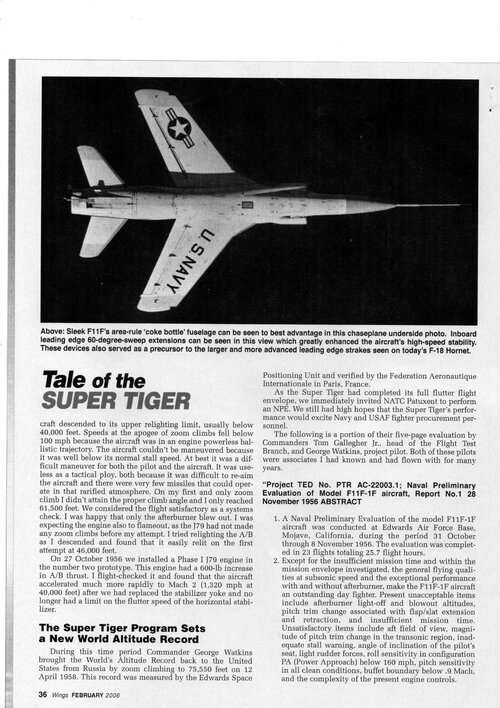
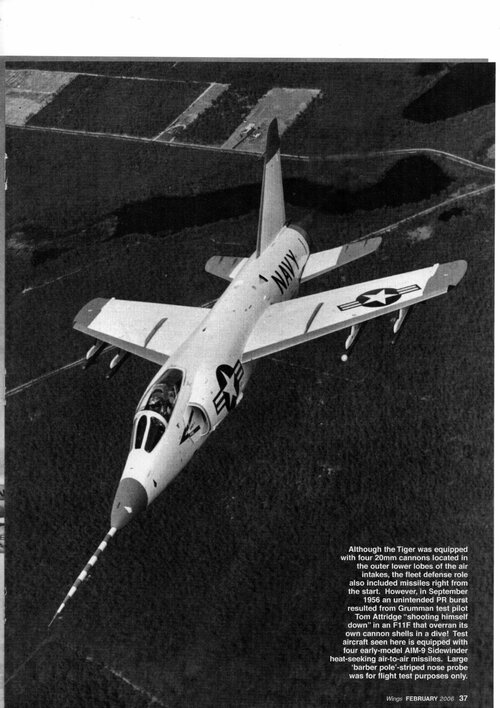
In terms of performance, the Super Tiger appears to be somewhat superior to the Vought F-8 Crusader, in terms of speed, TWR and ceiling.
From what I remember, the Super Tiger is some 908kg-1361kg (2,000 Ibs-3,000 Ibs) lighter than the Crusader - empty (the J79 being somewhat lighter and smaller than the J57).
Regards
Pioneer
From what I remember, the Super Tiger is some 908kg-1361kg (2,000 Ibs-3,000 Ibs) lighter than the Crusader - empty (the J79 being somewhat lighter and smaller than the J57).
Regards
Pioneer
J79 is shorter than J57, which eliminates the needs for a variable incidence wing. The Crusader needed the V.I wing so that's its long rear fuselage did not hit the carrier deck on landing, also it's undercarriage was pretty short.
Overall the Super Tiger fuselage / undercarriage design is probably more balanced than the Crusader, so no need for VI wing and less dangerous approaches.
The Crusader landing mishap rates was appaling.
Overall the Super Tiger fuselage / undercarriage design is probably more balanced than the Crusader, so no need for VI wing and less dangerous approaches.
The Crusader landing mishap rates was appaling.
apparition13
I really should change my personal text
- Joined
- 27 January 2017
- Messages
- 760
- Reaction score
- 1,397
1. Variants that could use the Sparrow III were offered.I've got a few questions about the F-11F-1F Super Tiger
- Was the F11F-1F going to be AIM-7 capable? If not was it possible to make it AIM-7 capable?
- Would HMAS Melbourne have been able to operate the F11F-1F with how she was, or would she need a 8 degree angle flight deck? Larger Elevators? Longer 145' BS4A Catapult?
- How many F11F-1F could HMAS Melbourne operate? 4? 8? 10?
2. I think the virtual angle on Melbourne would work fine.
3. It's bigger than an A-4, but I can't seem to find it's spot factor.
My concern would be landing speed and weight. It's the official reason the USN didn't go for it (I don't buy it), but it would still be more than the Skyhawk.
I doubt it would help, I think the J79 was the best of that size turbojet. If the RB106 had gone forward that would have been better.Thxs Mate
You would think if it was to employ the AIM-7 it would be the AIM-7 Sparrow III. I wonder how the RR Avon engine would effect the Super Tiger
All -I've got a few questions about the F-11F-1F Super Tiger
- Was the F11F-1F going to be AIM-7 capable? If not was it possible to make it AIM-7 capable?
- Would HMAS Melbourne have been able to operate the F11F-1F with how she was, or would she need a 8 degree angle flight deck? Larger Elevators? Longer 145' BS4A Catapult?
- How many F11F-1F could HMAS Melbourne operate? 4? 8? 10?
Howdy !
The F11F-1 reminds me of the Folland Gnat in its mound lines and platform…..
while being approx 50% larger in length, span; and height. Also….the crouched, nose up position on the ground; and the aircraft’s belly and under-wings proximity to the
“ ground “.
For info:
The F11F-1 that was tested w/ “ thrust reversing “, used to be located @ the Pima County Air Museum just outside of Davis-Monthan AFB in Tucson, AZ. I don’t see it officially listed as the F11F-1 the museum has…. Painted in Blue Angels livery.
Not sure it is the same jet ?
With regards,
357Mag

- Joined
- 3 June 2011
- Messages
- 20,996
- Reaction score
- 19,264
But then there was this:In terms of performance, the Super Tiger appears to be somewhat superior to the Vought F-8 Crusader, in terms of speed, TWR and ceiling.
From what I remember, the Super Tiger is some 908kg-1361kg (2,000 Ibs-3,000 Ibs) lighter than the Crusader - empty (the J79 being somewhat lighter and smaller than the J57).
Regards
Pioneer

Caryina2642
ACCESS: Top Secret
- Joined
- 17 September 2022
- Messages
- 593
- Reaction score
- 316
Thxs Mate1. Variants that could use the Sparrow III were offered.
2. I think the virtual angle on Melbourne would work fine.
3. It's bigger than an A-4, but I can't seem to find it's spot factor.
My concern would be landing speed and weight. It's the official reason the USN didn't go for it (I don't buy it), but it would still be more than the Skyhawk.
I doubt it would help, I think the J79 was the best of that size turbojet. If the RB106 had gone forward that would have been better.
I would say the USN didn't want it cause they had the Phantoms & Crusader in development.
If the Super Tiger can operate from Melbourne that would make it quite a handy. A Mach 2 Fighter operating off a WW2 Light Fleet Carrier
- Joined
- 27 March 2006
- Messages
- 1,992
- Reaction score
- 2,148
I still believe that when one looks at the Majestic/Colossus class carriers used globally (about 15 completed?) and considering that postwar their aircraft complement when upgraded ran to between 21 and 27 aircraft....
...even with half of that airwing going to the Super Tiger, you have a production run of something approaching 200 aircraft.
Throw in the Centaur class, attrition replacements, and the inevitable sneaking of an ancillary purchase by the odd land based airforce..you would have to think a production run of around 400 would be feasible.
It might even have given units of the Illustrious (mostly less than 15 years services) and Implacable ( approx 11 years services) class some service stretch.
Stealing the odd F104 order pushes production figures higher again.
It's easier ordering an aircraft in production and being supported.
All things being considered, not beyond the realms of possibility of a healthy production run approaching the upper hundreds.
I always thought it was a missed chance.
I can understand why Grumman kept marketing it.
...even with half of that airwing going to the Super Tiger, you have a production run of something approaching 200 aircraft.
Throw in the Centaur class, attrition replacements, and the inevitable sneaking of an ancillary purchase by the odd land based airforce..you would have to think a production run of around 400 would be feasible.
It might even have given units of the Illustrious (mostly less than 15 years services) and Implacable ( approx 11 years services) class some service stretch.
Stealing the odd F104 order pushes production figures higher again.
It's easier ordering an aircraft in production and being supported.
All things being considered, not beyond the realms of possibility of a healthy production run approaching the upper hundreds.
I always thought it was a missed chance.
I can understand why Grumman kept marketing it.
Last edited:
- Joined
- 21 May 2006
- Messages
- 3,262
- Reaction score
- 2,885
Isn't she beautiful, in a weird way.....
But alas, the Crusader III for all intent and purposes, was a completely different beast, as you'd undoubtedly appreciate.
There's no way she's going to take-off, let alone land on the Majestic-class HMAS Melbourne, as per Caryina2642 enquiry/requirement.
Regards
Pioneer
Last edited:
- Joined
- 3 June 2011
- Messages
- 20,996
- Reaction score
- 19,264
True.Isn't she beautiful, in a weird way.....
But alas, the Crusader III for all intent and purposes was a completely different beast, as you'd undoubtedly appreciate.
There's no way she's going to take-off, let alone land on the Majestic-class HMAS Melbourne, as per Caryina2642 enquiry/requirement.
Regards
Pioneer
Caryina2642
ACCESS: Top Secret
- Joined
- 17 September 2022
- Messages
- 593
- Reaction score
- 316
Plus the French for there carriers instead of the F8. I think the production would be a lot higher off Lockheed hadn't slid the money under the table for the f104. Cause I belive it was the front runner for West Germany, Japan and Canada before they selected the f104. Plus if the RAN is operating it off its carriers the RAAF might select the super tiger over the mirage III.I still believe that when one looks at the Majestic/Colossus class carriers used globally (about 15 completed?) and considering that postwar their aircraft complement when upgraded ran to between 21 and 27 aircraft....
...even with half of that airwing going to the Super Tiger, you have a production run of something approaching 200 aircraft.
Throw in the Centaur class, attrition replacements, and the inevitable sneaking of an ancillary purchase by the odd land based airforce..you would have to think a production run of around 400 would be feasible.
It might even have given units of the Illustrious (mostly less than 15 years services) and Implacable ( approx 11 years services) class some service stretch.
Stealing the odd F104 order pushes production figures higher again.
It's easier ordering an aircraft in production and being supported.
All things being considered, not beyond the realms of possibility of a healthy production run approaching the upper hundreds.
I always thought it was a missed chance.
I can understand why Grumman kept marketing it.
Last edited:
The Super Tiger would have required BLC, much like the Etendard IVB. It would have been limited in take off and landing weights. See the thread on Super Tiger upgrade ideas and my post there: https://www.secretprojects.co.uk/th...cessful-grumman-super-tiger.49631/post-837178Would HMAS Melbourne have been able to operate the F11F-1F with how she was? How many F11F-1F could HMAS Melbourne operate?
As for Melbourne’s air group, it would depend on the aircraft mix, whether S-2 Trackers would be carried, and whether the RAN decided to upgrade the flight deck. You can play with the images below, where I had illustrated some small mods (angle deck + deck park) to increase capacity to 18 Super Tigers and 30 aircraft total (no S-2 Trackers though).

Caryina2642
ACCESS: Top Secret
- Joined
- 17 September 2022
- Messages
- 593
- Reaction score
- 316
Thxs mate how many would Melbourne be able to hold with a karel Doorman rebuild, 8.5 degree deck and longer catapult, plus with Trackers.The Super Tiger would have required BLC, much like the Etendard IVB. It would have been limited in take off and landing weights. See the thread on Super Tiger upgrade ideas and my post there: https://www.secretprojects.co.uk/th...cessful-grumman-super-tiger.49631/post-837178
As for Melbourne’s air group, it would depend on the aircraft mix, whether S-2 Trackers would be carried, and whether the RAN decided to upgrade the flight deck. You can play with the images below, where I had illustrated some small mods (angle deck + deck park) to increase capacity to 18 Super Tigers and 30 aircraft total (no S-2 Trackers though).
So with BLC and blow flaps it would be able to operate off Melbourne, that would be quite good capability for the RAN then.
Where there any plans for the super tiger to have folding wings to make them fit 2 a side in smaller hangers?
- Joined
- 21 May 2006
- Messages
- 3,262
- Reaction score
- 2,885
I'm sure the F-11F-1F Super Tiger employed the same downward wingtip folding arrangement of the legacy F11F-1 Tiger. But I could be wrong......Where there any plans for the super tiger to have folding wings to make them fit 2 a side in smaller hangers?
Regards
Pioneer
Caryina2642
ACCESS: Top Secret
- Joined
- 17 September 2022
- Messages
- 593
- Reaction score
- 316
Apparently the F11 Tiger had a folded wingspan of 8.33m and Melbourne had a Hanger width of 15.24m so, the if the Super Tiger had the same folded width you can't store 2 a side in the hanger of Melbourne. So the Super Tiger would need a new wing folding mechanism that makes its folded wing width smaller to fit 2 a side in Melbourne's hanger.I'm sure the F-11F-1F Super Tiger employed the same downward wingtip folding arrangement of the legacy F11F-1 Tiger. But I could be wrong......
Regards
Pioneer
- Joined
- 21 May 2006
- Messages
- 3,262
- Reaction score
- 2,885
Although it isn't inconceivable to have Grumman redesign the Super Tiger to incorporate a much greater proportion of foldable wing. This would impact wing fuel cells, not too mention a greater cost (R&D, manufacturing jigs, etc). But saying this, such a reduced wing-folded span could entice further purchases by other navies with Majestic/Colossus-class Light Fleet Carrier's....Apparently the F11 Tiger had a folded wingspan of 8.33m and Melbourne had a Hanger width of 15.24m so, the if the Super Tiger had the same folded width you can't store 2 a side in the hanger of Melbourne. So the Super Tiger would need a new wing folding mechanism that makes its folded wing width smaller to fit 2 a side in Melbourne's hanger.
Regards
Pioneer
Last edited:
Caryina2642
ACCESS: Top Secret
- Joined
- 17 September 2022
- Messages
- 593
- Reaction score
- 316
Thats why I think it would be in there interest to do such a thing to make the super tiger even more appealing to say Australia and Canada for their carriersAlthough it isn't inconceivable to have Grumman redesign the Super Tiger to incorporate a much greater proportion of foldable wing. This would impact wing fuel cells, not too mention a greater cost (R&D, manufacturing jigs, etc). But saying this, such a reduced wing-folded span could entice further purchases by other navies with Majestic/Colossus-class Light Fleet Carrier's....
Regards
Pioneer
I never quite understood why the original Tiger flew at Mach 1.1 when the Crusader hit Mach 1.7 or more. Without creating the Super Tiger - just changing the J65 - could a Tiger fly faster and get exported to foreign navies, like the Skyhawk and Crusader were ?
The J65 was a piece of junk but the Sapphire it derived from looks like a much better engine. So, improved Sapphires into an improved Tiger ? There might be a what if to dig there...
https://en.wikipedia.org/wiki/Armstrong_Siddeley_Sapphire#Variants
The J65 was a piece of junk but the Sapphire it derived from looks like a much better engine. So, improved Sapphires into an improved Tiger ? There might be a what if to dig there...
https://en.wikipedia.org/wiki/Armstrong_Siddeley_Sapphire#Variants
- Joined
- 21 May 2006
- Messages
- 3,262
- Reaction score
- 2,885
Archibald, the inherent small size of the legacy F11F-1 Tiger also inherited the issue of minimal growth. It's inability to incorporate an appropriate radar and weapons being an issue I think Grumman strived to remedy with the F11F-2 Super Tiger. In essence, it just wasn't the issue of an engine.I never quite understood why the original Tiger flew at Mach 1.1 when the Crusader hit Mach 1.7 or more. Without creating the Super Tiger - just changing the J65 - could a Tiger fly faster and get exported to foreign navies, like the Skyhawk and Crusader were ?
The J65 was a piece of junk but the Sapphire it derived from looks like a much better engine. So, improved Sapphires into an improved Tiger ? There might be a what if to dig there...
https://en.wikipedia.org/wiki/Armstrong_Siddeley_Sapphire#Variants
Regards
Pioneer
The public perception versus the users perception seems to differ quite a bit. For subsonic aircraft of its day, like FJ-4 Fury, it seemed a good fit. Allison didn't do perhaps a great job with supersonic versions. By then we had sturdier engines like J57 or hotrods like J79 available. Allison clearly did not do well on supersonic capable engines in comparison. But Allison wasn't exactly horrible with engines design around subsonic platforms.
About 15 fighters, 5 Trackers & 5 Sea King. 25 aircraft max.how many would Melbourne be able to hold with a karel Doorman rebuild, 8.5 degree deck and longer catapult, plus with Trackers.
Here I'm showing 16 Skyhawks, but 15 Super Tigers should be possible (losing only one spot in the hangar).
Madrat -The public perception versus the users perception seems to differ quite a bit. For subsonic aircraft of its day, like FJ-4 Fury, it seemed a good fit. Allison didn't do perhaps a great job with supersonic versions. By then we had sturdier engines like J57 or hotrods like J79 available. Allison clearly did not do well on supersonic capable engines in comparison. But Allison wasn't exactly horrible with engines design around subsonic platforms.
Howdy -
Allison did poorly on the TF41 for the A-7D/Ks.
I recall an engine failure being the root cause of an A-7 crashing into a hotel in Indianapolisin 1987. Another engine failure nearly put an A-7 into a school near Davis-Monthan AFB in Tuscon, AZ Oct 1978. To name just a few examples.
With regards,
357Mag
15 Super Tigers should be possible
Here is Melbourne with the increased angle deck, Karel Doorman style lengthened catapult and deck park behind the island.
15 Super Tigers
5 S-2 Trackers
5 Sea King
Total 25 aircraft

Last edited:
Regarding the discussion around J65, J79, and the correlation between the engine's thrust and F11F speed, here is a very informative plot from the Naval Fighters vol. 40, about F11F, which provides a general idea about the limitations of J65:

Also, worth noting is that the original contract for J65 called for 11k lbs of afterburning thrust, while the actual J65-W-18 delivered 10,500 lbs of thrust. According to Grumman's, with 11k, F11F should have been able to hit the contract specification speed of 1.21M (although the plot mentions the need for an additional 1000 lbs, but as we know, Grumman wasn't particularly good at estimating the Tiger's speed).

Also, worth noting is that the original contract for J65 called for 11k lbs of afterburning thrust, while the actual J65-W-18 delivered 10,500 lbs of thrust. According to Grumman's, with 11k, F11F should have been able to hit the contract specification speed of 1.21M (although the plot mentions the need for an additional 1000 lbs, but as we know, Grumman wasn't particularly good at estimating the Tiger's speed).
Last edited:
Caryina2642
ACCESS: Top Secret
- Joined
- 17 September 2022
- Messages
- 593
- Reaction score
- 316
Thxs mateHere is Melbourne with the increased angle deck, Karel Doorman style lengthened catapult and deck park behind the island.
15 Super Tigers
5 S-2 Trackers
5 Sea King
Total 25 aircraft
View attachment 790335
This would be a quite a handy air wing from a light fleet carrier. Makes me feel.the the super tiger was a missed opportunity to have a mach 2 fighter on Melbourne for the RAN

- Joined
- 19 February 2007
- Messages
- 1,644
- Reaction score
- 3,484
There were two Tigers in the Rohr thrust reverser test program; the modified aircraft (BuNo 141853) and an unmodified chase Tiger (BuNo 141824) in the same color scheme. Both initially went to Pima. The test aircraft later went to the museum in Pueblo, Colorado. The chase bird stayed at Pima and was repainted into Blues marking gratis by Learjet as apprentice training for their paint & finishing facility at TIA. HTH!The F11F-1 that was tested w/ “ thrust reversing “, used to be located @ the Pima County Air Museum just outside of Davis-Monthan AFB in Tucson, AZ. I don’t see it officially listed as the F11F-1 the museum has…. Painted in Blue Angels livery.
Not sure it is the same jet ?
Similar threads
-
-

-
What If? game - the F11F-2 and F8U-3 replace the F-104 and F-4 in history.
- Started by apparition13
- Replies: 56
-
Skylancers for the Marine Corps; Super Tigers for... the CIA (U-2 cover)
- Started by Archibald
- Replies: 23
-
 Speculative Mirage III upgrade path for a fictitious nation
- Started by Blackscorpy
- Replies: 18