
BlackBat242
OK, I changed my personal text ;)
- Joined
- 10 April 2013
- Messages
- 1,620
- Reaction score
- 5,024
If they had added a tail to the mockup it would be better... but not very much.

Does the suggestion of G128C (as opposed to the Missileer G128E/F) mean that Grumman was at least investigating a TF30 powered attack intruder in the early 60s? That seems like a really interesting path not taken! Is there more info on this?This variant was designed by William Rathke and dates to June 1959. Another Missileer Intruder was Model 128F, while Model 128C is "A2F-1 attack aircraft in Missileer airframe".
Source:
Robert F Dorr, Grumman A-6 Intruder, Osprey 1987

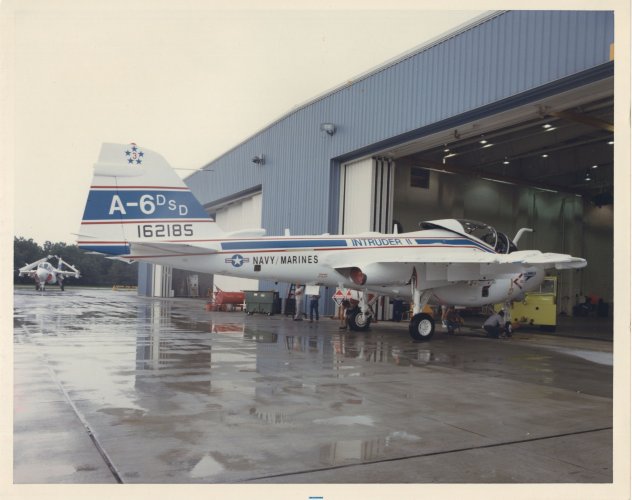
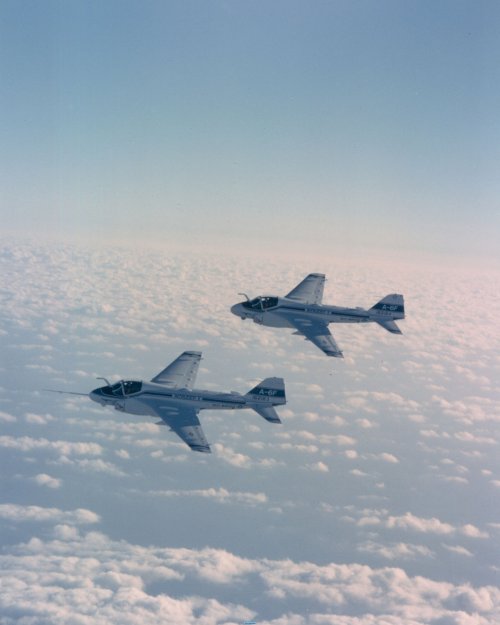
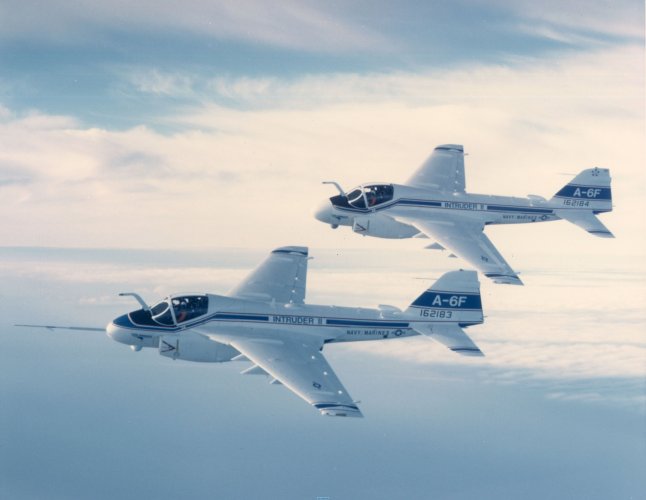
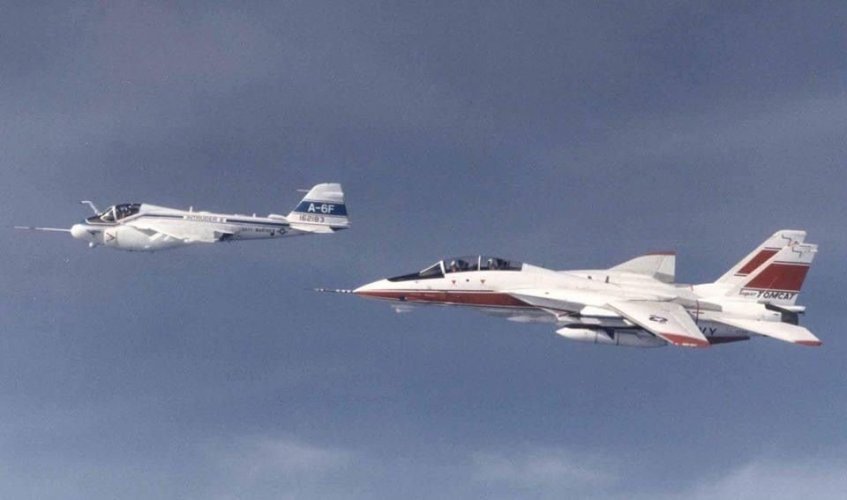
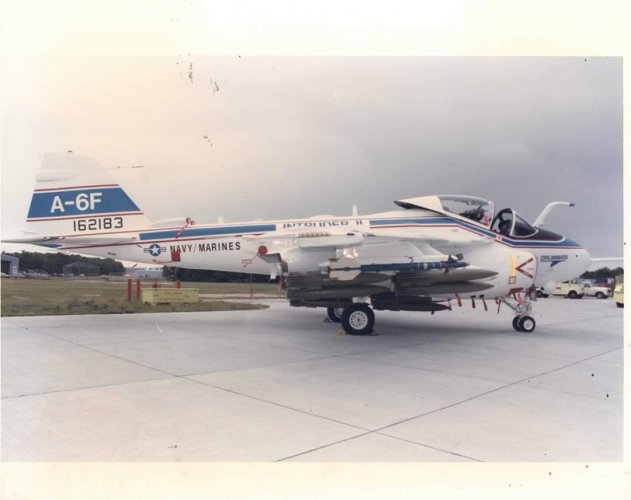
I wish Lehman would have been a bit more forward thinking and paid more attention to what the USAF was doing with the F-15E; the F-14D Quickstrike would have been a superb strike fighter and ensured the that the Tomcat matured into its growth potential.A couple of notes on the A-6F. This was championed by then Secretary of the Navy John Lehman as a method for providing a dramatic enhancement to navy deep strike at a relatively low cost by using an improved A-6 airframe, non afterburning F404 engines, new avionics & displays (some shared with the F-14D, AV-8B and F/A-18). improved capabilities and lower maintenance. It was also to serve as a "bridge" to the A-12 as well as a hedge should unexpected problems show up in the latter's development. As a strike aircraft, it would not be as capable as the A-12, but would be considerably more capable than other Navy options, especially any derivative of the Hornet.
Once John Lehman has stepped down the A-6F was canceled. This happened for a couple of reasons. First, there had been some acrimony between Naval Aviation and the Office of the Secretary of Defense during the '80s. When Lehman left, one of the strongest proponents of navy all-weather/deep strike was no longer their to champion the A-6F and so OSD zeroed it out, and showed little interest in the A-6G, which was basically an A-6E with the avionics of the A-6F. The second reason was that the projected in service date of the A-12 was not all that much behind the IOC of the A-6F, and given this it was thought kind of redundant to develop the A-6F. This latter reason resulted in the wrong decision being made for the right reason (As opposed to the later cancellation of the A-12 which was the right decision for the wrong reasons).
Withe the cancellation of the A-6F, there was no longer a sufficient domestic market for the F404 to justify the proposed Pratt line and, coupled with the problems Pratt was having and the fact that the two versions turned out to not be interchangeable, killed the Pratt F404. The A-6F's share of the overhead on displays and those avionics that would be used by other programs was absorbed by those programs.
Of course a few years later, Dick Cheney, said to be even more hostile to naval aviation, canceled the A-12. OSD then ordered the F/A-18E/F, sold as an "interim" aircraft until the arrival of the replacement AX (later enhanced into the A/FX). With the cancellation of the A/FX and the early retirements of the A-6 and F-14, Naval aviation essentially has become a secondary force.
In an interview given earlier this decade, John Lehman said if he had to do it over again, he would not have started the A-6F program. He would have developed a strike fighter version of the upcoming F-14D instead, giving more versatility to the NAVAIR deckload and probably might have been a program that could have survived the acrimony with OSD. In essence this was what was later proposed as the F-14D Quickstrike which OSD rejected in favor of its less capable Super Hornet program.
I wish Lehman would have been a bit more forward thinking and paid more attention to what the USAF was doing with the F-15E; the F-14D Quickstrike would have been a superb strike fighter and ensured the that the Tomcat matured into its growth potential.
It's didn't help that Lehman came from the A-6 community as a USNR B/N. He did some great things as SECNAV but was near sighted on championing the A-6F derivatives and continuing to promote the separate VF and VA cultures. That being said no one predicted the USSR would collapse so suddenly from the vantage point of the mid 1980's. Had the F-14D been entrenched in the fleet in larger numbers maybe the evolution to the F-14D Quickstrike would have happened on its own in the wake of the A-12 cancellation. It would have been difficult for Cheney to justify the F-18E/F despite whatever agenda he had in the matter.


I was in the advanced design / new product development side of Grumman in the 70s and 80s. My knowledge is based on hearsay, and limited to the early concepts for an A-6 bowlegs* -- the 'office buzz' was that Lehman specifically directed the dry F404 engine. I distinctly remember the aero performance guys complaining that it was short on thrust for engine-out carrier cat-shots and bolters. For an improved A-6 design the working level at Grumman was clamoring instead for use of the J52-P-408 that powered the EA-6B, with about 10% more installed thrust than a dry F404-400 and about 15% more than the A-6E's current engine. Never heard mention of any other engine candidates.Were there any proposals to give the A-6 turbofan engines during the 1970s? It seems odd to have a subsonic attack aircraft with turbojets into the 1970s.

According to Wikipedia, the upgrade kit was only for p-408 engines, so with the A-6G proposal keeping the earlier existing J52-P-8A/B engines from the E model, upgrades would have been a no-go.I hadn't realized that the non-afterburning F404 made less thrust than the J52-P-408. Is it possible a newer non-AB F404 variant could have brought the thrust up to the same level?
Perhaps there was some consideration by Grumman that if the Navy went with the A-6G offering they might upgrade the J52s in those to P-408 or P-409 standard.
I also remember that.I seem to recall that the Navy was making a big push for engine commonality at the time,
"So, we're going to be putting a non-afterburning F110 engine into the A-6s. Because it's about the same size as the old J52. Just much better fuel economy."Probably made more sense putting dry F118s into a new A-6 at the time. It was subsonic and the bigger leading fan would not have been problematic. F118 was 3200 pounds in weight with 17000 pounds in dry thrust.
Oh wow; it's really nice to have someone who actually worked on the Intruder on a forum.Never heard mention of any other engine candidates.
I think turbofans were too new and marginally reliable when the A6 was being designed in 1957-58. The Douglas Missileer was being designed in 1959.turbofans were sorta-emerging in the late 1950s when the A-6 was being designed, and the F-111 got a turbofan... was A-6 just too early to be designed with a turbofan in mind?
Great suggestion. Now consider it to go on S-3F Viking and A-7F Corsair. Commonality between programs ftw.I suppose the F412 intended for the A-12 could have been a good option. It was basically the prototype for the F414 and had around 13k thrust. Would have been ready sooner than the F414.



Might work on the S-3, though I'd rather go looking at the CF34 variants instead. More bypass ratio, better fuel economy. (And we then fit the CF34s onto A-10s who really need the power)Great suggestion. Now consider it to go on S-3F Viking and A-7F Corsair. Commonality between programs ftw.

