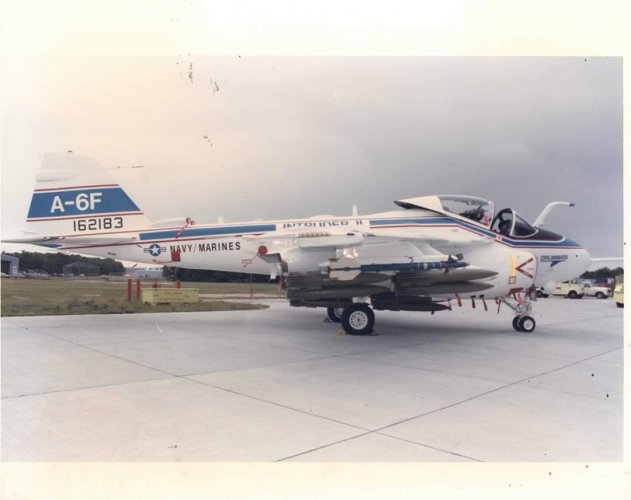
Grumman A-6 Intruder projects

Sorry, just a bit of a sidebar from the Missileer thread:
This variant was designed by William Rathke and dates to June 1959. Another Missileer Intruder was Model 128F, while Model 128C is "A2F-1 attack aircraft in Missileer airframe".

Source:
Robert F Dorr, Grumman A-6 Intruder, Osprey 1987
Does the suggestion of G128C (as opposed to the Missileer G128E/F) mean that Grumman was at least investigating a TF30 powered attack intruder in the early 60s? That seems like a really interesting path not taken! Is there more info on this?
 
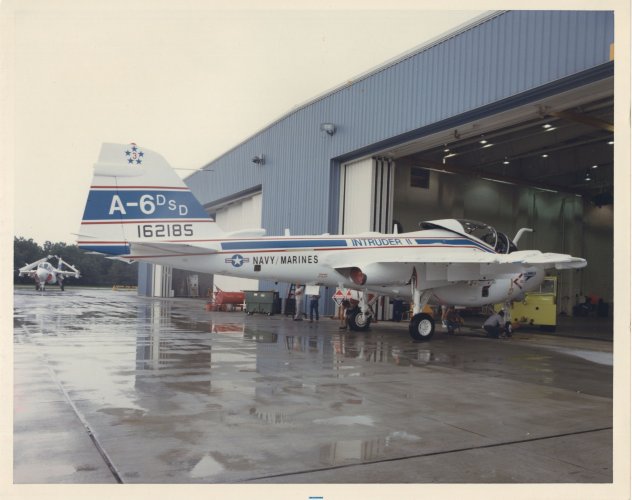
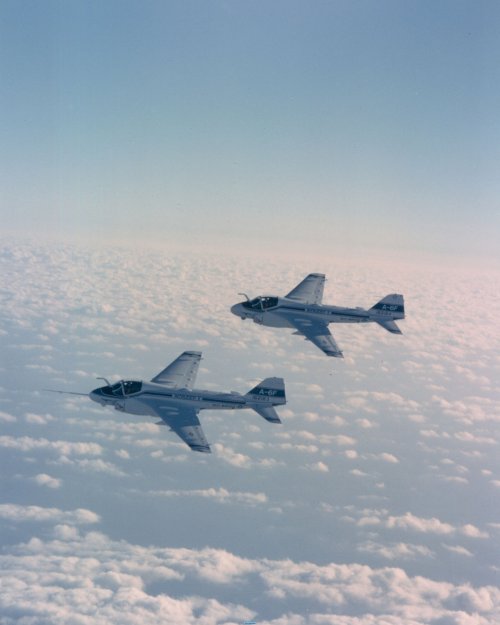
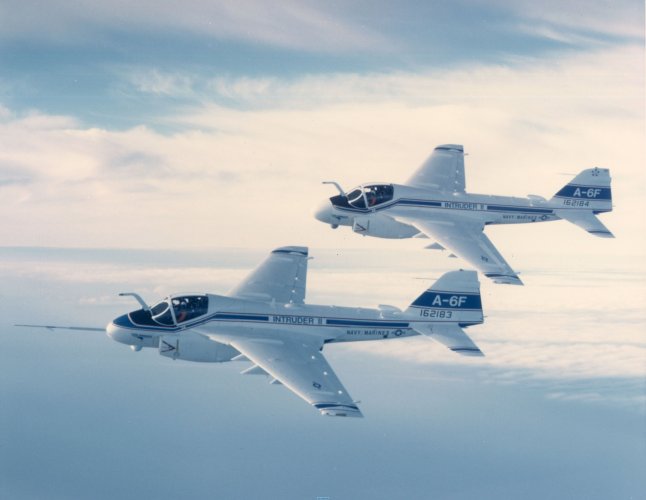
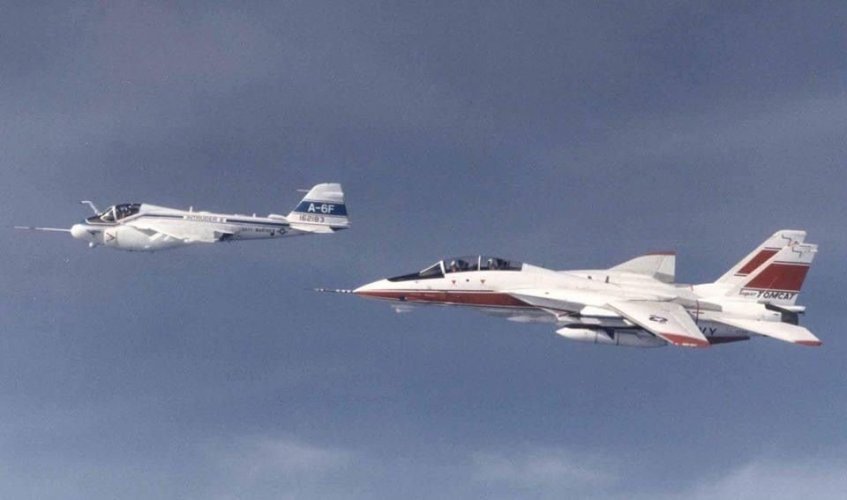
A couple of notes on the A-6F. This was championed by then Secretary of the Navy John Lehman as a method for providing a dramatic enhancement to navy deep strike at a relatively low cost by using an improved A-6 airframe, non afterburning F404 engines, new avionics & displays (some shared with the F-14D, AV-8B and F/A-18). improved capabilities and lower maintenance. It was also to serve as a "bridge" to the A-12 as well as a hedge should unexpected problems show up in the latter's development. As a strike aircraft, it would not be as capable as the A-12, but would be considerably more capable than other Navy options, especially any derivative of the Hornet.

Once John Lehman has stepped down the A-6F was canceled. This happened for a couple of reasons. First, there had been some acrimony between Naval Aviation and the Office of the Secretary of Defense during the '80s. When Lehman left, one of the strongest proponents of navy all-weather/deep strike was no longer their to champion the A-6F and so OSD zeroed it out, and showed little interest in the A-6G, which was basically an A-6E with the avionics of the A-6F. The second reason was that the projected in service date of the A-12 was not all that much behind the IOC of the A-6F, and given this it was thought kind of redundant to develop the A-6F. This latter reason resulted in the wrong decision being made for the right reason (As opposed to the later cancellation of the A-12 which was the right decision for the wrong reasons).

Withe the cancellation of the A-6F, there was no longer a sufficient domestic market for the F404 to justify the proposed Pratt line and, coupled with the problems Pratt was having and the fact that the two versions turned out to not be interchangeable, killed the Pratt F404. The A-6F's share of the overhead on displays and those avionics that would be used by other programs was absorbed by those programs.

Of course a few years later, Dick Cheney, said to be even more hostile to naval aviation, canceled the A-12. OSD then ordered the F/A-18E/F, sold as an "interim" aircraft until the arrival of the replacement AX (later enhanced into the A/FX). With the cancellation of the A/FX and the early retirements of the A-6 and F-14, Naval aviation essentially has become a secondary force.

In an interview given earlier this decade, John Lehman said if he had to do it over again, he would not have started the A-6F program. He would have developed a strike fighter version of the upcoming F-14D instead, giving more versatility to the NAVAIR deckload and probably might have been a program that could have survived the acrimony with OSD. In essence this was what was later proposed as the F-14D Quickstrike which OSD rejected in favor of its less capable Super Hornet program.
I wish Lehman would have been a bit more forward thinking and paid more attention to what the USAF was doing with the F-15E; the F-14D Quickstrike would have been a superb strike fighter and ensured the that the Tomcat matured into its growth potential.

It's didn't help that Lehman came from the A-6 community as a USNR B/N. He did some great things as SECNAV but was near sighted on championing the A-6F derivatives and continuing to promote the separate VF and VA cultures. That being said no one predicted the USSR would collapse so suddenly from the vantage point of the mid 1980's. Had the F-14D been entrenched in the fleet in larger numbers maybe the evolution to the F-14D Quickstrike would have happened on its own in the wake of the A-12 cancellation. It would have been difficult for Cheney to justify the F-18E/F despite whatever agenda he had in the matter.
 
Last edited:
I wish Lehman would have been a bit more forward thinking and paid more attention to what the USAF was doing with the F-15E; the F-14D Quickstrike would have been a superb strike fighter and ensured the that the Tomcat matured into its growth potential.

It's didn't help that Lehman came from the A-6 community as a USNR B/N. He did some great things as SECNAV but was near sighted on championing the A-6F derivatives and continuing to promote the separate VF and VA cultures. That being said no one predicted the USSR would collapse so suddenly from the vantage point of the mid 1980's. Had the F-14D been entrenched in the fleet in larger numbers maybe the evolution to the F-14D Quickstrike would have happened on its own in the wake of the A-12 cancellation. It would have been difficult for Cheney to justify the F-18E/F despite whatever agenda he had in the matter.

It really didn't matter. Both the F-14D and and A-6F were doomed by post-Cold War budget cuts. Both were killed off because they were both horrendously expensive to operate and maintain, and Congress was determined that the so-called Peace Dividend wouldn't be an empty promise. Couple that with the reduced threat projection for the next decade or two, and NavAir was pretty comfortable taking cheap over world-beater from the 90's onward. People complain about the compromises of the Super Hornet, but it basically saved Naval Aviation after the Cold War was over, and the Navy's nearest peer enemy was the USAF. And the Super allowed USN to put fresh airframes on deck in an era when USAF was limited to under 200 F-22's, and was forced to stretch out the life of old teen series birds as a result. So in retrospect, the Super Hornet was probably inevitable no matter what. If we had chosen one or both of the Tomcat or Intruder airframes, we'd have had many fewer of them, probably not enough to justify 10 carriers.
 
Were there any proposals to give the A-6 turbofan engines during the 1970s? It seems odd to have a subsonic attack aircraft with turbojets into the 1970s.
 
Were there any proposals to give the A-6 turbofan engines during the 1970s? It seems odd to have a subsonic attack aircraft with turbojets into the 1970s.
I was in the advanced design / new product development side of Grumman in the 70s and 80s. My knowledge is based on hearsay, and limited to the early concepts for an A-6 bowlegs* -- the 'office buzz' was that Lehman specifically directed the dry F404 engine. I distinctly remember the aero performance guys complaining that it was short on thrust for engine-out carrier cat-shots and bolters. For an improved A-6 design the working level at Grumman was clamoring instead for use of the J52-P-408 that powered the EA-6B, with about 10% more installed thrust than a dry F404-400 and about 15% more than the A-6E's current engine. Never heard mention of any other engine candidates.

Lehman dictating the F404 solution correlates well with what I know firsthand: during the early ATA days (1983-84) the 'Navy' gave us a short list of 'requirements', and curiously one was that the stealthy A-6 replacement will be powered by the F404 engine. It only took us a week to get back to the Navy office with the feedback that the F404 was much too small for an aircraft designed to the other items on the Navy's list. Looking back years later, I've always assumed that Lehman, after being read into the Senior Trend program (F-117A), wanted to tap into the existing F404 covert production run up in Lynn, MA.
-------
* Footnote: before the A-6F designation it was referred to as the A-6( ) a.k.a. A-6 bowlegs, a term often used at Grumman for advanced versions of production aircraft. Don't know if that's Navy speak or just Long Island talk.
 
Last edited:
I really never understood the F404 idea either given the drop in thrust compared to the J52-P-408. The F414 in non-AB form would have been just about perfect, had it been ready in time.
 
I hadn't realized that the non-afterburning F404 made less thrust than the J52-P-408. Is it possible a newer non-AB F404 variant could have brought the thrust up to the same level?

Perhaps there was some consideration by Grumman that if the Navy went with the A-6G offering they might upgrade the J52s in those to P-408 or P-409 standard.
 
I hadn't realized that the non-afterburning F404 made less thrust than the J52-P-408. Is it possible a newer non-AB F404 variant could have brought the thrust up to the same level?

Perhaps there was some consideration by Grumman that if the Navy went with the A-6G offering they might upgrade the J52s in those to P-408 or P-409 standard.
According to Wikipedia, the upgrade kit was only for p-408 engines, so with the A-6G proposal keeping the earlier existing J52-P-8A/B engines from the E model, upgrades would have been a no-go.

"The P-409 would have been available as a new engine or as an upgrade kit for P-408 engines, but was never ordered in significant quantities"

As for the insistence on F404 engines in the A-6F, I seem to recall that the Navy was making a big push for engine commonality at the time, and there was a lot of buzz that they might even try mandate a single tactical engine supplier. GE was supposedly who was favored with the F-18 hitting the fleet in quantity with their F404's (an engine everyone seemed to be happy with), and the planned upgrades of F-14's with the preferred F110 engine. The A-7 was in the beginning of being phased out at this time, and the F-4 was out of front line fleet service, leaving 4 tactical jets that would all be powered by GE if the Intruder upgrade/new build program was approved: F-14D, F/A-18, A-6F, and the S-3. So you would have at least a partial commonality of engine parts between the Hornet and the Intruder, benefiting the supply and maintenance systems. The Navy was also not terribly happy with Pratt and Whitney at the time, according to press sources. I highly doubt that Congress would have approved a single supplier, but the Navy still had a sour taste from the experiment with Pratt and Whitney license-producing F404's.
 
Probably made more sense putting dry F118s into a new A-6F at the time. It was subsonic and the bigger leading fan would not have been problematic. F118 was 3200 pounds in weight with 17000 pounds in dry thrust. Another alternative was the Rolls-Royce Spey 511-8 used in Gulfstream III.
 
Last edited:
Probably made more sense putting dry F118s into a new A-6 at the time. It was subsonic and the bigger leading fan would not have been problematic. F118 was 3200 pounds in weight with 17000 pounds in dry thrust.
"So, we're going to be putting a non-afterburning F110 engine into the A-6s. Because it's about the same size as the old J52. Just much better fuel economy."
 
Never heard mention of any other engine candidates.
Oh wow; it's really nice to have someone who actually worked on the Intruder on a forum.

From what I can gather, if they wanted to switch to a turbofan, there would have been lots of changes to the airframe, including inlets and suchlike? But turbofans were sorta-emerging in the late 1950s when the A-6 was being designed, and the F-111 got a turbofan... was A-6 just too early to be designed with a turbofan in mind?
 
turbofans were sorta-emerging in the late 1950s when the A-6 was being designed, and the F-111 got a turbofan... was A-6 just too early to be designed with a turbofan in mind?
I think turbofans were too new and marginally reliable when the A6 was being designed in 1957-58. The Douglas Missileer was being designed in 1959.

So I think TF30s could have been an option, but Grumman went with an engine already in heavy Naval use in A-4 Skyhawks instead.

If the Missileer concept was approved it'd be an option. Best chance for change would have been while originally designing, or maybe in the step from YA-6 to A-6A. Because after that Vietnam is eating all the budget and it's unlikely to get funding for new engines that weren't in service anywhere else until 1968 or the 70s. Not while the J52s were working well enough. After Vietnam the US was more or less in a Drawdown, so selling Congress on a new version with newer, more fuel efficient engines would not be an easy sell.

Maybe in the 1980s during the 600-ship Navy days?
 
I left off the 'F' as in A-6F in my previous post. That may have been important for context.

The F404 was minimal fuselage change but mostly more of the same thrust with a slight improvement in weight. But A-6 had a lot of physical space to put in a bigger leading fan. They had Spey 511-8s in the system with similar weight specs to F404 but more thrust (over 12,000 pounds) and a better fuel burn. Or use the non-afterburning F1x0 with a similar leading fan to the 511-8 but a much larger thrust gain but similar fuel ratio burn as the Spey. (And the Prowler could have probably found a way to use all of the extra power available.) The substantial increase of thrust cost you an additional ton. You were still going to be subsonic but the acceleration greatly improves. A-6 was literally the tactical bomber of the Navy and fought in almost all of the same scenarios as F-111 of the USAF. But the A-6 had a wider array of weapons to deploy and were heavily used whereas the F-111 being land-based was constantly running into national boundaries bottling up the use.

The reason to go F404 was to share the same engine version with Hornet. Even if their basic versions were from the same F404 family they were being made for different purposes and would use some different parts. GE would have loved that, but P&W did not compete for the bid. Pick F1x0 for GE and P&W to compete on price, but put the Spey as a third rail to ensure best prices. (Honestly even the Spey was a nice leap in thrust.) The USAF would later figure this out to make industry compete. The sentiments to force competition were already being freely thrown out in the public at that time. During the era that brought about the A-6F proposal was a non-competition phase in the industry. Too much was being chosen where nobody competed. And a better A-6F threatened jobs in states involving other vendors with larger voting blocks in the legislature. It was a real political circus to end up the choices eventually made. The American public were not benefitting. When the A-12 failed to materialize they really could have used an improved A-6 version. We were using them all over the globe at the time and these aircraft were brute force trauma on enemies.
 
I suppose the F412 intended for the A-12 could have been a good option. It was basically the prototype for the F414 and had around 13k thrust. Would have been ready sooner than the F414.
 
I suppose the F412 intended for the A-12 could have been a good option. It was basically the prototype for the F414 and had around 13k thrust. Would have been ready sooner than the F414.
Great suggestion. Now consider it to go on S-3F Viking and A-7F Corsair. Commonality between programs ftw.
 

Attachments

  • 20260730_Grumman_A-6F_Development_Aircraft_001.jpg
    20260730_Grumman_A-6F_Development_Aircraft_001.jpg
    1.2 MB · Views: 74
  • 20260730_Grumman_A-6F_Development_Aircraft_002.jpg
    20260730_Grumman_A-6F_Development_Aircraft_002.jpg
    993.6 KB · Views: 28
  • 20260730_Grumman_A-6F_Development_Aircraft_003.jpg
    20260730_Grumman_A-6F_Development_Aircraft_003.jpg
    795.8 KB · Views: 23
  • 20260730_Grumman_A-6F_Development_Aircraft_004.jpg
    20260730_Grumman_A-6F_Development_Aircraft_004.jpg
    1.3 MB · Views: 25
  • 20260730_Grumman_A-6F_Development_Aircraft_005.jpg
    20260730_Grumman_A-6F_Development_Aircraft_005.jpg
    41.6 KB · Views: 28
  • 20260730_Grumman_A-6F_Development_Aircraft_006.jpg
    20260730_Grumman_A-6F_Development_Aircraft_006.jpg
    52.4 KB · Views: 32
Last edited:
Great suggestion. Now consider it to go on S-3F Viking and A-7F Corsair. Commonality between programs ftw.
Might work on the S-3, though I'd rather go looking at the CF34 variants instead. More bypass ratio, better fuel economy. (And we then fit the CF34s onto A-10s who really need the power)

A-7F would have an F100 or F110 (common with F-16s and/or F-14s), and is competing against the Legacy Hornet in the Navy. But if that gets more Tomcats upgraded to F110 its a win.
 

Similar threads

Back
Top Bottom