Please , go to :
- Histoire 2 ; l'histoire de l'avion prototype A.C.A n°1
- Pionniers Aviation 1 ; Emile Chapeaux ingénieur lyonnais et pionnier du vol à voile français
Please , go to :
- Histoire 2 ; l'histoire de l'avion prototype A.C.A n°1
- Pionniers Aviation 1 ; Emile Chapeaux ingénieur lyonnais et pionnier du vol à voile français
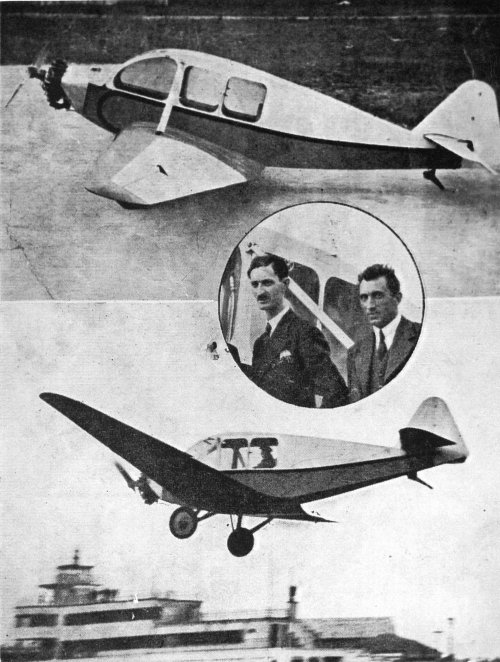
Finally, last but not least, an article from Vie Lyonnaise presenting two photos of a tourist airplane
designed by Emile Chapeaux and piloted by Antoine Chailloux. The first official flight is dated
Tuesday, October 12, 1933 in Bron.
Equipped with a 60 horsepower star engine, it has a low wing and sedan, two faired shrouds
connecting this wing, of trapezoidal shape with great aspect ratio and rounded ends, at the
top of the fuselage. The aircraft is largely glazed and the tail units are triangular in shape.
Fixed train. Nice discovery by Jacques Delarue.
And a description from: Emile CHAPEAUX : ingénieur lyonnais et pionnier du vol à voile français
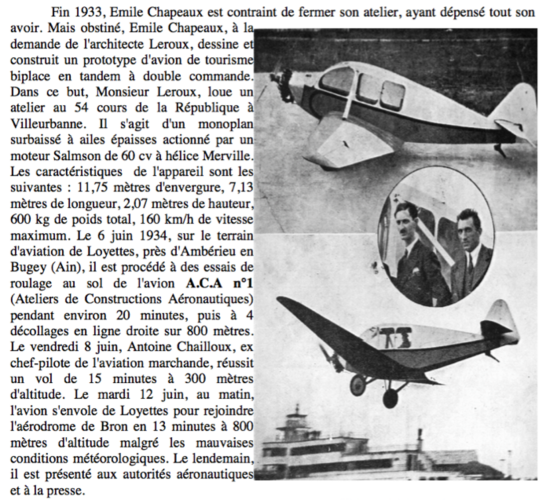
It was a low-profile thick-winged monoplane powered by a 60 hp Salmson engine with Merville propeller. The characteristics of the device are as follows: wingspan 11.75 meters, length 7.13 meters, height 2.07 meters, total weight 600 kg, maximum speed 160 km/h. On June 6, 1934, on the Loyettes airfield, near Ambérieu en Bugey (Ain), ground testing of the ACA aircraft n ° 1 (Ateliers de Constructions Aéronautiques) was carried out for approximately 20 minutes, then 4 takeoffs in a straight line for 800 meters. Friday June 8, Antoine Chailloux, former commercial chief pilot, succeeds in a 15-minute flight at an altitude of 300 meters. On the morning of Tuesday, June 12, the plane was flown from Loyettes to Bron. It reached Bron aerodrome in 13 minutes, flying at an altitude of 800 meters despite bad weather conditions. The next day, it is presented to the aeronautical authorities and to the press.
In # 567 I gave the link for the story of the A.C.A 1 , and showed the article in post # 573 . The pictures where published in "La vie Lyonnaise" , but I am unable to find the original on the net ...
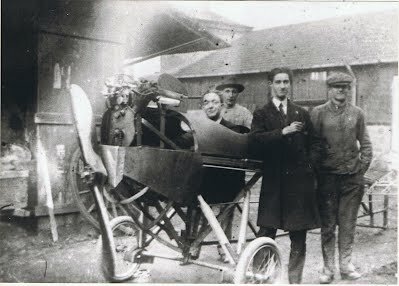
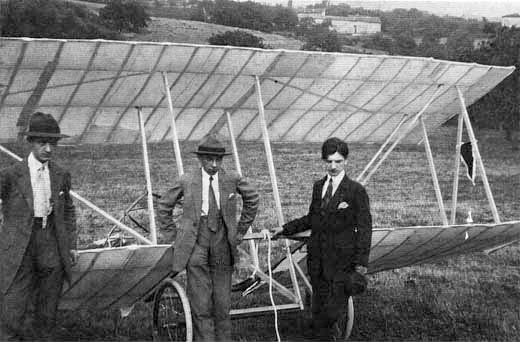
Émile, Joseph, Alexandre CHAPEAUX was born on February 18, 1904, in Lyon's 6th arrondissement. At the age of 16, he sailed a model of a hydrofoil he had built on the lake in the Parc de la Tête d'Or in Lyon. In 1922, on a site in Dardilly, a suburb of Lyon, he flew a biplane glider of his own design, which was launched using a bungee cord (see photo, right). Around the same time, he built the EC monoplane sailboat called "Le Vautour Oricou,"or VBSC, after the initials of his friends who helped him (Varichon, Biessy, Sabourault, Chapeaux). The following year, he continued his study of prototypes: the BC biplane glider, and the MC (Moulin et Chapeaux) "aero-sailboat". After graduating from the Lycée Ampère in Lyon, he took engineering courses by correspondence from the École du Génie Civile, graduating in 1924.
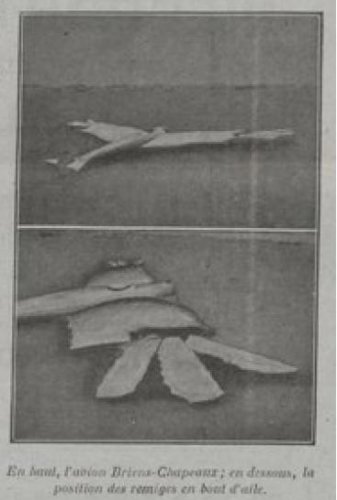
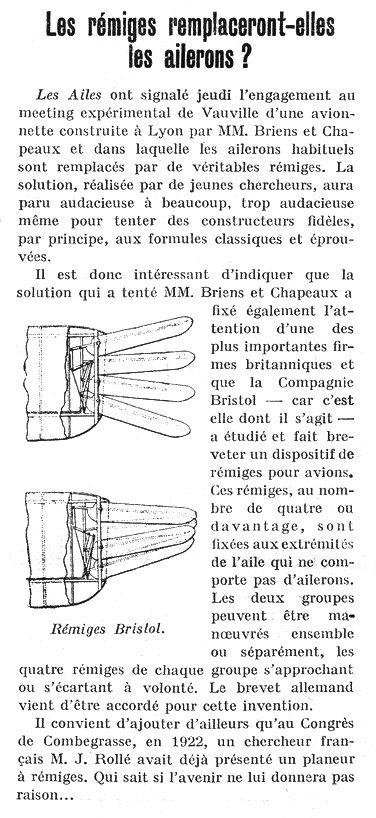
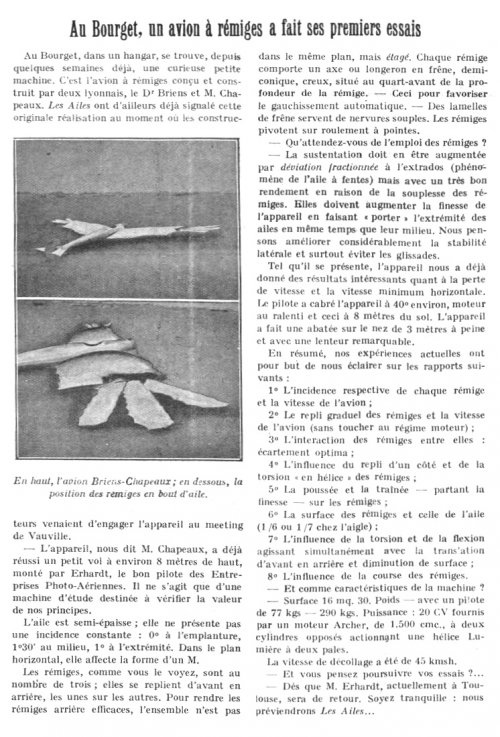
In collaboration with friends and with the financial support of Mr. Briens, a pharmacist in Lyon, Émile Chapeaux created the CX.2 avionnette (the first and last letters of his surname). This variable-surface aircraft was called a 'flight aircraft' because of its resemblance to bird feathers. It was equipped with small, stepped-shaped wings at the wingtips. The pilot folded the flight feathers unilaterally or bilaterally using two pedals, which reduced the surface area on one side or the other, or on both sides simultaneously. The respective positions of the wings offered the advantage of slotted wings, which benefited from the high-lift effect. The concept was introduced publicly in the May 7, 1925 issue of Les Ailes. Briens and Chapeaux entered the aircraft in the famous Vauville competition, but was not ready in time to participate. Equipped with a 22-hp, two-cylinder Archer engine, it finally flew on November 1, 1925 at Le Bourget airfield, piloted by Mr. Erhardt. A communication was then made to the French Air Association (Patent No. 588,585) and in the Nov. 26 issue of Les Ailes, the builders promised to keep the newspaper informed of further tests. The fact that the CX.2 was no longer heard of likely indicates that the results were highly disappointing.
During 1926, Émile Chapeaux built the first portable monoplane glider—a Lilienthal type—which was tested on the slopes of Mont Thou, north of Lyon. From 1925 to 1930, he tested various models in a wind tunnel, the result of extensive aerodynamic research and vivisections at the Lyon Veterinary School, where he had a laboratory. His research was rewarded with a special grant from the Ministry of Public Instruction, following several papers submitted to the Lyon Faculty of Medicine and technical journals, including: "The Conditions of Rowed Flight in Birds, Aerodynamic Ornithology, Study on the Relative Proportions of the Wing Bones in Some Birds," and "The Wonders of the Wing in Birds. Essay on Physiology" with Albert Seruajean.
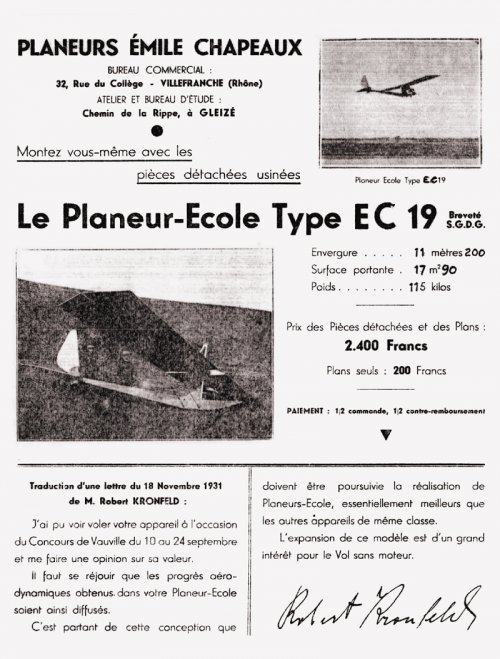
Chapeaux permanently left his position as head of the Design Office of the Compagnie Générale de Constructions et d'Entretien de Matériel de Chemin de Fer (C.G.C.E.M.) to create his own company in 1930, Planeurs Émile Chapeaux: the sales office was at his home, the workshop and design office were located on Chemin de la Rippe, in Gleizé, in the suburbs of Villefranche-sur-Saône. His company, which entered the industrial phase, was to employ eight workers. Here are the gliders they produced:
CH 19, a single-beam glider with a raised horizontal tail beam, sold to Mouettes Lyonnaises in 1931. Numerous flights on Saturdays and Sundays on the slopes of Mont Thou were carried out by instructors Simonet and Messine, using bungee cords.
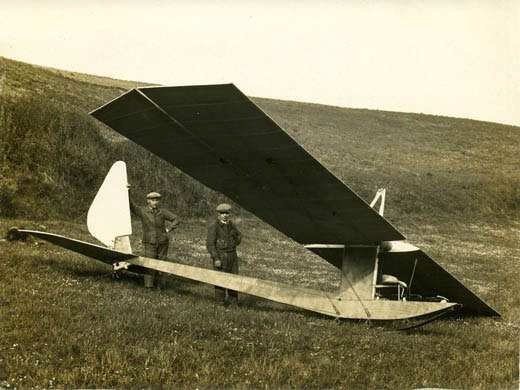
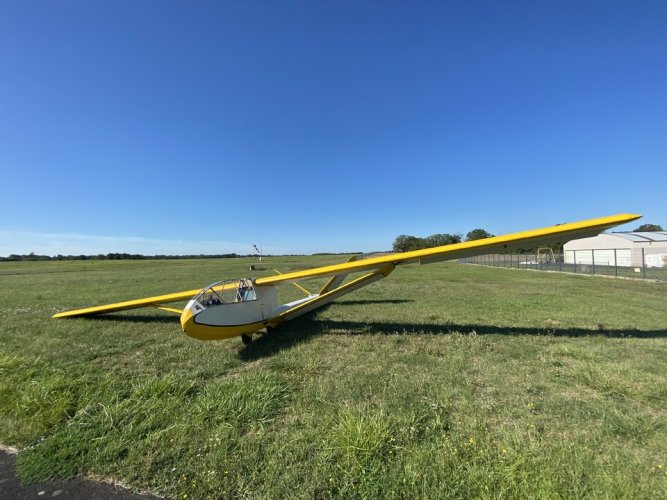
CH 19 B, Patent No. 712.375, a low-slung single-beam glider, with a wingspan of 11.20 meters and an aspect ratio of 7. This aircraft participated in the Vauville International Gliding Competition (Manche) in September 1931. Sold to the Aéroclub du Rhône et du Sud-Est"...the beam carries a streamlined mast at the front, itself accommodating the rectangular wing, divided into two half-wings, with the pilot's head housed between the two leading edges. The pilot sits on a seat placed on the beam and leaning on the mast, in the open air, of course. A cushioned ski is placed under the beam at pilot height, and a large stand at the rear allows for landing. The tailplanes are carried by the beam at its rear end. Finally, the wing is strut-mounted from the top and bottom, the upper strut being connected to a small cabin carried by the central mast."
CH 19 C, a low single-beam glider, with a wingspan of 11.20 meters and an aspect ratio of 8, but with a tapered fairing on the front part of the beam. Sold in 1932 to the Aeroclubs of Villefranche-sur-Saône, Corsica, Mostaganem, Poitou, Montpellier, Sète, the University Aeroclub of Caen and Calvados, and to Ailes Abbevilloises.
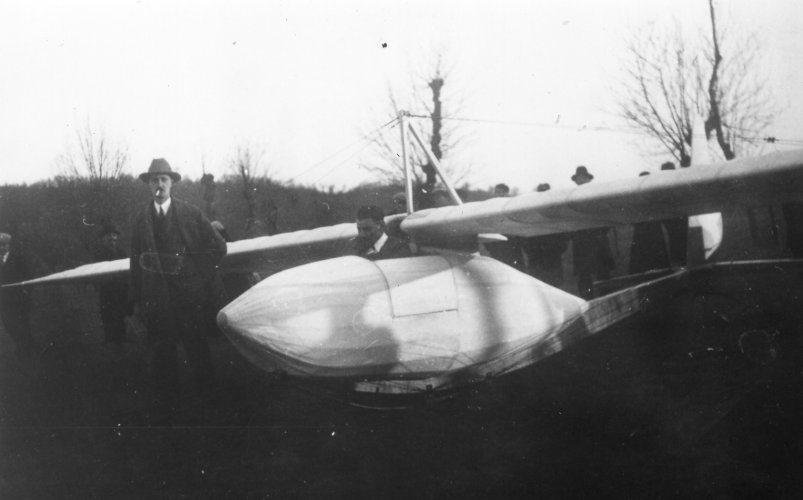
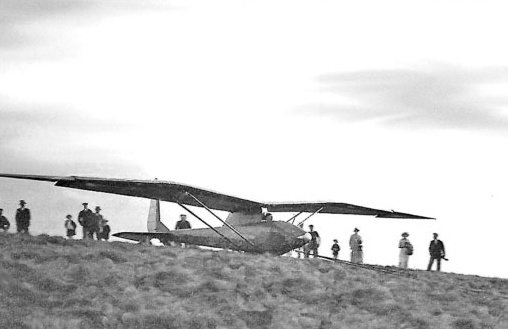
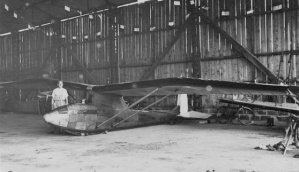
CH 23 gull-wing performance glider, the construction of which began in 1931, an extrapolation of Emile Chapeaux's various research projects. "...the fuselage is elliptical in section with birch plywood covering. It is formed of a crossbeam that accommodates the seat support frame, the control column, and the forward towing hook. A series of frames connected by six main spars and intermediate stringers form the fuselage framework. A crossbeam allowed for a very large opening for the cockpit access door. The pilot can therefore easily and quickly parachute out. The twin-spar wing has an M-shape, seen from the front. It has a rectangular twin-spar central section that then tapers. The tapered ends are formed by the ailerons themselves; they are therefore entirely mobile." The wing's angle of attack varies from the root to the tips, with the maximum being located in the first third of the wingspan. It is covered with 10/10 alder plywood. This wing is mounted on a streamlined cabin located behind the cockpit and braced to the fuselage by two pairs of parallel masts.The aircraft, with a wingspan of 18.50 meters, a surface area of 19.20 m², an aspect ratio of 18, and a glide ratio of 25, has a vertical descent speed of 0.60, and weighs 185 kg empty." Only one glider was built. In order to participate in the International Ordanche Glider Competition near Clermont-Ferrand, Émile Chapeaux entrusted the tests to Georges Burlaton of the Aéroclub du Rhône et du Sud-Est. Three winch tests took place at Bron airfield on December 26, 1932. Burlaton held the air for 1.15, 1.40, and 2.7 minutes in adverse weather conditions. In January 1933, another test took place at Bron: a Caudron 125 piloted by Olive towed the glider to an altitude of 400 meters. Burlaton landed after 7.12 minutes of flight. On Saturday, January 7, another towed test was conducted over Mont Verdun, in the Monts d'Or, north of Lyon. From an altitude of approximately 1,000 meters, Burlaton landed after 21.3 minutes of flight. This aircraft would make numerous flights until the outbreak of war in 1939.
At the end of 1933, Emile Chapeaux was forced to close his workshop, having spent all his assets. But the stubborn Chapeaux, at the request of the architect Leroux, designed and built a prototype tandem two-seater passenger aircraft with dual controls. For this purpose, Mr. Leroux rented a workshop at 54 Cours de la République in Villeurbanne. It was a low-slung, thick-winged monoplane powered by a 60 hp Salmson engine with a Merville propeller. The aircraft's specifications were as follows: 11.75 meters wingspan, 7.13 meters length, 2.07 meters height, 600 kg total weight, and a maximum speed of 160 km/h. On June 6, 1934, at the Loyettes airfield, near Ambérieu-en-Bugey (Ain), the Ateliers de Constructions Aéronautiques A.C.A. No. 1 (Aeronautical Construction Workshops) aircraft was tested for approximately 20 minutes, followed by four straight takeoffs over 800 meters. On Friday, June 8, Antoine Chailloux, a former chief pilot in the merchant aviation industry, successfully completed a 15-minute flight at an altitude of 300 meters. On the morning of Tuesday, June 12, the aircraft took off from Loyettes, arriving at Bron airfield in 13 minutes at an altitude of 800 meters despite poor weather conditions. The next day, it was presented to the aviation authorities and the press.
It is sad that Émile Chapeaux is mostly forgotten nowadays, so I'm grateful to the Cercle Aéronautique Louis Mouillard for writing the article that served as a basis for the greater part of this post.
CN-18 was a single-seat Zogling-style glider CH-10 was a glider of 1932,had 11m span CH-20 was a two-seat trainer glider,had a fuselage of CH-19 CH-21 & CH-22 were also a two-seat trainer gliders
(Here is the second part of my research on Émile Chapeaux)
More Chapeaux gliders and aircraft:
CN.18, a Zögling-type single-seater sold to the Mouettes Lyonnaises in 1931.
CH.19 D, similar to CH.19 C with a few detail modifications.
CH.19 H, a variant with rigid struts making assembly and disassembly more easy.
CH.20, a glider with rectangular fuselage section and plywood covering. Sold to Club de Vol à Voile Charles Nungesser in Paris.
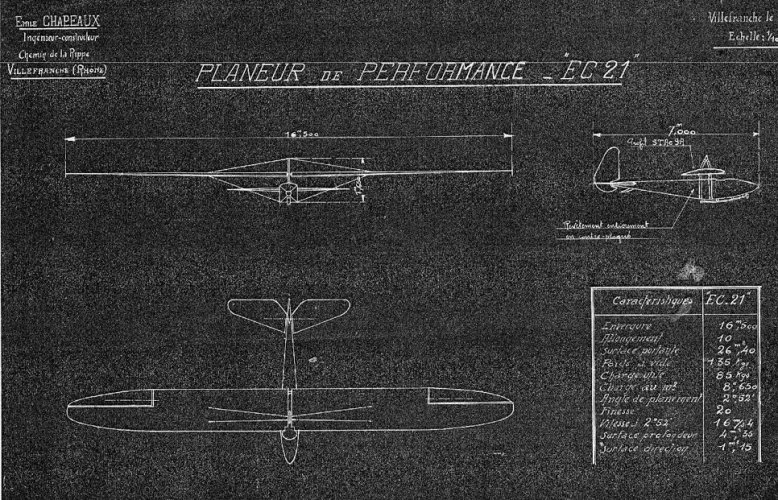
CH.21 (or EC.21) and 22, semi-performance/training gliders sold for 8,500 francs, with 16.5 wingspan and an aspect ratio of 10. They also had plywood-covered fuselages of rectangular section, but wings with elliptical marginal edges, specially designed to facilitate parachute jumping. They were sold to the Aéroclub de Mostaganem et du Doubs in Dôle in 1932.
CH.46, conceived at home in Lyon in 1946.
The Chareyre airplane, conceived in a carpentry workshop in Lyon, also right after the war and assembled in Villeurbanne.
A 45 hp Percy single-seater in the early 1950s.
CX 44-2, a two-seat motorglider (1955), which served as a prototype for the CH.56.
CH.56, a single-seat motorglider (1956).
Le Moniteur (1957), a two-seat motorglider developed for the Compagnie Aérienne des Alpes Françaises (CADAF).
CX.19 L'Hirondelle (the swallow), a single-seat glider (1958).
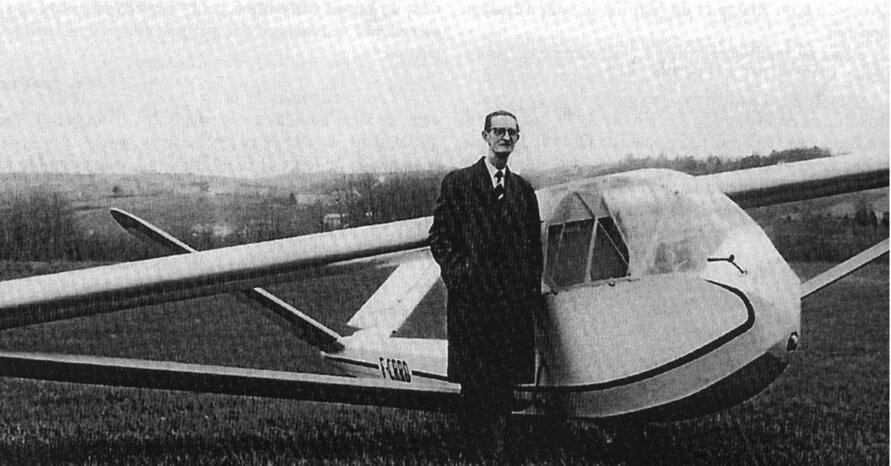
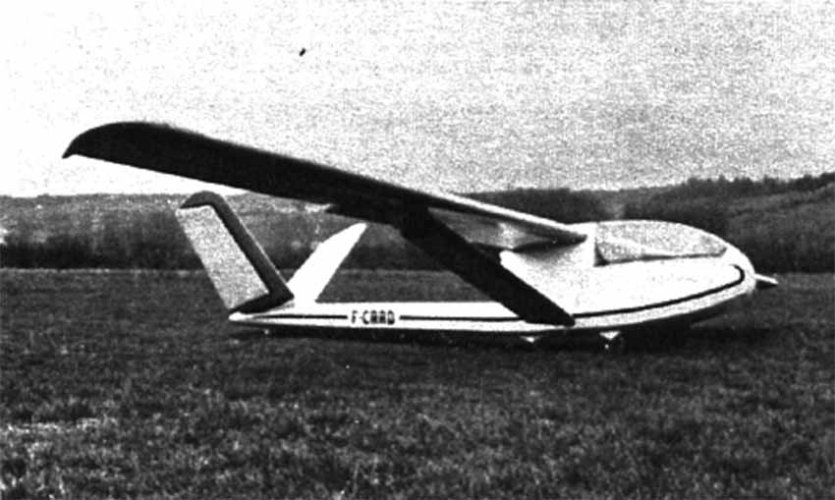
CXD.18 (Chapeaux-Durand) [F-CRRD], a simple motorglider conceived at the request of a Mr. Durand (chief-pilot at the Aéroclub de Villefranche-sur-Saône) for flights near the Colombier airfield. Early studies were conducted in the workshops of the SECMA (Société pour l'Entretien et la Construction de Matériel Aéronautique) at Trévoux, of which Durand was the manager. The CXD.18 had a rectangular wing, an aspect ratio of 15, struts of variable inclination also serving as air brakes, a beam-type fuselage, a "butterfly" (V-type) tail and a pusher engine behind the cockpit. Several patents were associated to the design. The CXD.18 flew as a glider at the Colombier airfield in Anse on April 14, 1967.
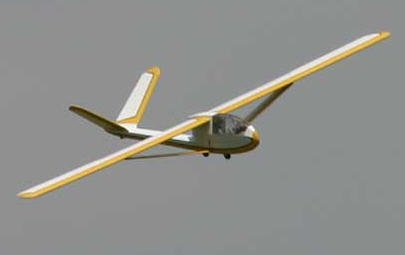
The CXD.18, and a beautiful modern flying model of it.
An infatigable inventor, Émile Chapeaux did several other aviation-related studies including flapping-wing scale models and plans for a Gyroptère and an Ornithoptère. But his career didn't stop at aviation. In 1939, he conceived "runabouts" for Constructions Nautiques et Motonautiques Françaises in Lyon, while developing "Sabran et Chapeaux" electric cars, four of which were built during the German Occupation era all of different configurations, with main assembly by a firm called Ultima and detail finish by car bodybuilder Declérieux.
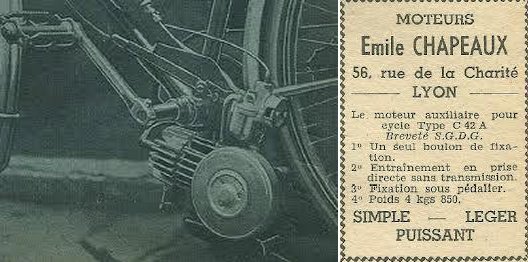
In 1942, Chapeaux started working on an auxiliary bicycle engine, for which several patents were obtained. He eventually set up a company in 1952 to built that engine. During the 1960s, he also had many inventions in the field of industrial cranes through his collaboration with the firm Potin & Weitz. His last project? Another electric car, a two-seat coupé with plastic hull and a single tractor wheel at the front. Studies were completed in 1968, but none of the planned twenty cars was ever built.
Émile Chapeaux was honored with the Médaille de l'Aéronautique in 1962. After his passing in October 1979, and since he had never married nor had any children to give it to, Durand tried to get the RSA museum in Brienne-le-Château to acquire the CXD.18 motorglider, but they never did. Eventually it landed in the GPPA collection in Angers.
NOTE ABOUT DESIGNATIONS: EC.19 was another name for the CH.19 series. It seems that Émile Chapeaux never settled on a coherent designation system... Some of his creations used the prefix "EC" (his initials), others used "CX" (first and last letter of his surname), while others still used "CH" (first two letters of the same). Same for the numerals: CH.18 to 23 were sequential, but CH.46 and 56 used the years they were built in, and the CX series seemed to work differently...
Again, I based most of my research on the publications from the Cercle Aéronautique Louis Mouillard.
This site uses cookies to help personalise content, tailor your experience and to keep you logged in if you register.
By continuing to use this site, you are consenting to our use of cookies.