French 6th generation fighter

The choice by India of France as a partner is likely to be at least partly based on economic assessments of Europe's vs Russia's prospects and stability too, considering India's past willingness to work with the Soviet Union and Russia.
 
The choice by India of France as a partner is likely to be at least partly based on economic assessments of Europe's vs Russia's prospects and stability too, considering India's past willingness to work with the Soviet Union and Russia.
This bad?
Partner's instability is a leverage.
Granted, this is in impressions rather than in actual practice, but the recurring fact is that Russia can do it again and again by itself, and (other?) European countries - can't. At this point, they can't do it even in an internal block without external (Japanese) input any longer.

France is physically capable of doing so, but this isn't capability alone - Europe is full of engineering capability. Their current fiscal limit, however, is a Rafale MLU, and even that is a painful one.
 
Last edited:
This is unilateral communication from India, so there isn't much to read into for now.

The only thing I thought about was yesterday’s “Mecca Joint Defence Agreement” between Turkey, Saudi Arabia and Pakistan and if that could potentially trigger something between France, the UAE and India ?
3 biggest Rafale users, all with already existing defence pacts/partnerships.

I wouldn't really be in favour of it tbh, but i could make sense in a lot of ways …
 
The Point is, we are going Off topic since it is no News as long only Indian sites propose and report this!

Again, only when France suggests it itself, then we can start to think about it and even then India will simply not be able to contribute anything technologically.

That's about as ridiculous as if my local soccer club, Tuss Bretzenheim, decided to compete in the UEFA Cup and would like to start negotiations with the FIFA and only local newspapers from Mainz Report this „mayor new“!
 
The choice by India of France as a partner is likely to be at least partly based on economic assessments of Europe's vs Russia's prospects and stability too, considering India's past willingness to work with the Soviet Union and Russia.

And that they have a need for a carrier capable fighter too and have designed their carriers around the Rafale (which has caused some complications with the smaller deck lifts)
 
Why are people so negative? It isn't outwardly that India will seek to continue its cooperation with Dassault/France with the next project of their industry. Them voicing (hypothetically) their intend comes at the right moment: FCAS 1 is dead. FCAS 2 is also dead. Vive le FCAS III (pronounce triple "i", like in India).

But true, signing first that infamous order for their Air Force Rafale would be more appropriate.
 
Last edited:
It’s not about being negative, but about being realistic!

The fact is—and this is evident from every project India has undertaken in recent decades (especially Tejas and Kaveri)—India can contribute NOTHING technologically to the FCAS.3, so what’s the point? Funding—which would otherwise have come primarily from Germany and Spain—to develop the type, but to believe—given that France has already been quite reluctant to make concessions regarding technology transfer, IP rights, project leadership, etc., to Germany, Spain, and Belgium—that India would be allowed to join as an equal partner is downright naive!

If they’re allowed to participate—and only by France’s grace—then they’ll have to pay, have no say in decisions (because India only delays everything even more than Germany did), and in the end, politely say thank you. If they’re lucky, they’ll get a production line in India and assemble kits… that’s all it will amount to!
 
I wouldn't dismiss Indian technological expertise to that extent. True, it doesn't shines at doing combat aircrarft, and that's mainly due to the fact it's done by state-owned companies white elephants, buried under red tape, with managers clinging to their posts as if they were for life.
But the tech expertise is there, other projects are quite convincing, take Bhramos for example. Or expertise in electronics. One has to check for other Indian private partners.
It’s not about being negative, but about being realistic!

The fact is—and this is evident from every project India has undertaken in recent decades (especially Tejas and Kaveri)—India can contribute NOTHING technologically to the FCAS.3, so what’s the point? Funding—which would otherwise have come primarily from Germany and Spain—to develop the type, but to believe—given that France has already been quite reluctant to make concessions regarding technology transfer, IP rights, project leadership, etc., to Germany, Spain, and Belgium
It's Dassault, not France. And also see the very beginning of the agreement :
- It was to be a cooperation between Dassault (France) and Airbus DS (Germany), with Dassault leading the design. The thing was signed as such.
- Spain was then added (at Dassault's dislike) , as Airbus Spain, which is Airbus the same as Airbus DS... So Dassault found itself having 33%, with in effect Airbus having 66% of the thing.
- the Belgium wanted to join all the while ordering F-35s, adding to the comedy.
- That's when Dassault started seeing there was clearly a problem with tech transfert while having only 33%, AND the fact that the political situation had changed in Germany, with an big new def budget and Airbus/Germans politics and unions pushing to have a big chunk for them only, so they started dragging their feet, contesting the initial agreement that Dassault would manage the design.

There could have been tech transfert from Dassault, IF the situation had stayed the same as the initial agreement, ie France - German, Dassault - Airbus, 50 - 50 % cooperation, with Dassault leading the design.

—that India would be allowed to join as an equal partner is downright naive!

If they’re allowed to participate—and only by France’s grace—then they’ll have to pay, have no say in decisions (because India only delays everything even more than Germany did), and in the end, politely say thank you. If they’re lucky, they’ll get a production line in India and assemble kits… that’s all it will amount to!
Well yes, maybe India would have much less to put on the table in term of tech for such a cooperation, appart from money.
But it would be a 50/50 cooperation, as the original FCAS agreement, which Dassault signed.
Not Dassault willing to transfert tech for only 33% work share and no leading role.

And there are other factors than tech to be taken into account.

Both countries have strategic common interests, they are both very attached to their defence and political independence (each their own way obviously), they are both nuclear powers, they both want a navy capable of defending their interests in the Indian and Pacific oceans. All this can be very valuable in such cooperation.
I think, France has in fact more in common with India in term of foreign policy strategic interests than with Germany.

So Tejas, HAL and other stuff may be laughable, but it's not the only things one has to keep in mind when thinking about India to make a realistic assessment.

 
Last edited:
The problem is 20 years ago, you could replace "France" and "Fcas" with "Russia" and "FGFA".
All the same ingredients which broke down FGFA are there, in an overdrive.
Not really. Since the number of fighters in the IAF is shorter, and Sindoor occur.
 
Not really. Since the number of fighters in the IAF is shorter, and Sindoor occur.
But India is in a far more capable position, and it'll demand it's part everywhere.
I personally think that su-30mki will remain a one off anomaly, unless idk France will fiscally collapse.
 
It was the same question in the 80's 90's about Rafale.
At the end Rafale was less costly and more potent than EF2000.
Even 100 billions, on 20 years, is a smooth depense for french economy.
The problem is everything else that needs to be replaced or upgraded right now. Or capabilities built up from nearly nothing, like SPAA/SP-CUAS, Loitering munitions etc.

France is building new carriers and new SSBNs. Their new carrier is BIG, on the order of Forrestal sized. New SSBNs are obscenely expensive, look at the USN wincing about the Columbia-class. And both of those are required purchases, so they're competing with the 6gen Fighter for funding.

In the 1990s, France could say "the Army and the Navy will be giving up more funding to preserve the Rafale"

Can't say that now.
 
Granted, this is in impressions rather than in actual practice, but the recurring fact is that Russia can do it again and again by itself, and (other?) European countries - can't. At this point, they can't do it even in an internal block without external (Japanese) input any longer.

France is physically capable of doing so, but this isn't capability alone - Europe is full of engineering capability. Their current fiscal limit, however, is a Rafale MLU, and even that is a painful one.
This is a very bold statement. Technology wise France can already do a state of the art multi-role fighter 100% by themselves. I would argue that in Europe the UK is another nation that can probably do it alone if it comes to it. And there are several more nations in Europe that probably don't have all of the pieces but can reasonably develop them in the coming decades if it comes to it.

Since the topic is about the French next generation fighter, I would say that for France it is entirely a matter of funding and not a challenge of lacking technology, industrial base or aviation tradition and know-how. And financing, on the other hand, especially for an economy of that scale of the French economy, is entirely a matter of priorities. If one day France decides that they urgently need a cutting edge technology next generation fighter, the funding will be available on the next day. From what I've found online France's defense spending is still just hovering above 2% of GDP (admittedly with an upwards trends) which also highlights that in the end it is all about priorities with ample room for increase if they feel the need to do so.

In my opinion the war in Ukraine is one of the leading decision making factors in Europe right now and it has clearly demonstrated that the current aviation technology available to Europe is sufficient for the time being if there is a direct armed confrontation with Russia. If Ukraine can hold them off with vintage Su-27s and MiG-29 and the occasional outdated F-16s and Mirage-2000s, then a combined European force (even without the US, which in the current climate can't be relied on) that is bigger than the VKS and consists of Rafales, Eurofighters and F-35s will surely be enough. At the same time the conflict has shown certain gaps that are much more pressing to be addressed. Not necessarily technological, but quantative gaps. Hence the massive effort to increase ground based air defense (for example SAMP/T and IRIS-T interceptor production both already increased about 5-fold since the start of the war) and interceptors production and to develop new cost effective systems against massive drone swarms (like the Skyranger).

This is why I am confident that the next generation French fighter will eventually be developed and it will be competitive to other global competitors at the time of its introduction. Clearly France needs it, has the technology to develop it and their economy can sustain the development cost over the project lifecycle. At the same time right now there are more pressing matter, so perhaps the development time might be longer than if this was a top priority project, but it will happen.
 
This is a very bold statement. Technology wise France can already do a state of the art multi-role fighter 100% by themselves. I would argue that in Europe the UK is another nation that can probably do it alone if it comes to it. And there are several more nations in Europe that probably don't have all of the pieces but can reasonably develop them in the coming decades if it comes to it.
Many countries can do many things in principle, if they decide it's a Noah's ark.
I'm certain Kim can wish one into being.
Broad problem is doing it easily enough as to make it not such a national undertaking. When you ask women to sell heirlooms to fund battleships - something is wrong.

And yes, I don't doubt for a second that larger countries in Europe (advanced countries of 60-90 million people) can do it in principle. It's just takes to decide "that they urgently need" it above all else.
And realistically, for many decades, only several nations together (preferably with money from the outside) achieve that.
France is the last hold out, but it's visible that France is struggling to decide this time.
 
Many countries can do many things in principle, if they decide it's a Noah's ark.
I'm certain Kim can wish one into being.
Broad problem is doing it easily enough as to make it not such a national undertaking. When you ask women to sell heirlooms to fund battleships - something is wrong.

And yes, I don't doubt for a second that larger countries in Europe (advanced countries of 60-90 million people) can do it in principle. It's just takes to decide "that they urgently need" it above all else.
And realistically, for many decades, only several nations together (preferably with money from the outside) achieve that.
France is the last hold out, but it's visible that France is struggling to decide this time.
All this "France can't do" again and again is a bit tiresome tbh.

The French policy as been to keep and develop a def industrial base and expertise ever since the end of WWII and got even stronger after 1956, it's one of the core of French strategic policy, that now, with the current global big geopolitical changes, some others are kicking themselves for not having done the same, whilst others are working flat out to achieve it.

If you think an economic or debt crisis is going to change that, I have a bridge to sell you.
Because EVERYONE is anyway going to suffer some kind of economic hardship in the coming 20 - 30 years, leading to tensions for which that very French independent strategic policy was intended prepare the country.
 
All this "France can't do" again and again is a bit tiresome tbh.

The French policy as been to keep and develop a def industrial base and expertise ever since the end of WWII and got even stronger after 1956, it's one of the core of French strategic policy, that now, with the current global big geopolitical changes, some others countries are kicking themselves for not having done the same, whilst others are working flat out to achieve it.
Well, in observable universe France, before any hardship, already settles on Rafale F5 for the time being (till 2040s).

Rafale F5 is an impressive upgrade, close to a new plane(apparently quite comparable in depth to super hornet/su-35/gripen-e), but it is still not what Mirage 2000 was to Mirage 3.

Mirage-2000 directly challenged new generation fighter aircraft from the superpowers (and was clearly ahead of rest of Europe), on a matching timeframe.

France, as of 2026, only really tried to do something similar with Germans. Now there's India trying.
If you can do something without struggling, you just do it directly. FCAS alone wasted time period sufficient to achieve IOC on a new generation fighter aircraft, and it wasn't a big surprise.

And yes, we currently see how all "global north" from Ancoridge to Tokyo is visibly shaking. But if everyone collapses, a fully new french fighter is unlikely to make it either. It wasn't produced even when time was good.
 
Well, in observable universe France, before any hardship, already settles on Rafale F5 for the time being (till 2040s).

Rafale F5 is an impressive upgrade, close to a new plane(apparently quite comparable in depth to super hornet/su-35/gripen-e), but it is still not what Mirage 2000 was to Mirage 3.

Mirage-2000 directly challenged new generation fighter aircraft from the superpowers (and was clearly ahead of rest of Europe), on a matching timeframe.

France, as of 2026, only really tried to do something similar with Germans. Now there's India trying.
If you can do something without struggling, you just do it directly. FCAS alone wasted time period sufficient to achieve IOC on a new generation fighter aircraft, and it wasn't a big surprise.

And yes, we currently see how all "global north" from Ancoridge to Tokyo is visibly shaking. But if everyone collapses, a fully new french fighter is unlikely to make it either. It wasn't produced even when time was good.
Well, in this same observable universe Sir, France as already gone through difficulty funding new jet fighters. It's really nothing new.
It couldn't fund beauties such as Mirage Gs, Super Mirages, Mirage 4000s, and had to settle to smaller machines or continued upgrade existing ones. It also several time tried cooperations with other countries to share funding of bigger machines before Fcas, there was the AFVG, or Eurofighter, which failed or France didn't took part of, doesn't mean it was the end of French military jet designs.

So settling for a Rafale F5 for now is really not surprising for me, and does not indicate that we are entering a "new era where France will abandon" doing new jets on her own. It's just that a Rafale F5 is what they are willing to pay for now and is considered to be enough for now.

That doesn't mean Rafale will never need any replacement, it will come anyway.
 
Last edited:
Regarding finances, it's more than probable that Dassault, Thales and Safran will contribute to the development cost, like they did with the Rafale program (25% I think).

It's not far fetched that there are negotiations to include foreign companies from strategic countries to make up let's say another 25%.

The french state finances the remaining half and the ROI will come from sales royalty.

If it's the manned plane alone, France might have to find 25b of financing to cover 20 years. Doable.
 
What is the last jet fighter 100% GB made ?
I think SAAB is in a best shape than BAe to do so thanks to Gripen and Gripen NG.
They are, but to be fair - GCAP nations are quite aware of that, and specifically do a "training jet" as a part of the process. Not ideal, expensive, but it's a way to derisk some necessary skills.

Gripen E itself came after a long pause (probably it's part of the reason it took quite long).

Dormant development skills are usually in bad shape, but they aren't atrophied for good.
 
Regarding finances, it's more than probable that Dassault, Thales and Safran will contribute to the development cost, like they did with the Rafale program (25% I think).

It's not far fetched that there are negotiations to include foreign companies from strategic countries to make up let's say another 25%.

The french state finances the remaining half and the ROI will come from sales royalty.

If it's the manned plane alone, France might have to find 25b of financing to cover 20 years. Doable.

Yes development doesn't seem too unaffordable if you assume ~25B over 10-15 years for a new fighter, based on reasonable estimates from past programs such as Rafale, F-22 etc, adjusted for inflation.*

Split that 50-25-25 and the French state's portion development would be 12-15B, with the remaining coming from French industry (4-6B) and foreign partners (also 4-6B). UAE and India being most likely... they would also (roughly) double the launch order, bringing a lot of scale to help put the new fighter on a sound industrial and financial footing beyond their short-term contribution to R&D.

* Of course dev costs could also skyrocket with very advanced requirements, adaptive engines, complex software built from scratch, lots of inexperienced dev partners etc. But unlikely that Dassault would let that happen if they're given full control as prime over a Neuron-style partnership under DGA oversight. There's also an opportunity to control dev costs by reusing Rafale F5 avionics and Safran's M88 T-REX technology (scaled-up 25-30% to 11-12t thrust), similar to how KAI and TAI have reused off-the-shelf components to come up with decent 5th gen fighters for a lot less than 25B.
 
Last edited:
These "generation" discussions are tiresome and pointless, today more than ever before. Fighter generations have never been uniform and before the so called 5th generation nobody dared to classify aircraft with post-decimal dot generations, which don't exist in nature anyway. Given that especially 4th generation aircraft have been in production for such a long time and have seen generationS of technological evolution it's completely mood.
 
t is still not what Mirage 2000 was to Mirage 3.

Mirage-2000 directly challenged new generation fighter aircraft from the superpowers (and was clearly ahead of rest of Europe), on a matching timeframe.
Same can be said of F16.
 
Yes development doesn't seem too unaffordable if you assume ~25B over 10-15 years for a new fighter, based on reasonable estimates from past programs such as Rafale, F-22 etc, adjusted for inflation.*

Split that 50-25-25 and the French state's portion development would be 12-15B, with the remaining coming from French industry (4-6B) and foreign partners (also 4-6B). UAE and India being most likely... they would also (roughly) double the launch order, bringing a lot of scale to help put the new fighter on a sound industrial and financial footing beyond their short-term contribution to R&D.

* Of course dev costs could also skyrocket with very advanced requirements, adaptive engines, complex software built from scratch, lots of inexperienced dev partners etc. But unlikely that Dassault would let that happen if they're given full control as prime over a Neuron-style partnership under DGA oversight. There's also an opportunity to control dev costs by reusing Rafale F5 avionics and Safran's M88 T-REX technology (scaled-up 25-30% to 11-12t thrust), similar to how KAI and TAI have reused off-the-shelf components to come up with decent 5th gen fighters for a lot less than 25B.
Secuting orders from India and the UAE will be a priority since the first payment would help finance the industrialisation phase.

It's sounds like a concept of a plan...

Regarding the engine, Safran will still go for a new engine because M88 wasn't designed for massive use of CMC materials in mind. They can do the funniest thing by using M53 tech for the VCE.
 
Secuting orders from India and the UAE will be a priority since the first payment would help finance the industrialisation phase.

It's sounds like a concept of a plan...

Regarding the engine, Safran will still go for a new engine because M88 wasn't designed for massive use of CMC materials in mind. They can do the funniest thing by using M53 tech for the VCE.
The R&D phase will be made without any order. It is where India & UAE (& ?) will want some tech and work shares....

M88 was studied in 3 version :
-Legacy M88-2 of 7.5 tons, with some improvements on fuel consumption and sustainability. It will evolved within same space and weight in T-Rex of 9 tons.
-The M88-3 of 9 tons that made field tests trials (for a potentail UAE order never inked).
-The M88-4, a paper project, of 10.5 tons.

A M88-3 "T-rex" may developp 10.5 to 11 tons.
A M88-4 "T-rex" may developp 12.5 tons. Enough for a SCAF. May be a plan B....

But I think Safran will favour a brand new design.
The variable cycle remains on debat. Some french army top brass think it is costly for a marginal improvement... to be seen.
 
The variable cycle remains on debat. Some french army top brass think it is costly for a marginal improvement... to be seen.
A lot of the research on variable cycle engines is mixed. Certainly there are (small?) fuel efficiency gains, but the trade-offs can be significant, especially in supersonic performance. One study I read estimated a ~4% gain in cruise consumption (only 2% at low speed loitering speeds), offset by 20% slower supersonic acceleration in reheat and no ability to supercruise (!).

Perhaps the USAF has found a way to push back against these known technological limits... but right now based on what's in the public domain it seems far from a sure thing that variable cycles are better. For sure they'll be more expensive, heavier, draggier, with less supersonic thrust... all things you don't really want in a fighter engine.
 
Let's see what happens to the variable cycle engines and if they improve engine performance for the next generation fighters as a whole.
 
A lot of the research on variable cycle engines is mixed. Certainly there are (small?) fuel efficiency gains, but the trade-offs can be significant, especially in supersonic performance. One study I read estimated a ~4% gain in cruise consumption (only 2% at low speed loitering speeds), offset by 20% slower supersonic acceleration in reheat and no ability to supercruise (!).
I mean, the simple explanation of a VCE is a smaller core that powers everything else.
 
Some new info
https://www.legifrance.gouv.fr/jorf/id/JORFTEXT000054694832

To paraphrase it, 'France commits to retaining the technologies required to produce a sixth-generation fighter that can carry the ASN4G nuclear missile and operate from France’s future aircraft carrier, while saying European partnerships will be sought where requirements can be reconciled.

'It explicitly acknowledges the “stoppage of the NGF” and replaces the previous NGF demonstrator objective with a national sixth-generation fighter demonstrator, with the possibility of partnerships.'
 
https://www.politico.eu/article/fra...er-jet-cooperation-with-sweden-dassault-saab/

France opens door to fighter jet cooperation with Sweden​

France is open to cooperating with Sweden on the development of a next-generation fighter jet, an Élysée official told reporters on Friday.

“We’re both looking for aircraft that are fairly similar, fairly small,”
the French official said, speaking ahead of President Emmanuel Macron’s visit to the Nordic country on Monday.

“In response to the question: Are there any avenues for cooperation? Of course, there are many: we have aircraft engine production capacity that Sweden doesn’t have — that’s something we could cooperate on,” the official added.

The French comments are the clearest overture made to Stockholm since the high-profile failure of a next-generation fighter jet project between France, Germany and Spain, known as the Future Combat Air System (FCAS). The decade-long program faltered due to disagreements between France’s Dassault Aviation and Germany’s Airbus Defence and Space, and ultimately collapsed last spring.

The competition between Paris and Berlin to attract Stockholm is one of the most closely watched developments in the aerospace sector. POLITICO previously reported that Germany had already reached out to Sweden.

The Nordic country’s defense champion Saab produces its own fourth-generation Gripen fighter, although the aircraft’s engine uses core technology from American company GE Aerospace. Engines for France’s Rafale fighter jets are locally produced by Safran.

“Dassault builds its own aircraft, and Saab builds its own: two competitors with fairly similar approaches who respect one another. There was cooperation in the past,” the official said, stressing, however, that “nothing formal has been agreed” on fighter jet cooperation.

Sweden is expected to decide on the next steps for its fighter aircraft program by September 2027.
 
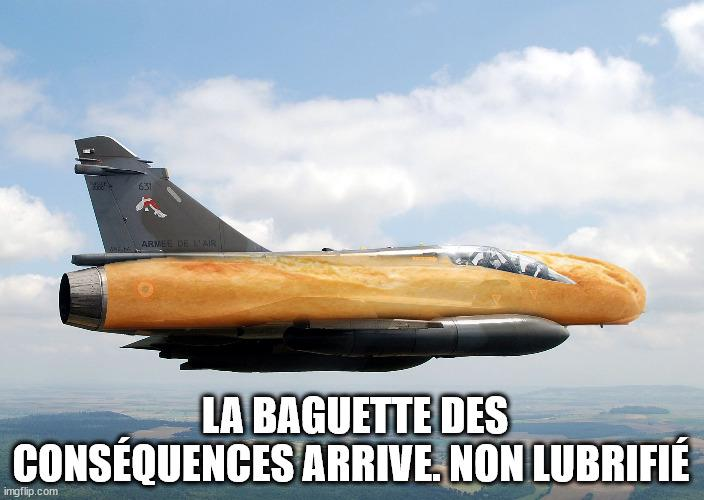
It's french, renewably powered by stale baguettes.
View attachment 822439
I think the aircraft could be inbred. Light the fire and kick the baguettes! If you use enough yeast, you can increase capacity. Dough! If it's underpowered, would it be considered a loafer? Sorry all, I could not resist the temptation, I know my puns can be half-baked.
 
Back to the unnamed statement*, I am surprised of this reversal from Large to Small airframe. The only small aircraft project we know is the Rafale block 5, which is not classed as a 6th Gen per French definition itself. I am then dubious of the solidity of this piece.


*before some Mods short of morning coffee turns your French Baguette into some Belgian Waffle?
 
I am surprised of this reversal from Large to Small airframe
No reversal, he means small compared with other 6th-gen projects … like what GCAP and the Luftwaffe seem to be aiming for.
The french side has always been very clear about making the airframe as small as possible.
 
Last edited:
Q:
Why would France seek small aircraft? What are its needs or reference threats that guide this?
Thanks.
 
If anyone needs a slightly smaller plane of the two, france and germany, it is germany. Not france. That said, any plane aiming for export success needs to be kept compact , not larger than an f35 or eurofighter. So neither plane (if there end up being two planes in the end) is really gonna be gcap sized.
Of course France is gonna court Saab and tell them what they want to hear.
 
Why would France seek small aircraft? What are its needs or reference threats that guide this?
Because smaller aircraft are cheaper. Or at least have been historically.

I'm not totally sold that a reduced size stealth aircraft will be all that much cheaper.

Also, for some strange reason the old SCAF models did not have folding wings or swing wings which did put a bit of a limit on the aircraft size.


If anyone needs a slightly smaller plane of the two, france and germany, it is germany. Not france. That said, any plane aiming for export success needs to be kept compact , not larger than an f35 or eurofighter. So neither plane (if there end up being two planes in the end) is really gonna be gcap sized.
Of course France is gonna court Saab and tell them what they want to hear.
I mean, people are buying Su57-sized airframes, and those are 75,000lbs/34tonnes. (Frankly, SCAF/Fr6gen's two named missions make it sound like it will look an awful lot like a Su-57.)

Any aircraft able to carry 4x 2000lb plus 4x BVR AAMs internally is going to be at least F-35 sized.
 
No reversal, he means small compared with other 6th-gen projects … like what GCAP and the Luftwaffe seem to be aiming for.
The french side has always been very clear about making the airframe as small as possible.

It is not. See here when the Reversal appeared in the press (you own quote from Dassault's CEO): https://www.secretprojects.co.uk/th...t-air-system-fcas-scaf-fsac.29201/post-834607

Let's remember in particular how I have advocated a nimbler design when many guys here vehemently pushed the bar to the heavy weight championship.
 

Similar threads

Back
Top Bottom