FFG7 class Anti- Surface Warfare Variant

The Skipper

I really should change my personal text
Joined
2 April 2016
Messages
54
Reaction score
44
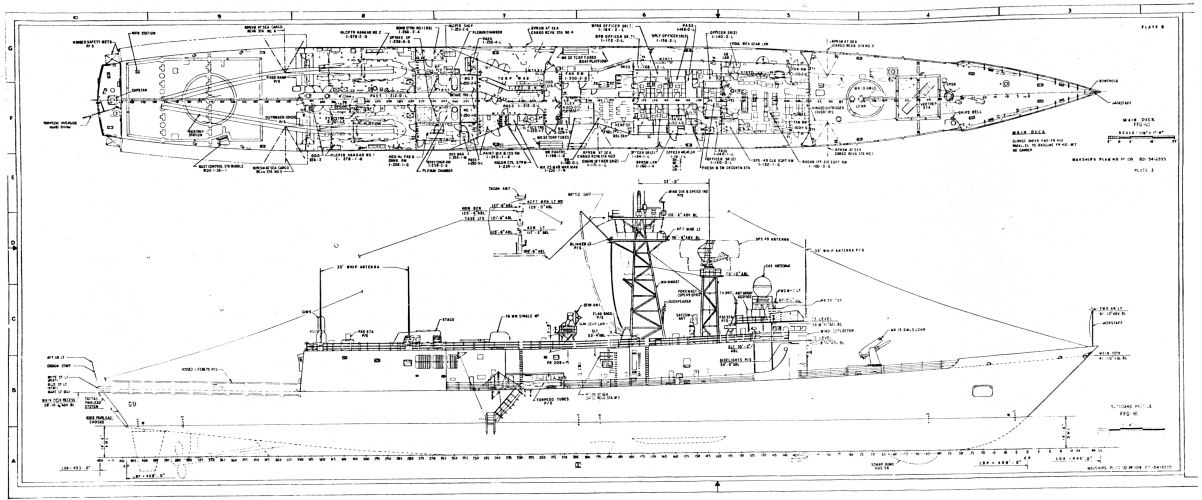
I have seen references, online, to a proposed anti- surface warfare (ASuW) variant of the FFG7 class frigate, with Tomahawk and Harpoon missiles in place of one or both helicopter hangars. The proposal seems to date from around 1980. I would be interested to learn more about this proposal, and see some pictures of the design.
 
I believe what you are referring to is a USNI article from 1980 entitled "Will Our Ships Have Enough Cruise Missile Firepower?". A rendition of it appeared on the Shipbucket forum in the "What if" section. The CGN-38 was also covered in that article IIRC. I've attached a copy of the Shipbucket graphic for the OHP.

The original article is probably available online at the USNI home website.

Edit: The article has been linked in later in this thread. CGN-38 is not mentioned. I must have conflated this with another article or paper referencing improving cruise-missile firepower on the CGN-38's. Sorry about that. If/when I find that article/Paper, I'll post it up.
 

Attachments

  • FFG-7 OHP ASuW Proposal.png
    FFG-7 OHP ASuW Proposal.png
    13.4 KB · Views: 274
Last edited:
I believe what you are referring to is a USNI article from 1980 entitled "Will Our Ships Have Enough Cruise Missile Firepower?". A rendition of it appeared on the Shipbucket forum in the "What if" section. The CGN-38 was also covered in that article IIRC. I've attached a copy of the Shipbucket graphic for the OHP.

The original article is probably available online at the USNI home website.

Do you happen to know what month that was? I suspect it's a Professional Note (or Nobody Asked Me, But) item, which are not indexed separately and suffer from poor OCR. It is much easier to search through one issue than the whole year.
 
I believe what you are referring to is a USNI article from 1980 entitled "Will Our Ships Have Enough Cruise Missile Firepower?". A rendition of it appeared on the Shipbucket forum in the "What if" section. The CGN-38 was also covered in that article IIRC. I've attached a copy of the Shipbucket graphic for the OHP.

The original article is probably available online at the USNI home website.

This really seems like a terrible trade-off: losing the helicopters for some missiles. The ability to carry helicopters is a major mod for a ship. Structure, support (fuel), etc. And the helos are supposed to work along with the ship's ASW capabilities. Taking the helicopters away really negates the usefulness of the FFG, and for no good reason. I doubt this was ever seriously studied by anyone.
 
I have seen references, online, to a proposed anti- surface warfare (ASuW) variant of the FFG7 class frigate, with Tomahawk and Harpoon missiles in place of one or both helicopter hangars. The proposal seems to date from around 1980. I would be interested to learn more about this proposal, and see some pictures of the design.
The Mk13 launcher could absolutely fire Harpoons natively. IIRC it normally carried 8x Harpoons in the launcher and 31x Standards. Admittedly, the Mk13 would be limited to about 3 shots a minute with Harpoons IIRC. They need time on the rail warming up before launch, and the canister launchers do greatly improve that issue.

Bolting a Tomahawk ABL onto the helicopter deck absolutely cripples the ASW capabilities of the ship.
 
I have seen references, online, to a proposed anti- surface warfare (ASuW) variant of the FFG7 class frigate, with Tomahawk and Harpoon missiles in place of one or both helicopter hangars. The proposal seems to date from around 1980. I would be interested to learn more about this proposal, and see some pictures of the design.
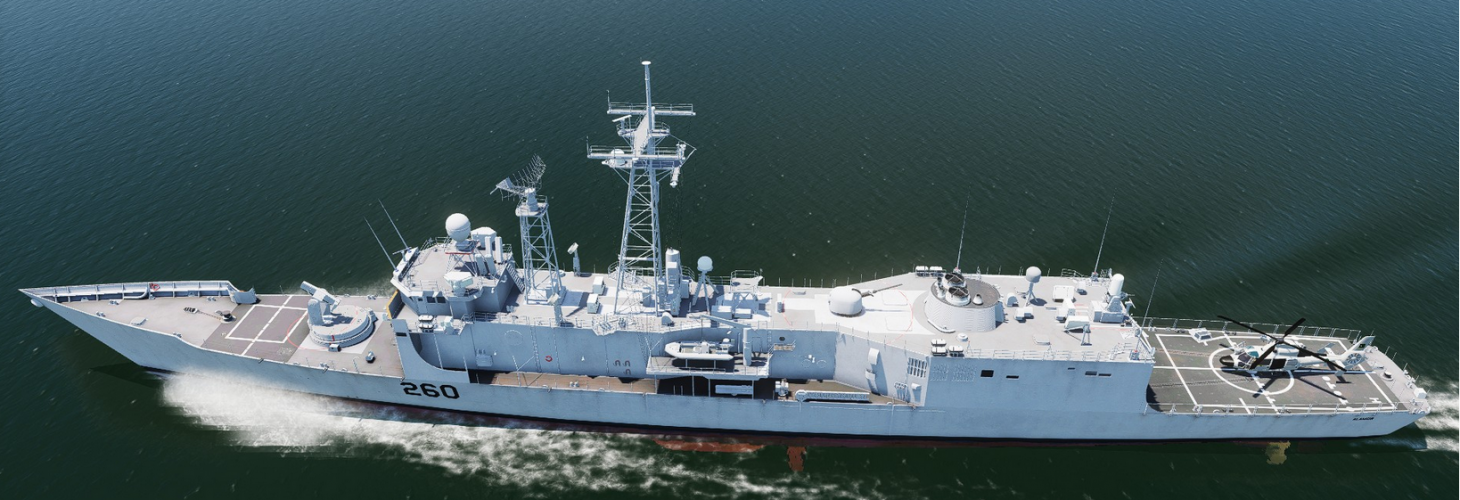
Technically it won't be much problem to replace two side hangar with one central, freeing space on rear deck. But for what? The Harpoon launchers? The Mk-13 could fire Harpoons already. The ABL's? Those are heavy; IRRC more than 26 tons each.
 
Bolting a Tomahawk ABL onto the helicopter deck absolutely cripples the ASW capabilities of the ship.
Well, if we remove one of two hangars - admittedly not the best idea either, but not much other choice - we could likely fit at least one ABL alongside it.

Let's calculate a bit. The two OHP hangars occupy all the ship's 14 meters width. By leaving only one hangar, we would free about 7 meters of space. The ABL's are only three meters wide and eight meters long (circa). So we could definitedly fit one ABL in the space freed from one hangar removal, and probably even two. But the mass would be a problem; I have no idea how much hangar structure weights, but probably not hundreds of tons. And we need 26 tons per each ABL.

Generally, I would prefer to move the sole remaining hangar to the centerline, and install ABL's behind bulwarks at its sides. Such arrangement would be more stable.
 
Generally, I would prefer to move the sole remaining hangar to the centerline, and install ABL's behind bulwarks at its sides. Such arrangement would be more stable.
Agreed there. Hangar on the centerline and ABLs abeam.
 
As I suggested somewhere before, you can move the torpedo launchers somewhere else, even to the flight deck (they are very small) and you get a place for about 4 launchers on the sides of the superstructure, Harpoon or Tomahawk.

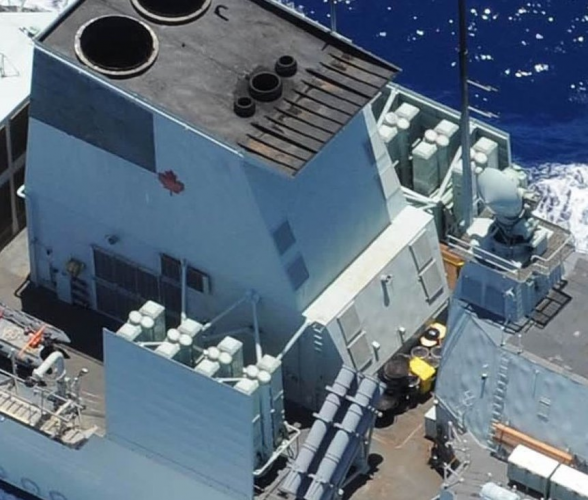
It's also possible to bolt some vertical Sea Sparrow cells to the sides of the structure, like the Canadians did.
 
As I suggested somewhere before, you can move the torpedo launchers somewhere else, even to the flight deck (they are very small) and you get a place for about 4 launchers on the sides of the superstructure, Harpoon or Tomahawk.
1766214704860.png
Not sure ABL would fit... the space is very tight there:

1766214835850.png
 
Harpoon will fit for sure, and that gives a ready 8, possibly 16-missile salvo (which may be better than firing missiles one by one from the launcher). As to ABL, you can probably fit two, but it should be checked.
 
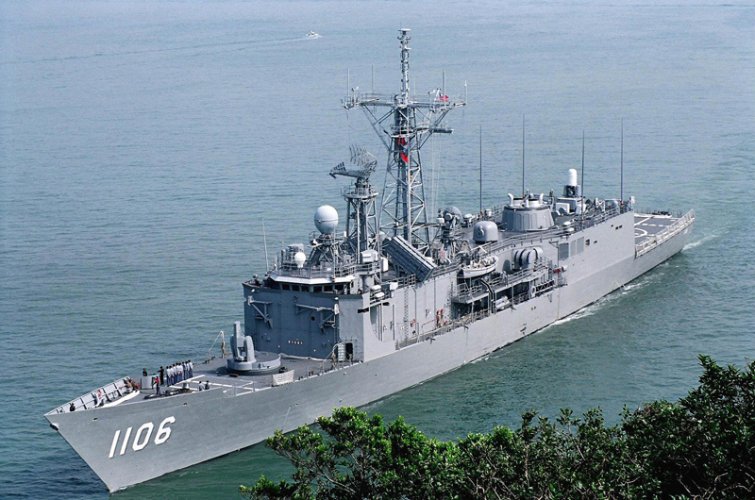
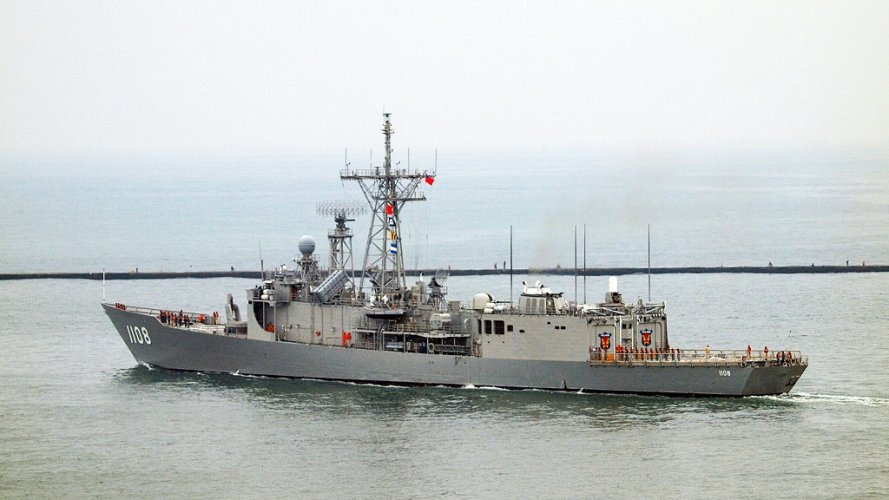
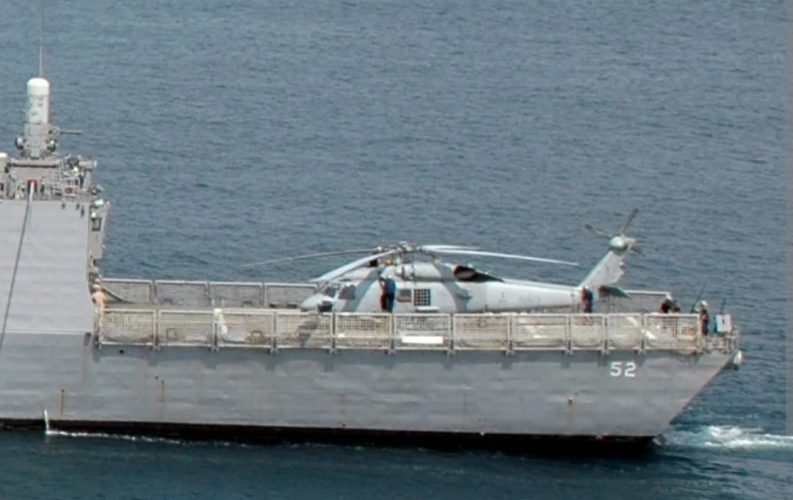
Regarding how to install anti-ship missile launchers on the Perry-class, the Cheng Kung-class would tell you:
Would probably be too top-heavy for USN seakeeping standards. Still think that reduction to one centerline hangar (freeing space aside) would be best solution.
 
Harpoon is easily doable, but the Tomahawk canisters are both large and heavy! With a centerline Hanger at both sides the launchers would overhang from the hull sides and that would be not ideal especially in a stormy weather. Or they need to be almost parallel to the ship hull. Doable but then you need catwalks on the side of the hanger for crow to get aft apart from going through the hanger. Maximum 4 quad launchers could be placed in the freed up space, question is enough weight could be allocated for them.
1766225445727.png
 
. Or they need to be almost parallel to the ship hull. Doable but then you need catwalks on the side of the hanger for crow to get aft apart from going through the hanger.

Hm, what if we put some bulwarks at the sides, so launchers would be protected from heavy waves? And what about placing them facing (and firing) backward, instead of forward?

question is enough weight could be allocated for them.
Frankly, I doubt that. Four ABL would weight about 100 tons alltogether, and I kinda doubt that removal of one hangar would free enough weight (hangars are relatively lightweight, after all). Likely no more than two ABL could be set - and even that might cause some problems.

P.S. Great visualization, by the way!
 
Well 10tons can be saved on the SH-60 Seahawk using 1 instead of 2.

I do not know what kind of launchers were proposed for the Tomahawks. The ABL's were heavy because they were armoured for protection hence the large weight, it is possible some lightweight variant was proposed as well.
 
I do not know what kind of launchers were proposed for the Tomahawks. The ABL's were heavy because they were armoured for protection hence the large weight, it is possible some lightweight variant was proposed as well.
I'm not sure, because non-armored launcher might be too risky to have onboard. Those big missiles are full of jet fuel, and leaving them in unarmored tubes (vulnerable to even bullets and fragments) would means BIG problems in case ship would be strafed or hit.
 
I'm not sure, because non-armored launcher might be too risky to have onboard. Those big missiles are full of jet fuel, and leaving them in unarmored tubes (vulnerable to even bullets and fragments) would means BIG problems in case ship would be strafed or hit.
Isn't that the same case for the Harpoons? I know they are smaller but still
 
Isn't that the same case for the Harpoons? I know they are smaller but still
Harpoon carries about 100 lb of fuel (later model close to 150). Tomahawk - about 800 lb of fuel (later model about 1000). IMHO the difference is serious enough to be a major concern for a ship's safety.
 
Found the article. It's a Professional Note from August 1980.

https://www.usni.org/magazines/proceedings/1980/august/professional-notes
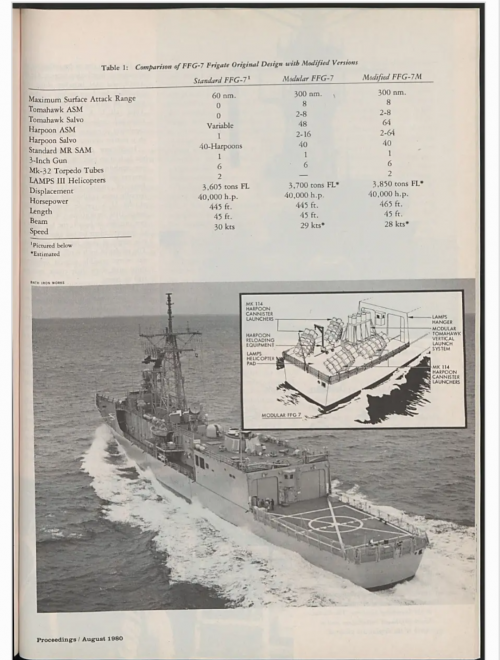
The retrofit proposal calls for the removal of the helos and their support equipment, and the installation of 4x4 Harpoon launches and 1x8 "lightweight vertical launchers" for Tomahawk, not ABL. One other feature is the use of the hangar space to stow two full reloads for the Harpoons.

The use of an unarmored launcher for Tomahawk isn't unprecedented. A few other designs from the era, like Strike Cruiser and the early Ticonderoga Tomahawk refit, showed angled launchers very much like Harpoon but larger. ABL seems to have been a later development. I suspect it was developed because most early Tomahawk deployments involved at least some TLAM-N, and the prospect of stowing nukes out in the open with only a canister wall for protection was scary. The FFG missile carrier would have been designed for only TASM so the safety requirements might have been less demanding.

The article regards this retrofit as an interim measure, proposing that future FFG-7s should be built with a modest stretch to house 20 Tomahawk VLS cells amidships and retaining the helo hangar.

In the end, it was another proposal from this article that was actually adopted, converting DD-963s as cruise missile carriers, with up to 61 Tomahawks in the VLS that replaced the ASROC launcher and magazine.

Funnily enough, the article was written by a Lockheed engineer working on Outlaw Shark. Its real purpose was clearly to promote the need for a widely deployed Tomahawk targeting network (like Outlaw Shark). And to justify that kind of network, you need lots of Tomahawk shooters.

 
Edit: The article has been linked in later in this thread. CGN-38 is not mentioned. I must have conflated this with another article or paper referencing improving cruise-missile firepower on the CGN-38's. Sorry about that. If/when I find that article/Paper, I'll post it up.

Found it in my files. Not about the FFG-7 ASuW but mentioned by me earlier. Moderators please feel free to move as necessary.
 

Attachments

  • A Method for Increasing the Firepower of the Virginia Class Cruiser.pdf
    346.4 KB · Views: 62
This really seems like a terrible trade-off: losing the helicopters for some missiles. The ability to carry helicopters is a major mod for a ship. Structure, support (fuel), etc. And the helos are supposed to work along with the ship's ASW capabilities. Taking the helicopters away really negates the usefulness of the FFG, and for no good reason. I doubt this was ever seriously studied by anyone.

This sort of mod might make sense for the "short hull" Perry's that are incapable of operating SH-60s.
 
Funnily enough, the article was written by a Lockheed engineer working on Outlaw Shark. Its real purpose was clearly to promote the need for a widely deployed Tomahawk targeting network (like Outlaw Shark). And to justify that kind of network, you need lots of Tomahawk shooters.
I was about to write "What problem was this supposed to solve?"

But you answered it--the problem was Lockheed did not have enough money.
 
The article regards this retrofit as an interim measure, proposing that future FFG-7s should be built with a modest stretch to house 20 Tomahawk VLS cells amidships and retaining the helo hangar.
Now I hope this doesn't move beyond the scope of discussion too much but would this actually be practical? and in any case I can't imagine those cells would be best used by TLAMs, as soon as Mk41 comes online they would be better suited to improving the air defense capabilities of the ship
 
Now I hope this doesn't move beyond the scope of discussion too much but would this actually be practical? and in any case I can't imagine those cells would be best used by TLAMs, as soon as Mk41 comes online they would be better suited to improving the air defense capabilities of the ship
20 cells would not be Mk41, as those are sets of 4 or 8. I'd guess that the intention was to be 2x10 cells.

Total stretch is going to be something like 65" in that case, ~20ft wide.

However, Mk41 is looking more like 16 cells (2x8), 9ft stretch and ~24ft wide
 
20 cells would not be Mk41, as those are sets of 4 or 8. I'd guess that the intention was to be 2x10 cells.

Total stretch is going to be something like 65" in that case, ~20ft wide.

However, Mk41 is looking more like 16 cells (2x8), 9ft stretch and ~24ft wide
I figured it would be too early for Mk41 as well.
 
Now I hope this doesn't move beyond the scope of discussion too much but would this actually be practical? and in any case I can't imagine those cells would be best used by TLAMs, as soon as Mk41 comes online they would be better suited to improving the air defense capabilities of the ship

At that time, I'm not sure the idea of a universal VLS was well established. Mk 41 was actually probably still too short for Tomahawk, so they likely intended to fit a specialized launcher. Same for VL Harpoon, which we see proposed in various forms over the years.

20 cells would not be Mk41, as those are sets of 4 or 8. I'd guess that the intention was to be 2x10 cells.

Total stretch is going to be something like 65" in that case, ~20ft wide.

However, Mk41 is looking more like 16 cells (2x8), 9ft stretch and ~24ft wide

So, I realized that I really misread the article on my phone, thanks to some lousy table formatting. Here is the actual table from the PDF/Scribd version. They are talking about a 20-foot, 250-ton stretch. It's not 20 Tomahawk but rather 8 Tomahawk and a whopping 64 Harpoon. (This math does not work out. Even a very optimistic analysis suggests the missiles and launchers alone would weigh at least 100 tons, without accounting for the hull under them or the superstructure around them.)

Screenshot_20251221-235453.png
 
Last edited:
So, I realized that I really misread the article on my phone, thanks to some lousy table formatting. Here is the actual table from the PDF/Scribd version. They are talking about a 20-foot, 250-ton stretch. It's not 20 Tomahawk but rather 8 Tomahawk and a whopping 64 Harpoon. (This math does not work out. Even a very optimistic analysis suggests the missiles and launchers alone would weigh at least 100 tons, without accounting for the hull under them or the superstructure around them.)
Does the article have any kind of drawing showing where the author intended the 20 foot insertion would go and/or what it might look like?
 
This sort of mod might make sense for the "short hull" Perry's that are incapable of operating SH-60s.

I just don't see it. Yes, nobody built this, so obviously there was no value in it. I'm just pressing that point further.

Whenever we see these kinds of proposals, it is really worth asking "What is the problem they are trying to solve?" At that time, the Soviet ASW threat was still real, so ASW ships were still necessary and any answer needs to also explain why fewer ASW ships was a good idea. (And the FFG-7s were good ASW platforms, so taking away that capability had a bigger cost than say removing the ASROC from an aging Gearing class destroyer.) Clearly the problem he was trying to address was insufficient surface-to-surface warfare capability in the fleet. But was that actually the case? Well, kinda (although the carrier guys would dispute that), but there were better ways of solving it, and they did not reduce ASW capability in the fleet.

So this was really a solution in search of a problem.
 
Does the article have any kind of drawing showing where the author intended the 20 foot insertion would go and/or what it might look like?

Sadly, no. The image here of the "modular" installation is the only FFG-7 drawing.

I can't quite figure where you could stretch it without some serious reengineering. I guess just ahead of the main machinery room, between the 76mm gun and the STIR antenna.
 
This sort of mod might make sense for the "short hull" Perry's that are incapable of operating SH-60s.
It was completely possible to stretch the transom of completed ships ~5ft to allow for H60s.


So, I realized that I really misread the article on my phone, thanks to some lousy table formatting. Here is the actual table from the PDF/Scribd version. They are talking about a 20-foot, 250-ton stretch. It's not 20 Tomahawk but rather 8 Tomahawk and a whopping 64 Harpoon. (This math does not work out. Even a very optimistic analysis suggests the missiles and launchers alone would weigh at least 100 tons, without accounting for the hull under them or the superstructure around them.)

View attachment 795987
64x Harpoons? What possible threat would require that?
 
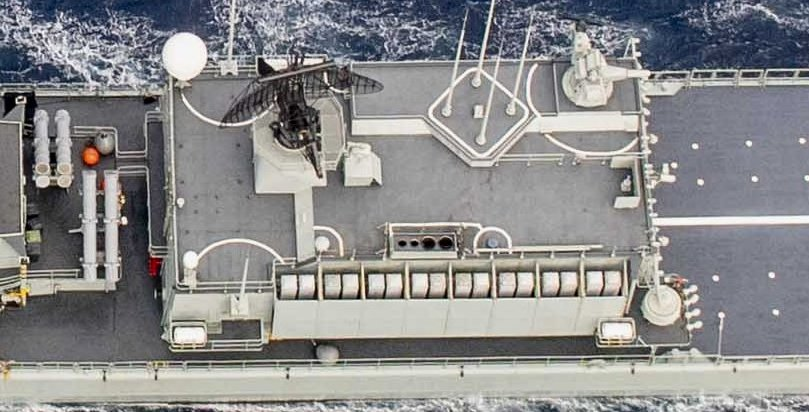
Those are Sea Sparrow-only launchers, not suited for anything else.
Playing with options.

This kind of containers enables to either increase the AA missile count, or you can take out the forward launcher, replace it with Tomahawk/Harpoon deck containers, and move the AA to those clusters.

Also, there was some mention that those containers could hold some other missiles.
 
Playing with options.

This kind of containers enables to either increase the AA missile count, or you can take out the forward launcher, replace it with Tomahawk/Harpoon deck containers, and move the AA to those clusters.

Could you really put anything on the deck forward of the superstructure without affecting stability?
 
Could you really put anything on the deck forward of the superstructure without affecting stability?
No, it's sufficiently close to the center of the ship.

But I still think central cutouts in the superstructure are an ideal place for the launchers (reusing the plan by @Tzoli above), that allows to keep 2 helicopters and full ASW capability.

1767045468535.png

Or you can have 8 of them.
 

Similar threads

Back
Top Bottom