Falklands War fought today?

Owens Z

quaerimus scientiam
Joined
6 October 2023
Messages
488
Reaction score
713
I was a kid in 1982 when I eagerly followed (via newspapers and TV reports) the war between Argentina and the UK over the Falkland Islands. The following year I read Max Hastings' bestselling book The Battle for the Falklands; I later read Admiral Sandy Woodward's memoir and thereafter have continued my interest (from an armchair) in the war and the underlying issues. In a speech in Buenos Aires last week President Javier Milei, who has been working to reform and strengthen Argentina's long-stagnant economy, repeated his nation's claim to the Falklands. Then Chile (which in 1982 had aided the UK), Bolivia, and Brazil publicly reiterated their support for Argentine sovereignty over the "Malvinas", though of course such diplomatic backing doesn't equate to joining an armed conflict. Milei stated that Argentina would get the Falklands by peaceful means, ruling out renewed violence, as presidents have stated since Carlos Menem in 1998. But in the same speech Milei pledged substantial funds to expand and re-equip Argentina's army, navy, and air force, which have languished in poor shape for decades.

Like most others, I don't foresee an actual second Argentine invasion (Milei's words may have been meant simply to humor domestic opinion). But militaries have to plan for the unexpected. Two matters to consider:

—After forty years of plans, geologic surveys, and some disappointing exploratory drilling, plus anti-oil obstructionism, it appears that offshore oil rigs in the EEZ of the Falklands will begin producing within another year or two. Assuming that all goes well and the Sea Lion Field is indeed as plentiful as anticipated, this means the sparse local population will become very rich. Wealth can invite predation. Note that in his recent speech Milei called Falklands oil production "illegitimate".

—When drone attacks over RAF Akrotiri began 1 March 2026, the Royal Navy had nothing on station near Cyprus, and found that no warship was deployable. After public embarrassment, Type 45 destroyer HMS Dragon at last sailed from Portsmouth on 10 March, arriving in Cyprus's waters on 23 March. Drone attacks ended before then and the destroyer has not fired in anger (according to reports yesterday Dragon is again out of service due to problems with her fresh water supply). As has drawn vigorous comment in the UK and elsewhere, what a bitter contrast to the sizable task force the Royal Navy gathered and dispatched to the South Atlantic three days after the 1982 Argentine invasion. Demonstrated weakness can invite predation.
 
Speculatively, could the UK win a rematch of the Falklands War? It's true that Argentina's navy has been in sad shape for a long time. Neglected destroyer Santísima Trinidad ignominiously sank beside her pier in 2013, and submarine San Juan was lost with all hands in a 2017 accident. Yet a determined attack by the few remaining warships would face little British opposition. The Royal Navy's longstanding practice of stationing a major surface combatant in the South Atlantic was allowed to lapse a decade ago. Currently one OPV, 2000-ton HMS Medway (armed with a 30mm cannon), is active around the Falklands and South Georgia. There is also an unarmed Damen Stan patrol boat, Lilibet, for fisheries protection. Icebreaker HMS Protector (armed with some rifle-caliber machine guns) visits the region on her way to and from the claimed British Antarctic Territory during Southern Hemisphere summer, which has just ended.

The British Army stations a company of infantry on the Falklands, and (given some warning) the locals can muster another infantry company of Defence Force volunteers. Two companies is not enough men to fight off a force even a fraction as numerous as the 10,000+ soldiers Argentina landed in 1982. The real deterrent to invasion seems to be the four Eurofighter Typhoon fighters based in the Falklands, at least some of which should be flyable at short notice. Requisitioned civilian ships as ersatz troop transports would be helpless against Typhoon strikes, and the Argentine Air Force has negligible air-to-air capability until the F-16 fighters bought from Denmark work up.

To ground the four Typhoons and prevent further aircraft and airlifted troops from reinforcing the Falklands, allowing an invasion's success, the obvious course would be to cripple RAF Mount Pleasant's two runways with a surprise attack immediately prior to hostilities. An attack not by Argentina's (nonexistent) surface-to-surface missiles, but by a smuggled truck bomb or similar.

In response the UK might deploy a nuclear-powered attack submarine (the fear of which bottled Argentina's warships in port during the Falklands War after cruiser Belgrano was torpedoed and sunk). But according to media discussions these past few weeks, recreating anything close to the UK's 1982 task force today would be impossible.
 
Between this, the Ukraine, the Koreas, Taiwan, Iran, and the general Middle East (and I am quite confident that I've inadvertently/ignorantly left off some more global hot spots, probably somewhere in Africa, Asia and/or South America), it's a backsliding into a tribal conflicts Strange New World indeed - I am beginning to wonder whether ambient average temperature rises around the globe might have anything to do with this...
 
Last edited:
but by a smuggled truck bomb or similar.

Tell me you know nothing of the Falklands and Mount Pleasant...how exactly would this 'truck bomb' arrive on the islands....and how would it then traverse the 60km long road to Mount Pleasant....then get on the runway...
Argentine Air Force has negligible air-to-air capability until the F-16 fighters bought from Denmark work up.

I don't think some ancient F-16, with no AAR, no radar coverage, limited pilot flying hours per year etc etc. are going to trouble the Typhoon and Land Ceptor...
Yet a determined attack by the few remaining warships would face little British opposition.

I'm not sure the 3 remaining 40 year old Almirante Brown Class with their (functioning??) Aspide SAM from the 1970's is going to hold up that well against a Paveway IV....
Two companies is not enough men to fight off a force even a fraction as numerous as the 10,000+ soldiers Argentina landed in 1982.

Argentina's forces of 10,000+ in 1982 were landed over a period of weeks by ship AND air, with no opposition, and then struggled to be maintained logistically...the initial landing force did not exceed 1,500...Argentina could not lift a fraction of that (1,500) now...

at least some of which should be flyable at short notice

You mean the QRA..at 5 mins readiness
the locals can muster another infantry company of Defence Force volunteers.

In time of war the FIDF activates 'Secondary Reserve Personnel'. These are former, trained members of the FIDF...they have the arms in store to equip them as well...if war was seen as likely that number would be well north of 300 (I wouldn't be surprised if it hit 500 with all the ex-Mil in the Falklands as well...).

In response the UK might deploy a nuclear-powered attack submarine (the fear of which bottled Argentina's warships in port during the Falklands War after cruiser Belgrano was torpedoed and sunk). But according to media discussions these past few weeks, recreating anything close to the UK's 1982 task force today would be impossible.

Its clear as day we couldn't land a force like that from 1982. That capability disappeared from 2010 onwards starting with the RFA Largs Bay being sold to the Australian's. The Amphibious Force just a few years before that point was far more capable than it was in 1982 with the 2 x LPD, 4 x LSD(A), 6 x Point Class and HMS Ocean (plus Argus and Diligence).

But...I note that you make no mention of the UK's carriers....

As for the escort fleet we all knew it would be hitting a crisis around now (and arguably for the next 5 years in terms of Frigates). But...by the middle of this year 4 of the 6 T45's will have finished PIP, with Diamond's not far off completion in 2027 (Diamond will also be the first to arrive back with PIP, Sea Viper Evolution, Aster 30 Block 1, Sea Ceptor and NSM fitted). Duncan will then go in for the full works, like Diamond, and arrive back by 2028 (likely to arrive back with DragonFire DEW as well, which 'potentially' Diamond might also have...). The near future for Type 45 is (finally) looking rosy....

Progressively over the next 5 years a lot of the RN's current major issues disappear....F-35B fleet is delivered in full (with Tranche 2 on order), FSS in build, T26 arrives, T31 arrives, Sea Venom FOC, SSN availability increases, T45 all available/working and upgraded, NSM on more of the fleet.... but to be fair there are some issues that still need resolution or are still a cause for concern.... like RFA pay, retention and availability, MRSS order, F-35 Block IV, Type 23 hanging in there etc etc. They're not out of the woods yet, but right now might be the absolute low point...

IF there was a window (and there isn't a credible one) for Argentinian action its rapidly closing day by day...
 
Last edited:
Considering the present very poor shape of both Argentina military by large and the RN, it would be akin to a boxing match between two former legends... now aged 95 or more, to the point of agony. It would be a very pathetic fight, if any fight could happen in the first place.
 
Argentine success in the Falklands would hinge on 2 elements:
  1. Neutralizing the Typhoons at Mount Pleasant
  2. Defending against the RN carrier task force that will inevitably be sent to retake the islands
#1 used to be quite hard. I remember sketching out some wild scenarios involving low level surprise attacks by Super Etendards or Skyhawks to hole the runways or hit the hardened aircraft shelters with guided bombs before the QRA Typhoons could get off the ground. That was always a long shot, and got harder with the new Land Ceptor SAMs protecting Mt Pleasant. So ideally it would need to be combined with a simultaneous attack by a special forces team infiltrated to spot targets, neutralize the SAM radar/command systems and hit any aircraft parked in the open. That requires a guided mortar or NLOS ATGMs... not so easy either.

Of course these days with quadcopter drones launched from a passing vessel perhaps an attack could work.

If you don't neutralize the Typhoons immediately and capture Mt Pleasant within 12-24H, you open yourself up to rapid destruction of your air/naval assets in the area, and rapid reinforcements by air from the UK. I'm assuming all the other "little" (note: not so little) problems can be solved, such as the logistics of landing an invasion force, glide bombing the defending ground forces from high altitude (in order to stay out of Land Ceptor range), deploying SAMs or fighter CAPs to shoot down any C-17s airdropping reinforcements etc.

But... even if #1 is solved I was never able to solve for #2. In every scenario the RN carrier task force would cut off the islands, pound the Argentinian defenders and eventually retake relatively easily. Unless the RN sinks itself... which admittedly it almost has given how badly it's been mismanaged.
 
To summarize:

* It's perfectly possible for Argentine to launch a sudden attack to neutralize a (very limited) British RAF force, protecting the islands. The simplest way to achieve this would likely be a swarming drone attack, launched from Q-ship positioned near the islands.

* It would be very problematic for Argentina to move any significant military force to occupy Falklands, due to generally poor state of Argentinean Navy & almost complete lack of amphibious capabilities

* It would be completely impossible for Argentina to protect islands against RN counterattack, taking into account the weakness of Argentinean Navy and Air Force. Even a very limited Royal Navy force would be able to sucsessfully cut off Argentinean access to islands. Its completely impossible for Argentine to challenge British control over sea & air space around Falklands.

* While Britain could face problems mustering an amphibious force, capable of re-taking he islands, those problems aren't exactly unsolvable. In extreme case, one of British carriers could be used as makeshift helicopter assault ship, transporting troops and helicopters (they are designed with such functions in mind)

* The Royal Navy have MUCH greater ability to hit Argentine mainland now, than in 1982. A Tomahawk missiles on submarines and F-35B fighter-bombers on carrer(s) could wreck enough things ih Argentina to cripple military efforts aimed toward Falklands

* Most importantly, the invasion could be too easily stopped completely, if at least one RN submarine would be deployed beforehand to challenge it. Moreover, even if no submarine would be actually deployed, the mere claim of such deployment would likely have deterring effect - the Argentinean ships coming toward Falklands could be destroyed, and Argeninean beachead (if they managed to actually establish one) could be hit by Tomahawks
 
* It's perfectly possible for Argentine to launch a sudden attack to neutralize a (very limited) British RAF force, protecting the islands. The simplest way to achieve this would likely be a swarming drone attack, launched from Q-ship positioned near the islands.

It's really not that simple....UK and FIG keeps a close eye on the Falklands EEZ and surrounding waters. As its not near shipping lanes any ships without a valid reason to be there are closely monitored and visited...because all fishing vessels in the EEZ are paying the Falklands Government for the privilege...and they're not the sorts of vessels that are particularly useful for launching swarming drones that could then cope with flight through South Atlantic weather (and thats a seriously underestimated part of the plan), over mountain ranges, undetected and arrive hundreds of km away at Mount Pleasant...

Any vessel approaching the EEZ that isn't licenced by FIG will stand out like a sore thumb...no chance of a random cargo vessel operating as a 'Q ship' not being noted prior as there is zero need to be there for any other purpose....
 
It's really not that simple....UK and FIG keeps a close eye on the Falklands EEZ and surrounding waters. As its not near shipping lanes any ships without a valid reason to be there are closely monitored and visited...because all fishing vessels in the EEZ are paying the Falklands Government for the privilege...and they're not the sorts of vessels that are particularly useful for launching swarming drones that could then cope with flight through South Atlantic weather (and thats a seriously underestimated part of the plan), over mountain ranges, undetected and arrive hundreds of km away at Mount Pleasant...

Any vessel approaching the EEZ that isn't licenced byby FIG will stand out like a sore thumb...no chance of a random cargo vessel operating as a 'Q ship' not being noted prior as there is zero need to be there for any other purpose....
Absolutely to be quite honest given the very nature of the business. There is no such thing as a random cargo vessel.
Any merchant ship that just appears off the Falkland's is most likely not a merchant vessel .
 
Last edited:
Any vessel approaching the EEZ that isn't licenced by FIG will stand out like a sore thumb...no chance of a random cargo vessel operating as a 'Q ship' not being noted prior as there is zero need to be there for any other purpose....
But it wouldn't need to be a Q ship. If you look at operative techniques from Ukraine the most likely platform would be a regularly scheduled cargo vessel supplying the Falklands, which could unwittingly serve as the vector for the drones. The drones would be hidden aboard a container, with the drones launched ideally while still at sea or perhaps after being landed ashore (depending on how thorough customs inspection routines are).

Distance from Mare Harbour loading dock to Mt Pleasant is 9-10km... about 5 min flying time for a drone. Obviously small drones won't be able to damage aircraft in the hardened shelters, but any QRA aircraft in the open and the SAM defenses would be vulnerable. If the container could launch Hellfire-class ATGMs with automatic target recognition that would be better to hit the shelters and would also reduce flying time to under a minute. Another alternative would be large cargo drones carrying concrete penetration bomblets which might be used against both the runways and shelters.
 
Last edited:
But it wouldn't need to be a Q ship. If you look at operative techniques from Ukraine the most likely platform would be a regularly scheduled cargo vessel supplying the Falklands, which could unwittingly serve as the vector for the drones. The drones would be hidden aboard a container, with the drones launched ideally while still at sea or perhaps after being landed ashore (depending on how thorough customs inspection routines are).

Distance from Mare Harbour loading dock to Mt Pleasant is 9-10km... about 5 min flying time for a drone

Hmmm....so you think the UK MoD is going to load a bunch of Argentinian drones.... in some unknown container, that are loaded by UK MoD themselves.....at Marchwood Military Port, in the UK....then sail them down to the Falklands on a Point Class strategic sea lift ship....

Because that's the ship that docks at Mare Harbour....its called Falkland Islands Resupply Ship (FIRS). Currently Anvil Point...


I don't know about you but that doesn't sound particularly credible...

Even if there was a civilian container ship that docks at Mare Harbour (there isn't) you'd need to ensure that somehow you guaranteed that your particular container ended up at the top of the stack....and that would rather raise suspicions....

The Ukrainian 'containers' were nothing of the sort, they were pre-fab home offices that the Ukrainian team constructed themselves in Russia, with internal power banks, solar panels on the roof to top them up and external satcoms...thats not going to work with a TEU...

There are small cargo vessels that land at Stanley, at the FIPASS installation (currently, replacement under construction) but they are thoroughly inspected by customs....and all commercial cargo is inspected in the UK prior to shipment at AMG North Weald or inspected and then consolidated in Montevideo by SAAS. There is very occasional shipments from Miami as well (I'd suggest no-one wants to mess with US HS though...).

 
Last edited:
Thanks @timmymagic I wasn't aware that there is no civilian cargo line to the Falklands! (From a quick search I found https://falklandislandshipping.com and I thought some Point class RO-ROs were civilian operated, but not on this route it seems)

Alternative means of delivery would be a sailing vessel pretending to be on the Cape Horn -> Atlantic route, as these often pass close to the Falklands (or pretending to be rounding Mare Harbour on its way to Port Stanley... ~25km distance). Would need to figure out how to launch lots of drones at once... perhaps a cruising catamaran as that would have more deck area. Also lots of oil & gas vessels operating around there... you could in theory try to imitate one but the AIS signal would likely look suspicious.
 
Last edited:
Even if there was a civilian container ship that docks at Mare Harbour (there isn't) you'd need to ensure that somehow you guaranteed that your particular container ended up at the top of the stack....and that would rather raise suspicions....
This could be circumvented by someone on islands ordering that particular container. A decoy company, for example, alllegedly doing some innocent work like fishery reserves research.
 
Point class RO-ROs were civilian operated, but not on this route it seems)

All 4 Point Class are civilian operated (2 of the original class were released from the contract). They're not RFA. All are required by the UK MoD contract to be UK citizens and are vetted. There are sometimes Naval or RFA onboard as well.

All 4 vessels are on permanent UK MoD charter, only on the Falklands route will they carry commercial cargo, but its limited amounts and is checked very thoroughly before embarkation. they're also RO-RO with multiple decks....so anything flying off unexpectedly is not going to happen.
 
Between this, the Ukraine, the Koreas, Taiwan, Iran, and the general Middle East (and I am quite confident that I've inadvertently/ignorantly left off some more global hot spots, probably somewhere in Africa, Asia and/or South America), it's a backsliding into a tribal conflicts
Blood and soil were the reasons behind many conflicts. The Cold War was of such gravity that it bred a level of maturity and intellect that has been ebbing away for years.

There would likely not be a defense today.

Falklands was the first conflict of note post Vietnam, sparking renewed adventurism.

Different world

It's all going back to blood and soil...but people are tired, and broke the world over.

I am hoping civil projects and exploration is the new field where nations meet to spar. People look at the Olympics as a kind of soft power projection from France. Their civil nuclear program should be a greater source of pride.
 
Last edited:
Alternative means of delivery would be a sailing vessel pretending to be on the Cape Horn -> Atlantic route, as these often pass close to the Falklands (or pretending to be rounding Mare Harbour on its way to Port Stanley... ~25km distance). Would need to figure out how to launch lots of drones at once... perhaps a cruising catamaran as that would have more deck area. Also lots of oil & gas vessels operating around there... you could in theory try to imitate one but the AIS signal would likely look suspicious.
A Shahed-type drones could be launched from containers, and have enough range to strike Falklands from up to thousand kilometers range. They could be equipped with heavy enough warheads (dual, shaped charge & penetration), to represent at least reasonable threat to HAS'ed aircraft.
 
A Shahed-type drones could be launched from containers, and have enough range to strike Falklands from up to thousand kilometers range. They could be equipped with heavy enough warheads (dual, shaped charge & penetration), to represent at least reasonable threat to HAS'ed aircraft.
Shaheds could be launched from the Argentine mainland. However their major defect is that are slow and will likely be detected while still far out to sea, even in a sea skimming profile. That leaves too much time for aircraft to take off and for SAM defenses to be ready... likely 15-20 minutes warning.
 
Shaheds could be launched from the Argentine mainland. However their major defect is that are slow and will likely be detected while still far out to sea, even in a sea skimming profile. That leaves too much time for aircraft to take off and for SAM defenses to be ready... likely 15-20 minutes warning.
Well, they are small, and could exploit gaps in radar coverage to close with the islands. Also, I doubt that garrison would be fast to react, especially if drones would approach from unexpected direction (say, from East). They would be heistant to start shooting, fearing some kind of mistake.
 
Well, they are small, and could exploit gaps in radar coverage to close with the islands. Also, I doubt that garrison would be fast to react, especially if drones would approach from unexpected direction (say, from East). They would be heistant to start shooting, fearing some kind of mistake.
There are no gaps in radar coverage. The Falklands are very well covered from multiple radars located at high points. 1 Shahed might create uncertainty, but 20+ inbound targets at sea level should definitely be interpreted as hostile.

That's why you either have to come in low and fast (550knots / 50 feet), which still might not be fast enough to prevent the QRA from taking off. Or find a way to sneak in and launch a surprise attack from relatively short range (either close inshore or from land) with drones, a guided mortar, NLOS missiles etc.
 
Last edited:
Considering the present very poor shape of both Argentina military by large and the RN, it would be akin to a boxing match between two former legends... now aged 95 or more, to the point of agony. It would be a very pathetic fight, if any fight could happen in the first place.

That does sound like the general circumstance, Archibald. Prompted by the humiliating Cyprus saga, noted YouTuber Mark Felton did an itemized video last month about the state of the Royal Navy's combatants, much diminished in numbers from thirty years ago; see <
View: https://www.youtube.com/watch?v=Gru2EDJvj9Q
>.

• Of the five Astute-class SSNs in commission, only one, His Majesty's Submarine Anson, is currently operational: she is in the Indian Ocean. (Two more Astutes are being constructed.) Mark Felton shows an overhead photo of twelve decommissioned SSNs of the Trafalgar, Swiftsure, Churchill, and Valiant classes languishing forlorn together in Plymouth, including Falklands War vet HMS Conqueror.

• Aircraft carrier HMS Prince of Wales is in Portsmouth at five days' notice to sail. (Sister ship Queen Elizabeth is in long-term drydock in Scotland.) As I understand, enough F-35B strike fighters and Fleet Air Arm/RAF pilots are currently available to outfit one carrier to her wartime max capacity, so that a US Marine Corps squadron is no longer necessary.

• Of the six Daring-class Type 45 destroyers, two are currently operational: HMS Dragon and HMS Duncan. (HMS Daring has been laid up "refitting" since May 2017; longer than the time to build her 2003-2009, and longer than her service life 2009-2017.)

• Of the sixteen Duke-class Type 23 frigates, seven remain in commission, of which five are currently operational.

A fleet of one attack sub, one aircraft carrier, two destroyers, and five frigates for the UK's worldwide commitments. The Mark Felton video explicitly compares and contrasts the current state of the Royal Navy to the sizable task force that sailed for the Falkland Islands three days after the 1982 Argentine invasion. And to compare and contrast today's fleet to the warships operational ninety years ago by the poorer, less populous Depression-era UK becomes ludicrous.
 
noted YouTuber Mark Felton did an itemized video last month about the state of the Royal Navy's combatants, much diminished in numbers from thirty years ago; see <
Owen, I watched an American political youtuber reaction to Felton's video, the second hand embarassment from seeing the brits getting clowned on still got me laughing today.
Pathetic that in the course of one, two decades the RN went from being a somewhat first class Navy to not much more than a second rate fleet with a kamikaze button. AFAIK, the current primary tool of wave-the-flag ops the RN use is the River class boats. Visually, for me, it looks barely bigger than the dredger my dad bought last month. And its primary armanent is a 30mm chain gun, god knows how much reload it has, with only optical directing too. A team of Russian/Pakistani advisors and a company of Somalian pirates, properly supplied and trained, could throw a pretty horrifying attack on a boat passing by.
 
Considering the present very poor shape of both Argentina military by large and the RN, it would be akin to a boxing match between two former legends... now aged 95 or more, to the point of agony. It would be a very pathetic fight, if any fight could happen in the first place.

Ever since San Juan sank in 2017 with most of the trained submarine force aboard, the Argentine navy's remaining subs, Salta and Santa Cruz, have been immobile at their piers. While the two officially remain in commission, and while it's reported that a handful of personnel have been trying to maintain skills via exchanges aboard Brazilian Navy and Peruvian Navy subs, it's unlikely (even with the increased defense budgets that Milei recently promised) that either Salta or Santa Cruz will sail again. Argentine submarines won't be a threat for the foreseeable future, unlike in 1982.

During the mid-2024 transit of aircraft carrier USS George Washington and her group from Atlantic to Pacific, 3600-ton destroyers La Argentina and Sarand and 1700-ton corvettes Espora and Rosales joined the formation and reportedly kept up, so at least those four Argentine warships are functional. Enough to overpower one British offshore patrol vessel. Unlike previous Gringo-Gaucho exercises that gave local pilots the opportunity to practice touch-and-go landings on a USN supercarrier, Argentine Naval Aviation no longer has Dassault Super Etendards in service, so in the 2024 exercise only some Sea King and Fennec helicopters were cross-decked. Naval jet pilots won't be fighting alongside Air Force jet pilots in a hypothetical future war over the Falklands, like they did in 1982.

Argentina's sail training ship Libertad (famously impounded in Ghana in 2012 for bad debts) has been invited to New York for the upcoming Semiquincentennial's parade of tall ships, but even that will be a struggle for the straitened Armada de la República Argentina. If Libertad makes it, she will be welcome.
 
Tell me you know nothing of the Falklands and Mount Pleasant...

As ever, for this new thread I welcome comments from those with more knowledge than I have, especially those with first-hand experience, as you appear to claim.

I'm not sure the 3 remaining 40 year old Almirante Brown Class with their (functioning??) Aspide SAM from the 1970's is going to hold up that well against a Paveway IV....

You seem to agree with me that the Royal Navy's lightly armed OPV HMS Medway could not stop even a small Argentine flotilla. A friend tells me that in fact the old-model Tranche 1 Eurofighter Typhoons currently assigned to the Falklands have no antiship or ground attack capability, other than strafing with their 27mm cannon. Of course, given some notice appropriate strike aircraft could be flown to the Falklands via Ascension using aerial tanker support, which is how the existing Typhoons got there. Reason again for an enemy to cripple all runways at the onset of hostilities.

In time of war the FIDF activates 'Secondary Reserve Personnel'. These are former, trained members of the FIDF...they have the arms in store to equip them as well...if war was seen as likely that number would be well north of 300 (I wouldn't be surprised if it hit 500 with all the ex-Mil in the Falklands as well...).

I accept your contention that the Falklands would have somewhat more trained riflemen to resist a second invasion than I had thought.

As for the escort fleet we all knew it would be hitting a crisis around now (and arguably for the next 5 years in terms of Frigates). But...by the middle of this year 4 of the 6 T45's will have finished PIP, with Diamond's not far off completion in 2027 (Diamond will also be the first to arrive back with PIP, Sea Viper Evolution, Aster 30 Block 1, Sea Ceptor and NSM fitted). Duncan will then go in for the full works, like Diamond, and arrive back by 2028 (likely to arrive back with DragonFire DEW as well, which 'potentially' Diamond might also have...). The near future for Type 45 is (finally) looking rosy...

I hope so. As an example, this British commentator < https://www.forcesnews.com/services...wards-capability-gap-type-45-retirement-looms > is less sanguine.
 
...I remember sketching out some wild scenarios involving low level surprise attacks by Super Etendards or Skyhawks to hole the runways or hit the hardened aircraft shelters with guided bombs before the QRA Typhoons could get off the ground. That was always a long shot, and got harder with the new Land Ceptor SAMs protecting Mt Pleasant. So ideally it would need to be combined with a simultaneous attack by a special forces team infiltrated to spot targets, neutralize the SAM radar/command systems and hit any aircraft parked in the open. That requires a guided mortar or NLOS ATGMs... not so easy either. Of course these days with quadcopter drones launched from a passing vessel perhaps an attack could work. If you don't neutralize the Typhoons immediately and capture Mt Pleasant within 12-24H, you open yourself up to rapid destruction of your air/naval assets in the area, and rapid reinforcements by air from the UK. I'm assuming all the other "little" (note: not so little) problems can be solved, such as the logistics of landing an invasion force, glide bombing the defending ground forces from high altitude (in order to stay out of Land Ceptor range), deploying SAMs or fighter CAPs to shoot down any C-17s airdropping reinforcements etc. ...

Thanks, H_K. For the present Argentine Air Force, getting a dozen or so A-4 Fightinghawks in the air with iron bombs and 57mm rockets for a strike on RAF Mount Pleasant is possible, given planning and determination. To accommodate pilot and equipment limitations, a daylight strike in clear weather. Perhaps preparations for war could be concealed from MI6 spies and the listening GCHQ (as happened in 1982). But a formation on radar approaching from the west is exactly what the British Army's Sky Sabre missiles, and the RAF's flight of Typhoon fighters, have been preparing against for many years. Few A-4s would pass the combat air patrol and then the SAMs; therefore a conventional surprise air raid putting RAF Mount Pleasant out of action is unlikely. Instead, to win a second Falklands War on a shoestring, Argentine military officers would have to think outside the box.

A more likely case would be a swarming drone attack from cargo ship. Argentina is clearly capable of both producing and buying attack drones.
Absolutely to be quite honest given the very nature of the business. There is no such thing as a random cargo vessel. Any merchant ship that just appears off the Falkland's is most likely not a merchant vessel .

Instead of a truck bomb, I had considered a mass drone attack on RAF Mount Pleasant as per Ukraine's successful Operation Spiderweb of 1 June 2025 against Russian airbases. I trust that the British have considered this too. But as you note, in those waters it would be difficult to get an Argentine Q-ship, or even an unwitting ship, within range. And for a second Argentine invasion, drones destroying RAF warplanes that happen to be sitting in the open would serve little purpose. Rather, Argentina must put all runways out of action. In the urgency of war, an inconvenient pothole won't do that. Neither would a burning wreck, which will be bulldozed aside.
 
Hm? I thought all RAF Typhoons were refitted to use LITENING pods & Paveway bombs?
Agreed.

What the Tranche 1 Typhoon FGR.4 of 1435 Flight in the Falklands lack is the ability to use more modern weapons such as Storm Shadow, Brimstone and Meteor. Those capabilities only come with FGR.4 aircraft from Tranches 2 & 3.
 
What the Tranche 1 Typhoon FGR.4 of 1435 Flight in the Falklands lack is the ability to use more modern weapons such as Storm Shadow, Brimstone and Meteor. Those capabilities only come with FGR.4 aircraft from Tranches 2 & 3.
Yes, but considering that Argentinean frigates at most have short-range old-type SAM defense (if it is workable at all), I think that Paveway would suffice to strike them. The Argentinean Aspide SAM are Mk-1 version, of 1970s design; their range is limited to circa 15 km, and their seekers aren't advanced. While Paveway IV isn't exactly a standoff weapon, I think it could be used more or less safely against such kind of defenses.
 
Hm? I thought all RAF Typhoons were refitted to use LITENING pods & Paveway bombs?

Yes and No. Tranche 1, the type used in the Falklands, can carry Asraam Blk V and lower, Amraam (but not Meteor). In terms of A2G weaponry they can carry Enhanced Paveway II and Litening III. Some of the Tranche 1 (the ones upgraded to Block V's) can also use Paveway IV. The aircraft in the Falklands were rotated in in 2024. They are all late build Tranche 1's so are highly likely to have Paveway IV and Enhanced Paveway II capability (if we haven't retired all of the EPWII yet). They can also carry Litening V but have hardly ever been seen with it as its full capabilities can only be used with T2 and T3.

All this is, to a degree, moot though as in 15 months the Tranche 1 will all be retired and will be replaced by Tranche 2 or Tranche 3 Typhoon (I'm guessing they'll send Tranche 2). That will bring Meteor, Asraam Blk. VI, Litening V, Brimstone 2/3 and Storm Shadow capability (and obviously full Paveway IV capability).

Personally I'd just leave the 4 T1's in the Falklands as a source of spares...and as decoys. Saves flying them home...
 
Yes, but considering that Argentinean frigates at most have short-range old-type SAM defense (if it is workable at all), I think that Paveway would suffice to strike them. The Argentinean Aspide SAM are Mk-1 version, of 1970s design; their range is limited to circa 15 km, and their seekers aren't advanced. While Paveway IV isn't exactly a standoff weapon, I think it could be used more or less safely against such kind of defenses.

You could definitely drop PWIV on an Aspide armed ship well outside of its engagement envelope.
 
Yep. So essentially the four Typhoons are perfectly enough to kill any kind of direct invasion.
To say nothing of the fact that if there was a genuinely threat to the islands, British Forces South Atlantic would be reinforced. IIRC that would bring the Typhoon contingent up to a full squadron and the infantry company up to a battalion. Somewhere I have the full wartime garrison envisaged when the facilities were designed, it's quite impressive but also overtaken by events. No, it wouldn't happen overnight, but nor would Argentine invasion preparations.

UK planning for defence of the Falklands has hinged on holding Mount Pleasant since 1985. Whoever holds the airfield can control the air and sea around the islands.
 
To say nothing of the fact that if there was a genuinely threat to the islands, British Forces South Atlantic would be reinforced. IIRC that would bring the Typhoon contingent up to a full squadron and the infantry company up to a battalion. Somewhere I have the full wartime garrison envisaged when the facilities were designed, it's quite impressive but also overtaken by events. No, it wouldn't happen overnight, but nor would Argentine invasion preparations.

UK planning for defence of the Falklands has hinged on holding Mount Pleasant since 1985. Whoever holds the airfield can control the air and sea around the islands.

Well, for the sake of the scenario we could allow that UK government would heistate, the internal politics would took its place, and Cabinet would still be debating - wouldn't reinforcing Falklands be viewed as too provocative. Of course, it's just the assumptions. But deploying full squadron of RAF and moving RN warships into area would basically cancel any Argentinean attempts of invasion anyway.
 
Well, for the sake of the scenario we could allow that UK government would heistate, the internal politics would took its place, and Cabinet would still be debating - wouldn't reinforcing Falklands be viewed as too provocative. Of course, it's just the assumptions. But deploying full squadron of RAF and moving RN warships into area would basically cancel any Argentinean attempts of invasion anyway.
I think it's probably unreasonable to imagine a significantly slower response than in 1982, when additional forces were despatched 3 days prior to the invasion. That isn't enough time to get the Navy down, and probably won't get ground forces reinforced in more than nominal quantities.

But even with no warning at all, the garrison doesn't need to hold out indefinitely. It just needs to hold out long enough for the RAF and Army reinforcements to arrive. Conversely, Argentina needs to take Mount Pleasant before that happens. Which is absolutely doable, given the right resources, training, and leadership, but is also not trivial.
 
For the present Argentine Air Force, getting a dozen or so A-4 Fightinghawks in the air with iron bombs and 57mm rockets for a strike on RAF Mount Pleasant is possible, given planning and determination. To accommodate pilot and equipment limitations, a daylight strike in clear weather. Perhaps preparations for war could be concealed from MI6 spies and the listening GCHQ (as happened in 1982). But a formation on radar approaching from the west is exactly what the British Army's Sky Sabre missiles, and the RAF's flight of Typhoon fighters, have been preparing against for many years. Few A-4s would pass the combat air patrol and then the SAMs; therefore a conventional surprise air raid putting RAF Mount Pleasant out of action is unlikely.
That's not what the air strike scenario would look like.

It would have to be a low level ingress coming under the radar horizon of the Mt Alice and Mt Kent radars. Flying about 100ft above the waves, then 50ft for the last minute or so. That gets you within ~55nm of the Mt Kent radar and ~40nm of Mt Pleasant before there's any chance of detection. At that point you're about 4.5 minutes flying time and depending on how quickly the Mt Kent radar crew can confirm inbound bogeys, notify HQ and the officer on watch decides to launch the QRA Typhoons (30 seconds, 1 minute?), the Argentine strike might get to Mt Pleasant before the QRA is in the air.

When ~3 minutes out from Mt Pleasant, the strikers would pop-up and launch ordnance. This would have to be guided missiles with enough standoff range to launch outside CAMM range and enough speed to minimize time-to-target. Glide bombs would be too slow.
Something like the Israeli Spice ER or Turkish UMTAS would be ideal. Ideally you need at least a dozen GPS/IR guided missiles to hit the hardened shelters and QRA aprons, plus a few laser-guided missiles to hit the QRA aircraft if they've already started taxying. That also means a good laser designator or a special-forces designation team on the ground to help with real-time targeting.

This is all quite high risk, and requires training + sophisticated munitions. But definitely more feasible than using dumb ordnance against a well-defended airfield. IMHO there's still too much that could go wrong so it wouldn't be worth trying unless there's also a back-up plan such as a coordinated strike by an infiltrated ground-team or passing sailing yacht, likely using NLOS ATGMs or drones to also try to hit the QRA birds.

for a second Argentine invasion, drones destroying RAF warplanes that happen to be sitting in the open would serve little purpose. Rather, Argentina must put all runways out of action. In the urgency of war, an inconvenient pothole won't do that. Neither would a burning wreck, which will be bulldozed aside.
Putting the runways out of action in the initial attack is probably too hard. There are 2 runways that would have to be holed in multiple areas... about 9 different cuts needed (every ~400m) to have any hope of stopping Typhoons from launching. And that would only be temporary. However once the Typhoons are neutralized, glide bombing with larger munitions becomes a possibility and you'd need only 2-3 cuts to stop C-17s from landing.
 
Last edited:
Putting the runways out of action in the initial attack is probably too hard. There are 2 runways that would have to be holed in multiple areas... about 9 different cuts needed (every ~400m) to have any hope of stopping Typhoons from launching. And that would only be temporary. However once the Typhoons are neutralized, glide bombing with larger munitions becomes a possibility and you'd need only 2-3 cuts to stop C-17s from landing.

What about anti-runway submunitions & mines? Like the combo in British JP233, with SG-357 cratering charges (about 27 kg each) and HB-876 mines (about 2.5 kg each). A drone capable of carrying 50 kg payload (Shahed-136 typical payload) could carry two SG-357 or about twenty HB-876. Not much, but a swarm of about 10 drones could cause serious troubles on runway.
 
Like the combo in British JP233, with SG-357 cratering charges (about 27 kg each) and HB-876 mines (about 2.5 kg each). A drone capable of carrying 50 kg payload (Shahed-136 typical payload) could carry two SG-357 or about twenty HB-876. Not much, but a swarm of about 10 drones could cause serious troubles on runway

Might have worked in earlier times but I'm not aware of any in-service runway cratering charges that the Argentinians could get their hands on?

Most problematically, slow drones have to be launched from very close in order to hit before the QRA has time to take off and before air defenses have time to get ready. Very unlikely that Shaheds could succeed ingressing from 40+ nm cruise at 100 knots, giving 20+ minutes of warning time to the defenders. If air defenses are expected to be that unprepared, just send in fast jets...

On the other hand, if they launch from just off the coast then that's 8-10nm and <5min flying time for a fast drone. But getting a launch platform that close is not so easy, especially if it needs to be big enough to launch 10+ big drones that can fly fast AND carry a large payload... very different from say a sailing vessel launching small FPVs to target aircraft in the open or the SAM batteries.
 
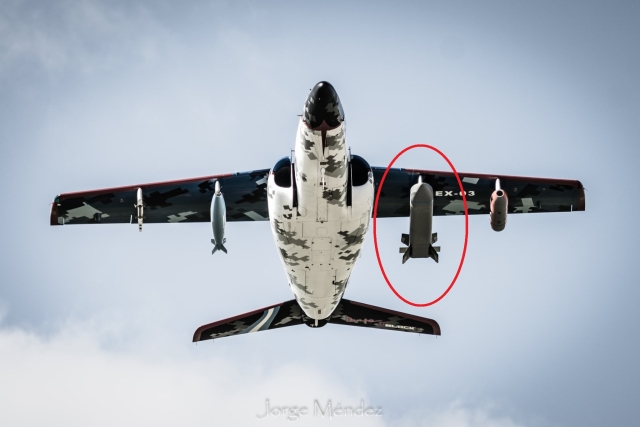
@Dilandu The Argentinians do have an interesting home-grown weapon in Dardo 2/3 that might be suitable as a mini-cruise missile.

Apparently they can rig it with a Mirage III APU as a mini-turbojet to turn it into a powered weapon. Perhaps scrounge around some old BAP 100 runway penetration bombs or similar... you could probably fit 4x submunitions, giving the ability for 5-6 strikers with 2x Dardos each to shutdown the runways. (If the weapon is reliable and accurate in a GPS-jamming environment)

6_1732537192.jpg
 
Between this, the Ukraine, the Koreas, Taiwan, Iran, and the general Middle East (and I am quite confident that I've inadvertently/ignorantly left off some more global hot spots, probably somewhere in Africa, Asia and/or South America), it's a backsliding into a tribal conflicts Strange New World indeed - I am beginning to wonder whether ambient average temperature rises around the globe might have anything to do with this...

Maybe (as the Argentinian government maintains) the Falkland Islands, and their promising oil reserves, will be taken peacefully.

In 1980, on behalf of the UK government, Nicholas Ridley tried to negotiate an agreement to give the Falklands to Argentina and then lease the islands back for an interim period. But negotiations broke down after those became public, due to vociferous opposition in the Falklands and in London. After the 1982 war and Argentine ejection from the Falklands and South Georgia, British forces settled accounts, demolishing Argentina's Corbeta Uruguay military outpost on Thule Island that had been built in 1976 but tolerated until the war. The strengthened South Atlantic patrol brooked no more nonsense from "scrap merchants". The blood shed during the Falklands War made further negotiations politically impossible, even had there been someone in the UK in favor of such negotiations. Renewed Argentine claims in the 1990s were scorned. And there things stood for a long while.

But today, with the public embarrassment in trying to reinforce Cyprus against attacks (Cyprus is much closer to the British Isles than the Falklands), and reports of a secret deal whereby British taxpayers would pay Mauritius to take the Chagos Islands off the UK's hands, and the news about Gibraltar, may indicate that at long last Argentina has an opening with this current UK government. Like everybody else, the Ministry of Foreign Affairs in Buenos Aires can read news reports. I would not be surprised if discreet inquiries have already been made to London.
 
Lots of questions and clarifications in this regard.

Besides the fact that Argentina's power projection capabilities are severely limited and its armed forces are now *generally speaking* at a historically low level, we must also consider the recent rapprochement between the two nations—especially the alleged secret talks between their respective defense ministries—and the fact that AR navy is frankly severely weakened.
Despite current re-equipment programs, regaining the lost capabilities and the additional ones required to attempt to recover the islands would raise serious concerns and could trigger direct US intervention.

In any event maybe 1435 Flight RAF Typhoons & the Sky Sabre / Sea Viper systems can be more than a match to their F-16 MLU :p. (AFAIK no more guided munitions- cruise missiles remain operative in AR hands)
 
Back
Top Bottom