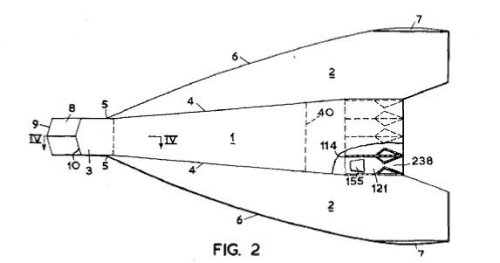
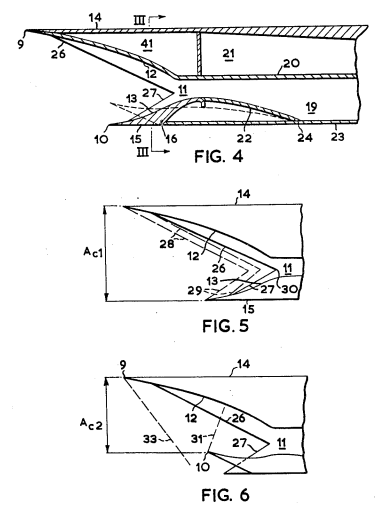
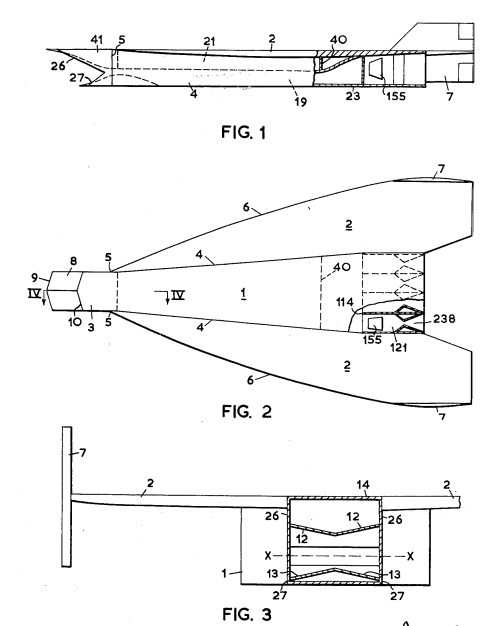
I am absolutely convinced that, despite the reference to freight and passengers, this was a missile concept and that it represented the logical end-point of the P.10D missile studies. The patent itself states:
The embodiment described herein above is powered by ram-jet propulsion engines only, and has accordingly to be accelerated by external means to a speed where these engines become self supporting. Alternatively the aircraft may be provided with auxiliary propulsion means (not shown) which are operative from standstill or at lower speeds.
I also note that there is no reference to an undercarriage. Practically, to carry freight or passengers the ramjets would have to be enormous. By contrast, with the lighter weight warheads then appearing their carriage in the upper fuselage would allow for sensibly sized ramjets The reduced intake drag, assuming this also applied when the ramjet burners were not lit, would have had benefit if this vehicle was being carried externally by a bomber. One of the advantages of the nose mounted intake would be the ability to have longer combustion chambers than the split-wing design of the P.10D as usually shown. It's mentioned in
Vulcan's Hammer that longer combustion chambers would allow light-up and full thrust at lower speeds (Mach 0.84 and Mach 1.25 respectively) which in turn has me wondering whether it might have been possible to dispense with boost motors altogether and rely on the speed of the launch platform - especially if that was
something like the Avro 732 (Link). I note that the apparently ramjet powered missile on two of the Avro 732 concepts appears to has a nose intake and no boost motors. Additionally, the original UK patent (GB911074A) filing date of January 1959 would align with OR.1149 and 1159.
I am also reminded of this passage from Tony F. Simmons in
TSR-2 with Hindsight:
And there was the P10D! By this time the Warton supersonic ramjet project had manifested itself as a long-range flying bomb – on paper only. I remember that Ollie Heath and I joined two boffins, senior and junior, from English Electric, Luton. We visited the Air Ministry at Whitehall Gardens and discussed global politics and oversize deterrents. We four came out of the Air Ministry and held a discussion in Charing Cross Gardens, sitting in a row on one side of the main promenade. A band was playing the grand march from Aida. Ollie talked with the principal Luton man (should the missile fly at Mach 3 or 4) and the words seemed to fit in with the music.
Finally, in
Vulcan's Hammer, at the top of page 97 is a box showing nine English Electric configurations to OR.1149. The top left most of these shows a configuration very similar to the one shown in this patent. The main differences are:
- The intake is a semi-cone rather than the variable ramp shown in the patent
- The wing has a straight rather than the ogival shape on the patent
- The vertical surfaces do not extend above the wing as they do on the patented design.
This all suggests the patented design was one of the final OR.1149/1159 configurations developed by English Electric and was a clear progression from the well known P.10D concept through the configuration shown in
Vulcan's Hammer.
Full patent and images attached for completeness.