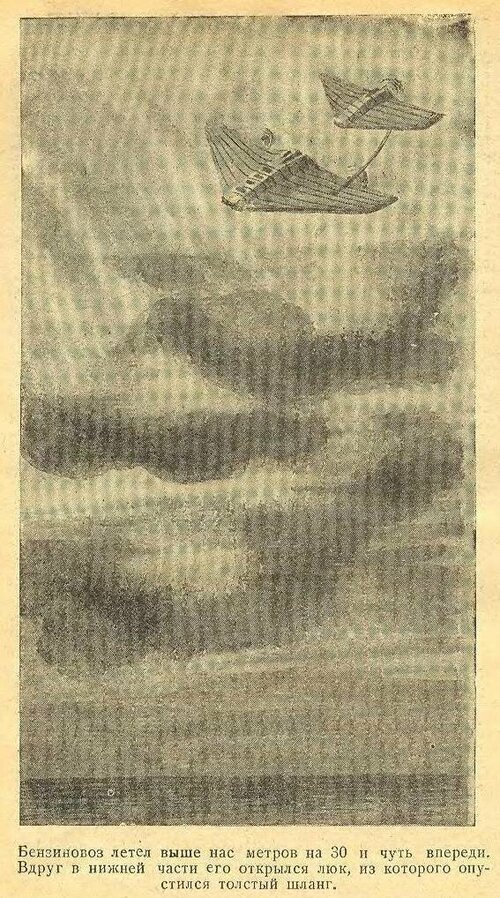
Published in "Техника Молодёжи-Youth Technique" from 1936 the picture shows a fuel supply in flight. The caption to the picture says "The fuel truck (aircraft tanker) flew 30 meters above us and slightly ahead. Suddenly, a hatch opened in the lower part of it, from which a thick hose descended", and I was wondering if there are other similar ideas prefiguring the in-flight fueling project before its actual realization.
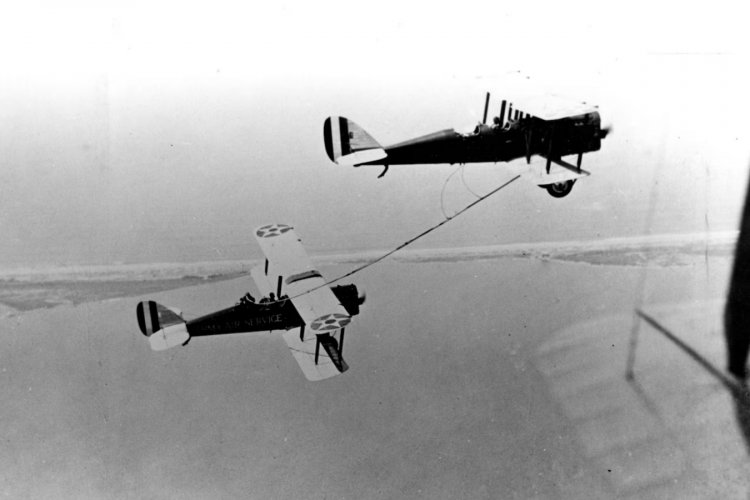
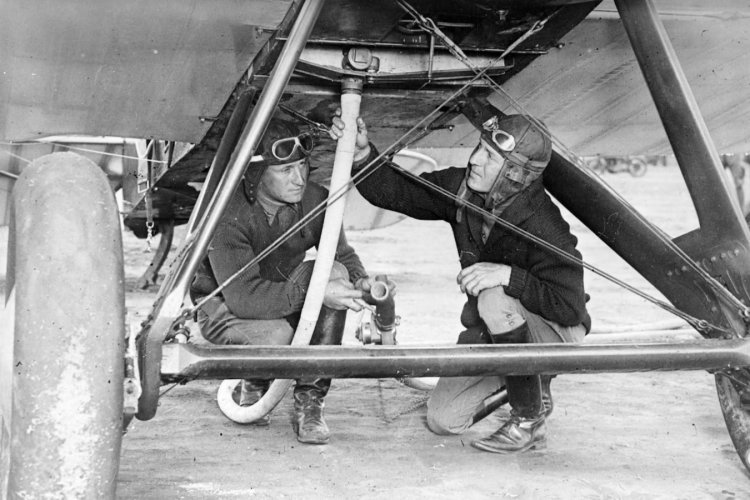
June 27, 1923: two slow-flying aircraft flew in formation, with a hose run down from a hand-held fuel tank on one aircraft and placed into the usual fuel filler of the other. The first mid-air refueling, based on the development of Alexander P. de Seversky, between two planes occurred on 27 June 1923, when Army Air Service 1st Lts. Virgil Hine and Frank W. Seifert passed gasoline from their aircraft through a gravity hose to another plane flying beneath it piloted by Capt. Lowell H. Smith and 1st Lt. John P. Richter, between two Airco DH-4B biplanes of the United States Army Air Service. An endurance record was set by three DH-4Bs (a receiver and two tankers) on 27–28 August 1923, in which the receiver airplane remained aloft for more than 37 hours using nine mid-air refueling to transfer 687 US gallons (2,600 L) of aviation gasoline and 38 US gallons (140 L) of engine oil. The same crews demonstrated the utility of the technique on 25 October 1923, when a DH-4 flew from Sumas, Washington, on the Canada–United States border, to Tijuana, Mexico, landing in San Diego, using mid-air refuelings at Eugene, Oregon, and Sacramento, California.
At Le Bourget Airport near Paris, the Aéro-Club de France and the 34th Aviation Regiment of the French Air Force were able to demonstrate passing fuel between machines at the annual aviation fete at Vincennes in 1928. The UK's Royal Aircraft Establishment was also running mid-air refueling trials, with the aim to use this technique to extend the range of the long-distance flying boats that serviced the British Empire. By 1931 they had demonstrated refueling between two Vickers Virginias, with fuel flow controlled by an automatic valve on the hose which would cut off if contact was lost.
Royal Air Force officer Richard Atcherley had observed the dangerous aerial-refueling techniques in use at barnstorming events in the US and determined to create a workable system. While posted to the Middle East he developed and patented his 'crossover' system in 1934, in which the tanker trailed a large hooked line that would reel in a similar dropped line from the receiver, allowing the refueling to commence.
In 1934, Sir Alan Cobham turned to the development of inflight refueling, founding the company Flight Refuelling Ltd (FRL). Atcherly's system was bought up by Cobham's company, and with some refinement and continuous improvement through the late '30s, it became the first practical refueling system.
Cobham's grappled-line looped-hose air-to-air refueling system borrowed from techniques patented by David Nicolson and John Lord, and was publicly demonstrated for the first time in 1935. In the system the receiver aircraft, at one time an Airspeed Courier, trailed a steel cable which was then grappled by a line shot from the tanker, a Handley Page Type W10. The line was then drawn back into the tanker where the receiver's cable was connected to the refueling hose. The receiver could then haul back in its cable bringing the hose to it. Once the hose was connected, the tanker climbed sufficiently above the receiver aircraft to allow the fuel to flow under gravity.
When Cobham was developing his system, he saw the need as purely for long-range transoceanic commercial aircraft flights, but modern aerial refueling is used exclusively by military aircraft.
By 1938 FRL had used its looped-hose system to refuel aircraft as large as the Short Empire flying boat Cambria from an Armstrong Whitworth AW.23. Handley Page Harrows were used in the 1939 trials to perform aerial refueling of the Empire flying boats for regular transatlantic crossings. From 5 August to 1 October 1939, sixteen crossings of the Atlantic were made by Empire flying boats, with fifteen crossings using FRL's aerial refueling system. After the sixteen crossings further trials were suspended due to the outbreak of World War II.
During the closing months of World War II, it had been intended that Tiger Force's Lancaster and Lincoln bombers would be in-flight refueled by converted Halifax tanker aircraft, fitted with the FRL's looped-hose units, in operations against the Japanese homelands, but the war ended before the aircraft could be deployed.
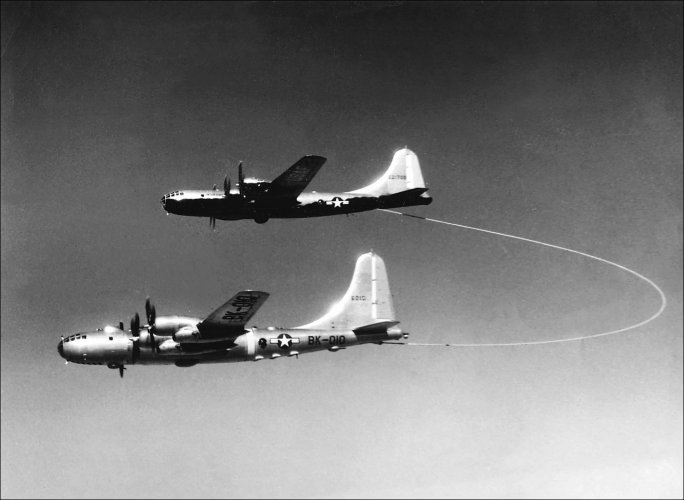
After the war ended, the USAF bought a small number of FRL looped-hose units and fitted a number of B-29s as tankers to refuel specially equipped B-29s and later B-50s. The USAF made only one major change in the system used by the RAF. The USAF version had auto-coupling of the refueling nozzle, where the leader line with the refueling hose is pulled to the receiver aircraft and a refueling receptacle on the belly of the aircraft, allowing high-altitude air-to-air refueling and doing away with the aircraft having to fly to a lower altitude to be depressurized so a crew member could manually do the coupling.
B-50A Lucky Lady II being refuelled by B-29M 45-21708 1947:
This site uses cookies to help personalise content, tailor your experience and to keep you logged in if you register.
By continuing to use this site, you are consenting to our use of cookies.