

TorpedoJ
ACCESS: Secret
- Joined
- 11 October 2023
- Messages
- 434
- Reaction score
- 869
As a result of reading this and other forums, I often come up with 'new' ideas to try and solve various aviation problems but dumping random suggestions into established project/discussion threads is not helpful and also frowned upon by moderators, especially when they come from someone like me who is just a well-meaning enthusiast rather than an expert and is therefore frequently wrong. As a result, I am creating this thread so that anyone who has come up with an idea based on discussions elsewhere on this forum, but doesn't want to clog up the source of their inspiration, can dump and/or discuss them here without fear of ridicule. I imagine there are quite a few people out there who read and watch the various threads but aren't brave enough to jump into them with their own hunches and lightbulb moments.
As an idea of what I mean, here's one I made earlier:
DIOD 1: Electrically Blown Flaps
Would it be possible to bury small electric fans/compressors inside the wing of fighters/drones/CCAs, to remove boundary air from above the wing and then blow it over the flaps, to improve lift at low speeds?
This came about from a discussion on another forum about whether it would be possible to create a STOL replacement for the F35B (in UK service) using various high lift devices to reduce touchdown speed to not much faster than a SRVL's 60kts. The consensus was that it would need some pretty hefty blown flaps, but the problem there is that to power the flaps the engine also needs to be running at near full chat to provide enough bypass air, etc.
But Rolls Royce's concept imagery and videos for the GCAP powerplant include not only a heck of a lot of power generation but also, crucially, power storage, mainly intended for DEWs and sensors. My idea was that when landing on the theoretical STOL jet would use this stored energy to power 'jet flaps' in the wings, with several compressor fans distributed across the trailing edge like the below (compressed air-powered) concept I found on the internet. The lack of engine involvement would allow lower approach speeds and possibly also reduced mechanical complexity as no compressed air piping would be required.

The compressors would be embedded sort of like below in the wing, with an intake slot above the wing and the blown air being diverted to the flaps.

Would this work or would the motors be too inefficient when combined with energy storage? I think there being multiple motors on each wing would be enough to deal with problems if one failed.
As an idea of what I mean, here's one I made earlier:
DIOD 1: Electrically Blown Flaps
Would it be possible to bury small electric fans/compressors inside the wing of fighters/drones/CCAs, to remove boundary air from above the wing and then blow it over the flaps, to improve lift at low speeds?
This came about from a discussion on another forum about whether it would be possible to create a STOL replacement for the F35B (in UK service) using various high lift devices to reduce touchdown speed to not much faster than a SRVL's 60kts. The consensus was that it would need some pretty hefty blown flaps, but the problem there is that to power the flaps the engine also needs to be running at near full chat to provide enough bypass air, etc.
But Rolls Royce's concept imagery and videos for the GCAP powerplant include not only a heck of a lot of power generation but also, crucially, power storage, mainly intended for DEWs and sensors. My idea was that when landing on the theoretical STOL jet would use this stored energy to power 'jet flaps' in the wings, with several compressor fans distributed across the trailing edge like the below (compressed air-powered) concept I found on the internet. The lack of engine involvement would allow lower approach speeds and possibly also reduced mechanical complexity as no compressed air piping would be required.
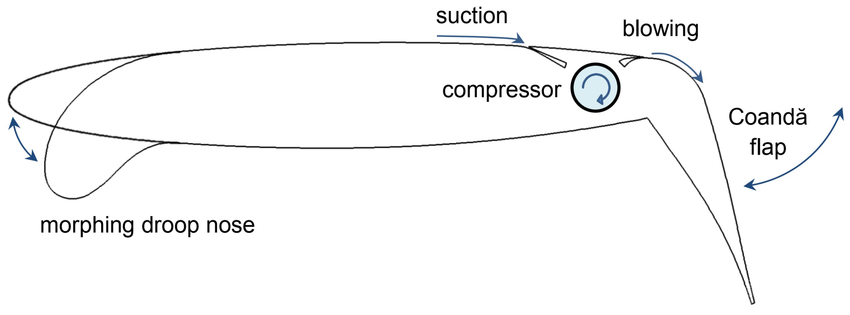
The compressors would be embedded sort of like below in the wing, with an intake slot above the wing and the blown air being diverted to the flaps.
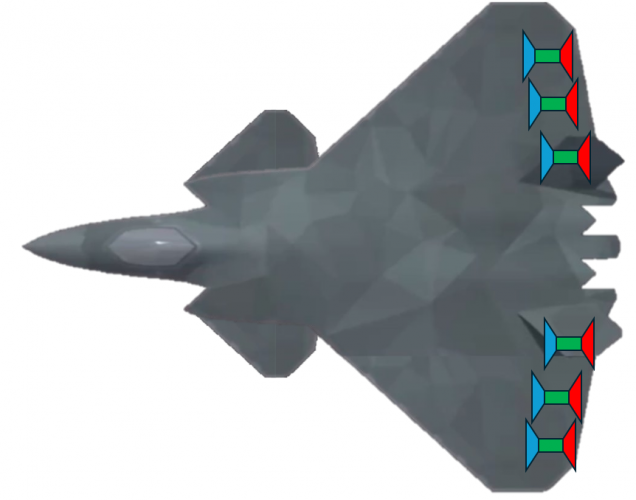
Would this work or would the motors be too inefficient when combined with energy storage? I think there being multiple motors on each wing would be enough to deal with problems if one failed.


