Dumb Ideas of the Day

TorpedoJ

ACCESS: Secret
Joined
11 October 2023
Messages
434
Reaction score
869
As a result of reading this and other forums, I often come up with 'new' ideas to try and solve various aviation problems but dumping random suggestions into established project/discussion threads is not helpful and also frowned upon by moderators, especially when they come from someone like me who is just a well-meaning enthusiast rather than an expert and is therefore frequently wrong. As a result, I am creating this thread so that anyone who has come up with an idea based on discussions elsewhere on this forum, but doesn't want to clog up the source of their inspiration, can dump and/or discuss them here without fear of ridicule. I imagine there are quite a few people out there who read and watch the various threads but aren't brave enough to jump into them with their own hunches and lightbulb moments.
As an idea of what I mean, here's one I made earlier:
DIOD 1: Electrically Blown Flaps
Would it be possible to bury small electric fans/compressors inside the wing of fighters/drones/CCAs, to remove boundary air from above the wing and then blow it over the flaps, to improve lift at low speeds?
This came about from a discussion on another forum about whether it would be possible to create a STOL replacement for the F35B (in UK service) using various high lift devices to reduce touchdown speed to not much faster than a SRVL's 60kts. The consensus was that it would need some pretty hefty blown flaps, but the problem there is that to power the flaps the engine also needs to be running at near full chat to provide enough bypass air, etc.
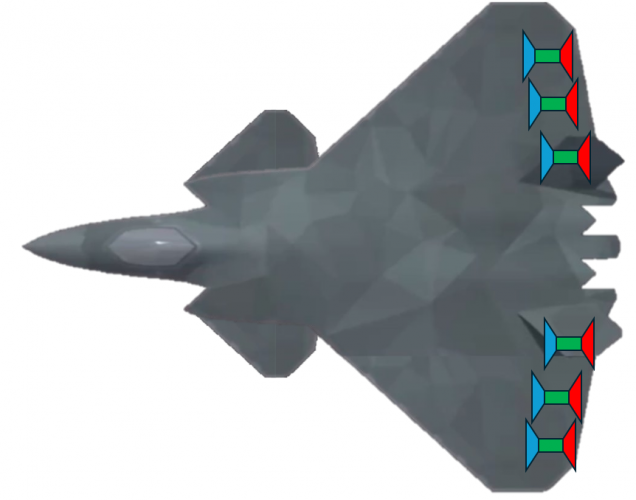
But Rolls Royce's concept imagery and videos for the GCAP powerplant include not only a heck of a lot of power generation but also, crucially, power storage, mainly intended for DEWs and sensors. My idea was that when landing on the theoretical STOL jet would use this stored energy to power 'jet flaps' in the wings, with several compressor fans distributed across the trailing edge like the below (compressed air-powered) concept I found on the internet. The lack of engine involvement would allow lower approach speeds and possibly also reduced mechanical complexity as no compressed air piping would be required.
1760459530145.png
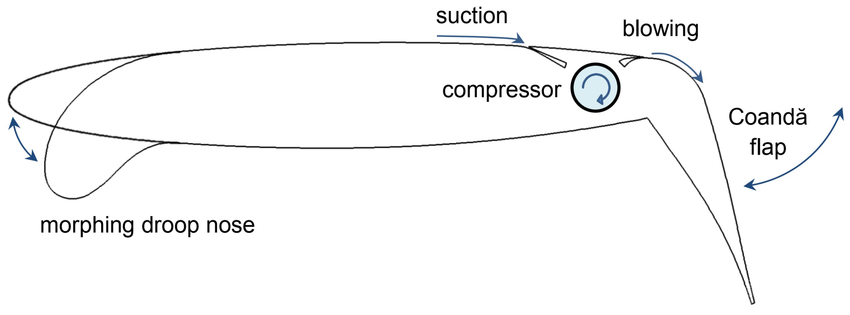
The compressors would be embedded sort of like below in the wing, with an intake slot above the wing and the blown air being diverted to the flaps.
1760460420739.png
Would this work or would the motors be too inefficient when combined with energy storage? I think there being multiple motors on each wing would be enough to deal with problems if one failed.
 
As a result of reading this and other forums, I often come up with 'new' ideas to try and solve various aviation problems but dumping random suggestions into established project/discussion threads is not helpful and also frowned upon by moderators, especially when they come from someone like me who is just a well-meaning enthusiast rather than an expert and is therefore frequently wrong. As a result, I am creating this thread so that anyone who has come up with an idea based on discussions elsewhere on this forum, but doesn't want to clog up the source of their inspiration, can dump and/or discuss them here without fear of ridicule. I imagine there are quite a few people out there who read and watch the various threads but aren't brave enough to jump into them with their own hunches and lightbulb moments.
As an idea of what I mean, here's one I made earlier:
DIOD 1: Electrically Blown Flaps
Would it be possible to bury small electric fans/compressors inside the wing of fighters/drones/CCAs, to remove boundary air from above the wing and then blow it over the flaps, to improve lift at low speeds?
Already tried.

https://en.wikipedia.org/wiki/Northrop_X-21
 
still have the same clogging problem.

Here is the same thing you are trying to do but with much less complexity.
The problem they encountered was ice formation at high altitudes and speeds, which would become less of a problem if the slots were only opened at landing and taking off. Though there might still be problems if they were frozen shut, maybe that could be helped with electrically heating the area around the slot?
External blowing doesn't work with stealth, nor does it have the potential to be combined with supersonic speeds.
The whole idea is that this is a variation on internally blown flaps, but trying to be more efficient and flexible by compressing the air inside the wing instead of using pipes from the engine.
 
The problem they encountered was ice formation at high altitudes and speeds, which would become less of a problem if the slots were only opened at landing and taking off. Though there might still be problems if they were frozen shut, maybe that could be helped with electrically heating the area around the slot?
No, there was other things that also clogged the holes.
, which would become less of a problem if the slots were only opened at landing and taking off.
How much is that going to weigh and cost?

External blowing doesn't work with stealth, nor does it have the potential to be combined with supersonic speeds.
Why would a stealth aircraft need this?
Why does it need to work at supersonic speeds?

but trying to be more efficient and flexible by compressing the air inside the wing instead of using pipes from the engine.

How does all that complexity, additional mass, loss of fuel volume, etc add more efficiency and flexibility?

What problem are you trying to solve? How would this help the B-21 or F-22?
 
The lack of engine involvement would allow lower approach speeds and possibly also reduced mechanical complexity as no compressed air piping would be required.
How would multiple air compressors with energy storage be "reduced" reduced mechanical complexity vs compressed air piping?

What are the multiple air compressors with energy storage doing the rest of the flight time?
 
No, there was other things that also clogged the holes.

How much is that going to weigh and cost?

Why would a stealth aircraft need this?
Why does it need to work at supersonic speeds?

How does all that complexity, additional mass, loss of fuel volume, etc add more efficiency and flexibility?

What problem are you trying to solve? How would this help the B-21 or F-22?
Ok, a bit of context is required I think.
The discussion I got the idea from was UK-centric; would it be possible for a replacement to F35B to land on the carriers with no direct vertical lift, ie how slow is it possible to make a jet stall and still retain supersonic performance? Obviously purely aerodynamic solutions wouldn't work, hence blown flaps, but when the alternative is LiftSystem some fans in the wing (and electric ducted fans are becoming really rather small and powerful as a result of drone developments) are a small price to pay in terms of weight and complexity.
Another alternative is conventional blown flaps, which lose efficiency through the pipes, use very high pressure air which is less efficient as well and require loads of piping and engine modifications. My suggestion (ideally) would use the power management system Rolls Royce is already developing to power DEW and sensors on GCAP, but in a different stage of flight when those other systems aren't being used, so that wouldn't be an extra weight beyond a conventional arrangement.
The problem with FOD in the holes might well be the Achilles Heel, but at sea hopefully that wouldn't be so big a problem. Like I said, dumb idea of the day.
 
but when the alternative is LiftSystem some fans in the wing (and electric ducted fans are becoming really rather small and powerful as a result of drone developments) are a small price to pay in terms of weight and complexity.
Unsubstantiated
Another alternative is conventional blown flaps, which lose efficiency through the pipes, use very high pressure air which is less efficient as well and require loads of piping and engine modifications.
Not a drawback since there is extra power available as you say below. And still simpler.
My suggestion (ideally) would use the power management system Rolls Royce is already developing to power DEW and sensors on GCAP, but in a different stage of flight when those other systems aren't being used, so that wouldn't be an extra weight

The problem with FOD in the holes might well be the Achilles Heel, but at sea hopefully that wouldn't be so big a problem.
It would be a bigger problem. Salt.
 
Unsubstantiated
LiftSystem is estimated to weigh 2500kg for 12000kg thrust, while the difference in fuel capacity between A and B is 2100kg.
The Greenjets Sycamore 160-6 gives 6kg thrust in a 0.8kg package. You could fit a lot of those things inside the wing of a jet, and if the intake slot is at half-chord and has a relatively flat channel to the motors it wouldn't impact fuel capacity horrendously.
Not a drawback since there is extra power available as you say below. And still simpler.
That would require the engine to be running at full capacity near landing like for the Blackburn Buccaneer, which isn't really viable for STOL. Electric power and energy storage allows the lift augmentation to be independent of the prime mover.
t would be a bigger problem. Salt.
Good point, but we've been running jet engines near the sea for decades. What's the extra problem with some cold-air electric motors?
 
LiftSystem is estimated to weigh 2500kg for 12000kg thrust, while the difference in fuel capacity between A and B is 2100kg.
The Greenjets Sycamore 160-6 gives 6kg thrust in a 0.8kg package. You could fit a lot of those things inside the wing of a jet, and if the intake slot is at half-chord and has a relatively flat channel to the motors it wouldn't impact fuel capacity horrendously.
still handwaving and not real engineering.
 
DIOD 2: Flying Towed Sonars!
This comes from the recent announcement that an unnamed military contractor has reserved 3 of the initial production run of Airlander 10, to be converted for military use: https://www.hybridairvehicles.com/n...-military-aircraft-reservation-for-airlander/
One of the main projected roles for Airlander is ASW, where 5-day endurance and lots of hull volume means good sensors and that the submarine can't just survive until the MPA runs out of fuel. But because it's a hybrid airship Airlander can't use a dipping sonar like a helicopter (it has to keep flying forwards, and I don't think airships could hover that still anyway). A 5-day mission would also mean a lot of sonobuoys; a P8 carries 120 of them for typical 4 hours on station, but if Airlander were on station for 2 days then that would mean a maximum of 8 TONNES of G-size sonobuoys at the same rate of expenditure, which isn't really feasible on a 3-tonne mission payload. For the sonar equipment there would probably be a weight budget of about 1 tonne as it is competing with MAD, radar, camera and computing equipment.
So, has anyone ever tried putting an ASW sensor, besides MAD (I assume that would be standard fit anyway), that can be deployed from a moving aircraft on a tether? The US do helicopter minesweeping, towing floating sleds from MH53s, but those are deployed from a ship rather than lowered from the helicopter.
There would need to be some sort of fin system to hold the towed body in the water (trawlers call them Otter Boards), with effectively a thin-line towed array streamed behind that and then a cable running up to the reel on the airship. The question is, can it be done light enough with equivalent performance to a typical dipping sonar at a towing speed of 20 knots?
 

Similar threads

Back
Top Bottom