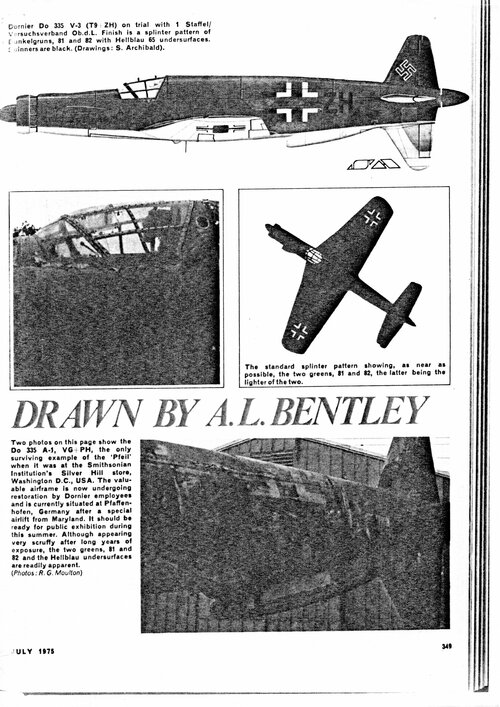
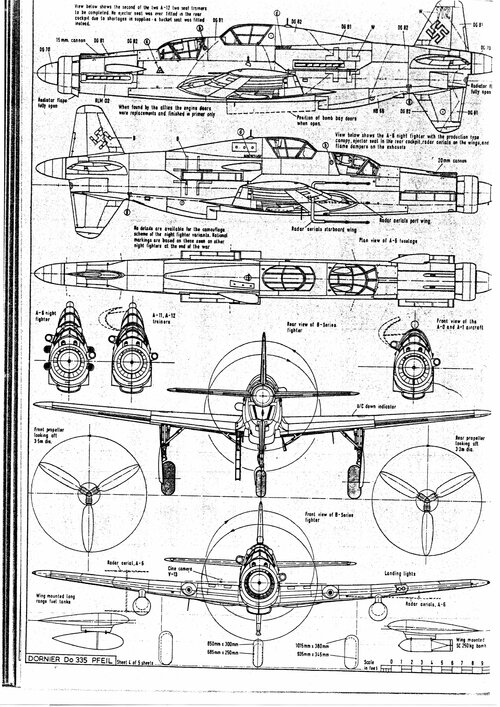
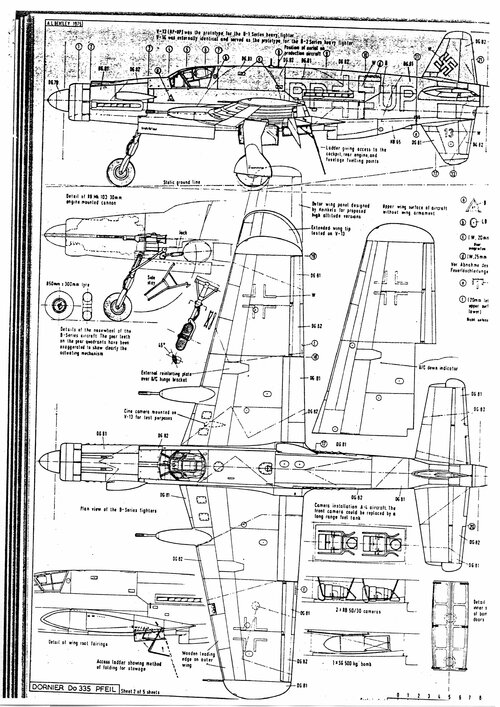
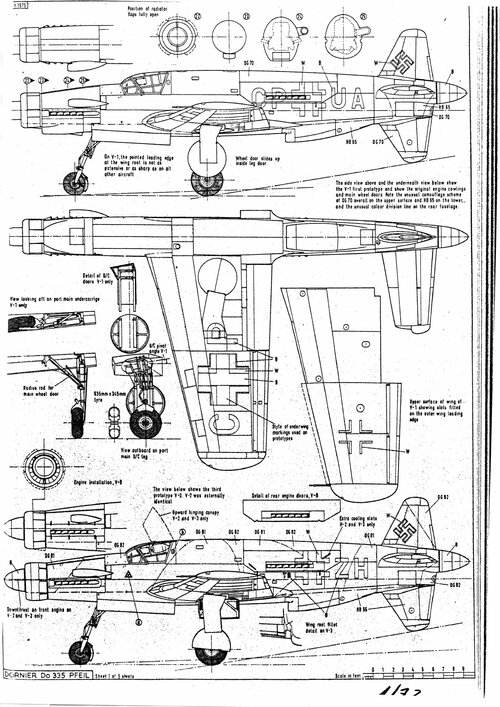
Dornier Do 335, Projects, Prototypes & Derivatives

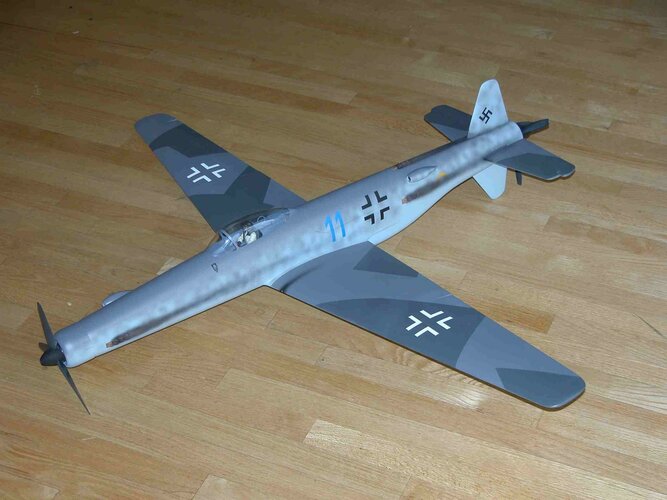
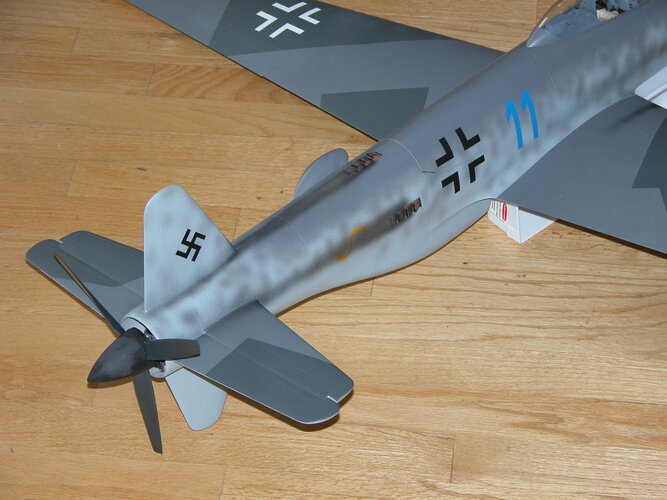
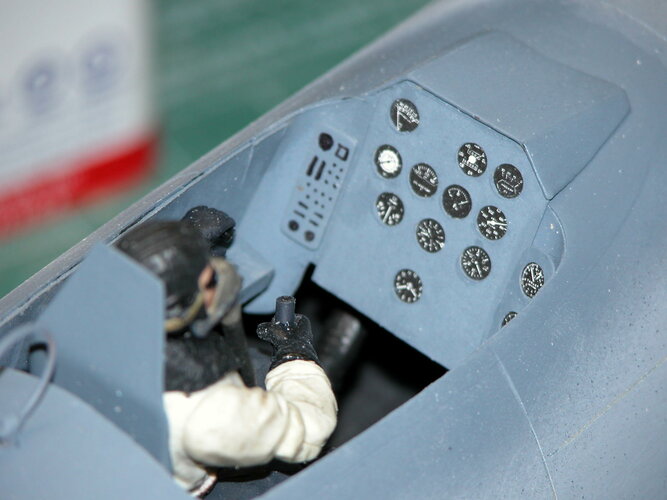
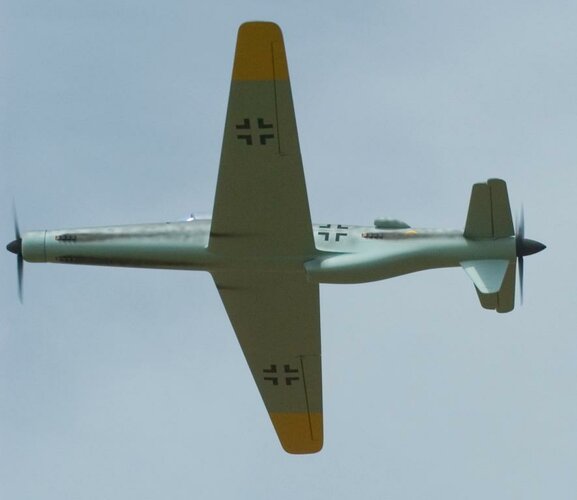
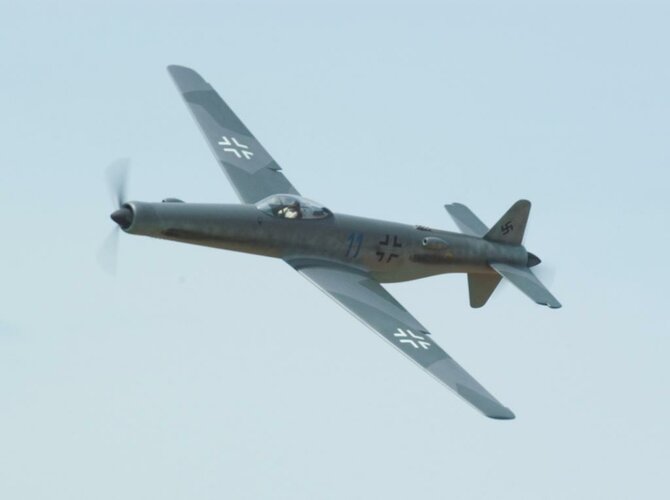
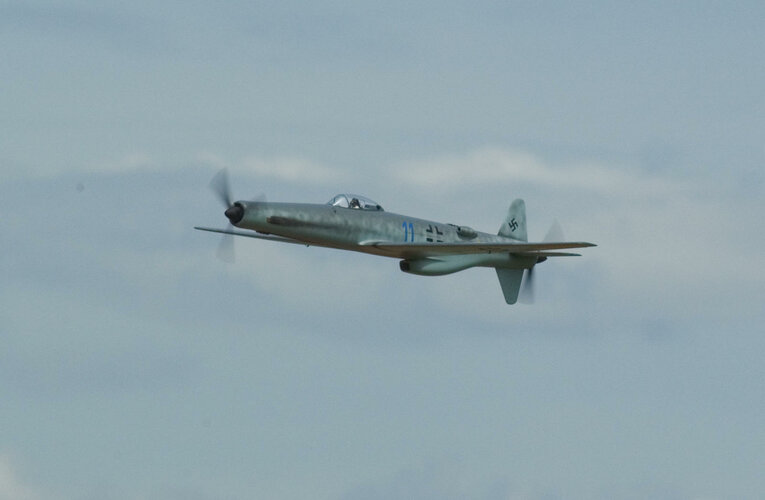
Dornier Do-435 model by Ken Stuhr (flyboyken on RC Groups)

http://www.rcgroups.com/forums/showthread.php?t=1423790
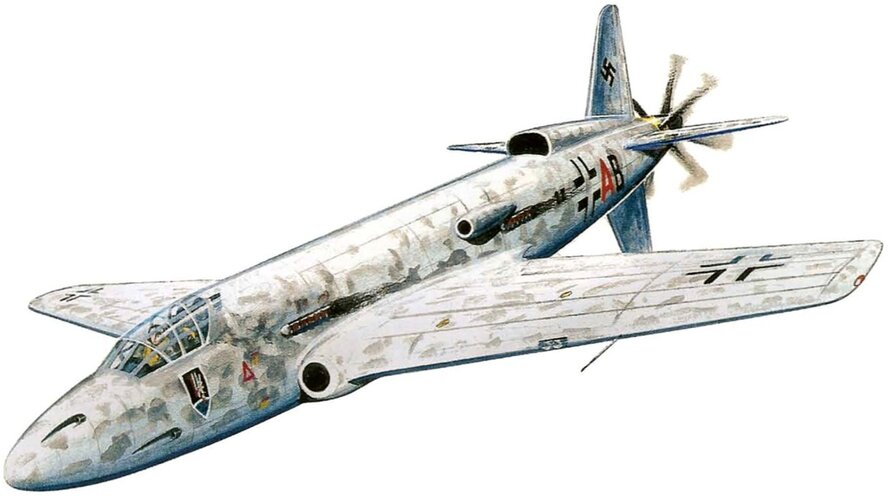
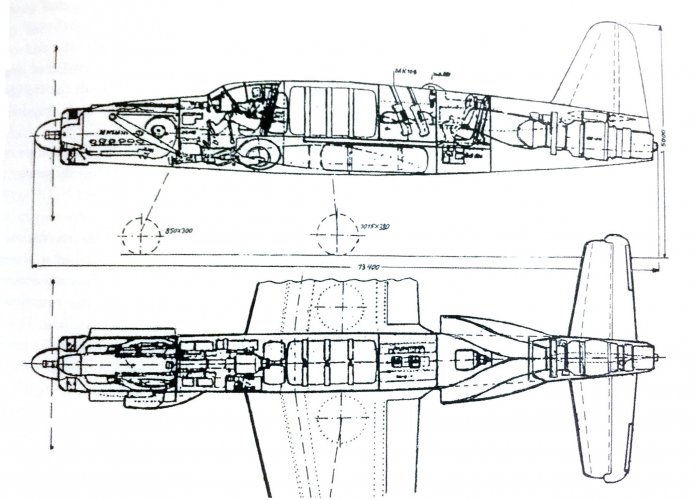
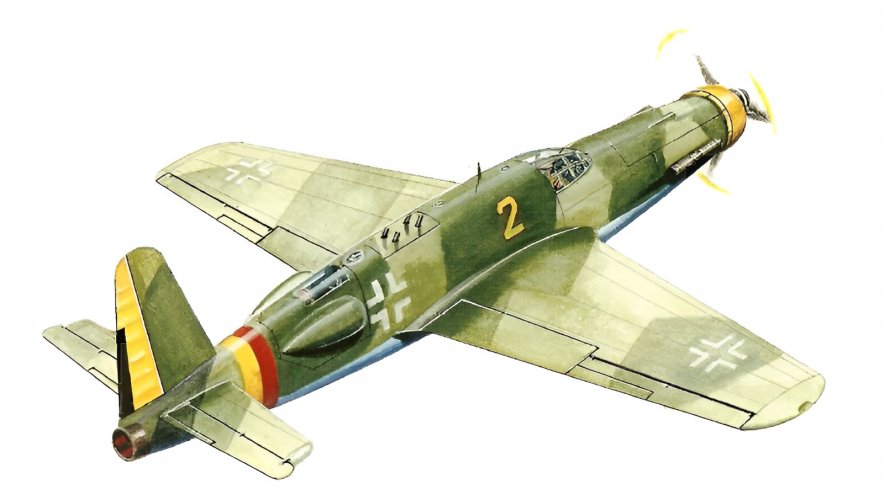
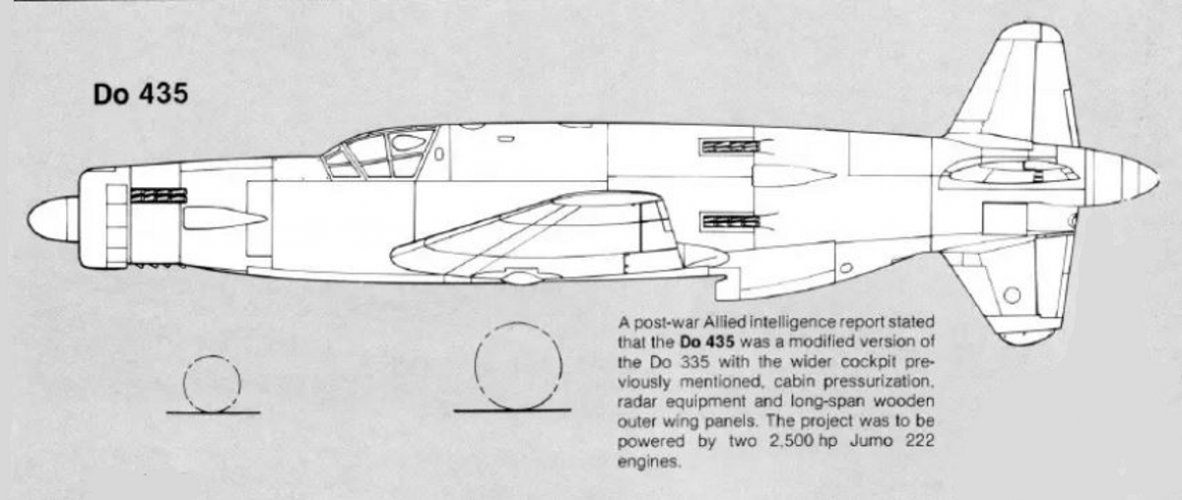
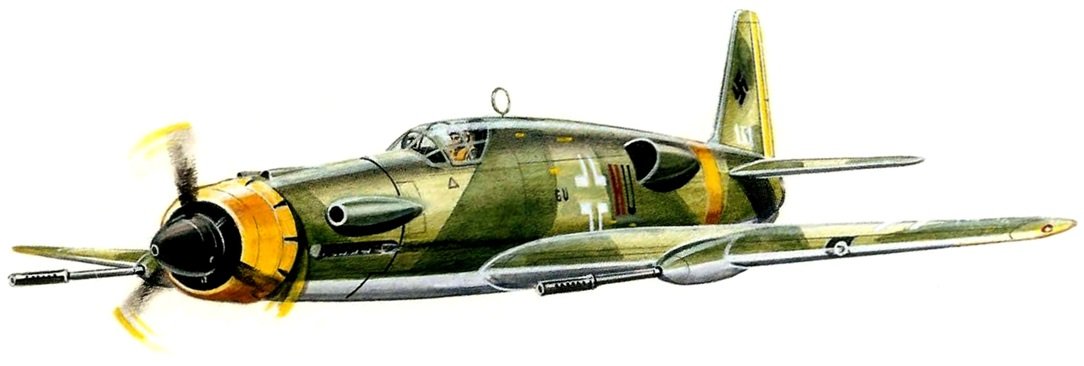
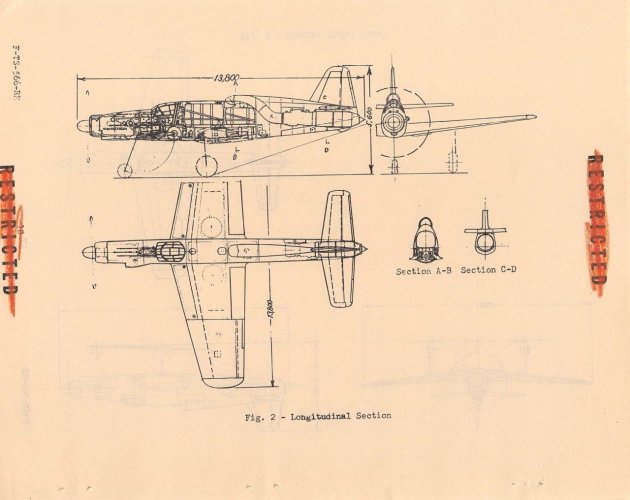
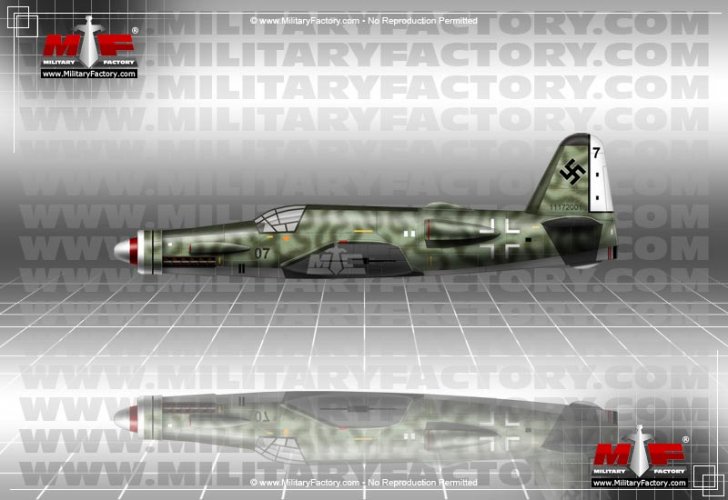
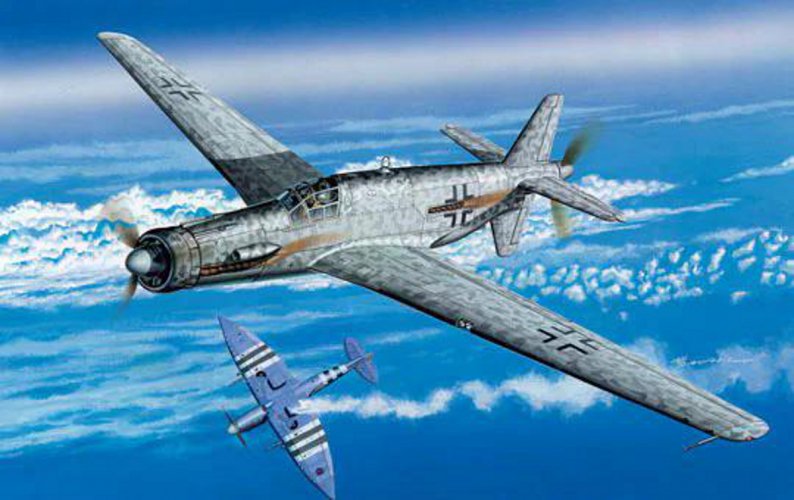
Posting some pics of what would have been an ultimate warbird, the Dornier Do 435. There were many derivative versions of the DO 335 drawn, with none actually built. This derivative was published in an older issue of Flug Revue which I happened to come across at the time. Derivative is almost a misnomer, as this was almost a completely new airplane.

The most common part was the wing, which was basically the wing from the D0 335 but with a stretch to increase span. This planform is shown in William Green’s book Warplanes of the Third Reich, as it was also intended for less advanced derivatives of the 335.

Coupling this wing with the other features of the 435 made good sense though. The longer fuselage carried one pilot but retained the push-pull engine arrangement. Increased length was needed just to house engines and give fuel capacity. And what engines these were! Jumo 222s were just developing at the end of the war. 2500 HP each, minimum, without turbocharging, which this airplane would have incorporated given its mission. So in the power arena, we see roughly double the installed power of the base model 335.

The mission for the type is clear: interceptor. Had the war gone on, B-29s would have approached targets at 25,000 ft at speeds of 330 kts. The Do 435 could have taken the fight to that altitude and much farther West of the “Fatherland” than earlier B-17 intercepts. Considering the installed power and design cleanliness, I think this airplane could have topped 480 MPH at altitude.

For this and many other reasons, good thing the Germans ran out of fuel, men, and ideas about that time. It would have been an awesome airplane.

Now the model:

Span 48”
Flying weight 42 ozs
Wing Section SD6060
Motors 2-Axi 2212/34
Propellers Master Airscrew 9” 3 blade 1 tractor 1 pusher
Battery 2-1200 3s Li-poly in parallel
Max current 9A x 2 = 18A Cruise current ~ 9A
Typ flight time ~ 10 mins
Controls 3ch Ail-Elev-Throttle

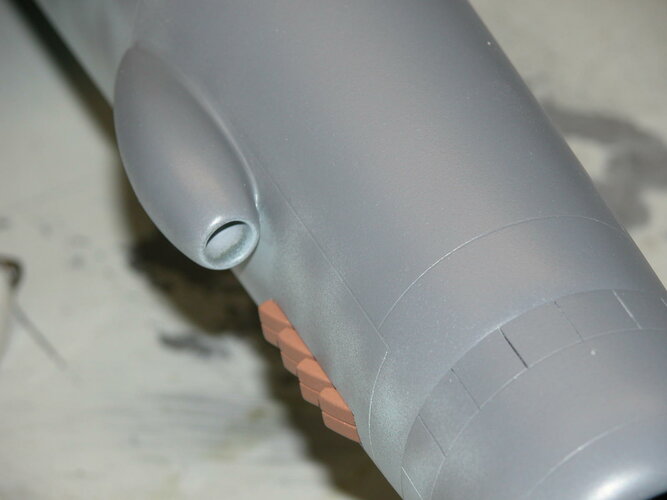
This is an all-balsa model. The wing is built up rib and sheet construction, using epoxy glass strengthening, 2 layers of ¾ oz overall. The fuse was strip planked and also glassed. It’s a belly lander and no, the lower fin has never broken off, because it's got up to 10 lams of glass cloth to beef it up.

The paint is Testors plastic model stuff, applied with a Binks airbrush. If you want the specific colors, let me know. Have to look them up. Panel line detail was added to the primer phase using striping tape.

It’s a rather old model, first flying in 2006 I think. Flies great! Its light enough to not have any vices and is very smooth and can be fast. Mostly though, it just looks so different that I really like flying it. Plus there’s no torque effect.
 

Attachments

  • Do-435 01.jpg
    Do-435 01.jpg
    72.3 KB · Views: 349
  • Do-435 07.jpg
    Do-435 07.jpg
    186.5 KB · Views: 267
  • Do-435 06.jpg
    Do-435 06.jpg
    212.9 KB · Views: 225
  • Do-435 05.jpg
    Do-435 05.jpg
    85.6 KB · Views: 207
  • Do-435 04.jpg
    Do-435 04.jpg
    140.5 KB · Views: 210
  • Do-435 03.JPG
    Do-435 03.JPG
    48 KB · Views: 227
  • Do-435 02.JPG
    Do-435 02.JPG
    45.2 KB · Views: 254
Hi
I have tried to find potential primary source material to support the infamous Do 435 design with a bubble canopy. Supposedly it was planned with two Jumo 222s and had an extended fuselage. Any idea where this design comes from? Hans Redemann probably mentioned it back in 1972/73. Modern literally describes the 435 as either a two seater 335, or as a version with hybrid propulsion.
Best
Kris
View attachment 707988

You may als have a look at post #137 onwards in this discussion:
https://www.secretprojects.co.uk/th...-prototypes-projects.17135/page-4#post-348737
 
How much fuel volume did the 2-seater lose?
http://www.pilotfriend.com/photo_albums/timeline/ww2/Dornier Do 335 Pfeil.htm#google_vignette
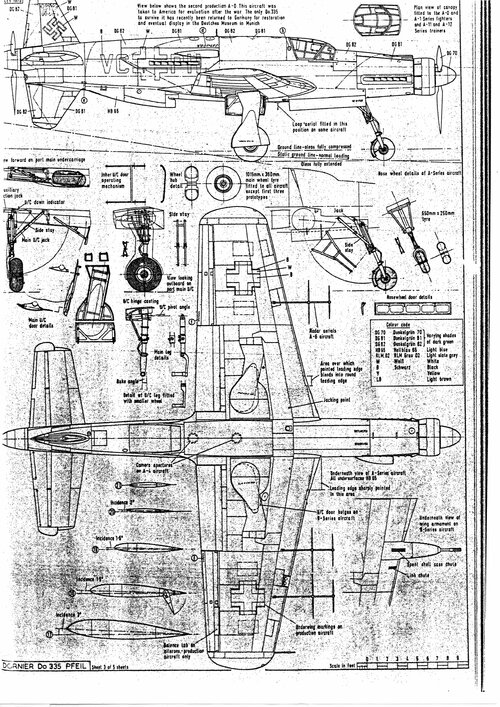
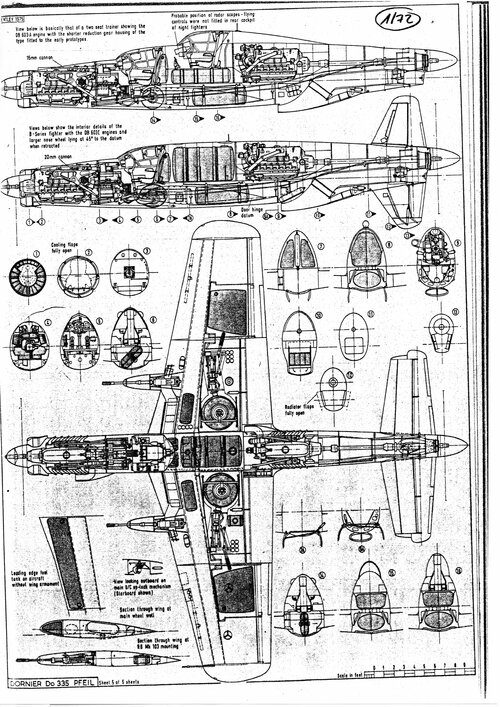
"Next in line of the Pfeil variants was the Do 335A-6 (prototype Do 335 V10), which was the night fighter variant. Armament remained unchanged from the fighter bomber, but FuG 220 Lichtenstein SN-2 or Fug 217J Neptune/FuG 218 Neptun V airborne intercept radar was to have been incorporated, the aerials being located forward of the wing (lateral beam port and vertical beam starboard). To operate the radar a second crewman was needed, and to accommodate him a cockpit was incorporated above and behind the pilot. Giving the Pfeil an even stranger appearance than before, the second cockpit also meant a considerable restructuring of the fuel system since fuel capacity was reduced to 600 litres. To augment this the weapons bay area was converted over to fuel storage. The negative effect on performance of the extra cockpit, aerials, weight and other modifications such as flame damping tubes over the exhaust ports was in the region of 10 percent, but production aircraft would have offset this partially by being fitted with DB 603E engines with MW-50 (water/methanol) boost instead of the DB 603A retained by the sole example. Production was scheduled to have been undertaken by Heinkel in Vienna, but this plan was overtaken by events and the tooling was never assembled. There was only one operational Do 335A-6, flown by Werner Baake in I./NJG 3 flying Do 335 V-10 (CP+UK) with FuG 220 Lichtenstein SN-2 radar."
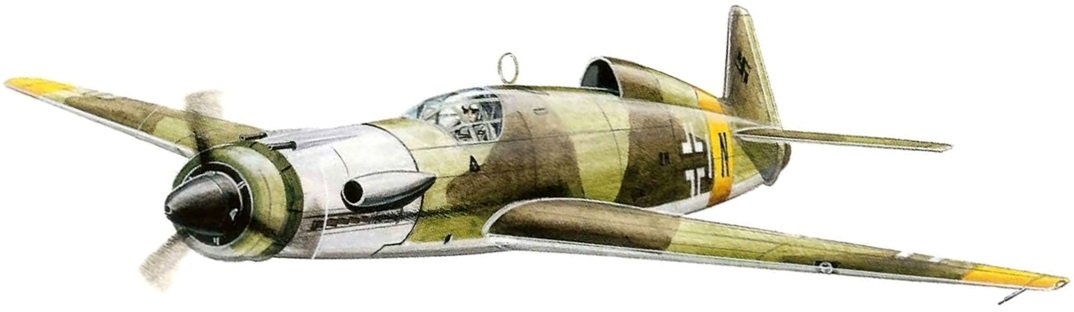
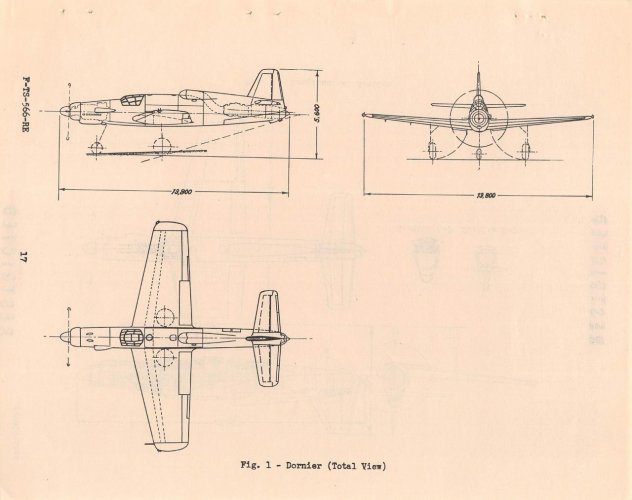
Do335 A-1 fuel capacity : 1,230L (wikipedia)

I think your question is a very good one, but it would be even better if you could do your own research and post the results.
 
Last edited:
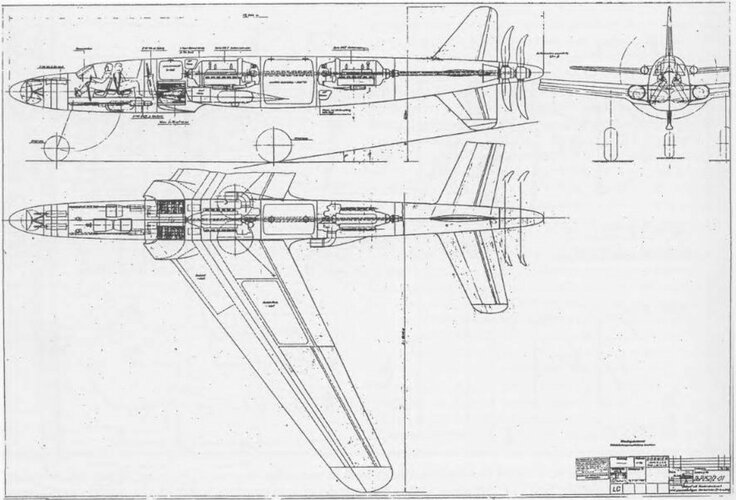
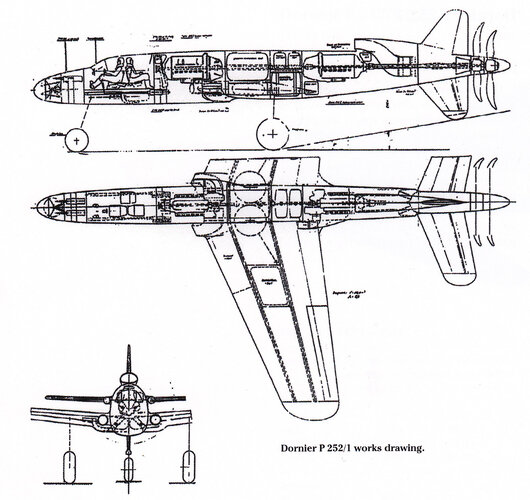
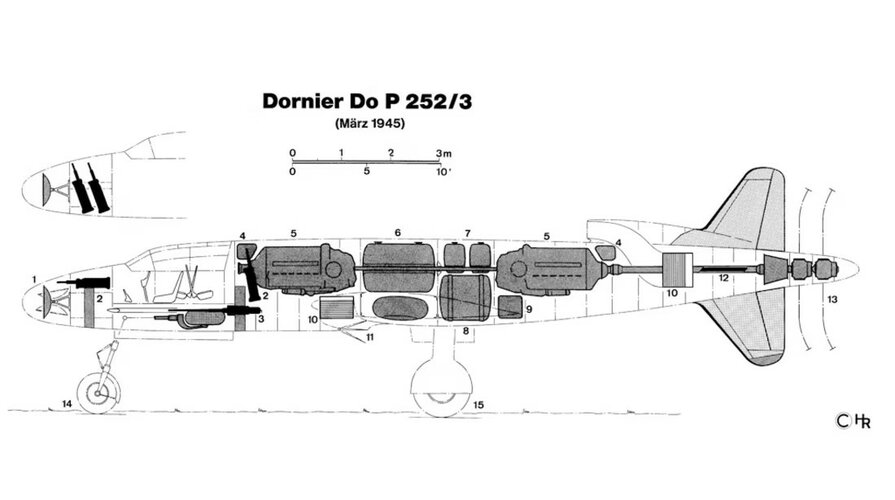
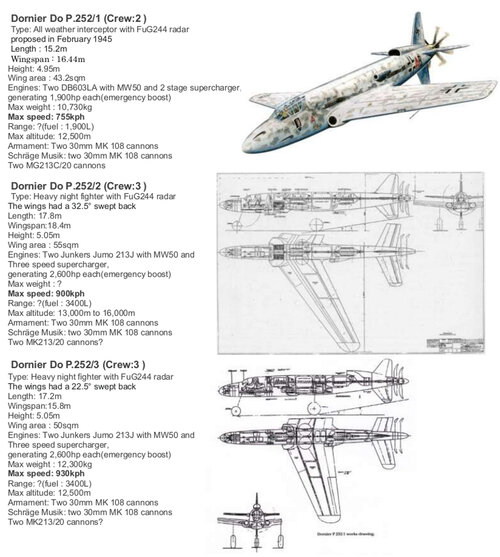
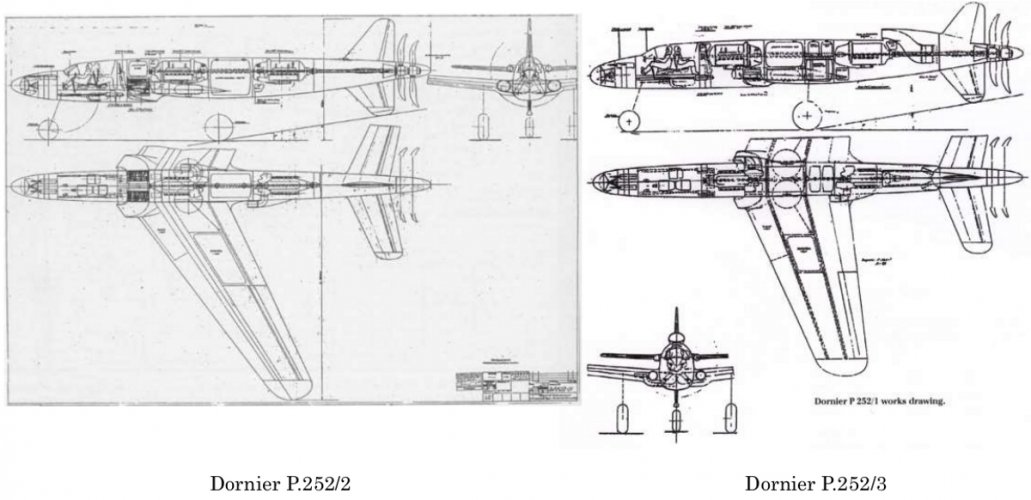
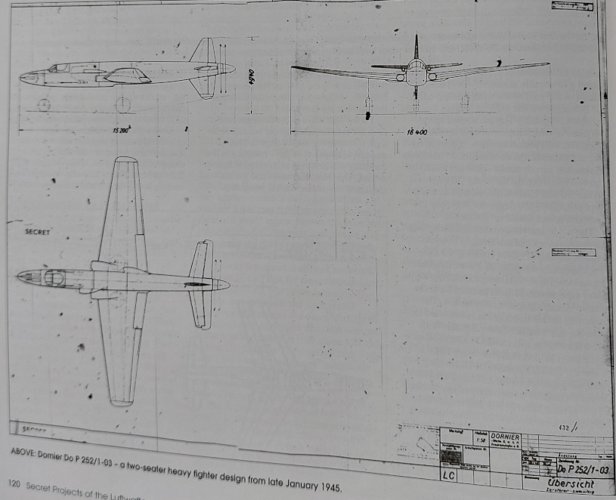
The Do P 252 was designed as an all-metal shell construction and was intended as an all-weather destroyer, but also as a night fighter and fighter-bomber. Its attack armament could have been adapted to the respective operational tasks. It normally comprised two 30 mm MK 108s with 2 x 80 and 1 x 60 rounds in the interchangeable nose cone and two MG 213C/20s with 120 rounds each in the fuselage below the front engine. For night fighter missions, it was possible to convert to two MK 108s with 100 rounds each as a fixed inclined armament (70°). For fighter-bomber missions, a bomb load of up to 1000 kg could be carried under the outer wings. The radio and navigation equipment of the Do P 252 was very extensive in keeping with the tasks of this model and was state-of-the-art. The large cockpit with access via a ladder through the nose wheel well was initially designed for two men, but was later enlarged to accommodate three men.

The Do P 252 was equipped with either two Daimler-Benz DB 603 LA or Jumo 213 J engines, which were installed in tandem in the fuselage and drove the counter-rotating, detachable thrust screws in the rear via interlocking long-distance shafts.
In Project 1 of the Do P 252, these were still conventional VDM propellers with adjustable wooden blades and a diameter of 3.20 m.
For Projects 2 and 3, however, the Pfeil propellers were chosen, which represented a technical innovation. They came from the Heine company. The DB 603 LA and Jumo 213 J were two liquid-cooled twelve-cylinder engines with two-stage chargers and MW 50 injection. Both developed a take-off power of over 2000 hp. The exhaust rows of the two engines could be fitted with flame arresters for night-time hunting missions.

The airframe and the wing were also changed several times. Project 1 received a two-spar, all-metal wing with a laminar profile and a span of 16.40 m.
The latter was increased to 18.40 m in Project 2, and the aerodynamic area was also larger at 55 m2 due to the stronger sweep.
Project 3, on the other hand, had a slightly smaller wing with a smaller nose sweep (25°) and a span of 15.80 m. As with the Do 335, the edge of the lower vertical fin was designed as a spring-loaded emergency skid. The arrangement of the tail unit was also adopted from the Do 335.

The projects may be technologically interesting even from today's perspective, but by mid-1944 at the latest it was clear that they would not have been realized given the course of the war and the ever-worsening shortage of materials.

Aviation Classics Issue 04/2012
https://www.flugrevue.de/klassiker/nachfolger-der-do-335-dornier-projekte-p-247-p-252/
 

Attachments

  • P.252-1.jpg
    P.252-1.jpg
    120.1 KB · Views: 222
  • P.252-2.JPG
    P.252-2.JPG
    302.7 KB · Views: 211
  • P.252-3.jpg
    P.252-3.jpg
    508.6 KB · Views: 221
Last edited:
Another information.
http://www.airwar.ru/enc/xplane/p252.html
The Dornier P.252 project was accepted for development as early as 1943, but was too late to be submitted to the Luftwaffe, according to their request and specification (27 January 1945) for a night fighter. Three variants were made within the project (P.252/1, /2 and /3), all of which were similar, despite slight differences in the dimensions and shapes of the wing schemes.

The P.252/3 had a long fuselage with a large cabin for three crew members. The wings were swept back at 22.5° with a dihedral "V". It was supposed to use two 12-cylinder Jumo 213J liquid-cooled engines (1,750 hp each) with a MW 50 system, which were to be installed in tandem and drive two 3.2-meter contra-rotating propellers (three-bladed propellers with 50° swept blades). Air flow was supplied to the front engine through round air intakes located in the wing roots. The second engine - through air intakes located on the sides in the rear part of the fuselage (2nd variant) or through a side air intake on the left side of the fuselage and a side air intake on the right (3rd variant). In addition, the 3rd variant had a large air intake in the rear part of the fuselage above the cruciform tail unit. The advantage of such a tail unit design was that the lower stabilizer also served as protection for the propellers from hitting the ground during takeoff.

The landing gear was supposed to be three-strut with a nose strut. The main struts retracted into the fuselage, and the front strut retracted toward the tail section.

The three crew members were in the cockpit located at the front of the fuselage, the pilot and radar operator sat back to back on the left side, while the navigator was on the right side facing the starboard side and slightly behind.

The P.252 had a powerful and varied armament (see table below), and also had an internal parabolic radar antenna under the fairing of the interchangeable nose section.

Although this design had many advantages over others, such as excellent visibility from the cockpit (due to the engines and propellers being in the tail), heavy armament and a long endurance (approximately four hours), the official Luftwaffe request called for an aircraft that would be powered by turbojet engines. Thus, the P.252 design was not accepted.​
 
Last edited:
Dornier Do P.252/3 Data w/two Jumo 213J engines
SpanLengthHeightWing
Area
Empty
Equipped Weight
Loaded
Weight*
Max. Wing
Loading
Max.
Speed
Rate of
Climb
Ceiling
15.8 m
51' 9.5"
17.2 m
56' 4.8"
5.05 m
16' 6"
50 m²
538 ft²
8600 kg
18959 lbs
12300 kg
27116 lbs
246 kg/m²
50.4 lbs/ft²
930 km/h
577 mph
21 m/sec
69 ft/sec
12500 m
41000'
* with 3400 liters (748 gallons) fuel

http://www.luft46.com/dornier/dop252.html
 

Attachments

  • b910e938-9344-4d44-82c5-ba2e0c8f0c64.jpg
    b910e938-9344-4d44-82c5-ba2e0c8f0c64.jpg
    67.1 KB · Views: 230

Attachments

  • DORNIER P.59-05.jpg
    DORNIER P.59-05.jpg
    92.5 KB · Views: 240
Last edited:
Hi!
Source : THE ULTIMATE PISTON FIGHTERS OF THE LUFTWAFFE JUSTO MIRANDA, etc

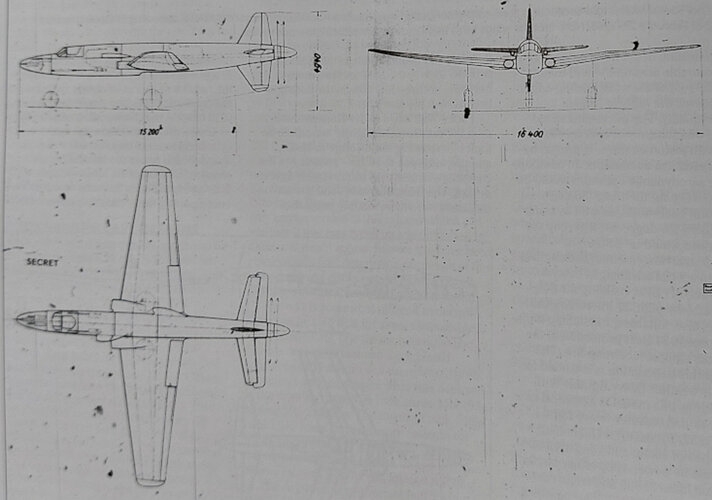
I have not seen any supposedly official drawings of the Dornier P.252/1 fighter.
 

Attachments

  • 252.jpg
    252.jpg
    531.3 KB · Views: 230
  • P.252-1.jpg
    P.252-1.jpg
    395.5 KB · Views: 214
Last edited:

Attachments

  • Dornier P254-1.jpg
    Dornier P254-1.jpg
    35.5 KB · Views: 77
  • 481659946_646415127765973_2063693354135244832_n.jpg
    481659946_646415127765973_2063693354135244832_n.jpg
    1.2 MB · Views: 60
  • 536119223_772515045155980_3141466011257792217_n.jpg
    536119223_772515045155980_3141466011257792217_n.jpg
    228.7 KB · Views: 57
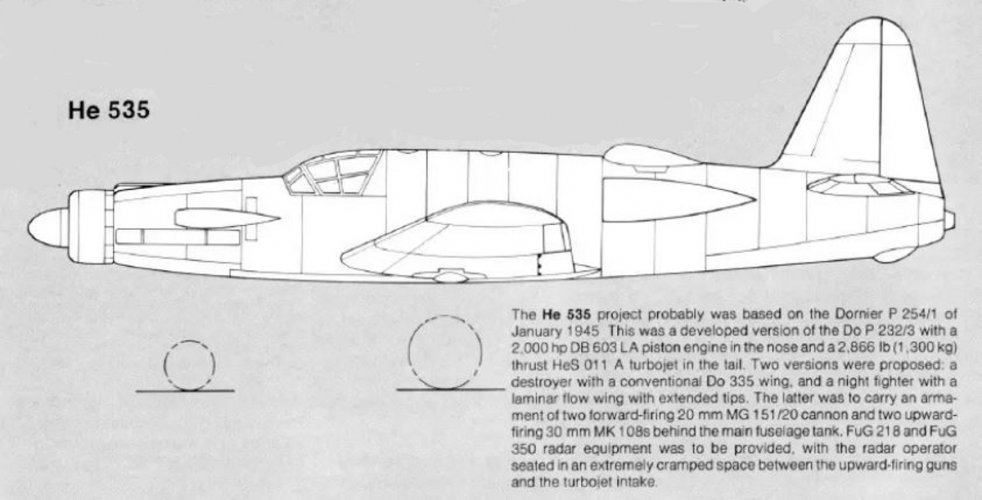
  • He 535.JPG
    He 535.JPG
    253.7 KB · Views: 55
  • mv7TKb-70C3E028-251F-462B-9729-494C13162A5F.jpg
    mv7TKb-70C3E028-251F-462B-9729-494C13162A5F.jpg
    1.5 MB · Views: 45
Last edited:
Hi! Do P 232/2 and P 232/3.
https://war-book.ru/dornier-p-232-istrebitel/https://www.aerospaceprojectsreview.com/blog/?p=2267
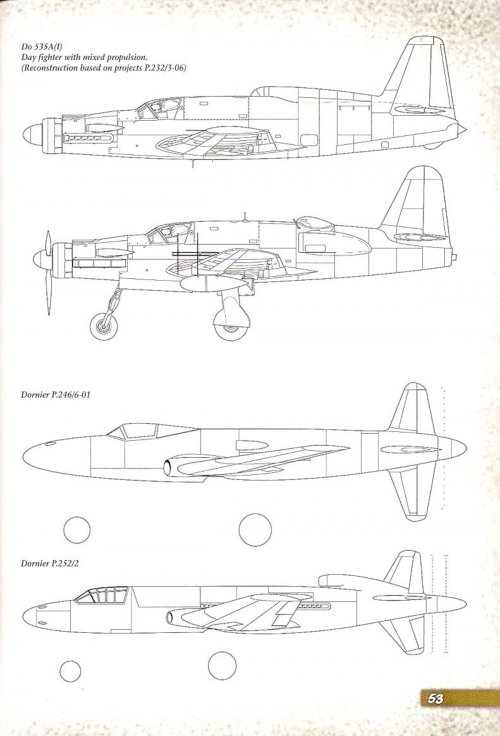
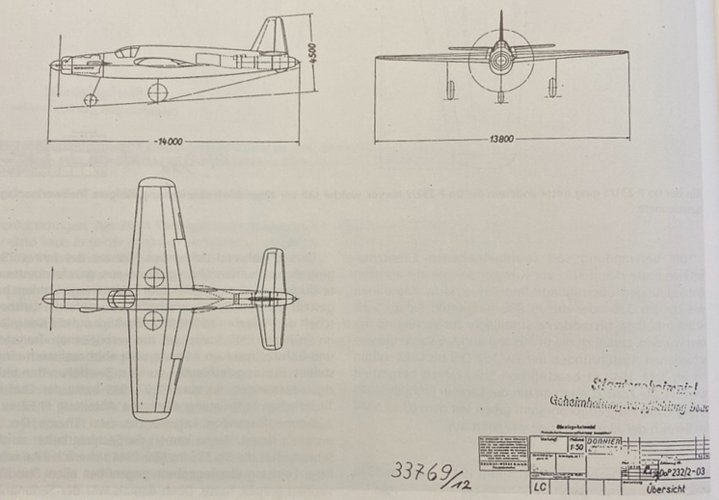
The Dornier P232/2 project began development in May 1943 as a single-seat heavy fighter, attack aircraft, and high-speed bomber. The aircraft was based on the Dornier Do-335 design, with a new propulsion system, which became a hybrid: a Junkers Jumo 004C jet engine and a Daimler Benz DB 603G piston engine. Work on the aircraft ceased in the fall of 1943, as all resources were concentrated on the development of the Dornier Do-335.

Dornier P232/2:
Engines: 1 x 1190 hp Daimler Benz DB 603G and 1 x 1200 kg Junkers Jumo 004C
Dimensions:
- wingspan – 13.8 m
- length – 14.0 m
- height – 4.5 m
- wing area – 38.5 sq.m.
Empty weight – 5370 kg
Fuel weight – 2550 l
Full weight – 8450 kg
Max. speed – 660 km/h
Ceiling – 13200 m
Takeoff run – 740 m
Armament: 1 x MK103 and 2 x MG151/20 or 2 MK103, 500 kg of bombs or 1000 kg in overload

Dornier P232/3:
Engines: 1 x 1190 hp Daimler Benz DB 603G and 1 x 1200 kg Junkers Jumo 004C
Dimensions:
- wingspan – 13.8 m
- length – 13.8 m
- height – 5.6 m
- wing area – 33.5 sq.m.
Empty weight – 5100 kg
Fuel weight – 1980 l
Full weight – 7750 kg
Max. speed – 420 mph
Ceiling – 13,300 m
Takeoff run – 1980 ft
Armament: 1 x MK103 and 2 x MG151/20 or 2 MK103, 500 kg bombs or 1000 kg overload
 

Attachments

  • P232-2.jpg
    P232-2.jpg
    80.1 KB · Views: 54
  • P232-3.jpg
    P232-3.jpg
    72.6 KB · Views: 51
  • 833041490_o.jpg
    833041490_o.jpg
    100.7 KB · Views: 58
  • 833041554_o.jpg
    833041554_o.jpg
    121.4 KB · Views: 62
  • samplepage3.jpg
    samplepage3.jpg
    672 KB · Views: 69
Last edited:
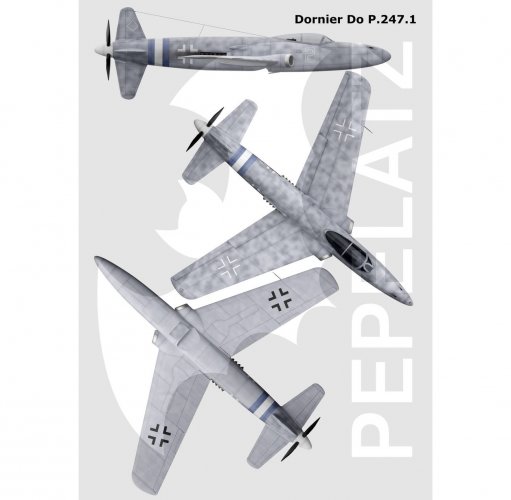
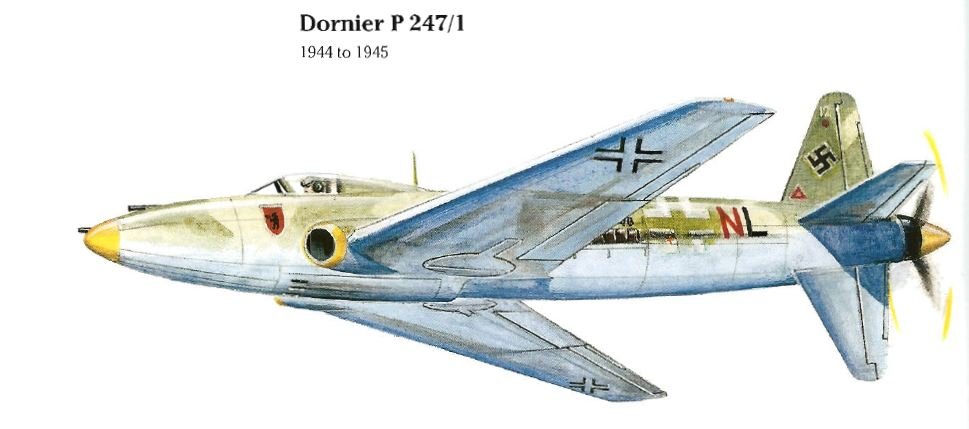
Hi! Dornier P,247/1.

Dornier Do P.247
Crew : 1, Engine Junkers Jumo 213×1
Wingspan ; 12 m, Length : 12.06 m, Height : 4.4 m, Wing surface : 25 m²
Fuel : 1040 kg
Maximum speed : 835 km/h
Armaments: Rheinmetall-Borsig MK 108
History
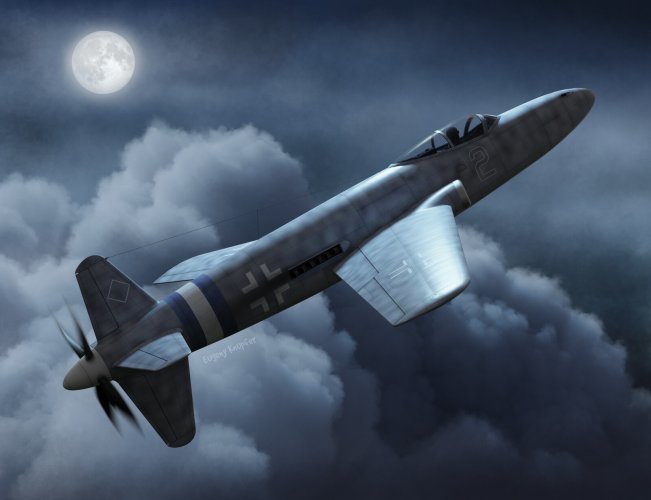
The performance of the Do 335 led to its redesign with different technical concepts. The P.247 thus saw the front propeller removed and the engine moved behind the pilot, to the middle of the fuselage, freeing up space in the nose for the installation of three 30mm Rheinmetall-Borsig MK 108 cannons. Power was provided by a Junkers Jumo 213 V12 engine, rated at 2,600 hp and delivering 1,850 hp at an altitude of 11,300 m.
The wings had a 28-degree rake . It carried 1300 liters of fuel for a takeoff weight of 6200 kg .
This prototype was never followed by mass production due to World War II.(Wikipedia)
https://www.artstation.com/artwork/A9eE4zhttps://aeroscale.net/news/dornier-do-p-247-1-test-casthttp://www.flying-things.ch/dornier.htm
 

Attachments

  • eugeny-knupfer-p-247-01-1600.jpg
    eugeny-knupfer-p-247-01-1600.jpg
    216.4 KB · Views: 67
  • P247-1.jpg
    P247-1.jpg
    142.3 KB · Views: 71
  • Do247.jpg
    Do247.jpg
    55.8 KB · Views: 74
Last edited:
There are some difference between P.252/2 and P.252/3.
For example, wing shape rear engine radiator.......
P.252/1 had a straight wing..
 

Attachments

  • Dornier P252.jpg
    Dornier P252.jpg
    261.1 KB · Views: 61
  • P252-1.jpg
    P252-1.jpg
    506.6 KB · Views: 65
Last edited:
Hi!
Do 435's wider cockpit means side by side seating.
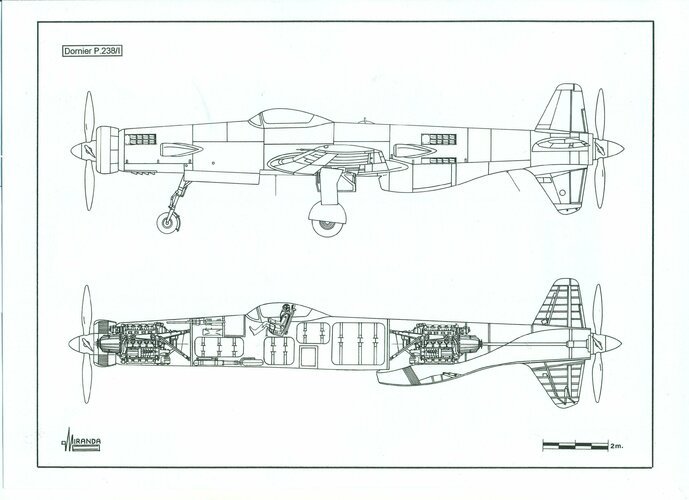
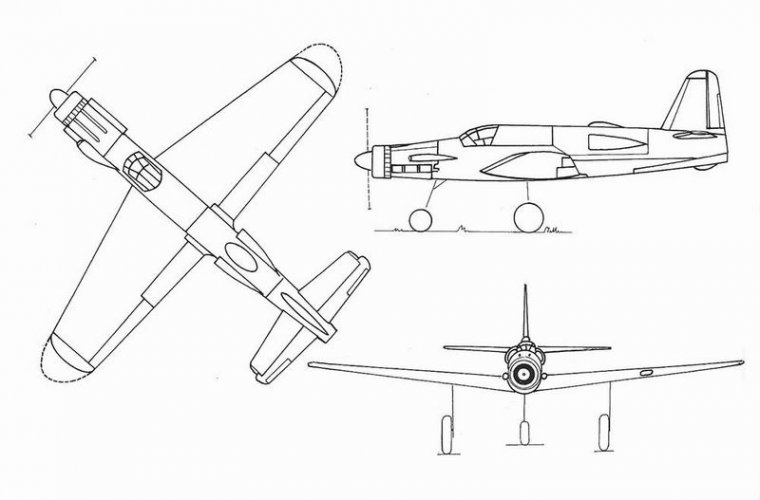
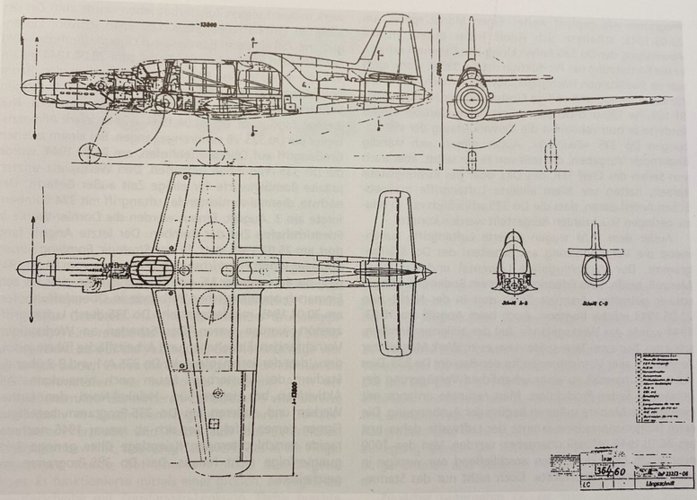
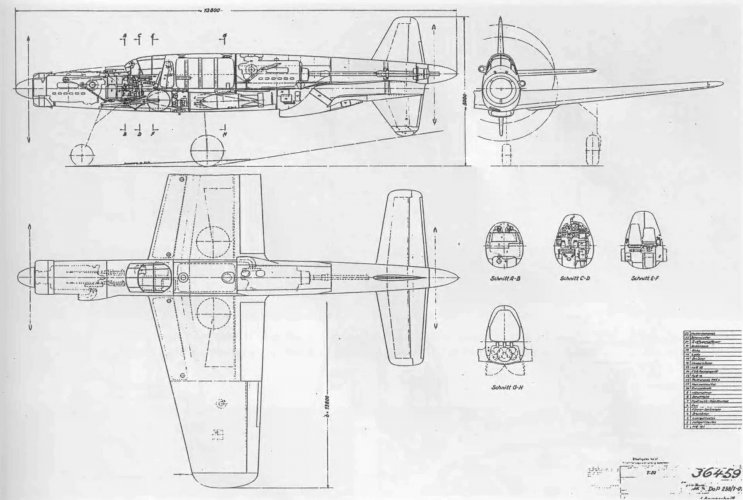
Please confirm following drawing for Do P.238/1-02? Fighter project(Do 435). (But engine is not Jumo222 and span is same as Do 335)
I imagine that another P.238 version has Jumo222 engine and extended wing. (Also has extended fuselage?)
 

Attachments

  • do335_p238_2-1920w.jpg
    do335_p238_2-1920w.jpg
    199.6 KB · Views: 95
Last edited:
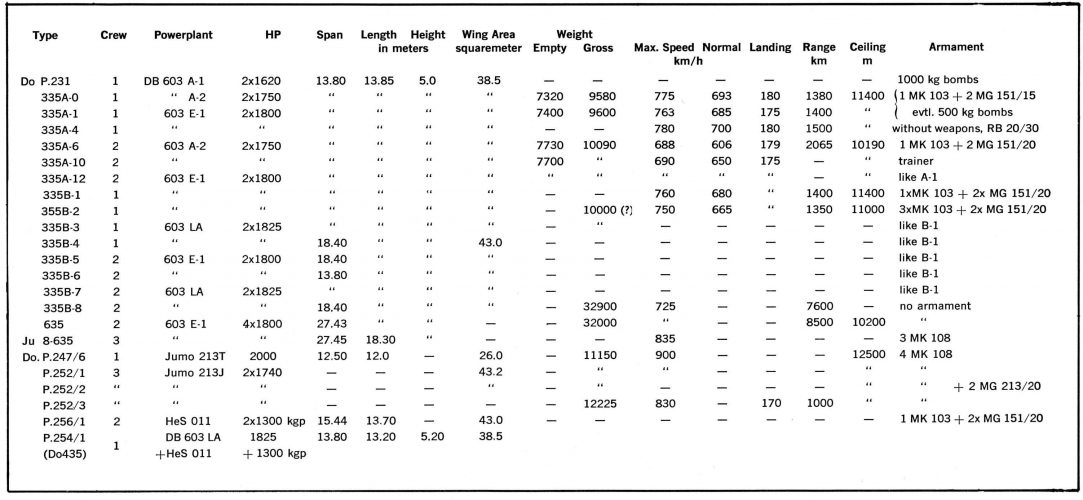
does anyone know what is the fastest Do 335 was in prototype stage or built?

i heard about some Do 335 B-3 / B-4 with Do DB 603 LA engines but i can't find one image for these Do 335 prototypes

Which Do 335 had strongest engines and was built !?
 
i wish if this image tell which Do 335 are in the images it's hard to tell what prototypes these Do 335 are but what i found is this
the Do 335 B-1 was abandon it used DB 603 LA engine and DB 603 E does anyone have images for the Do 335 B-1?
1781545179824.png am trying to find a really built Do 335 not in paper ! 1781545254607.png
 

Attachments

  • 1781545077807.png
    1781545077807.png
    1.1 MB · Views: 74
Do 335 Night Fighter Radar

Apparently, the possibility of installing the parabolic antenna in the spinner was also considered.

February 1, 1944
We conducted preliminary tests on the Dornier 335 involving the placement of the parabolic dish near the propeller. This is only feasible with inline engines, where we can route the cables through the axle between the cylinders. With radial engines, of course, it is not possible.

Source: Bundesarchiv
Signatur: RL 3/28; Page: 701
Direct Link:
https://invenio.bundesarchiv.de/invenio/direktlink/21911449-a6e7-4a60-9379-76a2b1733c7a/

Signatur: RL 2-V/181; Page: 279-280
Direct Link:
https://invenio.bundesarchiv.de/invenio/direktlink/2adda46b-81bf-4818-aeb3-5fc5f9bb1455/


Funkmeß-Antennen für Flugzeug-Bordgeräte
This document dated 30 September 1944 mentions the installation of the FuG 244 "Bremen" radar (Obertasse, Flügelobertassen / Teller) for the Dornier 335.
https://www.secretprojects.co.uk/threads/german-late-war-radar-development.25713/post-341790
 
Last edited:
Dornier 335 - Mixed-Propulsion

March 22, 1945
Production of the Bf 109, Fw 190, and Do 335 aircraft is discontinued.

March 22, 1945
The Führer does not agree with the cancellation of the Dornier 335. He insists on gaining practical experience with it at all costs.

March 26, 1945
The Dornier 335 project will be continued as a technical development task. In particular, work on the experimental aircraft with combined piston and jet propulsion is to be accelerated.

March 26, 1945
The Dornier 335 remains in the aircraft production program with a monthly output of 15 units. Production takes place in southern Germany.


Source: Bundesarchiv
Signatur: RL 3/2567; Page: 291, 295
Signatur: RL 3/2692; Page: 163, 165
 

Similar threads

Back
Top Bottom