Cool Science

The T. rex of the sea has been discovered, from Seven Days of Science (Hosted by English Clark Kent):


Palaeontologists have announced the discovery of a new kind of aquatic T. rex, a mosasaur species named Tylosaurus rex!
 
On research
https://phys.org/news/2026-06-dual-outgrow-national-oversight-analysis.html

Ice suppresion
https://phys.org/news/2026-06-plane-ice-bridges-reveal-suppress.html

Sound suppression
https://phys.org/news/2026-06-newfound-bulky-effective-soundproofing.html

A record flight and jet fuel
https://techxplore.com/news/2026-06-airbus-passenger-plane-fly-hours.html
https://techxplore.com/news/2026-06-plastic-yields-jet-fuel-kilogram.html

X-Ray improvements
https://techxplore.com/news/2026-06-real-ray-compression-size.html
https://phys.org/news/2026-06-ray-method-captures-solid-liquid.html

New camera
https://techxplore.com/news/2026-06-spiders-ultra-efficient-3d-camera.html
https://techxplore.com/news/2026-06-snapshot-3d-depth-coded-aperture.html
https://techxplore.com/news/2026-06-artificial-eyes-human-sight-cars.html
https://techxplore.com/news/2026-06-competition-threaten-gopro.html
https://techxplore.com/news/2026-06-sonarcamera-murky.html

lasers
https://phys.org/news/2026-06-cavity-strategy-blue-vertical-surface.html
https://phys.org/news/2026-05-quantum-boost-ultrafast-laser.html
https://phys.org/news/2026-06-ultrafast-laser-chip-scale-potentially.html
https://phys.org/news/2026-06-fiber-optic-components-enable-high.html
https://phys.org/news/2026-06-laser-cell-protein-networks-chemical.html
https://phys.org/news/2026-05-laser-enable-robust-miniaturized-sources.html
https://techxplore.com/news/2026-05-ai-ultralow-energy-lasers-enable.html
https://phys.org/news/2026-05-atom-camera-laser-nanoscale-ultracold.html

Optics
https://phys.org/news/2026-06-3d-microscope-technology-captures-high.html
https://phys.org/news/2026-06-small-optical-component-telescopes-view.html
https://phys.org/news/2026-06-3d-microscope-technology-captures-high.html
https://phys.org/news/2026-06-ai-paired-tiny-optical-device.html
https://phys.org/news/2026-06-photoexcitation-flips-2d-moir-devices.html
https://phys.org/news/2026-06-ai-optical-surfaces-real-world.html
https://techxplore.com/news/2026-06-framework-generates-shadow-art-scan.html
https://phys.org/news/2026-06-route-tailor-diamond-nanoparticles-quantum.html
https://phys.org/news/2026-06-terahertz-imaging-spatial-chirality-materials.html
https://techxplore.com/news/2026-06-ai-vision-prosthetics-closer-reality.html
https://phys.org/news/2026-06-gold-nanoparticles-vibrant-visible-spectrum.html
https://phys.org/news/2026-05-optoelectronic-synapse-exceptional-photoresponse-neuromorphic.html
https://phys.org/news/2026-06-entangle-easily-quantum-critical.html
https://phys.org/news/2026-06-method-uncovers-conical-intersections-driven.html
https://phys.org/news/2026-05-math-discriminates-exotic-classical-materials.html
https://phys.org/news/2026-05-topological-states-emerge-quantum-hall.html
https://phys.org/news/2026-06-tech-enables-scientists-emperor-penguins.html
https://phys.org/news/2026-05-axial-encoding-eightfold-faster-3d.html
https://phys.org/news/2026-06-flawless-flipped-hidden-defects-2d.html
https://phys.org/news/2026-06-terahertz-biophotonics-path-applications-biological.html
https://phys.org/news/2026-06-quantum-friction-nanoworld-movements.html
https://phys.org/news/2026-06-cryo-electron-microscopy.html
https://phys.org/news/2026-06-dynamic-terahertz-wavefront-stretchable-walled.html
https://phys.org/news/2026-06-molecule-ultranarrow-emission-spectrum.html
https://techxplore.com/news/2026-06-transparent-oled-advance-ar-displays.html
https://phys.org/news/2026-06-rare-earth-free-zinc-oxide.html
https://techxplore.com/news/2026-06-transistor-memory-emission.html
https://phys.org/news/2026-06-hardy-ice-optical-possibilities.html
https://techxplore.com/news/2026-06-artificial-eyes-human-sight-cars.html
https://phys.org/news/2026-06-magnon-momentum-microscopy-window-nanoscale.html
https://phys.org/news/2026-06-source-flim-playground-analysis-complex.html
https://phys.org/news/2026-06-physicists-synchronized-quantum-excitons-phonons.html
https://phys.org/news/2026-06-tunnel-vision-imaging-ai-fluorescence.html

The photon, split
https://phys.org/news/2026-06-photon-infinite-swarm-particles.html

physics
https://phys.org/news/2026-06-critical-te-decay-century-alpha.html
https://phys.org/news/2026-06-physicists-molecular-condensates.html

Cannibal cell
https://phys.org/news/2026-06-cell-cannibalistic-supergiant-swallowing-clones.html

More biology news
https://phys.org/news/2026-06-growth-forests-alaska-british-columbia.html
https://phys.org/news/2026-06-seeds-weeds-succeed-uncover-ways.html
https://phys.org/news/2026-06-early-life-rna-extinction-prone.html
https://phys.org/news/2026-06-gene-swapping-planet-decomposers.html
https://phys.org/news/2026-06-epigenetic-inherited-dna-animals.html
https://phys.org/news/2026-06-medicinal-yield-carbon-nanoparticles-red.html
https://medicalxpress.com/news/2026-06-3d-genome-architecture-pre-wires.html
https://medicalxpress.com/news/2026-06-people-gas-app.html
https://phys.org/news/2026-06-magnesium-discovery-rice-nutrition.html
https://phys.org/news/2026-06-brazilian-breadbasket-aquifers-falling-satellite.html
https://phys.org/news/2026-06-birds-newton-theory-sharpen-flocks.html
https://phys.org/news/2026-06-methods-tracking-individual-bird-species.html
https://phys.org/news/2026-06-animal-alike-species-common-communication.html
https://sciencex.com/news/2026-06-ancient-compound-key-metabolic-harmony.html
https://phys.org/news/2026-06-global-mycorrhizal-fungi-reveals-true.html
https://phys.org/news/2026-06-slime-molds-decisions-internal-fluid.html
https://phys.org/news/2026-06-evolutionary-history-millipede-dating-million.html
https://phys.org/news/2026-06-rivers-isnt-fish-evolving-response.html
https://phys.org/news/2026-06-newfound-whale-necropolis-reveals-million.html
https://phys.org/news/2026-06-ice-age-sea-falls-seafloor.html
https://phys.org/news/2026-06-lack-sex-held-life-diversity.html
https://phys.org/news/2026-06-animals-behaviors-alphas.html
https://phys.org/news/2026-06-anti-jellyfish-buoy.html
https://phys.org/news/2026-06-ocean-collapse-triggered-ancient-wildfires.html
https://thedebrief.org/this-species...ted-one-alive-and-well-on-a-carribean-island/
https://www.dailymail.com/sciencete...nge-creature-appears-boat-chilling-video.html
https://www.upi.com/Odd_News/2026/0...arket-Christchurch-New-Zealand/2441781023736/

Frankencells
https://phys.org/news/2026-06-scientists-unveil-ten-year-roadmap.html
https://phys.org/news/2026-06-bacteria-memories-brain.html
https://phys.org/news/2026-06-yeast-reveal-evolutionarily-backup-route.html
https://phys.org/news/2026-05-brain-cells-play-doom.html

Social studies and history
https://phys.org/news/2026-06-americans-struggles-deep-political-bipartisan.html
https://phys.org/news/2026-06-politicization-humanities-scholarship-compromise-scholarly.html
https://phys.org/news/2026-06-archaeologists-uncover-year-evidence-siege.html
https://phys.org/news/2026-06-technology-efforts-rome-colosseum-ipiranga.html
https://phys.org/news/2026-06-theoretical-isotopes-spectroscopy-results.html
https://phys.org/news/2026-06-ocean-collapse-triggered-ancient-wildfires.html
https://thedebrief.org/2600-year-ol...ent-structure-hidden-below-egypts-nile-delta/
https://boingboing.net/2026/06/08/hundreds-of-tiny-medieval-tunnels-no-one-can-explain.html
https://studyfinds.com/stonehenges-altar-stone-likely-from-scotland/
https://www.smithsonianmag.com/smar...-porcelain-dishes-and-luxury-goods-180988910/

learning
https://medicalxpress.com/news/2026-06-peripheral-vision-readers-words-milliseconds.html
https://phys.org/news/2026-06-day-museum-kids-curiosity-generations.html

Mystery
https://phys.org/news/2026-06-great-mysteries-archaeology-ancient-amazonian.html

fire and food
https://phys.org/news/2026-06-wonderwerk-cave-bones-reveal-human.html
https://hackaday.com/2026/06/08/optimizing-pancakes-from-chemical-principles/
https://techxplore.com/news/2026-06-espresso-coffee-world.html

Nature 200
https://phys.org/news/2026-06-scientists-years-nature.html
https://phys.org/news/2026-06-rival-coexist-secret-soil-beneath.html

Radiosonds
https://sondehub.org/#!mt=Mapnik&mz=5&qm=3h&mc=53.46189,-2.24121&box=aboutbox

More on weather and climate
https://phys.org/news/2026-06-hurricane-rainfall-landslide-southern-california.html
https://phys.org/news/2026-06-river-temperature.html
https://phys.org/news/2026-06-tracking-antarctic-ice-breakup.html
https://phys.org/news/2026-06-ai-coastal-cities-seas-extreme.html
https://phys.org/news/2026-06-satellite-reveal-southern-ocean-vertical.html
https://phys.org/news/2026-06-aerosols-cool-climate.html

Strange storms
View: https://m.youtube.com/shorts/VCwGzHWg4ok

https://x.com/ProjectVORTEXv4
https://x.com/intent/follow?ref_src=twsrc^tfw|twcamp^tweetembed|twterm^2062942760554860685|twgr^|twcon^s1_&ref_url=&screen_name=Gio_wx
https://weather.com/2026/06/05/news/weather/video/watch-home-fall-into-ocean-in-outer-banks
https://sciencex.com/news/2026-06-sea-worse-hidden-earth-physics.html
https://phys.org/news/2026-06-saturday-citations-greenland-sharks-quantum.html

Volcanism and geology
https://phys.org/news/2026-06-volcanic-eruptions-linked-famine-china.html
https://en.wikipedia.org/wiki/Titan_Ridge_Volcano
https://phys.org/news/2026-06-superheated-magma-similar-volcanoes-erupt.html
https://phys.org/news/2026-06-mount-etna-eruptions-reveal-carbon.html
https://phys.org/news/2026-06-evidence-yinshan-block-reveals-earth.html
https://phys.org/news/2026-06-massive-kamchatka-earthquake-rupture-overlaps.html
https://phys.org/news/2026-06-california-tectonic-stress-earthquake-reveals.html
https://phys.org/news/2026-06-drone-surveys-reveal-steep-alpine.html
https://phys.org/news/2026-06-superheated-magma-similar-volcanoes-erupt.html
https://www.livescience.com/planet-...catastrophic-stage-emerging-research-suggests

On language and consciousness
https://phys.org/news/2026-06-language-theories-fascinating.html
https://phys.org/news/2026-06-consciousness-unique-earthlings-paper.html
https://studyfinds.com/benefits-of-sleep-without-sleeping/
https://www.popularmechanics.com/preview/science/a71320046/superior-sleep-better-memory/
 
Last edited:
What lies beneath Antarctica's ice-cap:


Vostok, Antarctica, is one of the most remote and hostile places on the planet. Perched atop the South Geomagnetic Pole some 1,200 kilometres inland, it is a barren, frozen wasteland, with average winter temperatures hovering around -70ºC. On July 21, 1983, Vostok experienced the lowest temperature ever recorded on earth: a mind-numbing -89.2ºC. This, for the record, is colder than frozen carbon dioxide, or dry ice, which forms at a relatively balmy -78.5 degrees. It will come as no surprise, then, that this frigid outpost is inhabited almost exclusively by Russians. Established by the Soviet Union in 1957, Vostok Research Station has been inhabited almost continuously ever since, hosting around 25 scientists in the summer and 13 in the winter. The station’s name, which in Russian means “East,” comes from the flagship of Russian Admiral Fabian von Bellingshausen, who in 1820 became the first European to set eyes on Antarctica. Bellinghausen’s other ship, the Mirny or “Peaceful,” provides the namesake of Mirny Station on the coast. As aircraft cannot fly during the dark Antarctic winter, every year a convoy of snow tractors must make an epic 1,410 kilometre journey inland from Mirny to Vostok to keep the remote station resupplied. For over 50 years, Vostok Station has been involved in a wide variety of geophysical research including studying the earth’s magnetic field and drilling deep boreholes into the ice sheet to study the planet’s changing climate. But in 1993, researchers made an astonishing discovery that forever changed our understanding of the frozen southern continent. Deep below Vostok Station, buried under four kilometres of ice, lies a pristine body of liquid water the size of Lake Ontario, sealed off from the outside world for some 25 million years. It is one of the most unique and mysterious environments on earth, and one which may yield insights into our planet’s distant past and the existence of life on other planets. Welcome to the bizarre subglacial world of Lake Vostok.​
The existence of liquid lakes beneath the Antarctic ice sheet was first proposed in the late 19th Century by Russian anarchist and polymath Peter Kropotkin. However, it would be another half-century before scientists would uncover evidence to support his hypothesis. During the Soviet Antarctic expeditions in 1959 and 1964, geographer Andrey Kapitsa conducted a series of seismic soundings to measure the thickness of the ice sheet around Vostok Station. Strangely, some of these soundings indicated the presence of smooth, flat areas amid the jagged bedrock. In the 1970​
 
Scientists have revealed the biggest ever scorpion known to science:


Palaeontologists have just unveiled the largest scorpion to have ever lived, as far as we currently know - an enormous predator that lived over 400 million years ago and possessed pincers more than 6 inches long. Meet Praearcturus gigas.
 
A study solves the mystery of why humans are mostly right-handed, from Anton Petrov:


Hello and welcome! My name is Anton and in this video, we will talk about why humans are mostly right handed
Links:
https://journals.plos.org/plosbiology...https://www.youtube.com/redirect?ev...id=10.1371/journal.pbio.3003771&v=HtMCDWwLHrA
https://pmc.ncbi.nlm.nih.gov/articles...
https://www.youtube.com/redirect?ev...616222/pdf/biology-13-00502.pdf&v=HtMCDWwLHrA
Other videos: • Nanaimoteuthis: The 19-Meter Super-Predato...
https://www.youtube.com/watch?v=-qReEt7vjHA
#handedness #righthanded #biology


0:00 Righty or lefty? Animal kingdom rule
1:45 Why humans are kind of unique - the 90%
2:50 New study answers why it's usually right
5:50 How this compares to other cousins
6:40 One exception
8:00 So it's all about efficiency
8:50 What about other animals?
11:02 ...and plants?
12:40 So it's genetic...maybe?
13:30 What about lefties? The Fighting Hypothesis
15:30 Conclusions and summary
 
Electron matter waves impart torque
https://phys.org/news/2026-06-electron-gain-ultrafast-torque-flips.html

Wave shielding
https://phys.org/news/2026-06-janus-nanomaterials-pave-capturing-radioactive.html

Between those two perhaps a Judder drive is a bit closer.

String theory
https://www.science.org/content/article/after-empty-promises-string-theory-finds-new-uses

Light

Creativity cannot be boxed

Sheep

Skeeters and more
https://phys.org/news/2026-06-harmonic-radar-tags-reveal-mosquitoes.html
https://phys.org/news/2026-06-ghosts-mediterranean-rare-great-white.html
https://www.livescience.com/28828-10-strangest-sights-google-earth.html
https://www.livescience.com/planet-earth/has-all-the-water-on-earth-been-peed-before
https://www.livescience.com/planet-...-span-10-percent-of-the-milky-way-map-reveals
https://phys.org/news/2026-06-saturday-citations-jaxa-collaboration-toy.html
https://www.livescience.com/planet-...ten-note-from-richard-feynman-gets-deciphered

Climate
https://phys.org/news/2026-06-gulf-stream-shifted-north-year.html
https://phys.org/news/2026-06-solar-geoengineering-shield-oceans.html

Tornado threat
https://m.youtube.com/post/UgkxJEPFEagFN2nAOff8dAWn1bvWbpC_QnY0

Aftermath
https://talkweather.com/threads/severe-weather-threat-june-6-14.2527/page-40#post-208362
https://stormtrack.org/threads/2026-06-09-reports-sk.33449/
https://weather.com/2026/06/12/news/trending/video/tornado-rips-through-illinois
https://weather.com/2026/06/11/storms/tornado/video/tornado-carves-through-unionville-missouri

Solar farm hit
https://www.youtube.com/watch?v=Q7Bp1tuqurA

From 2011
https://talkweather.com/threads/significant-tornado-events.1276/page-734#post-208379

At close range
https://www.youtube.com/watch?v=05c04cAurBw
https://m.youtube.com/watch?v=N3qqp7XwL1I&ra=m

Twisters in Canada
https://weatherbrains.com/?p=11597

Fire breaks out in studio
https://talkweather.com/threads/severe-weather-threat-june-6-14.2527/page-6#post-207635
https://twisterzone.com/

Quake resistant structures
https://techxplore.com/news/2026-06-resilient-earthquakes-solution.html

Volcano
https://m.youtube.com/watch?v=o75HsCFvaK8&ra=m

Carbon storage
https://phys.org/news/2026-06-mountainous-landscapes-carbon-previously-thought.html

Mini-universe
https://phys.org/news/2026-06-scientist-miniuniverse-clock.html
 
Last edited:
The deadliest tree in the world:


In 1999, British radiologist Nicola Strickland went on holiday with a friend to the Caribbean island of Tobago. While exploring a deserted beach looking for seashells, the pair came upon a number of small, round, yellow-green fruits scattered among the fallen coconuts and mangoes. Intrigued, they decided to try the fruits and found them to be pleasantly sweet. But that pleasure was not to last. In a 2000 article in the British Medical Journal, Strickland describes what happened next:​
“Moments later we noticed a strange peppery feeling in our mouths, which gradually progressed to a burning, tearing sensation and tightness of the throat. The symptoms worsened over a couple of hours until we could barely swallow solid food because of the excruciating pain and the feeling of a huge obstructing pharyngeal lump.​
Over the next eight hours our oral symptoms slowly began to subside, but our cervical lymph nodes became very tender and easily palpable. Recounting our experience to the locals elicited frank horror and incredulity, such was the fruit’s poisonous reputation.”​
Indeed, Strickland and her friend were extraordinarily lucky to survive their ordeal, for the tree the innocuous-looking fruit had fallen from was none other than the Manchineel, a plant so extraordinarily toxic that one cannot touch it, shelter beneath it...​
This is an abridged version of a video on our channel TodayIFoundOut which you can check out and subscribe to here: / @todayifoundout
 
Change how you look and you find a lot more. If you dive deep with intensely bright white light, everything flees. Red/infrared however generally doesn't bother deep sea animals because they can't see it - their vision is optimised to see the frequencies of bioluminescence - blue and green. This means that we can see a lot more undisturbed behaviour.

View: https://www.youtube.com/watch?v=-W1Mwd0BWT4


01:20 - The Mistake
03:17 - Invisible Light
04:37 - The Breakthrough
07:56 - So Many Secrets
09:53 - The Least Explored Place on Earth
13:14 - How to Find a Colossal Squid
 
The pion unmasked
https://phys.org/news/2026-06-supercomputer-illuminates-subatomic-particle.html

Fire the chromium beam
https://phys.org/news/2026-06-unique-chromium-cosmic-ray-galactic.html

On packing and motion;
https://phys.org/news/2026-06-motion.html

Lipid cruncher
https://phys.org/news/2026-06-lipidcruncher-platform-molecular-analysis-transparent.html

Imaging and optics
https://techxplore.com/news/2026-06-upsampling-method-sharpens-ai-vision.html
https://phys.org/news/2026-06-silicon-compatible-nanocomposite-garnet-enables.html
https://techxplore.com/news/2026-06-tiny-chip-cameras-hidden.html
https://phys.org/news/2026-06-ai-driven-optical-tweezers-hundreds.html
https://techxplore.com/news/2026-06-lidar-material-properties.html

Thermo-glove
https://techxplore.com/news/2026-06-wearable-glove-personal-insights.html
https://techxplore.com/news/2026-06-stretchable-powered-sensor-stable-elongation.html

New flights
https://techxplore.com/news/2026-06-qantas-sydney-london-flights-october.html

Biology
https://phys.org/news/2026-06-timescapes-animal-species-events-differently.html
https://phys.org/news/2026-06-fossilized-babies-ancient-crocodile-predators.html

Academic misconduct
https://phys.org/news/2026-06-drivers-academic-misconduct-professors-students.html

Drone footage of twister

From last week
https://www.weather.gov/lot/2026_06_11_SevereWeather

Enderlin
https://www.reddit.com/r/EF5/

The real Cloverfield monster

The tiniest supercell
https://talkweather.com/threads/severe-weather-thread-6-15-26-6-18-26.2531/page-18#post-208872

Enterprise Alabama,


Up north
https://x.com/ryanhallyall/status/2067418513434677737
https://x.com/MaxVelocityWX/status/2067414466619154773
https://x.com/BreakingXAlerts/status/2067416488902816185
https://x.com/BradArnoldWX/status/2067428912976593285
https://x.com/HurricaneIsaac/status/2067448526389281035
https://x.com/BadWeatherKyle/status/2066762404286103774
https://weather.com/2026/06/18/storms/tornado/video/tornado-devastating-path-effingham-illinois
https://weather.com/2026/06/13/storms/severe/severe-weather-outbreak-midwest-northeast-forecast
https://weather.com/2026/06/15/stor...o-state-in-2026-is-not-oklahoma-texas-alabama

String of pearls
https://x.com/StrmchsrHunterF/status/2067373148950151556

Wild
https://talkweather.com/threads/severe-weather-thread-6-15-26-6-18-26.2531/page-36#post-209257
https://talkweather.com/threads/severe-weather-thread-6-15-26-6-18-26.2531/page-52#post-209563
https://www.reddit.com/r/tornado/comments/1u98gc4/tornado_damage_north_of_bloomington_indiana/
https://www.youtube.com/watch?v=jdFIGg_M3W4

Chicago even had a tornado warning

25 inches of rain fell here in 24 hours
https://x.com/MaxVelocityWX/status/2067686905190187195
 
Last edited:
A video about the most powerful recorded earthquake in history:


️ 1960 Valdivia Earthquake – The Strongest Earthquake in Recorded History
On May 22, 1960, the city of Valdivia, Chile, was struck by a devastating magnitude 9.5 earthquake, the most powerful ever recorded on Earth. This catastrophic event reshaped the region, triggered deadly tsunamis across the Pacific, and left a lasting mark on world history.
 
It would appear that scientists have figured out how pigeons navigate, from Anton Petrov:


0:00 Homing pigeons and human communication
1:30 New study solves the mystery of their navigation
2:18 Previous theories on how this works - eyes, iron particles and ion channels
4:15 Macrophages and ferritin inside liver and spleen
6:27 Connection to nerves and possible explanation
7:02 Elegant experiment and conclusions
8:55 Implications
10:20 Conclusions
 
More on the 'Cretaceous Kraken' saga:

View: https://www.youtube.com/watch?v=O8AObaTZluk&t=35s


Essentially, the 16 m lengths that are much commented on are the extreme upper end of a wide range of possibilities. Even at the lower end of the range of possible sizes, N. haggarti is still an impressive beast, comparable to a great white shark in size. The idea that they may have preyed on mosasaurs - fast, generally upper ocean predators - is less likely than their preying on other molluscs such as giant bivalves and ammonites - and indeed there's abundant fossil evidence of ammonites being eaten by other cephalopods, judging by damage to their shells. It's still a very exciting find despite not conforming to our need for sea monsters.

Gratuitous rant: I would say it's one of my pet peeves but I have many, so one of my menagerie of peeves is the particular subset of YouTube clickbait headlines that start with 'They lied' or some variant - they banned, the secret, they didn't want you to see, et bloody cetera. 'They banned' footage from this cult film? No, it was cut because it was shit. 'They suppressed this technology' No, it just flopped, it cost too much and nobody wanted it. 'They lied about...' No, they were just mistaken, based on overenthusiasm and scant evidence. It's an ironic pity that this creator has to resort to this nonsense to get traction with the algorithm (the real nefarious 'they').
 
The first artificial cell, from Anton Petrov:


Hello and welcome! My name is Anton and in this video, we will talk about the first ever artificial cell
Links:
https://www.biorxiv.org/content/10.64...https://www.youtube.com/redirect?event=video_description&redir_token=QUFFLUhqa092MUVoSHo2aU9ISW80ZTQ1enlpNUxXOWhoZ3xBQ3Jtc0tuX3dLSGZ6MkdMS3ZZaUJnZlJFay1oMWtQTVRCbzlGeFBfY3VHaGllNUNjSE1rRDZwZ21ZQi1ZeGcyV2VvdkZRWFcxbjhleHhZNzhKT3lxZFRPU0V3LW9pWkJ3bWdYMnB6ZDkzYTB5ZHctRlUxbUQwNA&q=https://www.biorxiv.org/content/10.64898/2026.07.01.735724v1.full.pdf&v=YIK5Hb8cB2Q
https://biotic.org/research/spudcell/https://www.youtube.com/redirect?event=video_description&redir_token=QUFFLUhqa1FTT1R5RWZhYjlRZUJibTlEbF95eXFnSENhd3xBQ3Jtc0tuMGttY05GRHBKRlE4X1VDNkN0clZfNkE1VkxUMWNOSG8xRHQ0S2VVVVM0Q1J6dnhENVJZY1JJTzFBdG15cGV1T3VWZ1VjVGd4d2J5YXNyMC1pSmtnSG0zNUgzbXM0bXFQdUpnc0ZrY1Zkd2p5QUYtVQ&q=https://biotic.org/research/spudcell/&v=YIK5Hb8cB2Q
Previous videos:
https://www.youtube.com/watch?v=0MRGJNKACYs
• Artificial Cell With Synthetic Genome Can ...
View: https://www.youtube.com/watch?v=g1hEJ0klRYc

• Major Advances in Synthetic Biology Result...
• Scientists Create an Artificial Cell With ...
View: https://www.youtube.com/watch?v=OxVZPKmm58M

#artificialcell #syntheticcell #biology

0:00 Most complete artificial cell ever made - the Spudcell
1:40 What is an artificial cell though? Example of Synthia
2:38 Bottom up approach used this time
3:20 What is Spudcell?
4:15 How it works inside
5:40 Replication
7:55 Artificial evolution through beneficial mutations
9:38 Why this is important
12:35 Public access and what's next? Conclusions
 
Last edited:
An overview of the state of the art in human hibernation or 'synthetic torpor.'

https://www.theguardian.com/science/ng-interactive/2026/jul/14/human-hibernation-space-mars

This surprised me:

“Protecting humans from radiation in space is very challenging,” Hahn says. “We haven’t yet found an effective shield.”

Research has found that hibernation defends against this harm. During hibernation, animals reduce their metabolic activity, use less oxygen, and tightly pack their DNA strands, all of which protect against radiation damage. Moreover, hibernators possess potent DNA repair mechanisms.


And this:

Since 2023, several groups, including scientists at Washington University in St Louis, have used ultrasound, a noninvasive technique that transmits sound waves, to trigger synthetic torpor in animals. Cerri and his colleagues, who receive funding from the Esa, are hoping to begin testing this approach soon in healthy human volunteers.

Hrvatin notes that this preoptic neural circuit probably exists in a wide variety of animals, including some that don’t hibernate or enter torpor at all. To Hrvatin, this suggests that it would be possible to trigger a hibernation-like state in animals that don’t normally shut themselves down. “Key aspects of the circuit appear to be conserved across different animals,” he says. “I think we can use it to modify metabolism.” It’s not clear if this preoptic circuit exists in humans; no one has looked. Hrvatin is planning to explore this question soon.
 
Oldest amber found rewrites plant history, from Anton Petrov:


0:00 Amber
1:10 What is amber and how does it form?
4:00 Why was this ability evolved?
4:50 New discovery from Devonian
6:10 What happened on Earth back then?
8:05 Amber era that lasted 54 million years
10:40 Why amber is important for science
11:55 Conclusions and implications
 
Here's an interesting video on our distant predecessor, Homo Erectus, and why it was scary (It was around for 1.9 million years before going extinct):


For nearly two million years, one human species owned the Earth — and compared to them, we are barely a rumor.
This is the story of Homo erectus, the toughest human that ever walked. They controlled fire before fire had a name. They crossed oceans no other primate could cross. They hunted apex predators in their own territory. They survived ice ages, supervolcanic eruptions, and the rise and fall of entire predator guilds. Six times longer than our species has existed.​
From the 1891 discovery on the banks of Java's Solo River, to Turkana Boy emerging from a Kenyan riverbed in 1984, to the Peking Man fossils that vanished during the Second World War, to the broken skulls of Zhoukoudian and the tiny "Hobbit" descendants found on Flores in 2003, this is the full story of the scariest human species that ever existed. Stronger than us. Tougher than us. And gone now, except for one thing: the body you live in.​
If you enjoyed this video, hit subscribe for more on prehistoric life, mass extinctions, and the deep history of Earth.
 
A video about how geneticist compared the DNA profiles of all 37 extant cat species and made some surprising discoveries:


In 2006, scientists sequenced DNA from all 37 wild cat species alive on Earth and compared them in a single study. The family tree that came out looked nothing like what everyone had assumed. The cheetah turned out to be in the wrong group entirely. The snow leopard got reclassified. A new species of clouded leopard was discovered hiding in plain sight. And the house cat's closest wild relative isn't the leopard — it's a tiny desert cat most people have never heard of.​
This video covers what that genetic comparison actually revealed: where cats originally came from, how they spread across every continent, why the cheetah is genetically closer to a cougar than to a lion, and what the DNA says about the animal sitting on your windowsill right now.​
Sources:
— Johnson W.E. et al. (2006). The Late Miocene Radiation of Modern Felidae: A Genetic Assessment. Science, 311(5757), 73–77.
— Buckley-Beason V.A. et al. (2006). Molecular Evidence for Species-Level Distinctions in Clouded Leopards. Current Biology, 16(23), 2371–2376.
— Driscoll C.A. et al. (2007). The Near Eastern Origin of Cat Domestication. Science, 317(5837), 519–523.
— Eizirik E. et al. (2001). Molecular Genetics and Evolution of Melanism in the Cat Family. Current Biology, 11(6), 448–451.
 
PBS Eons has uploaded this new video about the Great Dying also known as the End-Permian and Permo-Triassic extinction, this is part 1 of a 6-part series:


In the Late Carboniferous Period, predatory amphibians and giant arthropods ruled the swamps. But ancient seed plants and amniotes were evolving adaptations to drier climates. These will help them thrive on Pangea in the Permian Period to come.​
This is the first our our six-part series on life and death during the Permian period. Episode 2 is available right now! Watch the full series on the PBS App https://to.pbs.org/EonsApphttps://www.youtube.com/redirect?ev...Jx&q=https://to.pbs.org/EonsApp&v=RY8mipBWjyw​
Sign up for an invitation email to our watch party on August 4th at 4pm ET / 1pm PT
https://mailchi.mp/complexly/rsvp-pangea
Eons is a production of Complexly for PBS Digital Studios.
00:00 Where to Watch
00:10 The Great Dying
03:30 The History of Complex Life
05:33 The Late Carboniferous Period
14:49 The Seed
16:51 The Rise of Amniotes
21:39 The Carboniferous Rainforest Collapse
23:18 Welcome to Pangea
25:17 Next Time
25:46 Watch Party!
26:02 Credits
 
A video from Astrum Earth concerning new findings concerning the T. rex:


Did we get the T. Rex all wrong? New evidence suggests it was even bigger, stronger and deadlier than scientists previously thought. From its teeth, to its size, strength and speed, find out how recent breakthroughs have turned what we knew about T. Rex upside down.
▀▀▀▀▀▀
0:00 T. Rex
1:42 Discovery
5:08 Updated Skeleton
7:15 T. Rex Teeth
11:07 Did T. Rex Have Feathers?
17:03 Bigger Than We Thought
21:40 Faster Than We Thought
23:46 “Teen Rex”
28:34 Sense of Smell
30:13 T. Rex Vision
30:54 Deadlier Than We Thought

▀▀▀▀▀▀
References:
“The Making of T. Rex”, via newscientist.com https://astrumspace.info/trex
“Stance and Gait in the Flesh-Eating Dinosaur T. Rex”, via wiley.com https://astrumspace.info/trexstance
“Theropod Dinosaur Facial Reconstruction”, via science.org https://astrumspace.info/trexface
“Fossil Biomolecules Reveal an Avian Metabolism”, via nature.com https://astrumspace.info/warmtrex
“Decoupling Body Shape and Mass Distribution in Dinosaurs”, via nature.com https://astrumspace.info/trexshape
“Estimation of Maximum Body Size in T. Rex”, via wiley.com https://astrumspace.info/trexsize
“Evidence of Bird-Like Foot Function in Tyrannosaurus”, via royalsocietypublishing.org https://astrumspace.info/trexfoot
“Prolonged Growth and Development in T. Rex”, via peerj.com https://astrumspace.info/trexgrowth
“Nanotyrannus and Tyrannosaurus Coexisted”, via nature.com https://astrumspace.info/nanotyran
“Olfactory Receptor Repertoire Size in Dinosaurs”, via nih.gov https://astrumspace.info/trexnose
 
A new video concerning the evolution of Wales from hoofed ungulates originating in the Palaeocene era:


How did a small, deer-like land mammal become the largest animal to ever exist? In this video, I break down a new 2026 review paper by paleonbiologist Travis Park, published in Nature Reviews Biodiversity, which pulls together decades of fossil discoveries into the most complete picture of whale evolution we've ever had.​
We'll trace the journey from Pakicetus and other early archaeocetes wading through Eocene rivers in what's now Pakistan and India, through the fully aquatic Basilosauridae, all the way to the origin of modern baleen and toothed whales (Neoceti) and the key innovations, baleen and echolocation, that let them take over the oceans.​

Edit: Recent studies have found that the T. rex was even more scary than previously thought.
 
Last edited:
What happens if you freeze water in a super strong container that won't expand:


Some readers may recall a science class in which an excitable teacher walked to the front of the class to show off a small, cracked steel container, seemingly damaged by an incredibly powerful, but tiny force; only for said teacher to reveal that the damage had been done by nothing more than water. However, what would happen if you put the water in a container it couldn’t break out of and then froze it?​
This is an abridged version of a video on our channel TodayIFoundOut which you can check out and subscribe to here: / @todayifoundout
 
Some interesting news from Seven Days Of Science:


Palaeontologists have announced the discovery of the oldest-ever reptile known to be preserved with soft tissue traces of the stomach, liver and intestines, as an extraordinary Triassic-aged long-necked marine reptile has been uncovered in spectacular condition!

The oldest preserved stomach, liver and intestines in a fossil reptile (Austronaga minuta):https://www.science.org/doi/10.1126/s...https://www.youtube.com/redirect?ev....org/doi/10.1126/sciadv.aeb7528&v=nFtaMstPnCc

Chapters:
0:00 - Intro
0:29 - Oldest reptile fossil with internal organs
7:02 - Curiosity Box unboxing
12:52 - Outro
 
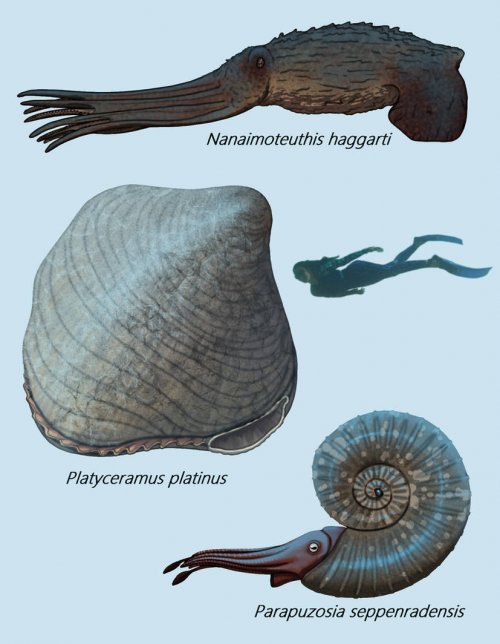
Continuing my mollusc obsession, the largest molluscs of the Cretaceous (that we know of). Nanaimoteuthis haggarti is depicted at the lower end of its possible range of sizes. It may have preyed on the bivalve, Platyceramus, and the ammonite, Parapuzosia, by chewing through their shells rather than munching on mosasaurs.

Art by Cindy Joli.

prehistoric_mega_molluscs_by_joliaquaislander_dmem1r3-414w-2x.jpg
 
The oldest cephalopod fossil has been found and more from 7 Days of Science:


The oldest cephalopod ever has been discovered; 40,000-year-old bird carvings made from mammoth ivory have been unearthed in Germany; scientists have revealed that hawkmoths can smell with their wings; and much more in this week's science news!

Sources:

Earliest cephalopod with a siphuncle:
https://www.nature.com/articles/s4158...https://www.youtube.com/redirect?ev...com/articles/s41586-026-10868-y&v=cqTxjRYbFa4
https://www.sci.news/paleontology/eoc..https://www.youtube.com/redirect?ev.../eoceras-shaanxiense-14958.html&v=cqTxjRYbFa4
Chapters:
0:00 - Intro
0:31 - Oldest cephalopod found so far
1:59 - Giant predatory amphibian from the Arctic
3:04 - New troodontid dinosaur Dinevenator robustus
4:00 - 40,000-year-old bird carvings
4:53 - Pluto’s atmosphere is shrinking
6:07 - Hawkmoths can smell with their wings
7:05 - Risk of a ‘bioinvasion super-spreader event’
8:25 - An AI ‘Raygun’ that can shrink or supersize proteins
9:25 - Outro
 
The New Scientist channel put out an interesting video concerning the KT-extinction event:


Dinosaurs are the biggest creatures to have ever walked on land, dominating Earth for over 130 million years. But how could such extraordinary creatures have simply vanished in the blink of a geological eye? For decades, we've assumed these prehistoric megafauna – a staple of our childhoods and Hollywood movies – went extinct for one simple reason: the asteroid that hit Earth was so unimaginably large that it changed everything in one single blow. But now, thanks to new research, an even more intriguing idea has emerged: size alone doesn't explain what happened.​
The real reason the impact was so devastating may have been its angle. Had the asteroid arrived a little steeper, the outcome might have been different. A little shallower, different again. And for life on Earth at the time, predominantly dinosaurs on land, marine creatures in the sea and pterosaurs in the air, it appears to have struck at almost the worst possible angle imaginable, launching vast quantities of rock, dust and climate-altering gases high into the atmosphere and triggering one of the greatest mass extinctions in Earth's history.​
About New Scientist:
New Scientist was founded in 1956 for “all those interested in scientific discovery and its social consequences”. Today our website, videos, newsletters, app, podcast and print magazine cover the world’s most important, exciting and entertaining science news as well as asking the big-picture questions about life, the universe, and what it means to be human.​

00:00 Introduction
02:30 The Mystery Before The Asteroid
10:05 This Asteroid Changed Everything
20:13 The World After Dinosaurs
23:24 Creating The Amazon
27:56 The Asteroid Was Just The Beginning

New Scientist
https://www.newscientist.com
/#palaeontology #dinosaur #dinosaurextinction #prehistoriclife #jurassicworld #science
 

Similar threads

Back
Top Bottom