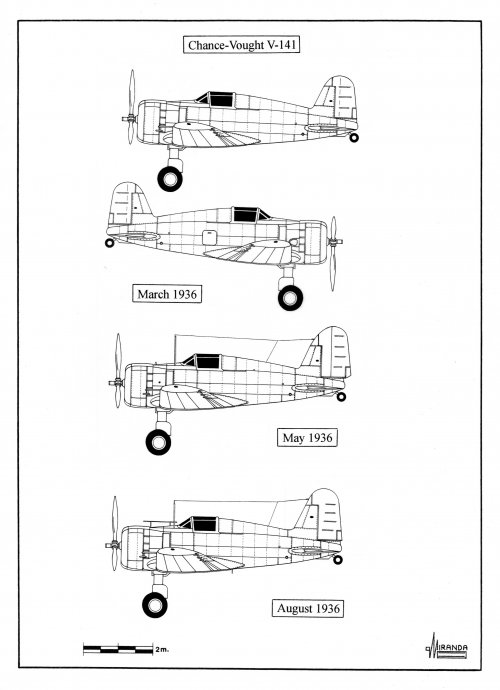
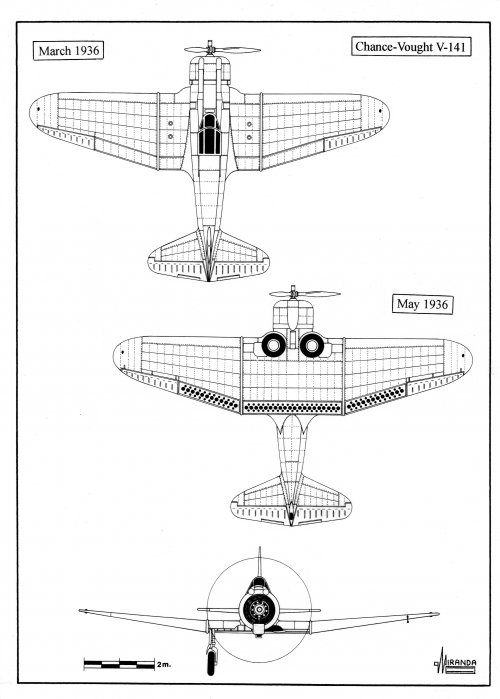
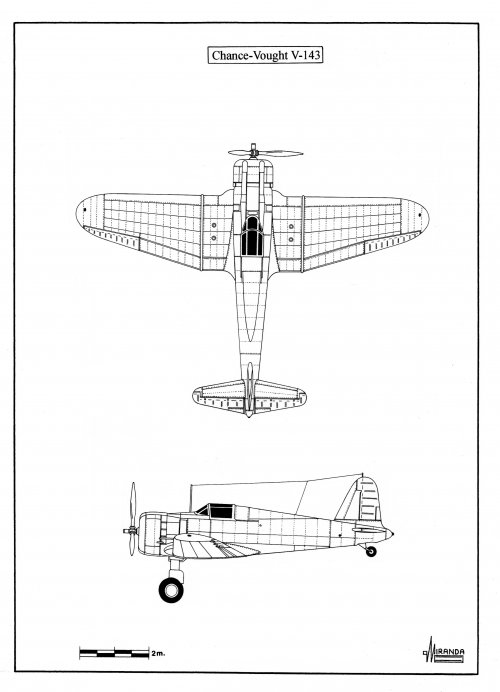
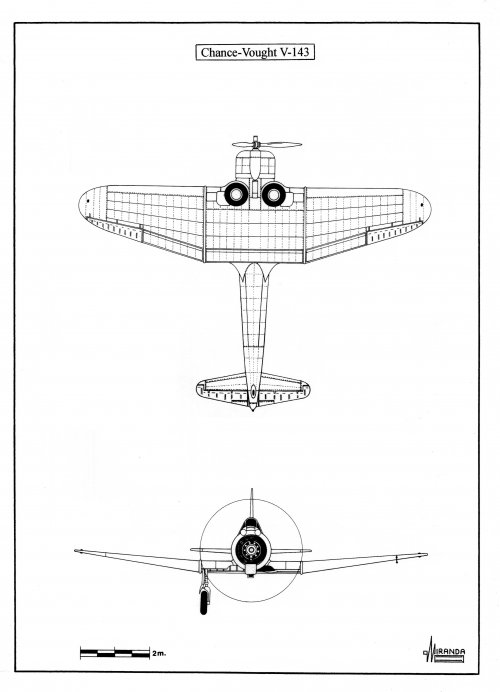
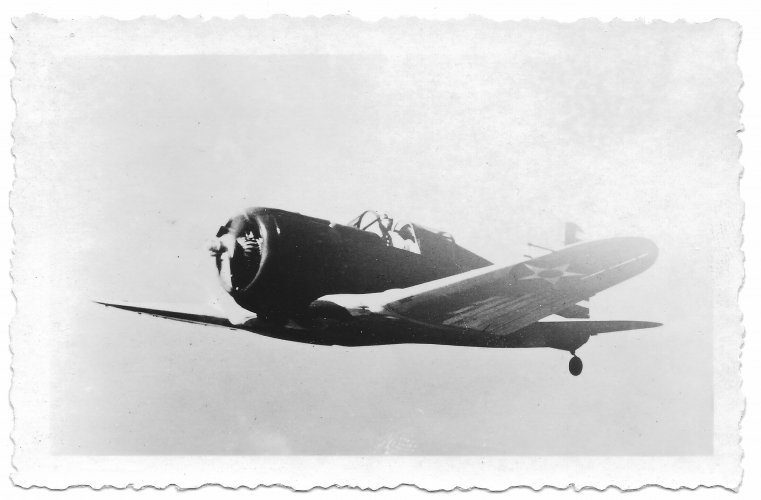
Chance-Vought V-141/V-143
By the mid-1930s, the Northrop Gamma 3 series fighters had acquired an alarming reputation after being rejected by the U.S. Navy and the U.S. Army Air Corps, but the Chance-Vought firm was interested in the construction technology and landing gear retraction system used in the Northrop 3 A prototype.
In January 1936, Vought acquired the Gamma 3 project from Northrop and the manufacturing license from Douglas.
To take part in the USAAC Pursuit Plane Competition that was delayed to April 15, 1936, the prototype Vought V-141 (c/n 1228) was built in just 45 days, with technical assistance from Northrop.
Compared to the Northrop 3A fighter the V-141 was fitted with redesigned cockpit hood and engine cowling, increased tailfin, revised oil cooler intake and simplified landing gear. The Vought engine chassis allowed the use of one row or two row engines without any major change in the fuselage structure.
The prototype was flown on March 29, 1936, at Rentschler Field-East Hartford. In April it was tested by the USAAC Matériel Division at Wright Field flying at 402 km/h, but the aircraft had inherited from Northrop 3A the same longitudinal stability problems, tendency to spin and poor control at low speeds and was rejected.
In May, Vought attempted to interest the U.S. Navy with a navalized version of the V-141, increasing the rudder height by 13-cm and the chord by 11-cm, the three flaps being replaced by perforated flaps that had been developed for the Northrop Gamma 2J in December 1935 and an R/T device with radio mast was installed.
The modified V-141 had a landing speed of only 105 km/h, but the Navy was not interested in the project.
In August 1936 the manufacturer obtained an export license, and the prototype was again modified with standard flaps, the rudder was replaced by another with a larger surface area and with a height increased by 50-cm, a telescopic gunsight mounting, a Colt MG-40 machine gun for synchronization tests and an anti-spin parachute were installed.
Between August 1936 and May 1937, the modified V-141 was offered to the air forces of Argentina, Turkey, Yugoslavia, Norway and Sweden, being rejected in all cases because successive modifications had failed to eliminate the dangerous defects of the original design.
Northrop engineers recommended increasing the fuselage length to improve the low effectiveness of the elevator and rudder.
In June 1937 the fuselage was modified, the tail surfaces were replaced by others that had been developed for the Vought XSB2U-1, a retractable tail wheel and a new, more powerful engine were also installed.
These changes improved the spinning characteristics, and the aircraft was reclassified Export Pursuit V-143 (NR-56V).
On June 23, 1937, the prototype made a demonstration for the USAAC flying at 523 km/h powered by an R-1830 engine with 100-octane fuel, but it was also not accepted on this occasion.
The aircraft was finally sold to the Japanese firm Mitsui on July 8, 1937.
On September 8, the Japanese also acquired manufacturing rights from Douglas.
In December, all the documents and technical drawings of the project were sent to Mitsui's offices in New York.
In Japan, the V-143 was redesignated Navy Experimental Fighter AXV1 and tested in competition with the Nakajima Ki.21 and Mitsubishi A5M Japanese fighters, but its mass production was not considered.
Chance-Vought V-141 technical data
Wingspan: 10.21 m, length (March 29, 1936): 6.95 m, length (May 1936): 7.06 m, height: 2.84 m, wing area: 17.37 sq. m, max weight: 2,009 kg, max speed: 441 km/h, service ceiling: 8,626 m, climb rate: 2,560 ft/min, range: 1,133 km, proposed armament: one 0.3-in (500 rpg) and one 0.5-in (200 rpg) nose mounted machine guns, power plant: one Pratt & Whitney R-1535-A5G air cooled radial engine rated at 750 hp driving a three-bladed, variable pitch Hamilton Standard airscrew with 2.9 m of diameter.
Painting schemes
USAAC proposal March 29, 1936
Overall natural metal, red engine cowling, meatball insignias in four positions, white/red stripes in the rudder and black walking in the port wing root.
U.S. Navy proposal May 1936
Blue fuselage and wheel caps, natural metal wings and tail surfaces, meatball insignias in four positions, white/red stripes in the rudder and black walking in the port wing root.
Exportation version August 1936
Blue fuselage, tailfin and wheel caps, natural metal wings.
Chance-Vought V-143 technical data
Wingspan: 10.21 m, length: 7.92 m, height: 2.84 m, wing area: 17.37 sq. m, max weight: 1,982 kg, max speed: 470 km/h, service ceiling: 9,327 m, climb rate: 3,225 ft/min, range: 1,300 km, proposed armament: one 0.3-in (500 rpg) and one 0.5-in (200 rpg) nose mounted machine guns or two wing mounted 20-mm (45 rpg) cannons, power plant: one Pratt & Whitney R-1535-SB4G air cooled radial engine rated at 825 hp or one Pratt & Whitney R-1535-S4C4 air cooled radial engine rated at 1,200 hp driving a three-bladed, variable pitch Hamilton Standard airscrew with 2.9 m of diameter.