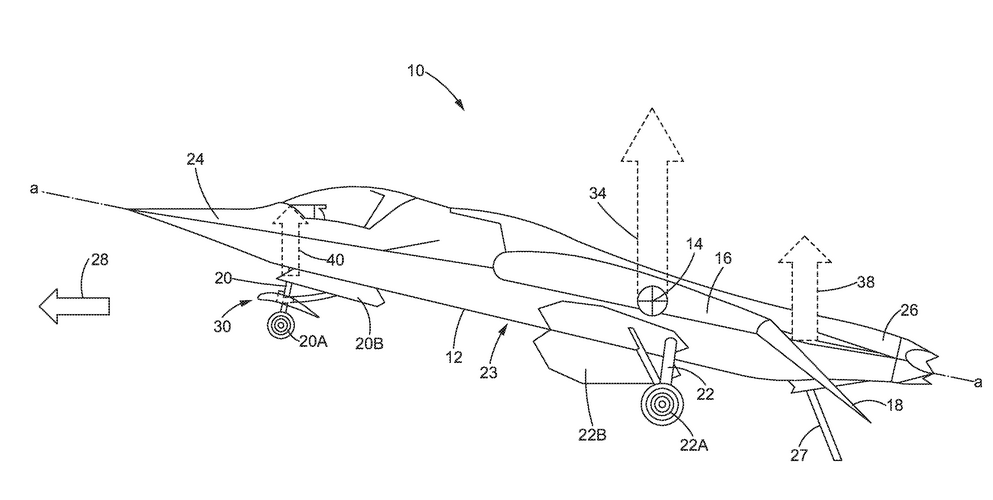
Hope that helps... Up-and-down movement of the canard causes a change of its angle of attack.

View attachment 784792

https://www.secretprojects.co.uk/th...ion-of-the-boeing-f-47-ngad.45793/post-772742

I'm not aware of any X/Y jet testing this kind of actuation.
But compared to all canards so far, this one would not produce enough deflection.
And this one still obstructs intakes when down.
It is really head scratching what Boeing has made, why so much suspense in its posters, when they'll reveal publicly.
 
Is there any chances that a 6th gen fighter jet could be operated via AI assisted remote control?
Probably not, I think that there is a very large overestimation as to the capabilities of AI in comparison to having a human in the cockpit. It's just no feasible, and I don't think it will be feasible for quite some time.
 
Is there any chances that a 6th gen fighter jet could be operated via AI assisted remote control?
Pilot on board? I am out of my depth here, but how would that be different from fly-by-wire?
I can't escape the feeling that slapping 'AI' on is the current go-to to market stuff.
 
I'm not aware of any X/Y jet testing this kind of actuation.
But compared to all canards so far, this one would not produce enough deflection.
And this one still obstructs intakes when down.
It is really head scratching what Boeing has made, why so much suspense in its posters, when they'll reveal publicly.

Check Boeing MRF studies. Several design include pivoting canards.
https://www.secretprojects.co.uk/threads/boeing-multi-role-fighter-mrf-studies.528/
 
Is there any chances that a 6th gen fighter jet could be operated via AI assisted remote control?
Pilot on board? I am out of my depth here, but how would that be different from fly-by-wire?
I can't escape the feeling that slapping 'AI' on is the current go-to to market stuff.
Sorry I can't be bothered to figure out how that multi quote thing works right now, but...

AI assisted remote control needs a lot of qualifying definitions here. If it's AI assisted like inputting flight controls and what not - there's neither a need for that nor is that safe. Automation does that well enough while also being safer and more conducive to human regulation via being able to directly understand how and why a decision was made thanks to being rule based. AI is horrible for this as more often than not, the decision boundary between one decision and another is simply an arbitrary difference of a few numbers rather than some rule you can point to. For AI to do well on stuff like this, it still requires a shell of formal methods developed software on the outside, which is already doing what automation was doing in the first place.

However - AI assisted battle space control/ planning/ maneuvering is and will be a thing. ABMS is supposed to be using that already. It wouldn't be surprising that an aircraft made to work with CCAs like the F-47 doesn't have a smaller version of that onboard either. There are certain functions AI might excel at - like determining an optimal engagement plan for the manned and unmanned aircraft working as a team, or when, optimally, to shoot, evade and recommit with the information being communicated via some kind of cue or visual on the HUD / HMD. In such cases, "AI assisted remote control" makes sense. If you wanted to, you can even let the AI / automation fly your plane in the most optimal evasion path or trajectory. It should also be noted that even in these cases, AI + formal methods and automation covers your generic 90 - 95% of use cases at best. In the remaining 5 - 10% of cases, AI will either make mistakes or fail to execute, in which case a human pilot would be needed to avoid the loss of an expensive plane like this.

Another thing - Let's be honest with ourselves here - whether its Chinese or US 6th gens, they most likely (hopefully) will start and end their life having spent the majority of their life flying missions in peace and in places where the air space isn't necessarily closed. It's still not a huge possibility that you have a peer on peer shooting war where it would warrant you to close an airspace and send in completely autonomous drones to hit everything that moves. So leaving AI + software in charge that may or may not account for the potential of false positives ( + wrong identifications and actions) without human input is going to lead to MH17 all over again.
 
Hope that helps... Up-and-down movement of the canard causes a change of its angle of attack.

View attachment 784792

https://www.secretprojects.co.uk/th...ion-of-the-boeing-f-47-ngad.45793/post-772742
That seems like it's going to do weird things to lift across the wing roots.


Is there any chances that a 6th gen fighter jet could be operated via AI assisted remote control?
Because the Mitchell aerospace study seem to want to go this way in their plan to stop China in the pacific.
https://www.mitchellaerospacepower....nder-Attack-Key-to-a-CCA-Force-Design-WEB.pdf
I don't think it's possible, yet. We've got the basic mission planning figured out, but not the automatic defensive maneuvers.
 
I don't think it's possible, yet. We've got the basic mission planning figured out, but not the automatic defensive maneuvers.
What automatic defensive maneuvers here are we talking about here? because that seems like one of the few spaces in which AI would actually be very good at. There was an article posted elsewhere that a much less ambitious project than DARPA's ACE program demonstrated ai controlled aircraft was able to not only conduct evasive maneuvers optimally, but also plan and coordinate in such a way that originally disadvantaged AI controlled aircraft were able to continually compress the human controller's timelines and force the human aggressor onto the defensive.

Basic automatic defensive maneuvers should be one of the first things a CCA would have. It's just debatable how "basic" are we talking about here and how well that "basic" translates to complex battlefield environments. From the AI pipeline point of view, I'm not sure how you could have mission planning figured out but not have figured out defensive maneuvers as maneuver in and of itself is what enables the mission planning part to be figured out.
 
What automatic defensive maneuvers here are we talking about here? because that seems like one of the few spaces in which AI would actually be very good at. There was an article posted elsewhere that a much less ambitious project than DARPA's ACE program demonstrated ai controlled aircraft was able to not only conduct evasive maneuvers optimally, but also plan and coordinate in such a way that originally disadvantaged AI controlled aircraft were able to continually compress the human controller's timelines and force the human aggressor onto the defensive.

Basic automatic defensive maneuvers should be one of the first things a CCA would have. It's just debatable how "basic" are we talking about here and how well that "basic" translates to complex battlefield environments. From the AI pipeline point of view, I'm not sure how you could have mission planning figured out but not have figured out defensive maneuvers as maneuver in and of itself is what enables the mission planning part to be figured out.
I think the trick is connecting the defensive maneuver into offensive maneuvers that is still lacking.
 
But compared to all canards so far, this one would not produce enough deflection.
The main intent is to get rid of the gap between fuselage and canard, which should improve frontal RCS, and in addition keep the distortion of airflow in front of the intakes small.

Yes, it does not provide the maximum possible deflection of a conventional canard. However, such large deflections are rarely used in flight, only at low speed, and when canards are used as air brakes.

For the vast majority of flight time the actual function of canards is to dynamically stabilize an unstable aircraft.
You also need to consider that they act in concert with the various control surfaces of the main wing and TVC, all controlled by the FCS.

And this one still obstructs intakes when down.
Have a look at Su-57 LEVCONs
 
The main intent is to get rid of the gap between fuselage and canard, which should improve frontal RCS, and in addition keep the distortion of airflow in front of the intakes small.
That can be easily done by tapering the edges from both sides.
F-22's slats & wing root taper, the slope is around 45 degrees which in case of canad can be lowered to say 30 degrees.
1758007467122.png

Also, F-22's RCS is lowest even after having 2 big rudders, so we can imagine rudder removed & canards added, basically what i imagined in my 2D derivations from F-22.

A Viggen like canard can also be created with rear half moving, but it should at slightly higher level like in all canard jets, not to interfere with air flow for slats, AFAIK.

Yes, it does not provide the maximum possible deflection of a conventional canard. However, such large deflections are rarely used in flight, only at low speed, and when canards are used as air brakes.
It is not about rare or frequent in total time from takeoff to landing, but something needs to be available when needed, even for short time which could be critical like landing, refuelling, dogfighting, escorting, etc, especially during winds.

For the vast majority of flight time the actual function of canards is to dynamically stabilize an unstable aircraft.
You also need to consider that they act in concert with the various control surfaces of the main wing and TVC, all controlled by the FCS.
True, but the above point should kept in mind - availability when needed.
Moreover, as we all know, when air stream strikes such horizontal surface, a boundary turbulent layer is created which needs to be separated from engine intake stream. So in this design the boundary layer stream created by canard root will be ingested by intakes & also mix with DSI bump compressed stream.
1758008455150.png

Have a look at Su-57 LEVCONs
There the top boundary layer stream created by Levcon is also separated by top gap with intake.

1758008836420.png
 
That can be easily done by tapering the edges from both sides.
I know, I know, but there is still a gap... I think my proposal is feasible, or at least not completely unfeasible :D
20250916_161056.jpg
It is not about rare or frequent in total time from takeoff to landing, but something needs to be available when needed, even for short time which could be critical like landing, refuelling, dogfighting, escorting, etc, especially during winds.
Like I said before, there is other control surfaces + TVC as well, to ensure sufficient control authority.
Moreover, as we all know, when air stream strikes such horizontal surface, a boundary turbulent layer is created which needs to be separated from engine intake stream. So in this design the boundary layer stream created by canard root will be ingested by intakes & also mix with DSI bump compressed stream.
It's a conceptual design. A real world implementation may or may not feature a DSI bump, a splitter plate, or other means of boundary layer management. I'll leave that to the experts ;)
There the top boundary layer stream created by Levcon is also separated by top gap with intake.
I was referring to your previous comment "And this one still obstructs intakes when down" Nothing of concern i think.
20250916_162921.jpg
 
Last edited:
Nice although I think actual NGAD will have angled wings like the YF118G probably not to the same extreme angle though
Mind you, BoP was designed inherent stable, had no fly by wire, and no TVC. I will be interesting to see if F-47 has indeed dihedral wings, as published CGI suggests.
 
After looking around a bit mainly re-checking the requirement especially looking up structure material I believe a lot of weight saving is possible now-a-day. But there's a clear lack of more recent publication from those parties of interest.
Previously, I said reducing airframe flight hours should save as much as 6% of structure mass. There is research and the declared intention to use biomimetic structures. It seems up to 50% could be saved but this wouldn't be desired for the miliatary. Because the fine structure would be bone like making them not field repairable or require a lot more delicate work.
It appearss active flutter control can save another 6% of TO weight. Stacking them all could save as much as 15-20%. Applyng more lighter materials could save some more.
That's roughly up to 15000 lb at TO weight. Subsystem weights and future upgrades requirement could lower this, though. Conservatively, lets say 10000 lb. It may not sound much but the greater impact is on fuel savings. It's difficult to judge since we don't know anything about drag. The amount could be surprisingly very low. But higher weapons load will significanly increase requirement. I prefer a bit more just to be save so internal fuel amount probably won't be lower than 20000 lb leaning toward 23k.
So my take on the specs. now is
gross TO ~69k lbs; w/ 4 droptanks ~87k lbs
Range on internal fuel 1200-1500 NM; +2 droptanks 1700-2100 NM
Supercruise 1.9-2.02 at altitude; 6g @M1.9
Max cruise (Dash) Mach 2.2-2.3
Max speed Mach 2.5-2.6
takeoff AB/ runway <300 m
supersonic climb to altitude in ~50-60s
service ceiling 70k+
 
Edit: Hey, mods, if I'm quoting someone, I am replying directly to them. Please leave an @-them.
@Seragina


I've been assuming that it's about 80k MTOW, no without drop tanks. Edit: which means a big airframe, probably 10% larger in all directions than F-22.
 
Last edited:
Rather than copy-and-paste the whole post, a link. Tip of the hat to had... and Millennium7 for a fascinating link:

https://www.secretprojects.co.uk/th...-aircraft-news-and-analysis.40872/post-836099
I'll repeat that while canards are suboptimal for frontal stealth, they're no worse than tailplanes if you must have dedicated pitch control surfaces when you're deep in enemy airspace and you're observed by radar 360 degrees.

Like the J-whatever, I think that the F-47 is going to have intakes that are integrated with the forward fuselage in an interesting way while the exhausts will be more like the YF-23's or even broad, like the B-21's (despite it being subsonic) rather than just like the J-whatever's.

Disclaimer: I'm not an aerodynamicist, a dentist, or an accountant.
 
Last edited:
I love the X-36 inspired F-47 but the vibes I’m getting, let’s say from the patches, tells me YF-118G might be what its shape and planform evokes.

As for a Boeing F/A-XX, I think a delta gives the USN what they want. ICE derived solutions and magic carpet can address the AoA concerns for carrier landings.
 
I love the X-36 inspired F-47 but the vibes I’m getting, let’s say from the patches, tells me YF-118G might be what its shape and planform evokes.

As for a Boeing F/A-XX, I think a delta gives the USN what they want. ICE derived solutions and magic carpet can address the AoA concerns for carrier landings.
Apparently, this is Boeigns solution:
284815-bd61c0d5f431c2f69211c6ce7ae72462.jpg
 
Going back on fuel amount I realized one key mistake in past and "recent" research papers considering a dash of 100 NM as part of the mission profile. That was fine when the F-22 was going M1.8 vs everyone else going M0.9 but now everyone goes supercruise at M1.2+ and assuming F47 goes M~2.3. For the same surprise/time advantage and due to greater missile ranges these days the distance now has grown to at least 200 NM. So double the fuel allocation for the dash part. In any case no matter how I play around with the numbers it seems hard to get fuel fraction above 0.37. It ended up ~25/26k lbs. This is useable fuel amount ofc; and considering 5% unuaseable it's actually 27.5k lbs. Some calculate with 10% like in the civil sector, though. Welp, my pet design has plenty of volume and some so it's not an issue but because of that I like to introduce a compacter version sometime later. It's actually an older idea just not agreeable with the official renders.
 
The radomes for these renders and diagrams all look so tiny for some reason - unless radome size isn't really a major factor when it's focusing on planform and control details...
It's fine with the new radar elements based on gallium nitride (GaN) technology and for the same range. And fine for a demonstrator.
That said nothing can replace aperture size for resolution regardless of the underly technology. And with 1000 km ranged missiles I believe a narrow beam scan for 1000 km is required while normal scan would be limited to 500 km range. So I think the radar should be wide(r).
 
And fine for a demonstrator.


That said nothing can replace aperture size for resolution regardless of the underly technology.
That's my hope - that these designs are demonstrator territory and actual designs would feature a much wider array than even the F-22.

To perform PCA well inside someone else's IADS, you're gonna need the sensor package + signature reduction combination that leaves you somewhere in the same ball park as the J-36.

Been trying to do some horrible pixel counting and radome guessing lately for the Chinese 6th gens. @Nx4eu you probably have a better idea than my crappy pixel counting, but:

  • J-XDS radome starts a short ways past the chin mounted EOTS. Past amateur radome size guessing for the J-20 ended up with something like a 1.08 m radome. For J-XDS, I got somewhere around a 1.15m radome. It looks to be the sameish height (thickness?) compared to the J-20 radome.
  • J-36 radome (for the main radar) starts probably where the two EOTS windows end. I got something like 1.3 - 1.35m from the head on views. I don't expect the J-36 radome to be any shorter in height than the J20's either although in some pictures it kind of looks that way.
So if those figures are anything to go by, I'd expect a similar width (which the F-47's officials renders do indicate) but also a similar height to the F-22 for the radome that goes into the F-47. It would be baffling otherwise.

 
That's my hope - that these designs are demonstrator territory and actual designs would feature a much wider array than even the F-22.

To perform PCA well inside someone else's IADS, you're gonna need the sensor package + signature reduction combination that leaves you somewhere in the same ball park as the J-36.

Been trying to do some horrible pixel counting and radome guessing lately for the Chinese 6th gens. @Nx4eu you probably have a better idea than my crappy pixel counting, but:

  • J-XDS radome starts a short ways past the chin mounted EOTS. Past amateur radome size guessing for the J-20 ended up with something like a 1.08 m radome. For J-XDS, I got somewhere around a 1.15m radome. It looks to be the sameish height (thickness?) compared to the J-20 radome.
  • J-36 radome (for the main radar) starts probably where the two EOTS windows end. I got something like 1.3 - 1.35m from the head on views. I don't expect the J-36 radome to be any shorter in height than the J20's either although in some pictures it kind of looks that way.
So if those figures are anything to go by, I'd expect a similar width (which the F-47's officials renders do indicate) but also a similar height to the F-22 for the radome that goes into the F-47. It would be baffling otherwise.
This is my possible F-47 model
1759611414259.png

This is a possible radar compared to the AN/APG-77.
1759611484475.png

A possible 1.12m^2 Area is easily possible in the spade nose, versus the AN/APG-77 with a 0.65m^2 aperture.
 
Well, with several AESA and low latency, robust LOS comm equipped CCAs flying alongside an F-47, you might have the requisite ingredients for a flying multistatic array, which is cool.

But this goes to my question in the Victus CCA thread about distributed stand-in EW effects vs a discrete airframe with a large monolithic AESA and the motor to power it… it’s nuanced.

As for F-47, you tell me the rough power coming off the engine shafts and the cooling systems, and then we can have a discussion about the sensor suite. Even with the voltage and heat gains from GaN, isn’t in flight power and cooling still the two factors we accommodate around?
 
Well, with several AESA and low latency, robust LOS comm equipped CCAs flying alongside an F-47
How much power are CCAs required to generate to power robust sensors and AESA radars? I'm thinking about a Mach 2, supercruising, high flying next generation air dominance aircraft utilizing small AESA radars onboard subsonic CCAs flying at medium altitudes. That doesn't really make as much sense as flooding these with different types of passive sensors, IRST, and electronic warfare more tailored to the concept and within SWaP margins of these relatively small and simple air vehicles.
 
How much power are CCAs required to generate to power robust sensors and AESA radars? I'm thinking about a Mach 2, supercruising, high flying next generation air dominance aircraft utilizing small AESA radars onboard subsonic CCAs flying at medium altitudes. That doesn't really make as much sense as flooding these with different types of passive sensors, IRST, and electronic warfare more tailored to the concept and within SWaP margins of these relatively small and simple air vehicles.

One alternative: F-47 supercruises to near the area of operation but decelerates to a more thermally LO state before it daps up CCAs. Only then does it duck the bouncer.

ingress into fun places is done at high altitude and with maximal full spectrum LO, which means no surface heating due to supersonic aero, ergo your CCAs top speed are as not rate limiting as much as their EM profile might be.
 
But this goes to my question in the Victus CCA thread about distributed stand-in EW effects vs a discrete airframe with a large monolithic AESA and the motor to power it… it’s nuanced.
Yeah like you said - there's a lot of other factors in there.
  • T/R module design + chips
  • Processing power & algorithms
  • Cooling and power generation both of which are tied to engine power, but dependent on generators and fuel (I think?)
  • Your corresponding signature reduction techniques
  • offboard sensing, multistatic effects, and what not
I recognize that I'm doing the very thing I myself warned against - judging air frame to air frame here but...

If you assume technological parity and asset (CCAs, EW, AEW) parity, it comes down to the design choices and tradeoffs being made in each design.

To retain (a stupid head on head scenario) at least mutual detection or better, you'd have to compete with an extra engines worth of cooling and a main array that's somewhat larger than your own. So that's why I said that I'd like to see a radar array size somewhere between J-XDS and J-36 arrays combined with an airframe thats at least YF-23 sized.

Maybe I should play less DCS
 
Some one should really be looking at designing a four engined 6.5 generation aircraft. Those extra two engines for cooling and to power an AWACS sized radar array.
Can't tell if you are being serious but ... why wouldn't fighters begin moving towards the J-36 size? Are there any reason besides cost that a large fighter like that would be disadvantaged by? At what point does it become "too big"?

There's definitely ways for a fighter with a smaller array to fight, just that you'd be pretty disadvantaged.
 
Some one should really be looking at designing a four engined 6.5 generation aircraft. Those extra two engines for cooling and to power an AWACS sized radar array.

I don’t think he was responding to my entreaties of ‘how does F-47 generate power without a third stream ACE?’, but @quellish has indicated Boeings AII-X was able to demonstrate a step function increase in power generation and I think it’s clear no AII-X demonstrator flew with a three stream ACE.

So the specific problem of 6th power generation - to say nothing of cooling - might have some non-obvious solves, besides throwing N engines at it.
 
Can't tell if you are being serious but ... why wouldn't fighters begin moving towards the J-36 size? Are there any reason besides cost that a large fighter like that would be disadvantaged by? At what point does it become "too big"?
IIUC, larger fighters can struggle in terms of maneuverability. I believe that they need more airframe mass for strength to hold the same g-forces.

For example, the MiG-25 and -31 are not 9gee or even 7.5gee fighters. IIRC they're 5gee. The Blackbird was 3.5gee.
 
Can't tell if you are being serious but ... why wouldn't fighters begin moving towards the J-36 size? Are there any reason besides cost that a large fighter like that would be disadvantaged by? At what point does it become "too big"?
It comes down to requirements. NGAD will have 70+ percent combat radius improvement over F-22. It will be Mach 2 capable and supercruise with a greater supersonic radius than F-22A. It will generate a lot more power and cooling capacity than the F-22 or F-35. A lot more. And, it won't have three, four, five or six engines nor be supersized relatively speaking.
 
Last edited:
It comes down to requirements. NGAD will have 70+ percent combat radius improvement over F-22. It will be Mach 2 capable and likely a supercruiser. It will generate a lot more power and cooling capacity than the F-22 or F-35. A lot more. And, it won't have three, four, five or six engines nor be supersized.
I know I'm asking a terribly stupid question so please bear with me but...

Are those requirements going to be enough if you're enemy has the same level of technical sophistication you can muster but on a much larger air frame, extra engines to generate more power and enough to take advantage of a much larger array?

I guess Scott is right. At a certain point, even if you can see and shoot first, you likely won't survive the counter shot thanks to being too heavy and too unmaneuverable...
 
Are those requirements going to be enough if you're enemy has the same level of technical sophistication you can muster but on a much larger air frame, extra engines to generate more power and enough to take advantage of a much larger array?
Perhaps. Perhaps not. But the three engine point still doesn't sit well with me. That's like one short of four. Imagine the array size, power and cooling that fourth could afford. Such a lost opportunity. For NGAD, I would have gone with four. Two side inlets. One on the top, and one on the bottom. Engine three gives me power for large array. Engine four powers my DEW and space weapons.
 
Last edited:
It comes down to the efficiency w which an aircraft system can extract useful work from the energy of the chemical bonds of the air it breathes and the fuel it carries, minus overhead.


There are many roads to Rome but adding more engines introduces more system complexity then getting more out of one or two engines, although both are non-trivial.
 
From my own drawing it looks like the radar aperture size is limited to 1.3 m, probably a bit less but certainly not much more.

Well, with several AESA and low latency, robust LOS comm equipped CCAs flying alongside an F-47, you might have the requisite ingredients for a flying multistatic array, which is cool.

But this goes to my question in the Victus CCA thread about distributed stand-in EW effects vs a discrete airframe with a large monolithic AESA and the motor to power it… it’s nuanced.

As for F-47, you tell me the rough power coming off the engine shafts and the cooling systems, and then we can have a discussion about the sensor suite. Even with the voltage and heat gains from GaN, isn’t in flight power and cooling still the two factors we accommodate around?
Not certain about powergeneration but I assume max thermal load should be at least 170 kW plus whatever increase there is from M2 to M2.5 from the friction.
 

Similar threads

Back
Top Bottom