Canadian Aircraft Mallard Airplanes & Projects

hesham

ACCESS: USAP
Senior Member
Joined
26 May 2006
Messages
38,288
Reaction score
20,425
Hi,

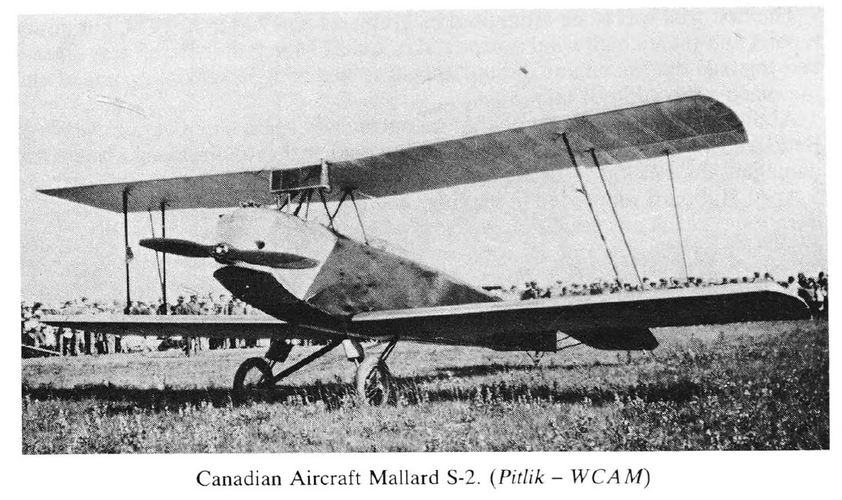
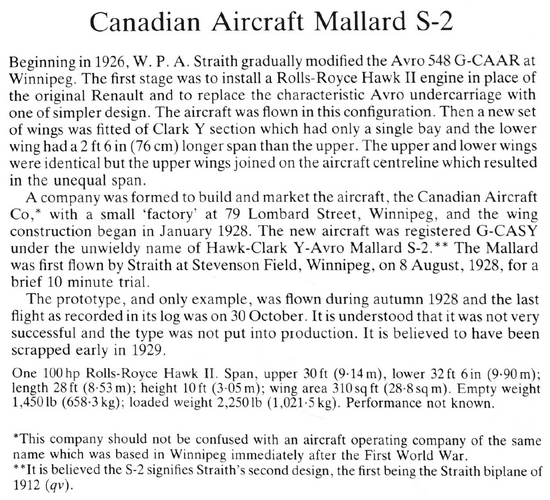
this company was appeared in 1926 by W. P. A. Straith,and built a modified Avro-548,called S-2,the S-1 was
a biplane of 1912.

In 1928 developed a single seat monoplane and a single seat biplane,maybe based on S-2,and a six-seat
airplane,may it was a biplane.

Canadian Aircraft since 1909.
 

Attachments

  • 1-1.png
    1-1.png
    738.4 KB · Views: 36
  • 2-1.png
    2-1.png
    652.3 KB · Views: 39
  • 3-1.png
    3-1.png
    88.1 KB · Views: 27
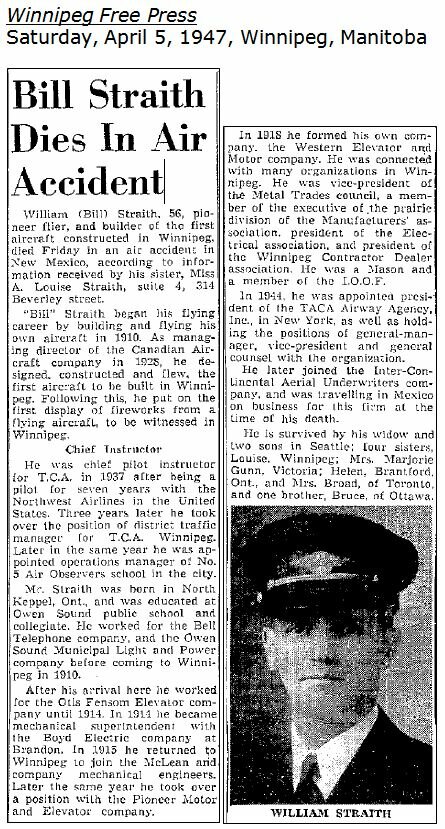
Incidentally, William Percy (Percival?) Alexander "Bill" Straith (1891-1947) may be the only Canadian who put together a Wright Flyer, before the Great War.

A very basic bio is enclosed.
 

Attachments

  • Winnpeg Free Press 5 april 1947.jpg
    Winnpeg Free Press 5 april 1947.jpg
    161.5 KB · Views: 26
... this company was appeared in 1926 by W. P. A. Straith,and built a modified Avro-548,called S-2,the S-1 was a biplane of 1912.

In 1928 developed a single seat monoplane and a single seat biplane,maybe based on S-2,and a six-seat airplane,may it was a biplane...

Old post, I know, but this is not a very accurate retelling of what K.M. Molson wrote in Canadian Aircraft since 1909. One page 163, Molson makes clear that the Canadian Aircraft Company "was formed to build and market" the Straith S-2. In other words, Straith's conversion of the Avro 548 airframe (2292H, G-CAAQ) [1] to revised S-2 standard was well underway (or complete) before Canadian Aircraft Co. was established.

On the Straith S-2, only the original Avro fuselage and tailplane was retained. Doubtless those remaining Avro features would have also been designed out had the Mallard reached production. One thing is sure, Bill Straith wasn't trying to hide its origins when he named his conversion the HawkClark Y-Avro Mallard S-2 - in one, run-on tongue-twister he covered powerplant, aerofoil section, [2] airframe origin, new type name, and personal series designation!

"In 1928 developed" introduces a misleading tense. Yes, the Canadian Aircraft Company had announced its plans to develop single-seat monoplane and biplane designs as well as a 6-seater (of unrecorded layout) but there is no evidence to suggest that any actual design work was embarked upon before the company was wound up.

As for "the S-1 was a biplane of 1912", Molson makes clear that this was pure conjecture. Yes, the 1912 biplane pusher was Straith's first original design (his previous build, as @fortrena pointed out, had been a Wright B Flyer). But there is nothing in writing to suggest that any designation was ever applied to that design - Ken Molson simply listed it as the Straith Biplane (more on that type if anyone is interested).

BTW, Molson notes a different firm with a similar name "based in Winnipeg immediately after the First World War". That refers to the Canadian Aircraft Co. Ltd established in 1919 to operate a Curtiss JN-4 (Can) on aerial photography runs or any other money-making activities. That Canuck (G-CAAO) had a reg only one letter different from the S-2's donor airframe. And this may have caused some understable confusion. [3]

______________________

[1] Avro 548 G-CAAQ (serial 2292H) was written-off in a failed take-off attempt from Winnipeg on 13 Aug 1927. Handily for Bill Straith, she was flown into trees and swiped off the original and now rather dated 2-bay RAF 15-section wings.
-- https://asn.flightsafety.org/wikibase/1100

[2] The contemporary Avro Avion series (type 581, 605, and 616) also employed the Clark Y aerofoil (in a modified form).

[3] Canuck G-CAAO (c/n C282) was operated by Canadian Aircraft Co. Ltd from May 1920 until April 1924 when the firm stopped operating. However, Golden Years of Aviation also lists "Canadian Aircraft Co Ltd/Winnipeg" as the operator of Avro 548 G-CAAQ - it being registered 2 days after the Canuck. -- http://www.airhistory.org.uk/gy/reg_G-C.html

Was that attribution an error? Was it just a crazy coincidence? Or did the demise of the prior owner's firm just give Bill Straith a naming inspiration for his entry into the business side of aviation? Who knows?

 
If one is to believe contemporary newspapers, Canadian Aircraft operated two Curtiss JN-4s, including one registered as G-CAAO, in 1919-20 and possibly later.

According to those same newspapers and http://www.airhistory.org.uk/gy/reg_G-C.html, the company received five Avro aircraft in 1920, including the Avro 504Ks G-CAAQ, G-CAAR and G-CABV and the Avro 548s G-CABS and G-CACD. Two of those aircraft sent from England were on floats, a useful configuration when flying in outlying areas of Manitoba.

G-CABS was rebuilt as G-CACI and registerred in June 1921, by Canadian Aircraft.

As was mentioned above, the fuselage of G-CAAQ went into G-CASY, the Hawk-Clark Y-Avro Mallard.

Incidentally, contemporary newspapers identified Straith as Canadian Aircraft's managing director no later than early August 1921.
 
Last edited:
Great stuff @fontrena!

You may have just unlocked this story. I didn't look very closely at the 1919-formed Canadian Aircraft Co. Ltd ... taking Kenneth Molson at his word that this firm and Straith's later company of the same name were unrelated.

But if newspapers of the day list "Straith as Canadian Aircraft's managing director no later than early August 1921", that must lead us to question whether the two identically-named Canadian Aircraft Companys were, in fact, one and the same. In other words, writing from Ontario long before the internet, Molson perceived an apparent gap between the activities of an aircraft operator formed in 1919 and Straith's activities in 1926-28. It sounds like the only real 'gap' may have been in information.

On G-CAAQ, I see different references to its identity. Like you, most sources say Avro 504K while Molson says that 'AQ was an Avro 548. If the latter, it would've been a rebuilt 504K airframe in any case. Molson makes no mention of how many seats the Mallard S-2 had (which would have clinched it). But he was specific about the engine - having Straith replace "the original Renault" with a R-R Hawk II (as per the one-off Avro 504F).

Changing out that Renault 80 hp air-cooled V8 with a R-R Hawk II water-cooled inline six will have saved Straith 34.5 kg in engine weight (not accounting for the added radiator plus its coolant and piping). Despite its name, the Renault 80 hp normally produced 75 hp. So the Hawk II gave a 25 hp jump in output (based on Molson's conservative 100 hp rating). Mind you, the 504K's lighter Le Rhône 9J rotary would put out 110 hp. So why the Hawk II?

I'm not seeing a huge advantage in Straith's engine-swap. That suggests that the original engine - whatever it might have been was damaged during the crash of G-CAAQ (or sold off afterwards). That would leave Straith with a more or less intact fuselage and tailplane. So, cheap if Straith had to purchase the remains, free (and just taking up space) if it already belonged to Canadian Aircraft. In other words, if Bill Straith was the Managing Director of Canadian Aircraft, this just became a much more interesting story about a struggling flying service provider attempting to transition into aircraft manufacturing. Nice!
 
It might be worth noting that the Archives of Manitoba have annual returns of Canadian Aircraft dated 1920, 1921, 1928 and 1929.

One has to wonder if the 1920-21 era company and the 1928-29 era one were two separate entities.

I cannot say how (in)significant the following info might be but Straith was involved in a small electrical and mechanical repair firm called Western Elevator & Motor of Winnipeg, Manitoba, no later than February 1920. By February 1923 at the latest, he was manager of that company which he had not founded. Western Elevator eventually became Excel Western Elevators, seemingly disappearing in the late 1990s.

Given Straith's involvement with Western Elevator & Motor, the failure of a hypothetical Canadian Aircraft 1.0 at some point around 1923-25 might not have affected him in a crippling way.
 
Last edited:

Similar threads

Back
Top Bottom