C-121 used for re-entry effects testing?

Maury Markowitz

From the Great White North!
Joined
27 February 2014
Messages
211
Reaction score
172
Some time ago I came across a USAF video on ICBM tech in the 1960s. In one part they showed a C-121 using tracking cameras on top filming an RV from (IIRC) an Atlas. It was a very useful video because it showed just how hopeless tracking was - even in optical the thing looked like a gigantic space sperm of silvery flashes, the RV inside was utterly invisible.

Does anyone recall this video and know how to find it? My google-fu has utterly failed me.
 
I haven't found the video yet but perhaps this will help to track it down:

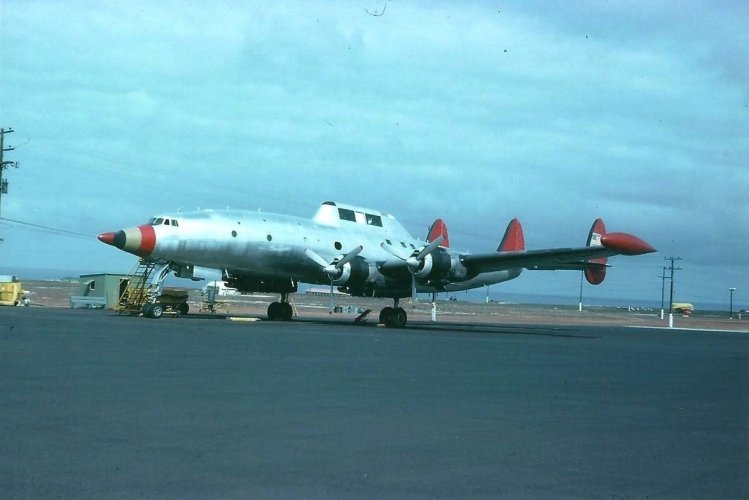
WV-2 BuNo 143226, re-serialed 56-6956 and later redesignated GRC-121D and then NC-121D. Nicknamed 'Triple Nipple'.


Jane's AWA 1961-62:
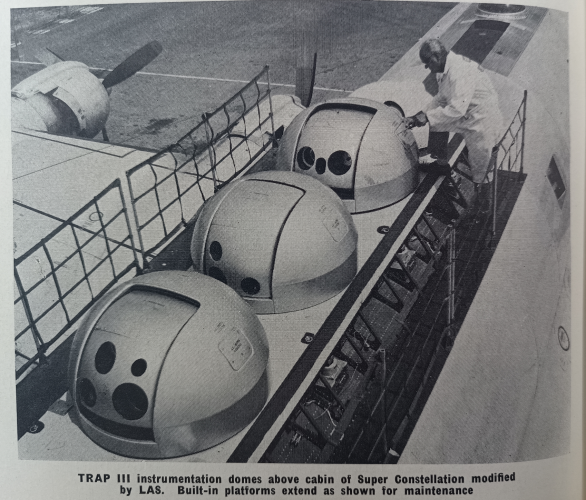
LAS TRAP III SUPER CONSTELLATION CONVERSION

Early in 1964, LAS delivered to the USAF Aeronautical Systems Division a Lockheed Super Constellation ( serial number 66956 ) modified to carry the TRAP III radiation measurement system designed by the Bendix Corporation.

The purpose of TRAP ( Terminal Radiation Airborne Program ) III aircraft is to scan the skies from a single observation point and obtain visual and precise optical tracking, recording and timing date associated with the re-entry of high-speed bodies into the Earth's atmosphere.

External features include a row of gun-turret-type domes above the fuselage, containing the optical radiation measuring equipment.

Dome installation required the removal of a large section of the Constellation's fuselage and the design and installation by LAS of the vibration-isolated rigid platform on which the domes are mounted, without disturbing the flight characteristics and cabin pressurisation of the aircraft. The platform has built-in walkways which extend on either side for servicing the domes. Two visual sighting stations are also provided in the aircraft.

TRAPIII.png
 
TRAP Project was still running my mid-1967, seems to have been contracted to Avco to manage.

However I haven't yet been able to work out how the early TRAP-III, above, fits in with the later airframes which had fixed, internally-mounted sensors peering through windows.

TRAP-1 JKC-135A 55-3134, equipment by GE Missile & Space Division ( DTIC AD0812389 )
TRAP-6 JC-121C 51-3841
TRAP-7 JKC-135A ???, equipment by Aerojet General Astrionics Dept ( DTIC AD0828968 )

Supplemented by a TRAP-Transportable system.

Martin-Marietta was contracted for the airframe modifications per the attached DTIC document. Lots of nice technical details about the sensor fit from page 90 onwards.

This is TRAP-6: ( Edit: I think this is actually BuNo 143196, confusingly used by the US Army for RV tracking from Kwajalein ). Was this one of the 'missing' TRAP numbers?

0-13841_TRAP-6.jpg
 

Attachments

  • TRAP_DTIC_AD0825637.pdf
    16.8 MB · Views: 53
Last edited:
I didn't get any notifications of posts to this thread so I'm only seeing it now. In retrospect, I'm thinking the one I saw was in the Atlantic test range (no idea why, that's just floating in my brain) so I'll focus on TRAP.

There's some interesting bits in the Kwaj footage. You can see the extensions at both ends of the main island are still being built, so this before MAR-2/Nike-X. You can see the Zeus installations, notably the TTR which is obvious in most of the shots. You can also see the ALTAIR on Roy, and I think that's TRADEX, but not MMX. That narrows down the dates a bit. Unfortunately I didn't see Meck, or didn't recognize it, so that seems to be before the MSR was built, making this early 1960s.
 
Well this isn't the one I remember, but good enough for what I'm looking for:

https://catalog.archives.gov/id/614788

Around the 3 minute mark you can see the problem for Zeus. The RV is somewhere in that mess. And this is optical, at radar frequencies this is just one big opaque cylinder.
 

Similar threads

Back
Top Bottom