
You are using an out of date browser. It may not display this or other websites correctly.
You should upgrade or use an alternative browser.
You should upgrade or use an alternative browser.
British AEW Projects
- Thread starter PMN1
- Start date



- Joined
- 26 May 2006
- Messages
- 38,284
- Reaction score
- 20,422
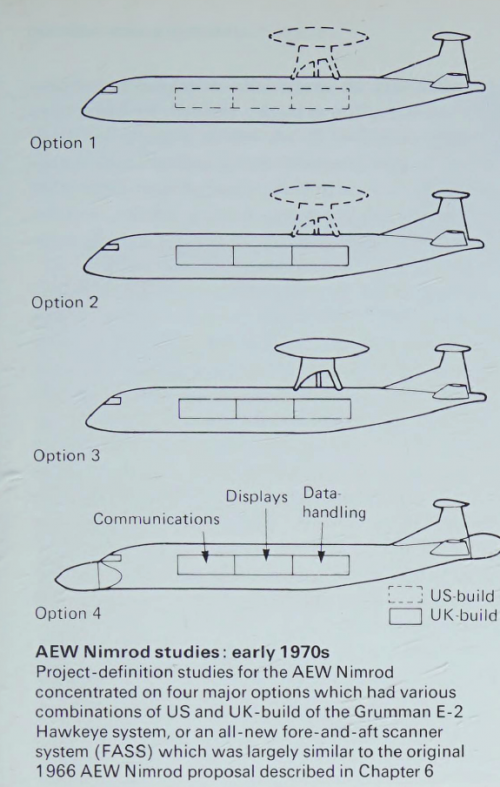
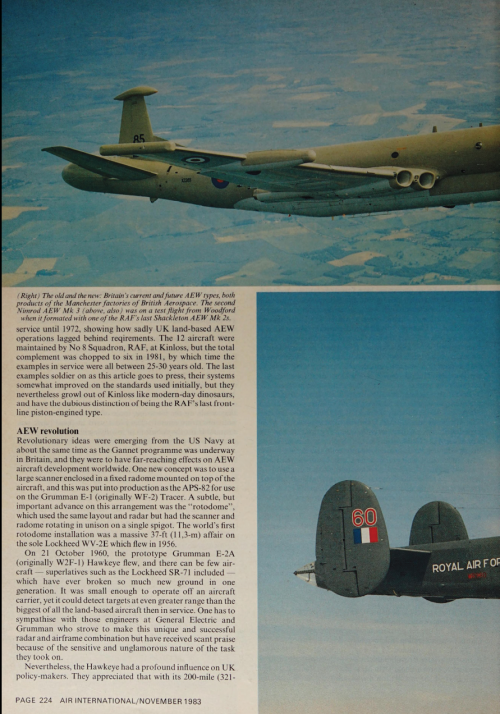
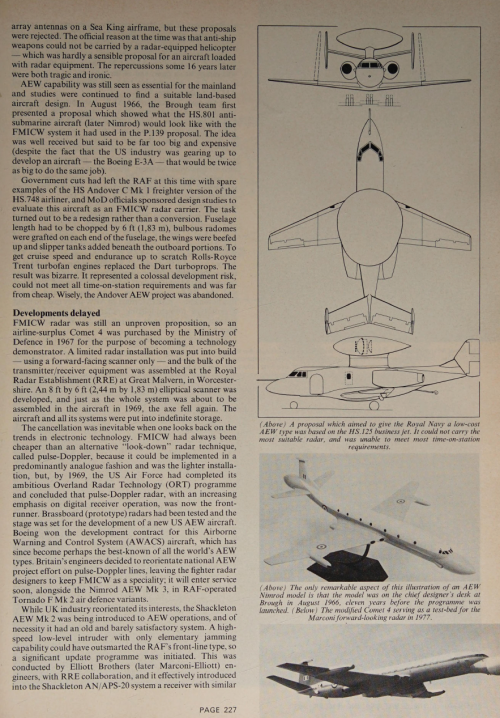
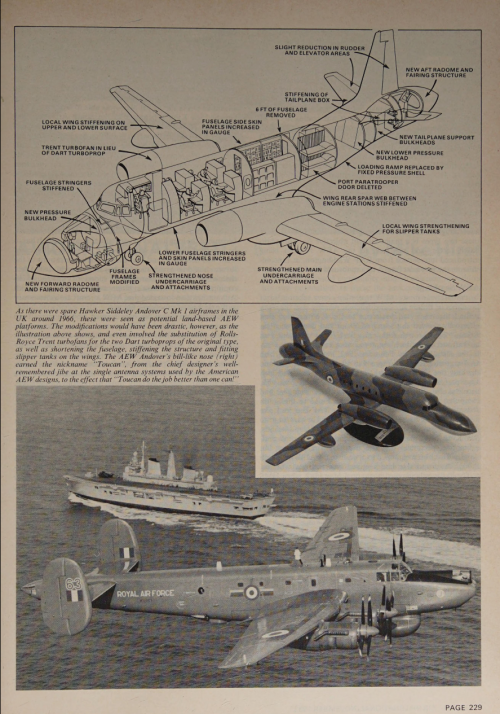
From Air International,
a clearer pictures to P.139 Model and 3-view.
The whole article from 1983
Attachments






FighterJock
ACCESS: Above Top Secret
- Joined
- 29 October 2007
- Messages
- 7,259
- Reaction score
- 8,571
I wonder what the RAF would have looked like if the Nimrod AEW had entered service and not had any of the problems with the radar system which was the cause of it being cancled and the RAF ended up with the E-3 Sentry for AEW duties instead.
- Joined
- 5 May 2007
- Messages
- 2,018
- Reaction score
- 4,280
That book was my first introduction to the concept of an 'unbuilt project'. Inexplicably, it was in my primary school library - I assume donated by some child's father who was associated with Nimrods, Shackletons, or both. It would have been quicker to list the children who didn't have such an association.From, Airborne Early Warning Design, Development, and Operations (Osprey Military)
The idea of Nimrods with spinny mushrooms on the back always seemed much more appealing than bulbous growths on either end, but that was largely an aesthetic preference.
Much depends on whether that means 'entered service in 1982 on time and on budget' or 'limps into service in the 1990s after vast diffiicult'.I wonder what the RAF would have looked like if the Nimrod AEW had entered service and not had any of the problems with the radar system which was the cause of it being cancled and the RAF ended up with the E-3 Sentry for AEW duties instead.
FighterJock
ACCESS: Above Top Secret
- Joined
- 29 October 2007
- Messages
- 7,259
- Reaction score
- 8,571
In this scenario Yellow Palace the Nimrod AEW would enter service on time and on budget, further I always thought that the radome on the E-3 looked rather strange when I first saw it at the Leuchars airshow when I first went.
lastdingo
Blogger http://defense-and-freedom.blogspot.de/
The British and Russians were the only ones to develop & deploy heliborne AEW (the French had a similar heli with big radar for ground SAR/GMTI).
Thus I'd like to ask here whether anyone has seen documents or calculations about how much effective range a heliborne radar could have against
I have a suspicion that Crowsnest is not really relevant against sea skimmer missiles.
Thus I'd like to ask here whether anyone has seen documents or calculations about how much effective range a heliborne radar could have against
- 1 sq m RCS fighter flying at 100 ft
- anti-ship missile (Kh-35, Exocet) at 15...50 ft over sea or at 100 or 200 ft over ground
I have a suspicion that Crowsnest is not really relevant against sea skimmer missiles.
- Joined
- 5 May 2007
- Messages
- 2,018
- Reaction score
- 4,280
There are two limitations on radar range: the horizon, and radar performance.Thus I'd like to ask here whether anyone has seen documents or calculations about how much effective range a heliborne radar could have against
Usually, the heliborne radar is going to be at a lower altitude, therefore have a closer radar horizon. One might expect this to result in about half the theoretical maximum range - something in the range of 95 nautical miles for Merlin-borne radar and 195 nautical miles for a Hawkeye. Assuming the radar is positioned up-threat, either ought to have line-of-sight to a low-level threat at useful range, but the fixed-wing platform has a clear advantage.
Detection range against a low-RCS target against surface clutter will require good radar performance, which is a function of transmitter power, antenna gain, receiver sensitivity, and processing power. The balance there is probably poorer for Crowsnest, but that's far from a given, and the actual numbers will be closely guarded.
That's not an inherent limitation of heliborne radar, though: one could imagine putting Crowsnest on a fixed-wing platform, or hanging some kind of APY-9 derivative under a really big helicopter.
- Joined
- 23 August 2011
- Messages
- 2,566
- Reaction score
- 8,460
There are two limitations on radar range: the horizon, and radar performance.
Usually, the heliborne radar is going to be at a lower altitude, therefore have a closer radar horizon. One might expect this to result in about half the theoretical maximum range - something in the range of 95 nautical miles for Merlin-borne radar and 195 nautical miles for a Hawkeye. Assuming the radar is positioned up-threat, either ought to have line-of-sight to a low-level threat at useful range, but the fixed-wing platform has a clear advantage.
Detection range against a low-RCS target against surface clutter will require good radar performance, which is a function of transmitter power, antenna gain, receiver sensitivity, and processing power. The balance there is probably poorer for Crowsnest, but that's far from a given, and the actual numbers will be closely guarded.
That's not an inherent limitation of heliborne radar, though: one could imagine putting Crowsnest on a fixed-wing platform, or hanging some kind of APY-9 derivative under a really big helicopter.
I wouldn't attempt to compare Crowsnest to E-2D....
But reportedly Seaking ASaCS.7 had better performance in littoral and cluttered environments than E-2C did during GW.2 hence why they were one of the main assets in the northern Gulf.
lastdingo
Blogger http://defense-and-freedom.blogspot.de/
The very first radars were quite good at picking up ship echoes. Ship detection is more of a starting point compared to the high end job of picking up a small RCS seaskimmer missile, especially if the latter is moving on a tangential course.Given that Searchwater was originally a surface-search radar I doubt that there would be much of a problem picking up low RCS objects against clutter.
Helo AEW with a mission of detecting sea skimmers ASAP might be on a much lower altitude than optimal for range against fighters.
I remember counter-arty radars scan just above the horizon because that makes detection of shells the easiest and quickest. WW2 ASW patrols were flying at about 3k ft only because at that altitude the horizon was at a distance where a submarine conning tower may still be visible and the horizon was the best place to spot it. So maybe seaskimmer detection AEW would choose its cruise (or hover) altitude with similar considerations.
British helo AEW were adaptations of fairly compact radars. The Soviets used a big ass antenna for helo AEW.
https://en.wikipedia.org/wiki/Kamov_Ka-31https://www.radartutorial.eu/19.kartei/08.airborne2/karte002.en.htmlhttps://www.redstar.gr/en/russian-aerial-means/avionics-cockpit/e-801e-oko-airborne-radar.htmlhttps://www.key.aero/article/eye-sky-2I wonder whether the small size of the RN-style helo AEW radars might make them impotent against low RCS seaskimmers and explain why CROWSNEST is supposed to go out of service just a few years after entering service (and without replacement!).
Helo radar is the most powerful radar if land- or carrier-based aviation is not available.
CEC (cooperative engagement capability) would permit engagement of aerial targets with LOAL (lock on after launch) missiles such as Aster, CAMM, IRIS-T SLM, VL MICA, ESSM Blk II, SM-6 and datalinks without making use of a shipborne radar.
This might in the most extreme case lead to no need for a dedicated AAW ship, just some SAM launch containers on cargo ships (but BMD would be an issue without a AAW ship). The consequences of an effective helo AEW could be huge - but the marginal deployment mighthave technical reasons rather than institutional inertia or even institutional self-protection against becoming obsolete.
Scott Kenny
ACCESS: USAP
- Joined
- 15 May 2023
- Messages
- 19,676
- Reaction score
- 28,160
Maybe. Where's @Dilandu our resident missile head, to give an idea for where the best altitude would be for an AEW for finding sea-skimming missiles?Helo AEW with a mission of detecting sea skimmers ASAP might be on a much lower altitude than optimal for range against fighters.
I remember counter-arty radars scan just above the horizon because that makes detection of shells the easiest and quickest. WW2 ASW patrols were flying at about 3k ft only because at that altitude the horizon was at a distance where a submarine conning tower may still be visible and the horizon was the best place to spot it. So maybe seaskimmer detection AEW would choose its cruise (or hover) altitude with similar considerations.
I do kinda expect next generation warships to all be equipped with a VTOL AEW drone as standard equipment, just to get the detection range for LO sea-skimming missiles out as far as possible. Mostly any supersonic LO sea-skimmers.Helo radar is the most powerful radar if land- or carrier-based aviation is not available.
CEC (cooperative engagement capability) would permit engagement of aerial targets with LOAL (lock on after launch) missiles such as Aster, CAMM, IRIS-T SLM, VL MICA, ESSM Blk II, SM-6 and datalinks without making use of a shipborne radar.
This might in the most extreme case lead to no need for a dedicated AAW ship, just some SAM launch containers on cargo ships (but BMD would be an issue without a AAW ship). The consequences of an effective helo AEW could be huge - but the marginal deployment mighthave technical reasons rather than institutional inertia or even institutional self-protection against becoming obsolete.
lastdingo
Blogger http://defense-and-freedom.blogspot.de/
Detection of seaskimmers by radar may be so difficult that a drone radar might be too heavy unless you go to manned helicopter sizes.
I looked at portable battlefield radars and they're all rather too heavy for all but the strongest multicopters.
Thermal cameras + radar warning receiver on the other hand would pose no such problem.
I looked at portable battlefield radars and they're all rather too heavy for all but the strongest multicopters.
Thermal cameras + radar warning receiver on the other hand would pose no such problem.

- Joined
- 6 September 2006
- Messages
- 5,316
- Reaction score
- 11,545
I honestly don't think that the sea-skimming missile is a problem for Searchwater. It has been constantly revised and upgraded to deal with small high velocity targets as well as aircraft while retaining the ability to do surface search and tracking down to periscopes etc.
For example: https://www.aviationtoday.com/2001/07/01/military-upgrades-how-the-royal-navy-advanced-its-aew/
Crowsnest is due for retirement in 2029, that is early but it seems to have been the lengthy development that has spooked the MOD/RN - probably more due to the software than the hardware. I agree it makes little sense to retire it prematurely given that millions have been spent to get it operationally capable only this year - but that's nothing new in the wacky world of MODland. The truth is that Merlin is probably the Achilles heel with not enough endurance or altitude and which was always going to be the main problem and which UAVs can solve.
For example: https://www.aviationtoday.com/2001/07/01/military-upgrades-how-the-royal-navy-advanced-its-aew/
Thales has tested its radar extensively, including vibration testing. Isolation performance is critical in a pulse Doppler system, from which operators rely on fraction-of-a-degree phase shifts to reveal the presence of tiny targets travelling supersonically in land and sea clutter. The radar also has been undergoing flight trials and was scheduled for military aircraft release by this summer.
Crowsnest is due for retirement in 2029, that is early but it seems to have been the lengthy development that has spooked the MOD/RN - probably more due to the software than the hardware. I agree it makes little sense to retire it prematurely given that millions have been spent to get it operationally capable only this year - but that's nothing new in the wacky world of MODland. The truth is that Merlin is probably the Achilles heel with not enough endurance or altitude and which was always going to be the main problem and which UAVs can solve.
lastdingo
Blogger http://defense-and-freedom.blogspot.de/
Periscopes were already detectable by radar during WW2 at short distances. And they're very easy to detect nowadays because of their wake. The periscope wake is something a seaskimmer does not produce.
BTW, periscope detection by radar is utterly pointless nowadays because every sub has a tiny ESM antenna to sniff for dangerous radar emissions and it's SOP to first deploy that one before exposing optronics or snorkel.
Merlin can stay in the air for 5+ hours. The endurance is fine, but sustainable flying hours per day is likely an issue.
BTW, periscope detection by radar is utterly pointless nowadays because every sub has a tiny ESM antenna to sniff for dangerous radar emissions and it's SOP to first deploy that one before exposing optronics or snorkel.
Merlin can stay in the air for 5+ hours. The endurance is fine, but sustainable flying hours per day is likely an issue.

Scott Kenny
ACCESS: USAP
- Joined
- 15 May 2023
- Messages
- 19,676
- Reaction score
- 28,160
Engine exhaust impinging on water will produce a wake.Periscopes were already detectable by radar during WW2 at short distances. And they're very easy to detect nowadays because of their wake. The periscope wake is something a seaskimmer does not produce.
ESM is built into the periscopes, not usually on a separate mast.BTW, periscope detection by radar is utterly pointless nowadays because every sub has a tiny ESM antenna to sniff for dangerous radar emissions and it's SOP to first deploy that one before exposing optronics or snorkel.
lastdingo
Blogger http://defense-and-freedom.blogspot.de/
http://www.khnt.co.kr/html/eng/business/submarine_01.html?ckattempt=1ESM is built into the periscopes, not usually on a separate mast.
See the tiny antenna in the middle. At first, they try to just extend a tiny antenna, then push out more.
lastdingo
Blogger http://defense-and-freedom.blogspot.de/
Engine exhaust impinging on water will produce a wake.
A sea skimmer will not affect the water surface significantly by underwing overpressure or by jet.
evidence: No visually discernible disturbance of the sea surface on videos of sea skimmer missiles in flight (mostly SINKEX and test videos).

zebedee
ACCESS: Secret
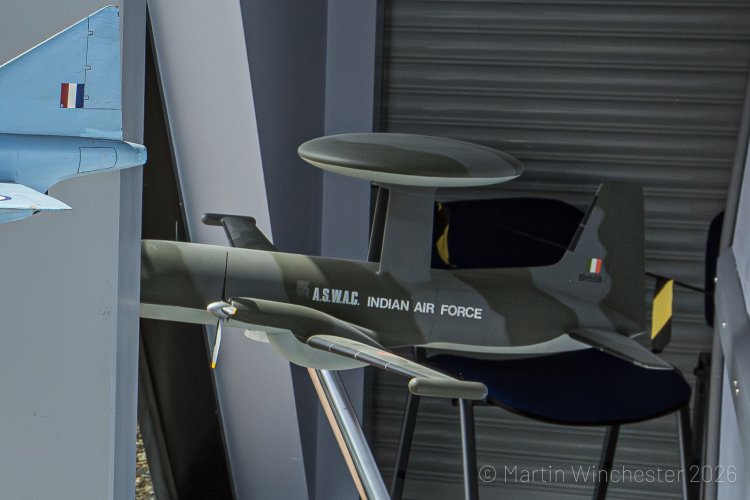
Going through my photos from a visit to the Woodford museum found this lurking in the background of a shot... 748 based AEW (AWSAC) project for the Indian Airforce... apologies for the quality and lack of nose... although I think by now we all know what a 748 nose looks like...!
Zeb
Zeb
Attachments
Last edited:
Scott Kenny
ACCESS: USAP
- Joined
- 15 May 2023
- Messages
- 19,676
- Reaction score
- 28,160
That looks like the E-3 radar setup!Going through my photos from a visit to the Woodford museum found this lurking in the background of a shot... 748 based AEW (AWSAC) project for the Indian Airforce... apologies for the quality and lack of nose... although I think by now we all know what a 748 nose looks like...!
Zeb

- Joined
- 12 July 2006
- Messages
- 977
- Reaction score
- 968
It's as if a painter wants to sell us a portrait as a nude painting — you can imagine the rest... apologies for the quality and lack of nose... although I think by now we all know what a 748 nose looks like...!
Zeb
 .
.Nevertheless, thank you for the informative photo
 .
.Similar threads
-
-
USAF Project 'AERIE' The ultimate stand-off interceptor?
- Started by Pioneer
- Replies: 33
-

-
 RAAF Wedgetail AEW&C proposals and early designs
- Started by Triton
- Replies: 2
-
