

AndersJ
ACCESS: Secret
- Joined
- 7 November 2023
- Messages
- 354
- Reaction score
- 900
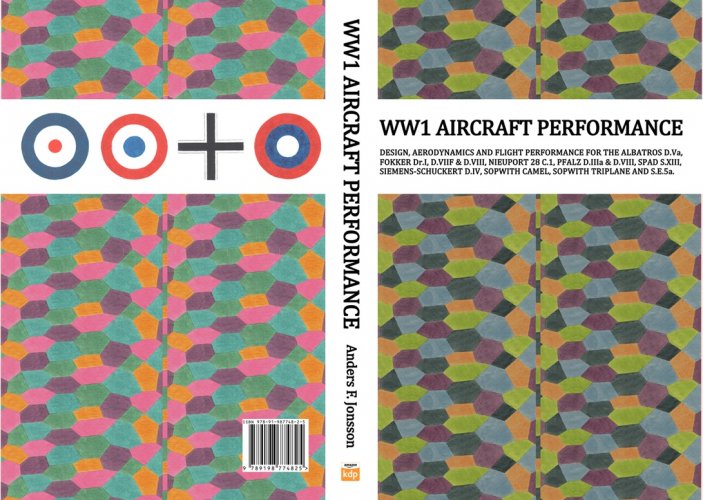
This is not a new release, but since I’ve seen a renewed interest in it in connection to my recent book release about the Spitfire Mk I and Bf 109 E, I thought I should say a few word about it here:
This book compares how many of the best known single-seaters of WW1 compared when it comes to flight performance. And in addition to speed and climb, it also looks into other metrics such as turn, acceleration, dive, dive and zoom, and energy retention.
And in summary, one can say that WW1 aircraft are quite different beasts compared to their WW2 brethren: They can only do sustained turns, and if one attempts an instantaneous turn in them, it’s basically like hitting a brick wall. In addition, their zoom potential after a dive is abysmal, and longer dives just burn off energy. Consequently, dive and zoom attacks are only viable if they involve a few hundreds of meters, no more.
The book also explains why the era of triplanes was so short: Because the third wing is basically a fifth wheel so to speak. And this is also why (contrary to its reputation) the Fokker Dr.I was actually a poorer turning aircraft than its low wing and power loading implies, and why the Sopwith Camel actually was better, especially if one compares them under fair terms, i.e. as in both carrying fuel for the same endurance.
The book also covers details about the emerging understanding of airfoil theory and the effects of aspect ratio on the induced drag. It also shows that while the Fokker’s thick wing profiles certainly were good, so was actually the RAF 15 profile used on British scouts at the time.
In addition, the book also covers why the Fokker D.VII became so legendary: Because while the basic design itself certainly was sound, its outstanding performance in combat was actually to a large extent simply due to its high-performance over-compressed BMW engine.
The book also show some unexpected results: For example, that the SPAD S.XIII was not only faster and climbed better than the Fokker Dr.I, but that it actually also out-turned it at higher altitudes!
The book is in 6” by 9” US trade format, 330 pages long, and more details about its contents and a thumbnail collection of the interior can be found on my webpage here:
https://militaryaircraftperformance.com/ww1-aircr-subpage-books/
The book is available on Amazon in paperback format here:
https://www.amazon.com/dp/9198774824
Note that this link is to Amazon.com, but that the book is also available at (Amazon.co.uk, .de, .fr, .es, .it, .nl, .pl, .se, .be, .ie, .jp, .ca, .au)


