
You are using an out of date browser. It may not display this or other websites correctly.
You should upgrade or use an alternative browser.
You should upgrade or use an alternative browser.
Boeing F-47 NGAD - Speculation and Theories
- Thread starter Bounce
- Start date

Reddington777
ACCESS: Top Secret
- Joined
- 23 March 2025
- Messages
- 830
- Reaction score
- 2,746
He wasn't the only one saying it. Did everyone else make it up too?You literally just made that up.
Reddington777
ACCESS: Top Secret
- Joined
- 23 March 2025
- Messages
- 830
- Reaction score
- 2,746
Or that you happen to be one of the ones who don't state any sources. At least quellish tells us his info is from FOIA.Consensus is truth?

- Joined
- 6 August 2007
- Messages
- 4,530
- Reaction score
- 10,229
GE and PW did not have a flight certified XA at any point thus far. What engine are you claiming flew in the LMCO demonstration aircraft?
6th Gen aircraft demonstrator are/were showcasing advanced features of their platforms. There would be no reason to shove an immature engine technology into any airframe for this show case.
Demonstrators do not “show case” anything. They are risk reduction platforms. They validate wether technology is useful, ready, etc
The Air Force set several of the new engine technologies as things they wanted to demonstrate and validate in flight test. For the Air Force it was a major objective of AII-X.

EmoBirb
ACCESS: Top Secret
- Joined
- 18 January 2025
- Messages
- 2,694
- Reaction score
- 6,920
There is such a thing?Im talking about the working class government employees lol

- Joined
- 27 December 2005
- Messages
- 19,225
- Reaction score
- 35,636
This is analagous to the YF-22 and YF-23 showing supercruise was a useful and ready technology. The actual engines were only prototypes, but they validated the concepts.Demonstrators do not “show case” anything. They are risk reduction platforms. They validate wether technology is useful, ready, etc
The Air Force set several of the new engine technologies as things they wanted to demonstrate and validate in flight test. For the Air Force it was a major objective of AII-X.
Scott Kenny
ACCESS: USAP
- Joined
- 15 May 2023
- Messages
- 19,517
- Reaction score
- 27,965
Right, that may have been poorly phrased.The F135 doesn’t need a new turbine, all models have the same LPT, with some minor modifications to the Turbine Exhaust Case for changes in the bypass flow when the roll posts are active.
The loss of thrust would only occur when the generator is loaded down to charge the directed energy weapon, if there was such a thing that would fit on the F-35. Might be an acceptable trade if there was such a weapon.
F135 is designed to drive the LiftFan.
Other engines are not designed for driving a huge load off the LP spool, so an engine not designed for intermittently driving a liftfan-equivalent would need a new set of LP turbines to have enough torque to spin the mega power generator. Like the difference between Olympus and Marine Olympus in terms of turbines.
Firefighters and the various land-use folks come to mind.There is such a thing?

barry bozo
ACCESS: Restricted
- Joined
- 4 February 2026
- Messages
- 41
- Reaction score
- 130
Not arguing this, just piggybacking off this.There was no "unusual wording". The adaptive engine that was flown on the Lockheed demonstrator was a pacing item that held up the schedule, it was an engine that the press has not reported on at all, it was not one of the the XA100 or XA101 engines or... whatever the hell the F-35 adaptive engine was. The engine used on the Lockheed demonstrator has been disclosed in the public domain (though not the fact that it flew, or that it flew on a demonstrator) but the press has not reported on it that I know of.
Don't make up things about what I say or my intent.
If it’s true that one prime ran with an adaptive engine (regardless of what engine it is specifically) and another ran with already available engines insinuates that engine technology/type was not a factor in the fly-off. Given the heavy "demonstrator" emphasis all around, I think it points to it being more about airframe/planform testing considering how supersonic tailless flight is still a challenge we have to conquer. I think it was likely less about testing new "technologies" as some have speculated since many of those technologies wont even be ready till months (or years) after flight test begins.
IF all that is roughly accurate, it surprises me that LM went with such a high risk-path for a demonstrator, given how important "fly-offs" are historically in deciding a winner.
Caveat being this isn't a true fly-off in the traditional sense since the order of events is a bit different.
Last edited:

FighterJock
ACCESS: Above Top Secret
- Joined
- 29 October 2007
- Messages
- 7,228
- Reaction score
- 8,539
That was like the ATF and JSF competitions they both had fly-off's before the winner was selected which is why I think that choosing the NGAD/F-47 without a fly-off is a bit strange, I would have loved to have seen one.
barry bozo
ACCESS: Restricted
- Joined
- 4 February 2026
- Messages
- 41
- Reaction score
- 130
It seems they did it in a non-traditional sense. Early fly-off for risk reduction (both for the concept as a whole and for each prime), then proper development for both to see which design proves best value/lowest risk in the end. More expensive since you have to fund essentially half an EMD program each, but likely reduces the risk of teething issues and cost ballooning like F-35 experienced.That was like the ATF and JSF competitions they both had fly-off's before the winner was selected which is why I think that choosing the NGAD/F-47 without a fly-off is a bit strange, I would have loved to have seen one.

dark sidius
ACCESS: Top Secret
- Joined
- 1 August 2008
- Messages
- 1,618
- Reaction score
- 1,710
Have you a link or something else ?There was no "unusual wording". The adaptive engine that was flown on the Lockheed demonstrator was a pacing item that held up the schedule, it was an engine that the press has not reported on at all, it was not one of the the XA100 or XA101 engines or... whatever the hell the F-35 adaptive engine was. The engine used on the Lockheed demonstrator has been disclosed in the public domain (though not the fact that it flew, or that it flew on a demonstrator) but the press has not reported on it that I know of.
Don't make up things about what I say or my intent.
insidersource
ACCESS: Top Secret
- Joined
- 24 March 2025
- Messages
- 521
- Reaction score
- 744
This was not a fly off like the YF-22 versus YF-23 or the X-32 vs X-35.The fact that one prime ran with an adaptive engine (regardless of what engine it is specifically) and another ran with already available engines insinuates that engine technology/type was not a factor in the fly-off.
The Boeing demonstrator was for the Navy F/A-XX requirement and the Lockheed Martin demonstrator was for the USAF NGAD requirement.
The adaptive engines were key technology for the USAF requirement.
barry bozo
ACCESS: Restricted
- Joined
- 4 February 2026
- Messages
- 41
- Reaction score
- 130
I still have no idea where this originated from. Both demonstrators would have been built to the same requirements. Pilots from both the Navy and AF both could’ve had go to give input, but the Boeing one being built specifically for the Navy is pure speculation that I've seen over and over from a number of people with no basis.The Boeing demonstrator was for the Navy F/A-XX requirement and the Lockheed Martin demonstrator was for the USAF NGAD requirement.
They both fed into the same NGAD. requirements, so having one contractor create a demonstrator for a different set of requirements would only put them at a disadvantage. No company in their right mind would agree to this, especially when your goal is to win both contracts. From a competition standpoint, it's just asking for a protest in the end when not giving the primes the same initial requirements for their biggest form of risk reduction.
Clearly not if Boeing won hand-over-fist (no protest from LM says a lot). Given than the NGAP engines wont be ready for several years at this point, all signs point to having an "off-the-shelf" engine for at least the first increment or blocks. With that information alone, you can conclude that adaptive engines were NOT a requirement to win, especially when you consider the timeline in which the gov wants it delivered.The adaptive engines were key technology for the USAF requirement.
Last edited:
- Joined
- 6 August 2007
- Messages
- 4,530
- Reaction score
- 10,229
They both fed into the same Airforce NGAD requirements, so having one contractor create a demonstrator for a different set of requirements would only put them at a disadvantage. No company in their right mind would agree to this, especially when your goal is to win both contracts. From a competition standpoint, it's just asking for a protest in the end when not giving the primes the same initial requirements for their biggest form of risk reduction.
They were not competing for a production contract. These were x-planes.
I don’t know why anyone here can speculate on an XA flying at this point. AETP was neither flight certified nor of a weight requirement for practical demonstration. High risk, low reward.
F-47 and F110
F-47 and F110
Last edited:
barry bozo
ACCESS: Restricted
- Joined
- 4 February 2026
- Messages
- 41
- Reaction score
- 130
I'm aware of the difference. They still served as primary risk reduction for the EMD contract. Pretending that the demonstrators and the final EMD designs in this case were not incredibly similar or representative (as far as planform and OML go) would be a misjudgement.They were not competing for a production contract. These were x-planes.
All-X requirements directly fed NGAD requirements. So again, giving your contractors two different sets of requirements would lead to less competition for each contract, and wouldn't give you the best comparison of planforms since you're comparing apples to oranges.
And when you consider that NG was also included in the initiative (whether they flew or not), what do they create? A Navy demonstrator? An Airforce demonstrator?
They were all meant to create a demonstrator for AF's NGAD, and lessons would be learned and applied to the Navy's since it comes later.
- Joined
- 15 January 2021
- Messages
- 649
- Reaction score
- 2,859
One possible engine that I forgot, the PW9000 which is rumored to be the power plant of the B-21. It was supposed to be the core of the PW1000 geared turbofan mated to the low rotor of the F135 (with no fan gearbox) or some variation of that low rotor. In the B-21, the low rotor would be a medium bypass fan with higher airflow for subsonic cruise at altitude, while a fighter variant would have a smaller lower airflow high pressure fan in the F100-220 and F110 bypass ratio range (0.7) with an afterburner. Since the B-21 is obviously flying without any public disclosure of the engine, this could be the basis of an undisclosed interim NGAP engine and would qualify as a “derivative” engine for the Navy. Pure speculation on my part, based on an AvWeek article in 2011-2012.XA100/101 were ground demonstrators, not flight weight or flight certified. There is no way they flew in any flight demonstration aircraft.
If the flight demonstrator aircraft flew with 45K engines, the F135 is your only choice.
If they flew with NGAP sized engines, your available choices are F119 or F110-132. Only F119 has a production LO exhaust system. It is possible that GE could have built a round AVEN F135 style LO nozzle for the F110-132, but there is still no LO features in the exhaust cavity without a very large development budget for a 1 off demonstrator.

In_A_Dream
ACCESS: Top Secret
- Joined
- 3 June 2019
- Messages
- 786
- Reaction score
- 926
Should also point out that the NGAD & PCA concepts went through a ton of changes as they were being developed.

- Joined
- 30 May 2023
- Messages
- 664
- Reaction score
- 1,436
I think @quellish has laid out very clearly the USN and USAF were interested in partially overlapping things with the AII-X demonstrators and that one of those things was an adaptive engine, which was at least one of the gating items for LM to fly its demonstrator.
@quellish has also said Boeing, who flew the USN oriented AII-X plane, also catered to USAF special areas of interest in at least one other area, which was the ability to rapidly generate a much higher level of power generation.
This capability may or may not be partially or largely enabled by an engine designed to harness more power (however) and possibly with a third stream integral cooling system. Apologies to @Seragina
Although I for one now have a different context for the Navy officials comment on engines as reflecting what Boeing flew as part of AII-X and no bearing on what happens to F/A-XXs engines in the future.
That still leaves me with the question of what will Incr1 F-47 fly with?
Maybe I’m too pessimistic and GE or PW can spin up a derivative engine quietly and quickly, as seems to be happening with B-21, albeit with a subsonic only performance envelope requirement.
Thanks to the aforementioned for taking the time to set things straight, as frustrating as it is.
@quellish has also said Boeing, who flew the USN oriented AII-X plane, also catered to USAF special areas of interest in at least one other area, which was the ability to rapidly generate a much higher level of power generation.
This capability may or may not be partially or largely enabled by an engine designed to harness more power (however) and possibly with a third stream integral cooling system. Apologies to @Seragina
Although I for one now have a different context for the Navy officials comment on engines as reflecting what Boeing flew as part of AII-X and no bearing on what happens to F/A-XXs engines in the future.
That still leaves me with the question of what will Incr1 F-47 fly with?
Maybe I’m too pessimistic and GE or PW can spin up a derivative engine quietly and quickly, as seems to be happening with B-21, albeit with a subsonic only performance envelope requirement.
Thanks to the aforementioned for taking the time to set things straight, as frustrating as it is.
Scott Kenny
ACCESS: USAP
- Joined
- 15 May 2023
- Messages
- 19,517
- Reaction score
- 27,965
You laugh, but the late-model F110s have roughly the same thrust as F119 with better fuel economy.F110 lol
EmoBirb
ACCESS: Top Secret
- Joined
- 18 January 2025
- Messages
- 2,694
- Reaction score
- 6,920
I don't think the "lol" was aimed at the performance of the F110 and more so at the ongoing discussion that for whatever reason seems to persist around that specific engine with little evidence supporting any significance to the NGAD program
Oh, I’m not laughing about that.
Hypothetically, speaking on F119…which are limited in number and not produced now, you have to get past the fact that it’s essentially LMCO property only supported by PW. They are either on wing or on reserve. Highly unlikely to spin a few off for other programs.
F135 would make more sense from PW. Actively in production, over 1000 engines produced as of 2022/23ish. High thrust and versatility. It’s even being updated. It would be easier to get a handful of those.
GE is friendly with Boeing.
PW is extra friendly with NG.
Hypothetically, speaking on F119…which are limited in number and not produced now, you have to get past the fact that it’s essentially LMCO property only supported by PW. They are either on wing or on reserve. Highly unlikely to spin a few off for other programs.
F135 would make more sense from PW. Actively in production, over 1000 engines produced as of 2022/23ish. High thrust and versatility. It’s even being updated. It would be easier to get a handful of those.
GE is friendly with Boeing.
PW is extra friendly with NG.

- Joined
- 3 June 2011
- Messages
- 20,896
- Reaction score
- 19,085
There was no fly-off for either the F-15 or F-14. In fact, fly-offs are relatively rare.That was like the ATF and JSF competitions they both had fly-off's before the winner was selected which is why I think that choosing the NGAD/F-47 without a fly-off is a bit strange, I would have loved to have seen one.
- Joined
- 15 January 2021
- Messages
- 649
- Reaction score
- 2,859
F110-132 has better fuel economy at Mil and below cruise, but significantly less thrust at Mil power. In max AB, the F119 SFC is better than the F110 - might be enough to offset the F119 higher thrust at Max. Granted, the F110 will probably have longer range with a long subsonic cruise leg, but you are giving up performance, especially in the supercruise envelope.You laugh, but the late-model F110s have roughly the same thrust as F119 with better fuel economy.
I see the requirement for best SFC for higher end supercruise and lower end loitering. Supercruise dash for 200 nmi and loitering for at least 2-3 hours after arrival. Although, I see a bypass ratio of 0.5-0.6 as desireable I'm not sure the small but high pressure chamber will be sufficient for higher thrust (up to 40+klb). I expect 35klb to be the threshold.
insidersource
ACCESS: Top Secret
- Joined
- 24 March 2025
- Messages
- 521
- Reaction score
- 744
Excuse me! Quellish has said the exact opposite to me twice this month. I was the one saying the Boeing demonstrator flew with large power generation. When I mentioned:quellish has also said Boeing, who flew the USN oriented AII-X plane, also catered to USAF special areas of interest in at least one other area, which was the ability to rapidly generate a much higher level of power generation.
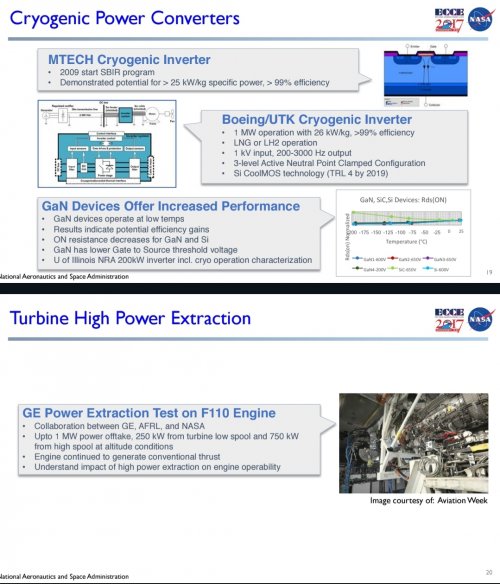
This is about 10-15 times more electricity than the existing F110 generators. This allows the F110 to meet the electrical generation requirements of a 6th gen fighter.
That was not requirement for the AII-X demonstrator that first flew in 2019.
Post in thread 'GE hybrid electric turbofan' https://www.secretprojects.co.uk/threads/ge-hybrid-electric-turbofan.51073/post-906412
No he laughing because he has said the Boeing aircraft has used F110 engines multiple times now.I don't think the "lol" was aimed at the performance of the F110 and more so at the ongoing discussion
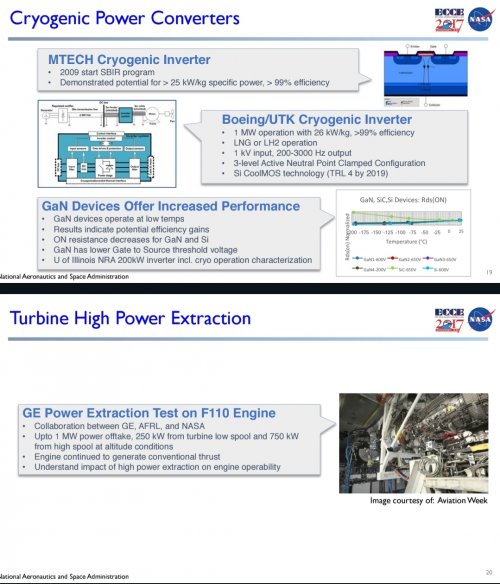
This is why the NASA program used the F110 in 2017 to fit electricity motor/generators on each shaft. Boeing did the Cryogenic invertor as it would have to be highly integrated into the Boeing airframe. TRL 4 by 2019. Ready for the Boeing first flight.
The PW9000 is a non-afterburning medium bypass turbofan. There is a small possibility that the LM demonstrator used a turbine based combined cycle. Project Mayhem has lots of information. It could have implemented the Lockheed Martin SR-72 research. This opens up the possibilities of engines. The core would be a normal non-afterburning engine as the afterburner would be in the shared exhaust. Combined cycle would still be considered adaptive like the SR-71 engine. I might watch Top Gun Maverick again tonight for clues.One possible engine that I forgot, the PW9000 which is rumored to be the power plant of the B-21.

- Joined
- 6 August 2007
- Messages
- 4,530
- Reaction score
- 10,229
Excuse me! Quellish has said the exact opposite to me twice this month. I was the one saying the Boeing demonstrator flew with large power generation.
No, I have not.
You said larger generators. I pointed out that generators were your assumption, then provided sources regarding power generation needs for sixth gen aircraft.
I have never said any AII-X aircraft used F110 engines and have repeatedly questioned that assumption made by others.
I have said it before, don’t try to put words in my mouth.
- Joined
- 6 August 2007
- Messages
- 4,530
- Reaction score
- 10,229
I'm aware of the difference. They still served as primary risk reduction for the EMD contract. Pretending that the demonstrators and the final EMD designs in this case were not incredibly similar or representative (as far as planform and OML go) would be a misjudgement.
All-X requirements directly fed NGAD requirements. So again, giving your contractors two different sets of requirements would lead to less competition for each contract, and wouldn't give you the best comparison of planforms since you're comparing apples to oranges.
And when you consider that NG was also included in the initiative (whether they flew or not), what do they create? A Navy demonstrator? An Airforce demonstrator?
They were all meant to create a demonstrator for AF's NGAD, and lessons would be learned and applied to the Navy's since it comes later.
The public record does not support these assertions.
https://www.secretprojects.co.uk/th...xperimental-aii-x-demonstrator-program.51707/
barry bozo
ACCESS: Restricted
- Joined
- 4 February 2026
- Messages
- 41
- Reaction score
- 130
Fair enough. I won’t argue what was said in the public record. +Thank you for creating that consolidation post. It’s good to have it all in one place to refer to.The public record does not support these assertions.
https://www.secretprojects.co.uk/th...xperimental-aii-x-demonstrator-program.51707/
As with any other program and initiative, things can change. It’s entirely possible that they didn’t stick to the original plan, and from what I’ve heard, naval test points were merely that and not built into the requirements for either. That’s where my assertion comes from.
But, provided that’s not in any way verifiable with the information available to us all, I’ll hop off my mound of salt until we have new and better information on it.
EDIT: It’s worth noting that the things I heard only come from one side of the coin. It’s very possible that perspective is different due to the fact that it doesn’t come from the opposite side of the coin. Hence the extra salt.
Last edited:

- Joined
- 9 March 2021
- Messages
- 169
- Reaction score
- 752
Two tidbits (from what I've been told) to throw into the conversation...
From my posting in March 2025:
1. B's F/A-XX uses a variable-bypass derivative of the F110. It was selected as their Navy baseline propulsion system many years ago. Seems reasonable to speculate that B's F-47 also uses a version of the F110 as an interim solution until NGAP is ready technically (TRL) or fiscally (AF budget).
2. AF contract with B somehow allowed for a switch to NGAP from an interim engine. Apparently the AF exercised this option immediately following the EMD contract award. More intrigue ...
From my posting in March 2025:
F/A-XX will be using an F110 derivative with variable-cycle features.
The AETP/NGAP 3-stream idea was eliminated a while ago -- cost was reason #2. Can't say what #1 is.
1. B's F/A-XX uses a variable-bypass derivative of the F110. It was selected as their Navy baseline propulsion system many years ago. Seems reasonable to speculate that B's F-47 also uses a version of the F110 as an interim solution until NGAP is ready technically (TRL) or fiscally (AF budget).
Clearly not if Boeing won hand-over-fist (no protest from LM says a lot). Given than the NGAP engines wont be ready for several years at this point, all signs point to Boeing having an "off-the-shelf" engine for at least the first increment or blocks. With that information alone, you can conclude that adaptive engines were NOT a requirement to win, especially when you consider the timeline in which the Airforce wants it delivered.
2. AF contract with B somehow allowed for a switch to NGAP from an interim engine. Apparently the AF exercised this option immediately following the EMD contract award. More intrigue ...
Sir, I hope you are well.I don’t believe any YF136 flight engines were ever produced, but I could be wrong. They made it to the ground development stage before the plug was pulled. The F136 engine was capable of even higher airflow than the F135 (there was some excess airflow capacity designed into the F-35 inlets), so it would be too large for a NGAP interim engine in the 35-40K range.
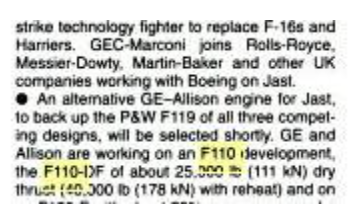
There's also a potential possibility: a variable-cycle derivative of the F110. According to reports from Flight Global and Aerospace in 1996, GE had two engines selected as candidates for the JAST project, one of which was a variable-cycle derivative of the F110, reportedly with a dry thrust of 25,000 pounds and a wet thrust of 40,000 pounds. Some forum users claim that the Navy's NGAP (now the F/A-XX) chose it as its power system baseline, although it's unknown whether this engine was secretly manufactured.
Two F110 growth steps are being offered, the DF3/DF6 providing 20-25% more power than the 130kN (29,000lb)-thrust F110-129, by using the up-rated core from the latest CFM56-7 commercial turbofan and the DV2/DV3 providing 35-40% more thrust, through the use of a higher-airflow bladed-disc (blisk) fan and variable-cycle core. Two variants of the 155kN-class YF120 are being proposed: the V4 providing a 20-25% thrust increase, with a blisk fan and variable-cycle core; and the F3 providing 40% more thrust, with a 50% airflow increase and a fixed-cycle core.
Attachments
insidersource
ACCESS: Top Secret
- Joined
- 24 March 2025
- Messages
- 521
- Reaction score
- 744
Your information is out of date. That is all JSF F-35 related.There's also a potential possibility: a variable-cycle derivative of the F110. According to reports from Flight Global and Aerospace in 1996.
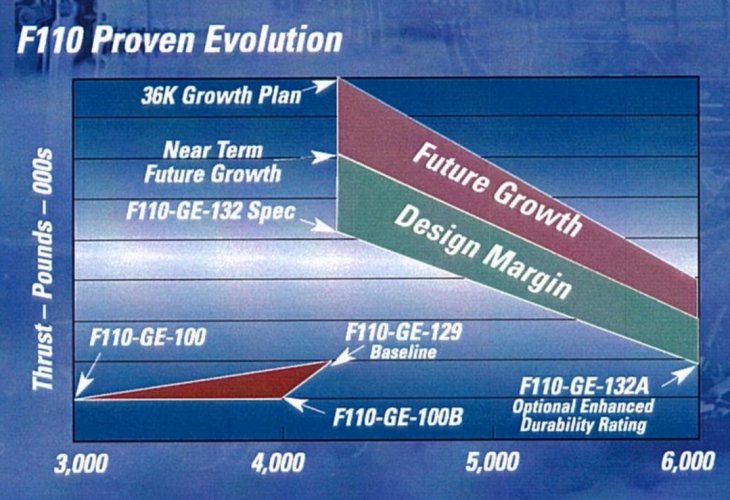
This is the F110 growth plan that was the entry level or interim 6th gen fighter engine.
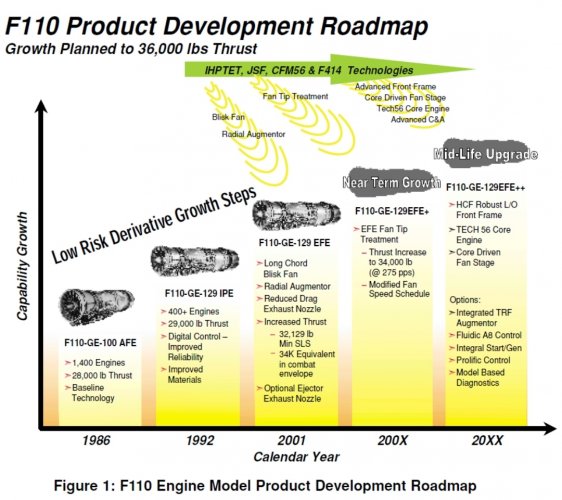
Notice the 20XX Mid-life upgrade includes the CFM56 core upgrade but also the Integral Start/Gen. Electric motors on both shafts and tested with NASA in 2017. Electrical power is crucial for 6th gen fighters. Note it even says Boeing making the inverter as this would be specific to each air frame.
There is no mention that they fitted YF120 style bleed valves to the F110 engine. The YF120 tech only has a fraction of the variability of the newer XA series engines. F119 doctor might be able to provide information on the variability.
Many people call this new engine the F110-GE-134. The 36,000lb thrust growth rating is for a low 4,000 cycle life which the US military has not deemed acceptable for over 40 years. It will most likely be derated to 34,000lb for increased life.
Last edited:
- Joined
- 15 January 2021
- Messages
- 649
- Reaction score
- 2,859
Anything is possible, especially if it was funded under some black world project. I have no knowledge if any of these proposals ever progressed beyond the paper description you have provided.Sir, I hope you are well.
There's also a potential possibility: a variable-cycle derivative of the F110. According to reports from Flight Global and Aerospace in 1996, GE had two engines selected as candidates for the JAST project, one of which was a variable-cycle derivative of the F110, reportedly with a dry thrust of 25,000 pounds and a wet thrust of 40,000 pounds. Some forum users claim that the Navy's NGAP (now the F/A-XX) chose it as its power system baseline, although it's unknown whether this engine was secretly manufactured.
Two F110 growth steps are being offered, the DF3/DF6 providing 20-25% more power than the 130kN (29,000lb)-thrust F110-129, by using the up-rated core from the latest CFM56-7 commercial turbofan and the DV2/DV3 providing 35-40% more thrust, through the use of a higher-airflow bladed-disc (blisk) fan and variable-cycle core. Two variants of the 155kN-class YF120 are being proposed: the V4 providing a 20-25% thrust increase, with a blisk fan and variable-cycle core; and the F3 providing 40% more thrust, with a 50% airflow increase and a fixed-cycle core.
Getting a ground development engine built and to test without non-program cleared personnel seeing the engine is possible with restricted areas and visual blockage of ground test stands. Getting engines to altitude test for flight clearance is much harder to do stealthily since all altitude test facilities have been consolidated at the Government run facilities at Arnold AFB in Tullahoma TN. Time in these test cells is precious and difficult to hide in the schedule. It is possible that the NGAD demonstrator took a variable cycle F110 derivative directly from ground test to flight, but that would bring a ton of risk to the program that Lockheed and the USAF would be unlikely to take.
Frankly, I have all the information you showed me about the F110 engine and have read it. What I posted above was simply to illustrate the thrust achievable by a variable-cycle engine derived from the F110. Furthermore, the images from the technical paper "F110-GE-129 EFE — Enhanced Power Through Low Risk Derivative Technology" demonstrate that the F110-GE-129EFE++ has a core-driven fan stage, confirming its variable-cycle identity. This is because the CDFS is one of the key designs of the YF120, a new component specifically designed by GE for variable-cycle engines at the time; the high-pressure compressor of a conventional engine cannot be directly used. PS: This topic is not about the F110. If you want to discuss the F110 engine, please move to the topic F110-EPE: https://www.secretprojects.co.uk/threads/f110-epe-proposals.40506/Your information is out of date. That is all JSF F-35 related.
This is the F110 growth plan that was the entry level or interim 6th gen fighter engine.
Notice the 20XX Mid-life upgrade includes the CFM56 core upgrade but also the Integral Start/Gen. Electric motors on both shafts and tested with NASA in 2017. Electrical power is crucial for 6th gen fighters. Note it even says Boeing making the inverter as this would be specific to each air frame.
There is no mention that they fitted YF120 style bleed valves to the F110 engine. The YF120 tech only has a fraction of the variability of the newer XA series engines. F119 doctor might be able to provide information on the variability.
Many people call this new engine the F110-GE-134. The 36,000lb thrust growth rating is for a low 4,000 cycle life which the US military has not deemed acceptable for over 40 years. It will most likely be derated to 34,000lb for increased life.
A few points I’m curious about. How is the engine information of the B-21 protected so well? And, according to claims from forum users, a variable-cycle derivative of the F110 has been selected by the Navy as the baseline propulsion system for the F/A-XX. Does this mean it might undergo standalone testing at the 44W/45W altitude test facilities(I suspect that these two facilities from NAPTC are specifically for serving NAVAIR), bypassing the AEDC C-1/C-2 altitude test cells entirely?Anything is possible, especially if it was funded under some black world project. I have no knowledge if any of these proposals ever progressed beyond the paper description you have provided.
Getting a ground development engine built and to test without non-program cleared personnel seeing the engine is possible with restricted areas and visual blockage of ground test stands. Getting engines to altitude test for flight clearance is much harder to do stealthily since all altitude test facilities have been consolidated at the Government run facilities at Arnold AFB in Tullahoma TN. Time in these test cells is precious and difficult to hide in the schedule. It is possible that the NGAD demonstrator took a variable cycle F110 derivative directly from ground test to flight, but that would bring a ton of risk to the program that Lockheed and the USAF would be unlikely to take.
By the way, the USAF is delaying the NGAP program citing supply chain issues, yet both PW and GE assert they can meet the original timeline for NGAP delivery. So where exactly lies the problem? Both the XA102 and XA103 have completed their ARR. Is it not feasible to achieve the FETT in 2027, with the winner then proceeding into the EMD phase? Another thought, similar to the F100-PW-100 development, could they just skip the Demo & Val phase and directly select the winner for EMD? After all, the technical viability of adaptive cycle engines has already been proven through the ADVENT program and the XA100/XA101 test campaigns.
- Joined
- 15 January 2021
- Messages
- 649
- Reaction score
- 2,859
To my knowledge, the NAPTC altitude test cells in Trenton were decommissioned. Wikipedia says in the mid-1990s. As far as I know, Tullahoma Arnold AFB has the only functional altitude test cells in the US.A few points I’m curious about. How is the engine information of the B-21 protected so well? And, according to claims from forum users, a variable-cycle derivative of the F110 has been selected by the Navy as the baseline propulsion system for the F/A-XX. Does this mean it might undergo standalone testing at the 44W/45W altitude test facilities(I suspect that these two facilities from NAPTC are specifically for serving NAVAIR), bypassing the AEDC C-1/C-2 altitude test cells entirely?
By the way, the USAF is delaying the NGAP program citing supply chain issues, yet both PW and GE assert they can meet the original timeline for NGAP delivery. So where exactly lies the problem? Both the XA102 and XA103 have completed their ARR. Is it not feasible to achieve the FETT in 2027, with the winner then proceeding into the EMD phase? Another thought, similar to the F100-PW-100 development, could they just skip the Demo & Val phase and directly select the winner for EMD? After all, the technical viability of adaptive cycle engines has already been proven through the ADVENT program and the XA100/XA101 test campaigns.
You are correct - the B-21 propulsion system has been kept very close, with the only information released is that the engines are produced by P&W. GE is just as capable of security, so it is possible they have developed an advanced F110 without any public disclosure.
The issue with the F-47 is that the USAF appears to have a 2028 first flight schedule, while the NGAP engine schedule is 2030-2031 for flight engines. On schedule for NGAP doesn’t support the first flight schedule, thus the speculation for an interim engine.
The USAF can make a down select between the XA102 and 103 at any time, but it looks like they are waiting until the first engines are built and completed at least initial test before entering EMD.
Similar threads
-

-

-
 DARPA to Transfer Advanced Space Debris Telescope to Air Force
- Started by Flyaway
- Replies: 6
-
 USAF/USN 6th Gen Fighters - F/A-XX, F-X, NGAD, PCA, ASFS News & Analysis [2008- 2025]
- Started by Matej
- Replies: 10K
-
Richard Vogt and B-47 design origins – father of all jets?
- Started by Ivan Culjak
- Replies: 3