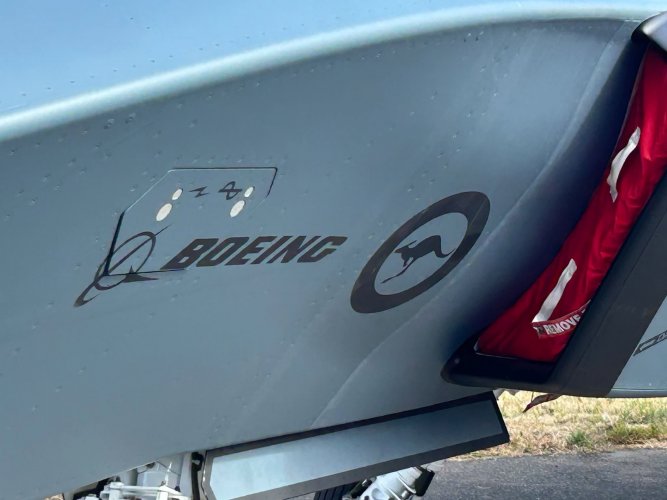
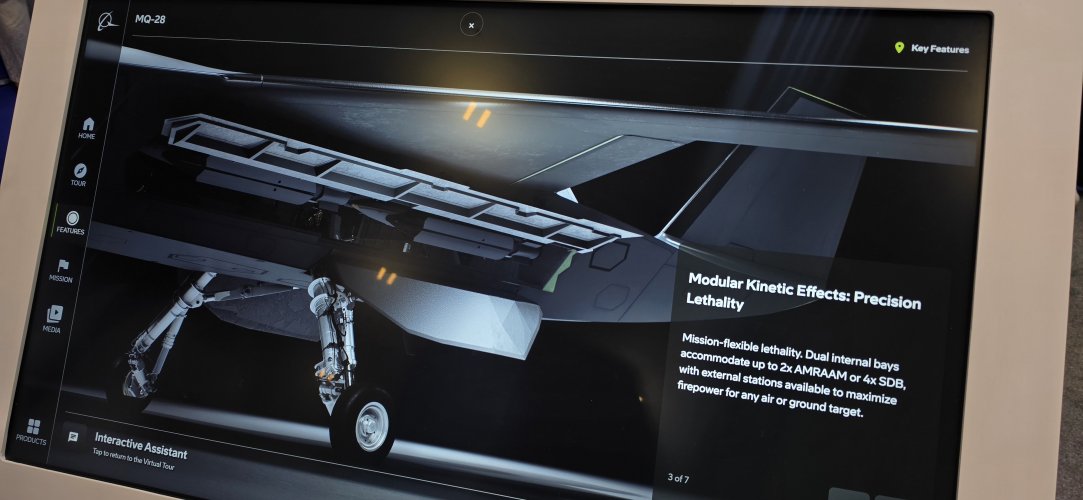
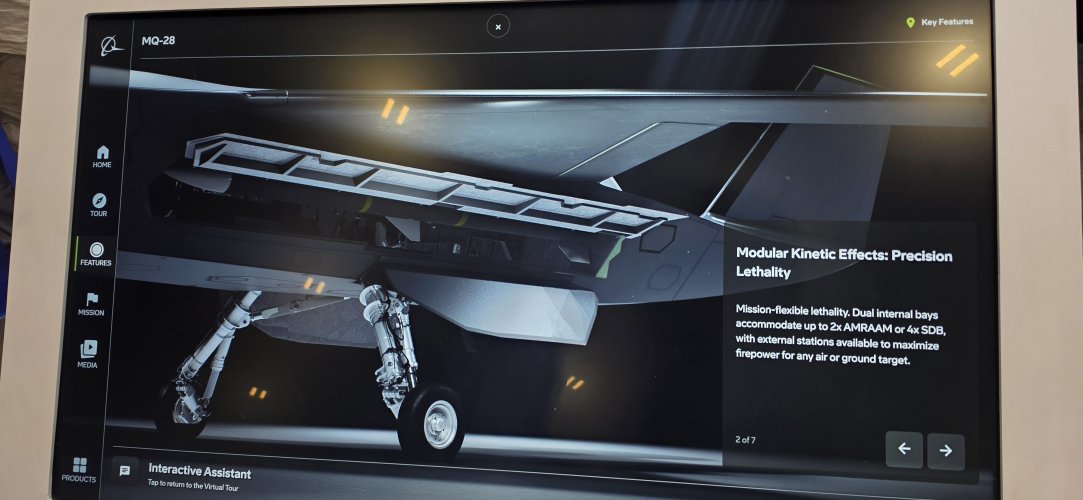
MQ-28 is not an Australian only endeavor.

I too would like to hear some examples and to know why you think this to be significant.

the MQ-25 is actually larger than an F-16 size wise...

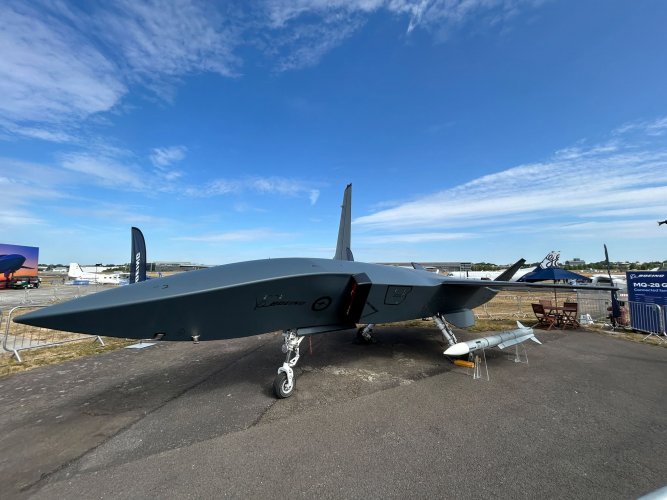
Not sure how you have arrived at that conclusion. Up to Block 2, Ghost Bat length is 11.70 m (a F-16 Block 50 measures 15.06 m) while span is 7.30 m (F-16 = 9.96 m).

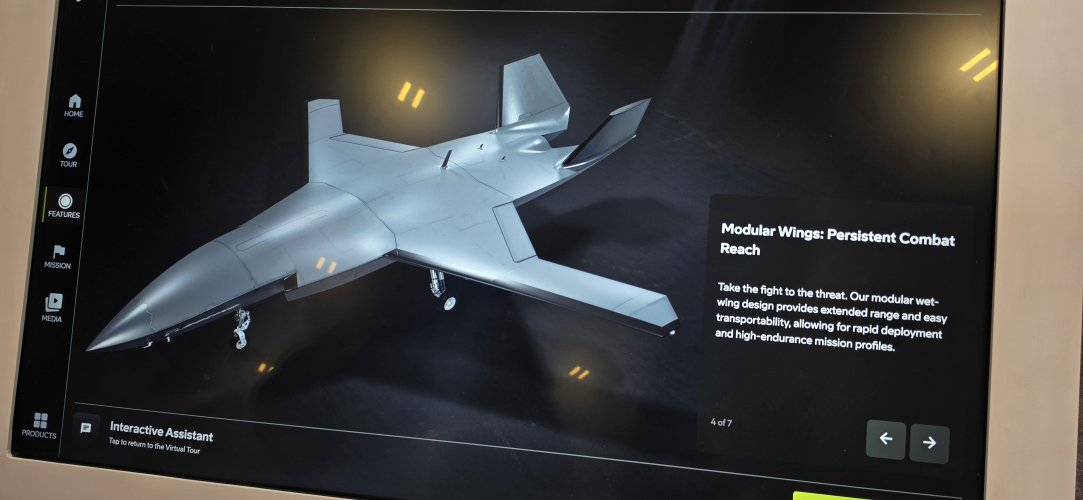
Or are you referring to the extended span of the planned Block 3 Ghost Bat? If so, then yes, the 10.60 m extended span would be a smidge more than an F-16.
 
Was announced at Farnborough that Leonardo having worked on the electronics of Ghost Bat for 8 years was now being upgraded to a full program partner in the aircraft alongside Boeing and will make an IRST for the swappable nose (without it the Ghost Bat lacks its own sensors relying purely on targeting information supplied by other aircraft), while Eaton have joined as a partner to manufacture the weapon rail and release system for Block 3 and will offer ITAR and non-ITAR compliant versions of the system. Hensoldt have signed to be responsible for the localisation of any German aircraft orders. MBDA will also integrate the Meteor on the Ghost Bat.
 
Last edited:
I edited out my comment multiple times because I'm not sure if I would have said more than I should so Im going to leave it at that and Im certainly not going into any more detail. Im new to the industry so Id rather be on the safe side.
When in doubt, first make sure your own butt is covered.

If you can cite a published document, do so in every post.
 
You do need CCAs.

Even from an air combat perspective alone, being able to engage from multiple geometries is more valuable and useful than firing longer ranged missiles from fewer locations. Mlst The benefit of reach can be used to keep enemy units at bay, but thats only if you can pin down all the units engaging you back. The problem with having lesser points of engagement is that opposing units left unegaged will quickly compress your engagement timelines. You now have less ability to prosecute follow on shots on individual targets of value too. So unless youve got an equally distributed force, the disadvantage is hard to make up.

In combination with having more engagement options comes the added benefits of:

-Sensing
-Distributed EW, which is taking the place of stand in jamming.
-Resilient LOS based information networking and relay nodes
-presenting so many targets that you can, essentially, hide your shooters in plain sight

The benefits and vastly expanded options of having CCAs is becoming par for course even for countries without much money. Not having them puts you at an inherent disadvantage even if you can fly higher and shoot longer ranged, because at a certain point in the engagement, you will be outmanuvered or run out of the airspace by being unable to put up the same amount of combat mass.

I should also add that i remember reading most actual AAM engagements happen at high subsonic to low supersonic speeds and altitudes generally not as high as we think (sub 40 k). That altitude and speed decreases as you near the target as well due to renegagement timelines and defensibility


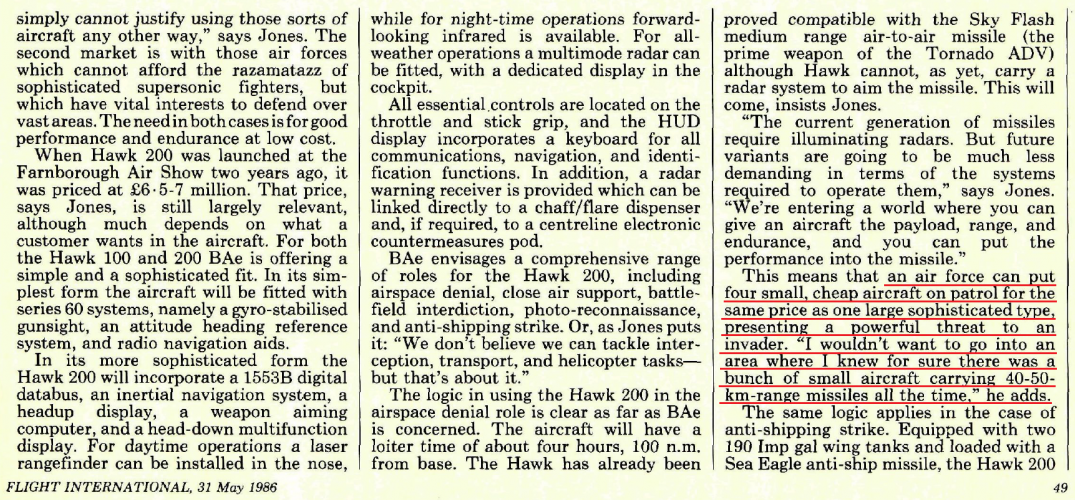
A number of cheap, subsonic fighters armed with longish range missiles defending an area is essentially the same as the case made by a BAe marketing manager 40 years ago. The key difference is whether they are manned or unmanned, IMHO.

conops.png
 
A number of cheap, subsonic fighters armed with longish range missiles defending an area is essentially the same as the case made by a BAe marketing manager 40 years ago. The key difference is whether they are manned or unmanned, IMHO.

View attachment 818956
A greater key difference is the C2 infrastructure to support that. In the context of the article above four small cheap aircraft didn't have the radar system to support long range fires, please no more Pierre Sprey, while the Tornado did. With CCA the systems are all networked together and so the parent aircraft can use a CCA's weapon to target an adversary that has been identified and verified by the parent aircrafts own sensors or from those within the CCA cloud.
 
BD Chief Kelly on the Airpower podcast was pretty clear on international plans for Ghost Bat - ITAR free backbone with mission autonomy software and hardware (nose portion) bespoke to the international user. While this will impose real limitations to this specific instantiation of the Ghost Bat spiral, it’s a pretty slick nearish-term solution for the defense middle market (ME, Indonesia, LatAm eg) that sidesteps ITAR.
 

Attachments

  • 2310A952-5653-4D66-801E-1FC0B92AA6B7.jpeg
    2310A952-5653-4D66-801E-1FC0B92AA6B7.jpeg
    496.4 KB · Views: 37
  • F4FB4BC7-90BB-4E3B-9556-8BBAF3CAED1F.jpeg
    F4FB4BC7-90BB-4E3B-9556-8BBAF3CAED1F.jpeg
    596.5 KB · Views: 38
  • 0C5C0649-E517-4F3C-A4AB-E3C6D1EC9A0C.jpeg
    0C5C0649-E517-4F3C-A4AB-E3C6D1EC9A0C.jpeg
    631.1 KB · Views: 33

Similar threads

Back
Top Bottom