Blohm & Voss P 184

Dan Sharp

ACCESS: Top Secret
Top Contributor
Senior Member
Joined
11 June 2014
Messages
1,641
Reaction score
3,510
Herwig and Rode presented this as the Blohm & Voss P 184.01 in 1998:
20251003_161501.jpg

I only have a drawing of the P 184.03 from July 1943, not the P 184.01, but even though the drawing I have is very faded, the cockpit canopy seems quite different (also the .01 has a single fin but the .03 has twin fins). What do you suppose the arrangement of the glazing actually looked like (if you were to draw over it and show where you thought the windows were, say)? Here are the side and top views. The forward view is useless because it's almost completely faded off.
Blohm & Voss P 184.03-01 cockpit detail.jpg

Top view.jpg
 
Dear,
here a better quality pic of the Bv P.184 (source Die Deutsche Luftrustung 1933 - 1945, Heinz J. Nowarra).
Cheers.
 

Attachments

  • 3-view.jpg
    3-view.jpg
    488.3 KB · Views: 125
Dear,
here a better quality pic of the Bv P.184 (source Die Deutsche Luftrustung 1933 - 1945, Heinz J. Nowarra).
Cheers.

Is it a better quality pic though? The canopy frame lines in the forward and top views don't match. Neither drawing is entirely convincing on the details, paricularly with undercarriage positioning, canopy design, prop spinners, tail turret etc. etc.

However, the fact that Herwig and Rode cite it as the 'P 184.01' does seem to lend them a little more credibility, since the drawing I have is very clearly 'P 184.03' and differs significantly in the tail form. The undercarriage as depicted in the Herwig and Rode drawing seems closer to how I would expect the undercarriage to have been depicted in an original drawing. In the drawing I have, it's completely faded off.
 
Is it a better quality pic though? The canopy frame lines in the forward and top views don't match. Neither drawing is entirely convincing on the details, paricularly with undercarriage positioning, canopy design, prop spinners, tail turret etc. etc.

However, the fact that Herwig and Rode cite it as the 'P 184.01' does seem to lend them a little more credibility, since the drawing I have is very clearly 'P 184.03' and differs significantly in the tail form. The undercarriage as depicted in the Herwig and Rode drawing seems closer to how I would expect the undercarriage to have been depicted in an original drawing. In the drawing I have, it's completely faded off.
Dear,
relax: "better quality photo" obviously referred to the quality of the image, NOT the accuracy of the drawings (in other words: mine was just a better—sorry, cleaner—scan from a book).
Also because I'm not an expert, so I can't say whether a drawing is accurate or not, which is also why I cited the source of the image...
Anyway, here I'm sharing another image from the project, taken from the book "Paper Planes of the Third Reich - Based on British Air Intelligence Reports" - Toros Publications.
I hope you like it!
Cheers.
 

Attachments

  • 3-view2.jpg
    3-view2.jpg
    702 KB · Views: 90

Kiradog's source is the same as mine but I was able to get a better scan of it. Leaving aside the horrible redrawings of P 184.01, and looking closely at the P 184.03 drawing sections i posted, I'm interested to know what people think the window arrangement was - especially on the nose.

You can see a pilot in there under some rectangular panes with rounded-off corners. But was the extreme nose a single large blister? I see faint shapes in that area but I can't really make them out.
 
Looks reminiscent of a B-29 nose to me, multi-paned around the pilot area. Can't really make out if the forward dome is single or divided into two pieces, I'd suspect the latter for structural reasons.

My crude tracing:
1759568744428.png
 
Looks reminiscent of a B-29 nose to me, multi-paned around the pilot area. Can't really make out if the forward dome is single or divided into two pieces, I'd suspect the latter for structural reasons.

My crude tracing:
View attachment 786830
Something that piques my interest here is the presence of cabin windows alongside the fuselage as outlined below. It is pretty unclear where and how many there are supposed to be, however this is not a feature typically seen on aircraft of this class. The windows appear to be of different sizes and shapes; and overlap other components of the drawing. Perhaps something that was never finalized? 1759569716370.png
 
I agree, at first I thought they looked like windows but surely can't be. I figured they might be outlines of electronic equipment inside the structure, something not unusual on technical drawings like this.
 
That thing seems designed for the battle of the Atlantic, perhaps as a long-range, high-altitude reconnaissance aircraft. That would explain the powerful tail defense, but it doesn't make much sense to use a forward firing heavy cannon MK 103. It wouldn't serve as a defense against naval fighters in an impossible dogfight, perhaps it could be used as an low-level anti-ship, but a 30-mm couldn't sink a cargo, and the plane seems designed to operate at high altitude. Perhaps it could attack the Coastal Command's obsolete British aircraft, but so could the Ju 88. To me this design doesn't make sense.
 
That thing seems designed for the battle of the Atlantic, perhaps as a long-range, high-altitude reconnaissance aircraft. That would explain the powerful tail defense, but it doesn't make much sense to use a forward firing heavy cannon MK 103. It wouldn't serve as a defense against naval fighters in an impossible dogfight, perhaps it could be used as an low-level anti-ship, but a 30-mm couldn't sink a cargo, and the plane seems designed to operate at high altitude. Perhaps it could attack the Coastal Command's obsolete British aircraft, but so could the Ju 88. To me this design doesn't make sense.
I'm happy that you brought this up since I know this was controversial a few years ago lol.

To get this out of the way, is this a long range anti-shipping aircraft, an "Amerika Bomber" of sorts, or just a regular heavy bomber like the He-274?
 
I'm happy that you brought this up since I know this was controversial a few years ago lol.

To get this out of the way, is this a long range anti-shipping aircraft, an "Amerika Bomber" of sorts, or just a regular heavy bomber like the He-274?
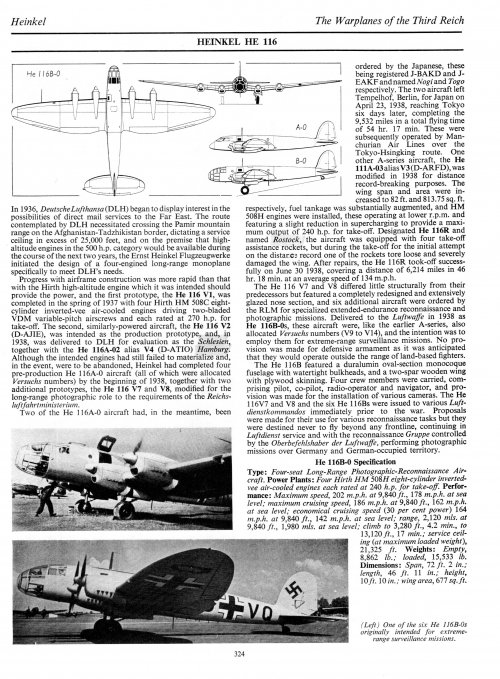
In my opinion it was a long-range, high-altitude recce airplane He 116 class. Perhaps the manufacturer included a bombing version, but it doesn't seem that that was its main role.
 

Attachments

  • 747.jpg
    747.jpg
    2.7 MB · Views: 66
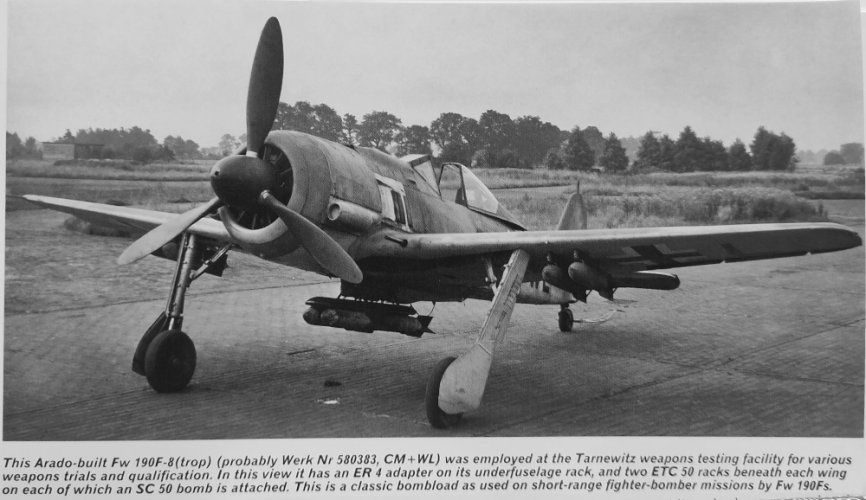
@Justo Miranda The two air intakes look like trop dust filters.
BMW 801D-2 had one single-stage two-speed supercharger.
Image from Aircraft of the Third Reich - Volume One - Arado to Focke-Wulf .by William Green, Aerospace Publishing 2010.
 

Attachments

  • Fw190F-8(trop).jpg
    Fw190F-8(trop).jpg
    268.3 KB · Views: 39
Last edited:

Similar threads

Back
Top Bottom