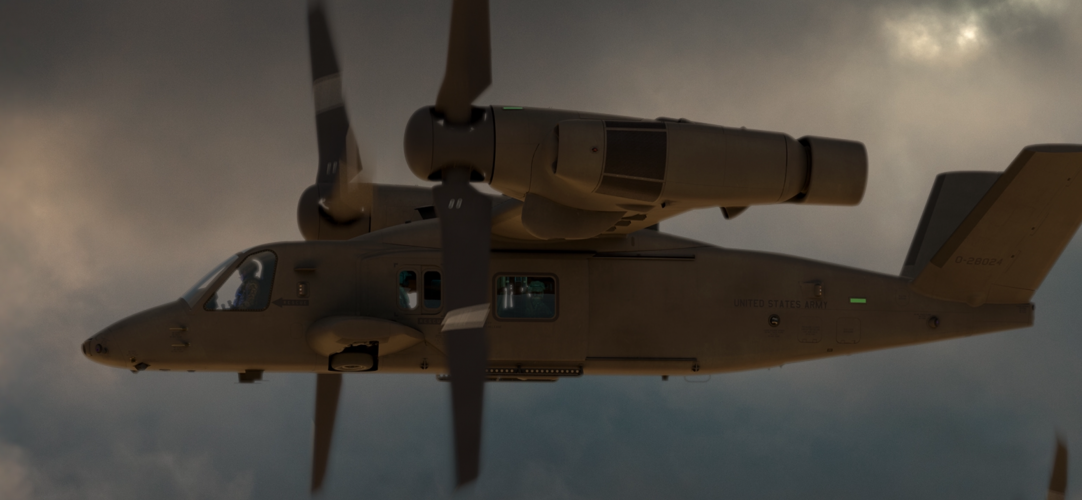
Bell MV-75 Cheyenne II (aka V-280 Valor)

A fixed engine would enable a more effective IR suppressor
I'm not sure that's true. The Osprey engine pods have a good portion aft of the trailing edge of the wing, and you could use the area above and below the pods for the cooling air inlets so as to not increase wingspan for folded length.

You could even put an inlet on the inboard side of the engine pod under the wing, because that won't interfere with the swivel. Just can't have an inlet inboard and above the wing.


I'll believe it when I see it.

I want it to happen, but I don't think it will.
 
You could do this, but I think the engine would still be placed below the rotor axis (instead of beside the rotor axis on MV-75) to preserve the total wing length for wing stow. There would be a performance hit. The V-22 solution has reduced download, points the residual thrust of the AE-1107 in a useful direction, and weighs less. A fixed engine would enable a more effective IR suppressor and was really necessary on the MV-75 to make the Army-preferred side doors practical.

The tilting engines is actually simpler in many ways than the fixed engines.
I'm afraid I have to disagree regarding the simplicity. Rolls Royce had to design two separate oil systems for the engine for vertical and horizontal flight. In fact, Bell and the U.S. Army have pointed out that the MV-75 layout was done to simplify the dynamic components of the tilt rotor. I believe that the Navy PMA for V-22 has also intimated several times that the Program Office is considering "Re-winging" V-22 in the next decade but are observing what happens with MV-75 before making the decision.

The current nacelle (For V-22) is being redesigned due to the maintenance difficulties of the current configuration. A number of pieces of engine equipment have to be removed in order to access others and this causes unnecessary wear and tear on the functioning equipment.

Also, the proximity of the exhaust of the current nacelle configuration has led to a number of grass fires in the training areas. I am told that there are notices now in the flight manuals, or training circulars of the USMC that caution about operating in this sort of environment.
 
Last edited:
I'm not sure that's true. The Osprey engine pods have a good portion aft of the trailing edge of the wing, and you could use the area above and below the pods for the cooling air inlets so as to not increase wingspan for folded length.

You could even put an inlet on the inboard side of the engine pod under the wing, because that won't interfere with the swivel. Just can't have an inlet inboard and above the wing.


I'll believe it when I see it.

I want it to happen, but I don't think it will.

@elmayerle - anything you can add on this given your background/expereince?
 
I'm afraid I have to disagree regarding the simplicity. Rolls Royce had to design two separate oil systems for the engine for vertical and horizontal flight. In fact, Bell and the U.S. Army have pointed out that the MV-75 layout was done to simplify the dynamic components of the tilt rotor. I believe that the Navy PMA for V-22 has also intimated several times that the Program Office is considering "Re-winging" V-22 in the next decade but are observing what happens with MV-75 before making the decision.

The current nacelle is being redesigned due to the maintenance difficulties of the current configuration. A number of pieces of engine equipment have to be removed in order to access others and this causes unnecessary wear and tear on the functioning equipment.

Also, the proximity of the exhaust of the current nacelle configuration has led to a number of grass fires in the training areas. I am told that there are notices now in the flight manuals, or training circulars of the USMC that caution about operating in this sort of environment.
There is also the famous issues the Osprey had on the older ships where it literally burnt the decks, there are even pictures of it on Japanese ships with 3 crew shoving pallets under the engines exhaust to protect there decks.

Basically cause a decent chunk of nato to resurface their flight decks to avoid that.


Bottom line from both of these articles is that decisions were made based solely on reduced available funds, with no supporting analysis.
 
We will have to see what happens to that order of 24 MV-75s in 24 months yasotay, it will be interesting to watch what happens in two years time when the order is complete.
 
Or what happens in 24 months when the order is incomplete… that’s an incredibly aggressive timetable for rotorcraft.

Can you even get enough long lead items like gearbox case and mast castings and forgings to ramp production that quickly?
 
The prototypes assembly went pretty rapidly already. Part count was a major aspect of that. Here, they face already the hurdle of loosing their subcontractor.
However, the quick prospect of a good check might give them enough momentum to invest in the tools and manpower they are lacking.
I am pretty confident they will match it.
 
It appears the U.S. Army is really remodeling just about everything. They are still getting rid of General Officer positions and consolidating offices with similar missions. Many mid-managers are retiring, moving, or just getting out. FARA, M-10, several other developmental efforts are dead. It appears that they are taking Dr. Watling (RUSI) and his recommendations to heart.

MV-75 has survived (to this point) because it is adaptable to a significant number of missions.

I highlight "adaptable" because it is the new paradigm shifting, game changing, flexibility word of the day for the DoD.
 
The Secretary of the Army and the Chief of Staff announced yesterday that they want 24 MV-75 in the hands of soldiers in 24 months. Anything less is failure.
Question is... 24 months from when?

I don't read his statement as necessarily meaning 24 months from now... it could be 24 months from signing the next contract extension, 24 months from first flight etc.

Because literally last week, they were reporting a 9 month delay to the Critical Design Review (originally summer 2025, now early 2026) and flight testing (originally 2026, now 2027), with first deliveries starting in 2029.
The service is targeting delivery of the Bell tiltrotor to its first units starting in 2029, about two years earlier than its previous planning. The timeline is aggressive as the first prototypes are still in modeling and design, with a critical design review (CDR) now not expected until 2026—about a nine-month shift.

“We think that investment up front in that extra time there is going to pay dividends in tests,” Col. Jeff Poquette, FLRAA project, told Aviation Week at the Army Aviation Association of America conference. “We’ll be able to do testing faster, we’ll be able to produce at a higher quality and we’ll be able to save costs in the long run for sustainment. So, we took the deliberate time to take an extra nine months to really get the design right.”

Bell and the Army are focusing on that CDR along with a series of subsystem design reviews, the company says. This design work is prioritizing risk reduction in the near term and has pushed back initial deliveries. Bell and the Army now say prototypes will be delivered in 2027, a year later than the previous schedule and two years later than the initial plan when FLRAA was awarded.
Source: https://aviationweek.com/defense/ai...ting-flraa-schedule-aiming-earlier-deliveries
 
@ H_K - A very valid question. I would venture a guess that it would mean from when the U.S. Army finally announces acceptance of the CDR. Given the clear desire to accelerate, I would think that Bell has already begun acquisition of long lead items that are not at risk of change in the pre-CDR phase. I say this due to the interest in increasing funding levels.

As mentioned elsewhere U.S. Amy leadership has not been impressed with the delays outlined in the AW&ST article.
 
They are in fact ready to fly operationally prototypes airframe as early as possible.

(from the above link)
Gen. James Mingus, the Army’s vice chief of staff, told reporters at the conference the service wants to deliver the aircraft to the first unit quickly–potentially with that unit flying the prototypes.

The transformational qualities of Valor makes it a suitable platform just as it is and worth waiting a fully compliant model.
 
Not to mention that I see the USAF and even USCG buying a crapton of MV-75s for SAR work.

Plus the Marines replacing all their H-1s.
 
Be interesting to see if you can which from them, can they winch from an osprey?

I have been told that the downdraft from the newer SAR helo's (Bristow 139 & 189?) make winching more difficult. A downside of the new advanced blades.

Makes me think it would be event worse with these.

Happy to be proved wrong
 
Winch operations will be from a wing mounted winch, so the local airflows will be different than for V-22 ramp winch operations. Closer to XV-15 demonstrations done decades ago, but MV-75 will have high disk loading than the XV-15. Not sure where it will land in the universe of winch operations.
 
Or what happens in 24 months when the order is incomplete… that’s an incredibly aggressive timetable for rotorcraft.

Can you even get enough long lead items like gearbox case and mast castings and forgings to ramp production that quickly?
Good luck.
 
Be interesting to see if you can which from them, can they winch from an osprey?

I have been told that the downdraft from the newer SAR helo's (Bristow 139 & 189?) make winching more difficult. A downside of the new advanced blades.

Makes me think it would be event worse with these.

Happy to be proved wrong
Should be do-able. No worse that working under an Osprey or H53 in terms of downwash, IIRC. So "very much not pleasant, but do-able."
 
6 proto by 2027+. CDR in 2026.

But there are other potential risks: financial concerns and potential capability gaps. To help pay for FLRAA, the Army is halting buys of General Atomics’ Gray Eagle drone, shelving AH-64D Apaches, stopping a Future Tactical Uncrewed Aircraft System (FTUAS) competition, possibly ending of General Electric’s development of the Improved Turbine Engine Program (ITEP), and maybe reducing the quantity of High Accuracy Detection and Exploitation System (HADES).

That kind of dramatic shake-up has left industry officials nervous about the future — understandably so, according to Gill.

“A lot of the reasons that we’re making decisions are because of political change,” the two-star general said. “That’s the reality of our governmental system. And so, we might be moving down a path for a couple years, and things change. The world changes. Wars happen.”

“In the case of the Future Long-Range Assault Aircraft, I think the Army has been very clear right now, we are 100 percent committed to it [...]


People would certainly be afraid of those short delays but the system of system approach makes Helo a constantly evolving asset to remain coherent on the battlefields. We have seen that with the Apache, the Kiowa, SOP Blackhawks and Reapers. Having a new airframe designed within the timeframe of an airframe, not shorted out by the multiple evolution and priorities changes of embedded systems, makes way more sense today.
In essence, communality of systems across US Army aviation platforms has probably rendered this approach natural.

(Edited)
 
Last edited:
6 proto by 2027+. CDR in 2026.
Isn't that a delay? Last year it was reported that they wanted the prototypes flying in 2026. The article you linked says first delivery in 2027 and last in 2028. I guess it's possible they mean that the first flight would undertaken by Bell before it's delivered to the Army, but is that how it's worked for other programs?
 
Continuing Resolution(s) are not your friend. Wonderful plans come crashing down when fiscal reality shows up. Also, I suspect all of the implications of moving the program left two years have not been fully considered and implemented. Because there are likely lawyers involved in the changes to the contracts, it will not be something that is resolved in the next month.
 

U.S. Army appears to be willing to take risks with the program. There is certainly a sense of urgency in this endeavor.
 
Well, the uglification of the V-280 has begun.

(uglification - the act of taking a sexy looking aircraft and making it ugly. Typically occurs with military aircraft after the demonstrator phase of the program.)
 
So, let's see what got added

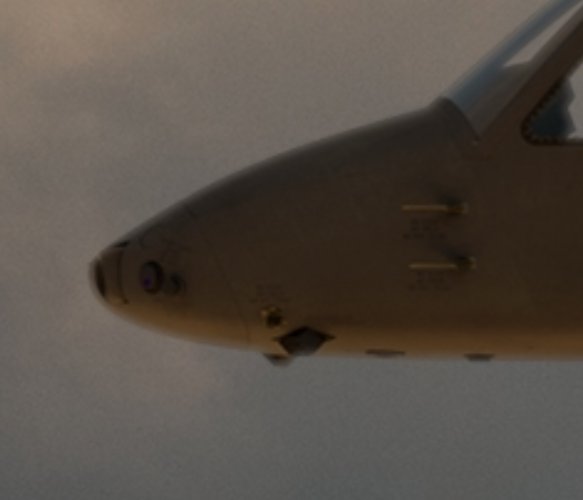
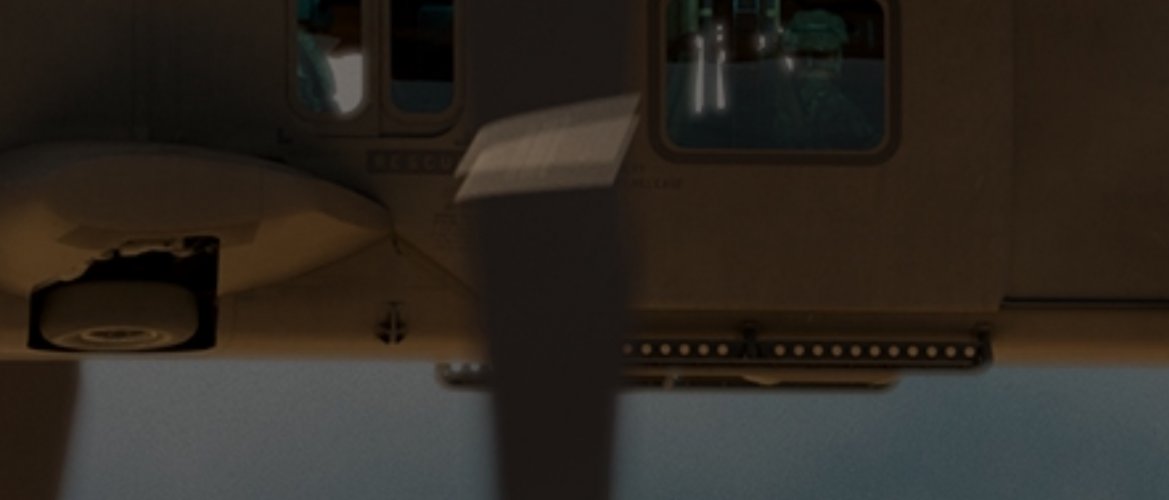
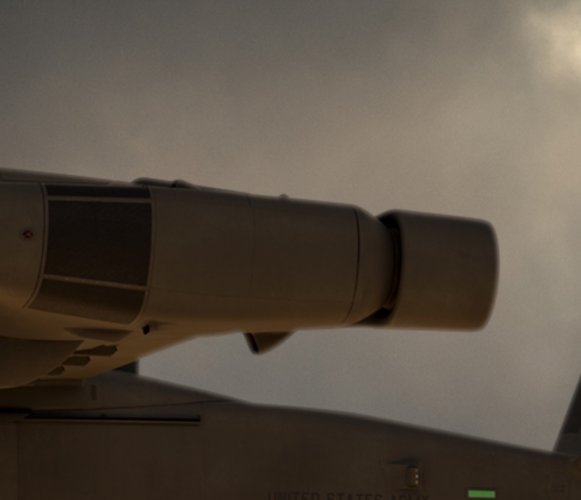
Obviously the nacelles got longer with some sort of IR shroud it looks like they had to add a step or running board under the cabin doors, and the main gear doors gone for mechanical simplicity. Plus the usual proliferation of probes, missile warning sensors, etc.

Could be worse. The running boards are the most obnoxious to me. I wonder what they do to the aerodynamics.
 
Last edited:
So, let's see what got added

Obviously the nacelles got longer with some sort of IR shroud it looks like they had to add a step or running board under the cabin doors, and the main gear gone for mechanical simplicity. Plus the usual proliferation of probes, missile warning sensors, etc.

Could be worse. The running boards are the most obnoxious to me. I wonder what they do to the aerodynamics.
No main gear doors, now open like a B737. Running boards from mid-size truck. The engine tail shroud from the Virginia-class sub (scaled down of course) and might house a second-stage pumpjet air/exhaust propulsor. The blister/shroud to protect the gearbox transition ballscrew actuator is quite large.
 
So, let's see what got added

Obviously the nacelles got longer with some sort of IR shroud it looks like they had to add a step or running board under the cabin doors, and the main gear doors gone for mechanical simplicity. Plus the usual proliferation of probes, missile warning sensors, etc.
Plus the proprotor bosses got a lot shorter and blunter.
 
No main gear doors, now open like a B737. Running boards from mid-size truck. The engine tail shroud from the Virginia-class sub (scaled down of course) and might house a second-stage pumpjet air/exhaust propulsor. The blister/shroud to protect the gearbox transition ballscrew actuator is quite large.
TomS is right, that's an exhaust suppression system on the aft end of the nacelle.

As for the running boards / external step, I bet there's an aerodynamicist with a large tab at the local brewery.
 
Well, the uglification of the V-280 has begun.

(uglification - the act of taking a sexy looking aircraft and making it ugly. Typically occurs with military aircraft after the demonstrator phase of the program.)
Heavily disagree. Tech demos tend to look featureless and toyish.

As for the MV-75, has there been interest from other branches or foreign militaries? Any indications?
 
Back
Top Bottom