If you delete a hull section, what are you throwing out? The IEP, going lower than 96 cells? Both of those are going to be required for any Burke replacement.And the next generation of UAVs and USVs may be more challenging, with the objective being to force you to expend AA missiles and complicate defence against ASMs.
I understood the DDG(X) midships hull insert could deleted to give a more budget destroyer, which may be the design that replaces older Burkes.

You are using an out of date browser. It may not display this or other websites correctly.
You should upgrade or use an alternative browser.
You should upgrade or use an alternative browser.
BBG(X) - US Next Generation Battleship
- Thread starter Forest Green
- Start date
Scott Kenny
ACCESS: USAP
- Joined
- 15 May 2023
- Messages
- 16,977
- Reaction score
- 24,087
Combined response:I understood the DDG(X) midships hull insert could deleted to give a more budget destroyer, which may be the design that replaces older Burkes.
I'm suspecting that the design actually has 3x Mk41 launcher sets in it.If you delete a hull section, what are you throwing out? The IEP, going lower than 96 cells? Both of those are going to be required for any Burke replacement.
CastleBravo
ACCESS: Restricted
- Joined
- 21 January 2026
- Messages
- 34
- Reaction score
- 46
There is no cut down AAW version possible. DDG(X) as it stood was the minimum viable product for today's threats. It wouldn't have worked well for things 10 years from now let alone at the end of its 30-40 year service life as there isn't much if any growth margin.
What airborne threats other than mid-course HGV and BMD is DDG(X) marginal for, and what other than new missiles does it need to meet these threats?
If a 39 RMA SPY-6 is marginal for mid-course defense, and smaller cheaper sensors are sufficient for air defense and terminal BMD, then we might be better off with a smaller and cheaper DDG without a mid-course BMD capability so that we can also afford to build a large fleet of high end CG/BBG with the biggest radars possible (~69 RMA?) for the mid-course missile defense role.
Maybe the UK RN has the right idea with the Type45. Something similar to that ship with a high mounted rotating radar on the forward superstructure (maybe SPY-6(V)2 ESDR with 9 RMAs, or LTAMDS), and then another rotating array (possibly based on AN/TPY-2) on the aft superstructure. Don't bother with SPG-62 illuminators on a DDG built in the 2030s; the old SARH missiles can stay on the Burkes, or maybe put some illuminators on the high-end CG/BBG if there is room.
A 20-25kt cut down more sensible BBG(X) still wouldn't provide the same relative leap in capability we had going from the Kidd's to the AB's. That's the level of capability improvement needed for a ship to serve for 40 years. This is also ignoring the fact that in those 40 years naval development stagnated to 10-15 years (1992- mid 2000s).
The leap in capability from Kidd to Burke didn't come from displacement though, they are roughly the same size. A new clean sheet DDG at ~10kt should offer a substantial improvement over DDG-51 with room to grow in the future. If DDG(X) can't offer that at 13kt, then it shouldn't be built. 8kt should be big enough for a future DDG that doesn't attempt mid-course BMD. 20kt should be more than adequate for a high-end surface combatant with full BMD capability as well as long range HGV strike.
Ainen
I really should change my personal text
- Joined
- 25 August 2011
- Messages
- 2,116
- Reaction score
- 3,600
Technically speaking, if mk.41 pac-3 integration is a success, going below 96 may not be necessariily the worst idea around. Esp. together with mk.41 usvs going forward.If you delete a hull section, what are you throwing out? The IEP, going lower than 96 cells? Both of those are going to be required for any Burke replacement.
Yes, it'll hurt strike/asuv substantially (which is suboptimal), but for specifically for AAW/ABM 48+ cells can work out. Burkes, with their huge strike potential and significant operational independence, are more than destroyers, and with competent foe it's hard to keep up on a design so...rich.
Alternatively, rather than replacement, it can be basis of further stratification (aaw escort destroyers/aa frigates in JMSDF/EU manner, for screen duties only). Biggest AAW(and asuv) reason for full cell, SM-6, is production constrained anyway; at the same time, it isn't really a screen weapon.
Last edited:
CastleBravo
ACCESS: Restricted
- Joined
- 21 January 2026
- Messages
- 34
- Reaction score
- 46
Technically speaking, if mk.41 pac-3 integration is a success, going below 96 may not be necessariily the worst idea around. Esp. together with mk.41 usvs going forward.
Yes, it'll hurt strike/asuv substantially (which is suboptimal), but for specifically for AAW/ABM 48+ cells can work out. Burkes, with their huge strike potential and significant operational independence, are more than destroyers, and with competent foe it's hard to keep up on a design so...rich.
Alternatively, rather than replacement, it can be basis of further stratification (aaw escort destroyers/aa frigates in JMSDF/EU manner, for screen duties only). Biggest AAW(and asuv) reason for full cell, SM-6, is production constrained anyway; at the same time, it isn't really a screen weapon.
Even without quad-packing them into mk41, 12-16x PAC-3 MSE missiles should fit in about the same deck space as a mk141 with 4x Harpoons. I don't see why a new ship design can't include deck launchers for PAC-3, NSM, ect. They might even be easy to reload at sea.
It's not midcourse HGV and BMD, it's also terminal HGV and BMD defense. With limited time before impact any increase in detection range is highly valuable. On top of detection of Chinese stealth aircraft.What airborne threats other than mid-course HGV and BMD is DDG(X) marginal for, and what other than new missiles does it need to meet these threats?
If a 39 RMA SPY-6 is marginal for mid-course defense, and smaller cheaper sensors are sufficient for air defense and terminal BMD, then we might be better off with a smaller and cheaper DDG without a mid-course BMD capability so that we can also afford to build a large fleet of high end CG/BBG with the biggest radars possible (~69 RMA?) for the mid-course missile defense role.
Maybe the UK RN has the right idea with the Type45. Something similar to that ship with a high mounted rotating radar on the forward superstructure (maybe SPY-6(V)2 ESDR with 9 RMAs, or LTAMDS), and then another rotating array (possibly based on AN/TPY-2) on the aft superstructure. Don't bother with SPG-62 illuminators on a DDG built in the 2030s; the old SARH missiles can stay on the Burkes, or maybe put some illuminators on the high-end CG/BBG if there is room.
The leap in capability from Kidd to Burke didn't come from displacement though, they are roughly the same size. A new clean sheet DDG at ~10kt should offer a substantial improvement over DDG-51 with room to grow in the future. If DDG(X) can't offer that at 13kt, then it shouldn't be built. 8kt should be big enough for a future DDG that doesn't attempt mid-course BMD. 20kt should be more than adequate for a high-end surface combatant with full BMD capability as well as long range HGV strike.
The proposed radar for CG(X) designed before China's rearmament picked up speed had a 22ft aperture vs a 14 ft aperture on the AB's. That's a huge performance difference. Then add on the fact that the DDG(x)'s propulsion setup is said to be directly lifted from a Zumwalt. Regarding that they had this to say during the CG(X) design phase.
The CG(X) would have used the IPS electric propulsion system of Zumwalt, as of the FY09 budget estimates in February 2008.[12] Zumwalt's gas turbines are capable of generating 78 megawatts (105,000 hp),[10] and that was thought barely sufficient for the radar and future weapon systems on the CG(X) - the working assumption is that the entire ship's electric load, including a Theater Ballistic Missile Defense radar will consume 31 megawatts (MW).[13] In July 2008, Young said that "for the most capable radar suites under consideration, the [Zumwalt] hull cannot support the radar"
Type45 is also a 25+ year old design, I wouldn't base any sensing requirements/designs off of it. I do agree a higher mounted radar is needed meaning a larger ship for a large high mounted radar, but steel is cheap. I also agree with no more illuminators.
I was referring to the leap in capability between the two. The change in capability between the AB and DDG(X) is a much more incremental one and will not last for 30-40 years as there's not much margin for further DDG(X) growth without expanding the hull due to future power generation needs that will increase along with limited magazine size (lower than AB once you add in CPS). A larger ship will be needed for a few reasons 1) increased crew comfort requirements (most navies are moving towards berthings where you can sit up for example to aid retention) 2) larger and higher mounted radars 3) larger and more numerous missiles for both strike and HGV/BM intercepts 4) power generation to support the radars/lasers 5) increased range requirements for the Pacific requiring more fuel.
Considering the fact that the Zumwalt was deemed insufficient for future radars and power generation at 16kt, I'm highly skeptical that a DDG(X) at 13kt will be sufficient.
Steel is cheap so there's little reason not to build in additional large VLS cells that can sit empty. I'm a huge supporter of boat with MK41 for strike that return to base for reloading when empty, but with the history of USN procurement, we should not depend on those coming around in a timely manner. Pac-3 MSE will have a much smaller defended footprint and range than SM6/3 especially the full 21inch versions of those. This will likely become an issue when there are many HGV/BM coming in at once and your lower range prevents you from launching enough rounds to fully intercept. So I disagree with reducing cell count.Technically speaking, if mk.41 pac-3 integration is a success, going below 96 may not be necessariily the worst idea around. Esp. together with mk.41 usvs going forward.
Yes, it'll hurt strike/asuv substantially (which is suboptimal), but for specifically for AAW/ABM 48+ cells can work out. Burkes, with their huge strike potential and significant operational independence, are more than destroyers, and with competent foe it's hard to keep up on a design so...rich.
Alternatively, rather than replacement, it can be basis of further stratification (aaw escort destroyers/aa frigates in JMSDF/EU manner, for screen duties only). Biggest AAW(and asuv) reason for full cell, SM-6, is production constrained anyway; at the same time, it isn't really a screen weapon.
Because deck launchers can only engage targets coming in from one side in a timely manner. This isn't an issue for strike but it is from AAW.Even without quad-packing them into mk41, 12-16x PAC-3 MSE missiles should fit in about the same deck space as a mk141 with 4x Harpoons. I don't see why a new ship design can't include deck launchers for PAC-3, NSM, ect. They might even be easy to reload at sea.
Last edited:
Scott Kenny
ACCESS: USAP
- Joined
- 15 May 2023
- Messages
- 16,977
- Reaction score
- 24,087
I'm not sure that a ship incapable of BMD is viable long-term. Haven't even the Houthis been throwing AShBMs around?The leap in capability from Kidd to Burke didn't come from displacement though, they are roughly the same size. A new clean sheet DDG at ~10kt should offer a substantial improvement over DDG-51 with room to grow in the future. If DDG(X) can't offer that at 13kt, then it shouldn't be built. 8kt should be big enough for a future DDG that doesn't attempt mid-course BMD. 20kt should be more than adequate for a high-end surface combatant with full BMD capability as well as long range HGV strike.
Also, the Navy has officially decided that EVERYTHING will have SPY6. Which means that the bare minimum size ship is ~7ktons, and that was a 32cell ship (admittedly one that might be expandable to ~72 cells using a mix of Mk57 around the helo deck and Mk41s forward).
So I strongly suspect that the smallest possible Burke Replacement is going to be ~10ktons.
CastleBravo
ACCESS: Restricted
- Joined
- 21 January 2026
- Messages
- 34
- Reaction score
- 46
It sounds like we are mostly arguing the same thing. The USN needs a new CG, and DDG(X) is not adequate for that role. A ~20kt ship with a massive theater BMD radar is required.
I am just adding that if we build that CG/BBG/whatever, then the new DDG can be significantly smaller and cheaper than DDG(X). It wouldn't need a theater BMD capability because the CG/BBG is handling it. TPY-2 would be more than adequate for terminal BMD, and it would be able to support the THAAD interceptor giving the Navy a new missile to fill in most of the altitude gap between SM-6/PAC-3MSE and SM-3.
I am just adding that if we build that CG/BBG/whatever, then the new DDG can be significantly smaller and cheaper than DDG(X). It wouldn't need a theater BMD capability because the CG/BBG is handling it. TPY-2 would be more than adequate for terminal BMD, and it would be able to support the THAAD interceptor giving the Navy a new missile to fill in most of the altitude gap between SM-6/PAC-3MSE and SM-3.

- Joined
- 3 June 2011
- Messages
- 20,030
- Reaction score
- 17,228
The USN should volunteer for the job. Given the mess they've made of DD/CG-21, DD/CG(X) (Zumwalt), LCS, FF(X), etc. I don't have high hopes.Not with POTUS acting as the design styling consultant.
CastleBravo
ACCESS: Restricted
- Joined
- 21 January 2026
- Messages
- 34
- Reaction score
- 46
I'm not sure that a ship incapable of BMD is viable long-term. Haven't even the Houthis been throwing AShBMs around?
Also, the Navy has officially decided that EVERYTHING will have SPY6. Which means that the bare minimum size ship is ~7ktons, and that was a 32cell ship (admittedly one that might be expandable to ~72 cells using a mix of Mk57 around the helo deck and Mk41s forward).
So I strongly suspect that the smallest possible Burke Replacement is going to be ~10ktons.
Terminal BMD should be a hard requirement for a new DDG. You don't need a full-fat SPY-6 AMDR for terminal BMD. I think we should build CGs for theater BMD with SM-3 and future exoatmospheric interceptors, and then DDGs for terminal BMD with SM-6/PAC-3/THAAD and follow-on missiles.
That's where we disagree what's acceptable as terminal BMD won't be acceptable in the future. With increasing number of HGV/BM and increasing HGV speed, you'll need to detect and engage correspondingly further away to get enough missiles off in time to intercept. Also on that topic, MK41 is more or less tapped out. Everyone is fielding larger VLS sizes to account for future growth. MK57 is still smaller than what other countries are fielding, something that would allow dual packing of SM-2 in the ~30in range is likely what's needed.Terminal BMD should be a hard requirement for a new DDG. You don't need a full-fat SPY-6 AMDR for terminal BMD. I think we should build CGs for theater BMD with SM-3 and future exoatmospheric interceptors, and then DDGs for terminal BMD with SM-6/PAC-3/THAAD and follow-on missiles.
Scott Kenny
ACCESS: USAP
- Joined
- 15 May 2023
- Messages
- 16,977
- Reaction score
- 24,087
Agreed.Terminal BMD should be a hard requirement for a new DDG.
I disagree here.You don't need a full-fat SPY-6 AMDR for terminal BMD. I think we should build CGs for theater BMD with SM-3 and future exoatmospheric interceptors, and then DDGs for terminal BMD with SM-6/PAC-3/THAAD and follow-on missiles.
You don't currently need the full SPY6v1 AMDR for terminal BMD. 20 years from now, I suspect that you will need something at least that capable.
- Joined
- 3 June 2011
- Messages
- 20,030
- Reaction score
- 17,228
Apparently pushing for larger cell size is frowned upon because it's just "dick measuring" and "not needed".That's where we disagree what's acceptable as terminal BMD won't be acceptable in the future. With increasing number of HGV/BM and increasing HGV speed, you'll need to detect and engage correspondingly further away to get enough missiles off in time to intercept. Also on that topic, MK41 is more or less tapped out. Everyone is fielding larger VLS sizes to account for future growth. MK57 is still smaller than what other countries are fielding, something that would allow dual packing of SM-2 in the ~30in range is likely what's needed.
I'm curious who is saying this? I believe with a ~30 inch cell you would be able to get hypersonic performance out to 1000+ miles with something like ASLAM removing much of the need for CPS tubes and allowing for unification of VLS cell sizes.Apparently pushing for larger cell size is frowned upon because it's just "dick measuring" and "not needed".
CastleBravo
ACCESS: Restricted
- Joined
- 21 January 2026
- Messages
- 34
- Reaction score
- 46
That's where we disagree what's acceptable as terminal BMD won't be acceptable in the future. With increasing number of HGV/BM and increasing HGV speed, you'll need to detect and engage correspondingly further away to get enough missiles off in time to intercept. Also on that topic, MK41 is more or less tapped out. Everyone is fielding larger VLS sizes to account for future growth. MK57 is still smaller than what other countries are fielding, something that would allow dual packing of SM-2 in the ~30in range is likely what's needed.
HGV detection by surface ship sensors is going to be heavily limited by radar horizon, and mid-course interception of existing HGVs is currently an unsolved problem, much less against future threats. I'm not sure mid-course HGV defense will ever be practical short of a massive number of orbital interceptors. Speaking of which, orbital weapons are likely to be yet another problem the Navy has to solve, and short of shooting down all of our potential adversaries' orbital launch vehicles before any of them can build up a sufficient weapons stockpile in space, terminal defense is probably the only option, so maybe we should get really good at it.
I agree on mk41 being dated. SM-2 needs to be put out to pasture too though. PAC-3 MSE is a better bet than SM-2 BlkIII or SM-Anything without a 21" booster really. The Navy should work with the Army on the resurrected LTFI program IMO.
- Joined
- 3 June 2011
- Messages
- 20,030
- Reaction score
- 17,228
It was a debate here several years ago.I'm curious who is saying this? I believe with a ~30 inch cell you would be able to get hypersonic performance out to 1000+ miles with something like ASLAM removing much of the need for CPS tubes and allowing for unification of VLS cell sizes.
HGV by their nature have to fly very high (30+km) for much of their flight path due to thermal limits and drag. So you won't be very limited by the radar horizon. Mid course intercept is mostly an unsolved problem as current interceptors don't have enough kinematic performance to have a significant interception window when the HGV isn't going directly at them. There's also the issue of response time and having sensors in the right location to give sufficient warning/targeting information.HGV detection by surface ship sensors is going to be heavily limited by radar horizon, and mid-course interception of existing HGVs is currently an unsolved problem, much less against future threats. I'm not sure mid-course HGV defense will ever be practical short of a massive number of orbital interceptors. Speaking of which, orbital weapons are likely to be yet another problem the Navy has to solve, and short of shooting down all of our potential adversaries' orbital launch vehicles before any of them can build up a sufficient weapons stockpile in space, terminal defense is probably the only option, so maybe we should get really good at it.
I agree on mk41 being dated. SM-2 needs to be put out to pasture too though. PAC-3 MSE is a better bet than SM-2 BlkIII or SM-Anything without a 21" booster really. The Navy should work with the Army on the resurrected LTFI program IMO.
Having more numerous much larger radars helps with the latter (until real time satellite AWACS exists), and larger VLS cells with interceptors with ramjet instead of rocket propulsion helps with the former.
I'd appreciate it, if you could link it here.It was a debate here several years ago.
Last edited:
Scott Kenny
ACCESS: USAP
- Joined
- 15 May 2023
- Messages
- 16,977
- Reaction score
- 24,087
I'm not sure that ground-based midcourse interception of HGVs is possible at all.HGV by their nature have to fly very high for much of their flight path due to thermal limits and drag. So you won't be very limited by the radar horizon. Mid course intercept is mostly an unsolved problem as current interceptors don't have enough kinematic performance to have a significant interception window when the HGV isn't going directly at them. There's also the issue of response time and having sensors in the right location to give sufficient warning/targeting information.
Having more numerous much larger radars helps with the latter (until real time satellite AWACS exists), and larger VLS cells with interceptors with ramjet instead of rocket propulsion helps with the former.
An old old study for intercepting hypersonics showed that a SAM needs to be based within 7-10km of the target or HGV course track to be able to intercept.
CastleBravo
ACCESS: Restricted
- Joined
- 21 January 2026
- Messages
- 34
- Reaction score
- 46
HGV by their nature have to fly very high for much of their flight path due to thermal limits and drag. So you won't be very limited by the radar horizon. Mid course intercept is mostly an unsolved problem as current interceptors don't have enough kinematic performance to have a significant interception window when the HGV isn't going directly at them. There's also the issue of response time and having sensors in the right location to give sufficient warning/targeting information.
Having more numerous much larger radars helps with the latter (until real time satellite AWACS exists), and larger VLS cells with interceptors with ramjet instead of rocket propulsion helps with the former.
At a target altitude of 35km, your radar horizon is about 400nmi. It doesn't take a 31 megawatt radar to handle that. Space based sensors and weapons are the right way to handle this threat IMO
CastleBravo
ACCESS: Restricted
- Joined
- 21 January 2026
- Messages
- 34
- Reaction score
- 46
I disagree here.
You don't currently need the full SPY6v1 AMDR for terminal BMD. 20 years from now, I suspect that you will need something at least that capable.
Why though? Is TYP-2 not good enough for that task? In the future when it isn't good enough, would a new radar in a similar footprint be capable?
I remember reading something along those lines. From what I remember were assuming no upstream sensors that hand off where the HGV is coming, and they were assuming lower performance interceptors.I'm not sure that ground-based midcourse interception of HGVs is possible at all.
An old old study for intercepting hypersonics showed that a SAM needs to be based within 7-10km of the target or HGV course track to be able to intercept.
Rotating it means you need to stop it to focus on a single region which will take quite a while due to its size. As it's quite large, I don't see how rotating it (large amounts of mechanical super structure is needed) would be cheaper than just a larger fixed array. It also leaves you vulnerable to stuff coming in from other directions.Why though? Is TYP-2 not good enough for that task? In the future when it isn't good enough, would a new radar in a similar footprint be capable?
CastleBravo
ACCESS: Restricted
- Joined
- 21 January 2026
- Messages
- 34
- Reaction score
- 46
Rotating it means you need to stop it to focus on a single region which will take quite a while due to its size. As it's quite large, I don't see how rotating it (large amounts of mechanical super structure is needed) would be cheaper than just a larger fixed array. It also leaves you vulnerable to stuff coming in from other directions.
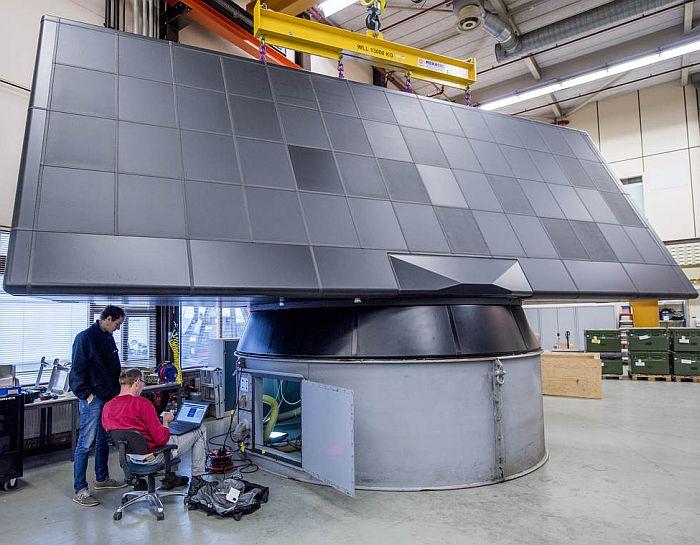
It wouldn't be the only radar on the DDG, just the BMD and long range search radar, somewhat similar in role to the Type 45's S1850M. You generally don't need to scan 360° for BMD, and the USN has the advantage of a robust network of missile warning satellites. It's cheaper because you are buying one of them instead of four.

Last edited:
Missile warning satellites will only tell you something is coming at you from a general direction and time, similar with a search radar. For BM/HGV you will need much more precise targeting information (than aircraft due to a much more limited interception window) and also discrimination from possible decoys. This means you will need a chonky radar for the engagement.It wouldn't be the only radar on the DDG, just the BMD and long range search radar, somewhat similar in role to the Type 45's S1850M. You generally don't need to scan 360° for BMD, and the USN has the advantage of a robust network of missile warning satellites.
CastleBravo
ACCESS: Restricted
- Joined
- 21 January 2026
- Messages
- 34
- Reaction score
- 46
Missile warning satellites will only tell you something is coming at you from a general direction and time, similar with a search radar. For BM/HGV you will need much more precise targeting information (than aircraft due to a much more limited interception window) and also discrimination from possible decoys. This means you will need a chonky radar for the engagement.
Yes, but my point is that a rotating radar can be cued by the launch warning sats so that it is pointed down the threat axis before the incoming missiles come into range. AN/TPY-2 is X-band, it is very precise, much more than SPY-6. This is the radar used for THAAD. It would probably help with discrimination for mid-course defense when paired with SPY-6 ships, but that isn't as relevant for terminal defense where you are engaging after atmospheric strip out of decoys.
Last edited:
Scott Kenny
ACCESS: USAP
- Joined
- 15 May 2023
- Messages
- 16,977
- Reaction score
- 24,087
I'm not sure that a BMD radar is really the right tool for tracking HGVs, but sure we can assume that a BMD radar would be adequate.Why though? Is TYP-2 not good enough for that task? In the future when it isn't good enough, would a new radar in a similar footprint be capable?
I am assuming that people will figure out faster and stealthier HGVs as a function of making intercepting them harder. Which means you need more capable radars and have less time to get a missile in front of them.

Dilandu
I'm dissatisfied, which means, I exist.
Not sure how far you could go there... Ionized air trail of HGV would be pretty reflective.stealthier HGVs
Ainen
I really should change my personal text
- Joined
- 25 August 2011
- Messages
- 2,116
- Reaction score
- 3,600
Steel is, but machinery and filling cells isn't. Empty air is not worth it.Steel is cheap so there's little reason not to build in additional large VLS cells that can sit empty. I'm a huge supporter of boat with MK41 for strike that return to base for reloading when empty, but with the history of USN procurement, we should not depend on those coming around in a timely manner. Pac-3 MSE will have a much smaller defended footprint and range than SM6/3 especially the full 21inch versions of those. This will likely become an issue when there are many HGV/BM coming in at once and your lower range prevents you from launching enough rounds to fully intercept. So I disagree with reducing cell count.

The problem with SM series is that other than ludicrously expensive SM-3(launching suicidal fighter jets), it isn't really an ABM weapon - pK is meh, while protected footprint isn't especially better than PAC-3 either. It was well known before, but Israel experience confirmed it.
I.e. SM-6(2) are more or less dual purpose missiles, esp. the coming SM-6 IB with much heavier warhead.
It's great for SAG, but in carrier escort, tbh, it seems somewhat wasteful.
Furthermore, if we go down this path, an escort destroyer can get a more purpose-designed ABM sensor suit...
Scott Kenny
ACCESS: USAP
- Joined
- 15 May 2023
- Messages
- 16,977
- Reaction score
- 24,087
Mostly for making the terminal engagement suck. Between thermal and ionized radar you're going to see an HGV from the other side of the planet.Not sure how far you could go there... Ionized air trail of HGV would be pretty reflective.

A Tentative Fleet Plan
I really should change my personal text
- Joined
- 9 April 2018
- Messages
- 1,356
- Reaction score
- 3,385
Naval development definetly stagnated between 1992-mid 2000s. People just kept on building what was designed before that period or adopted what others built right before that period (AB type ships).
Naval development advanced considerably in that decade, that was the decade when AESAs, Integrated Electric Propulsion and SAMs with terminal active radar homing were first beginning to enter service. Procurement of ships was reduced, due to the relatively benign security situation, but even relatively conventional ships like the Horizon class and Type 45 were a considerable advance on what they replaced, let alone more radical concepts like Arsenal Ship, DD-21/DD(X) and LCS.
- Joined
- 3 June 2011
- Messages
- 20,030
- Reaction score
- 17,228
HGV by their nature have to fly very high (30+km) for much of their flight path due to thermal limits and drag. So you won't be very limited by the radar horizon. Mid course intercept is mostly an unsolved problem as current interceptors don't have enough kinematic performance to have a significant interception window when the HGV isn't going directly at them. There's also the issue of response time and having sensors in the right location to give sufficient warning/targeting information.
Having more numerous much larger radars helps with the latter (until real time satellite AWACS exists), and larger VLS cells with interceptors with ramjet instead of rocket propulsion helps with the former.
I'd appreciate it, if you could link it here.
Thanks. Their stances were basically why are you copying China, and ships need to be larger. While ignoring other things that drive large ships and the ideal of dual packing sm2/6.
There’s also 34 inch GVLS proposed by Lockheed with better packing effiency due to revised exhaust setups. So I’m pretty sure there will be something larger than MK41 that’s not CPS tubes in the next gen of ships.
Last edited:
That would be whatever optional stuff they planned for that section, being designed to have the section added for specific variants that needed it. I imagine the strike variant would just insert CPS tubes. AAW might get extra power generation, an extra 64 Mk-41 or Mk-57 (for total 128), maybe some accomodation for AAW staff. BMD variant (if different) gets bigger radar so the insert might have more generators, as well as VLS, and probably stabilisers or an active ballast like Zumwalt. Then a basic variant might lose that stuff or just get a smaller insert with 32 VLS. I dont imagine any ASW gear would be amidships but maybe a side array sonar?If you delete a hull section, what are you throwing out? The IEP, going lower than 96 cells? Both of those are going to be required for any Burke replacement.
Seems like CG(X) was almost DDG(X) with an extra stack. Might have been useful if that was joined to a secondary radar mast for redundancy. If the ship's beam is designed for the biggest radar from the outset, then the DDG(X) inserts would basically turn it into a CCG already. A high X-band radar for horizon and closein resolution should allow the big radars to go lower anywayIt sounds like we are mostly arguing the same thing. The USN needs a new CG, and DDG(X) is not adequate for that role. A ~20kt ship with a massive theater BMD radar is required.
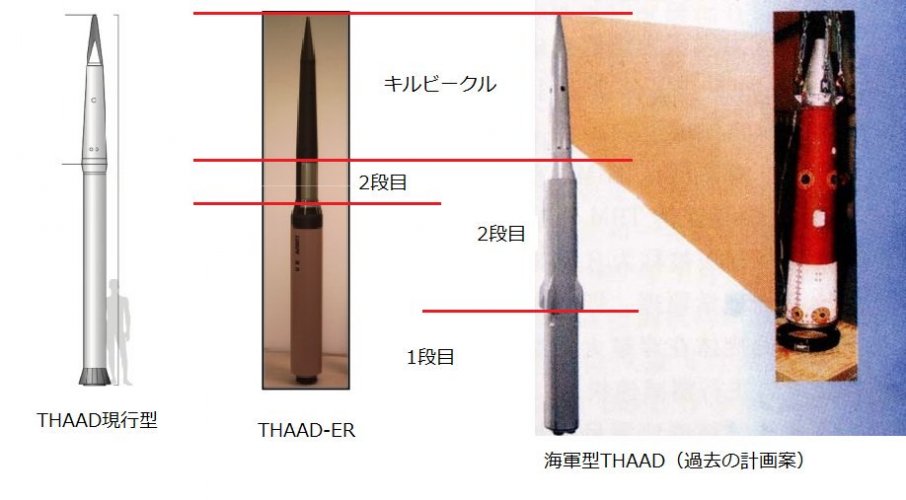
I like THAAD...THAAD interceptor giving the Navy a new missile to fill in most of the altitude gap between SM-6/PAC-3MSE and SM-3.
- Joined
- 3 June 2011
- Messages
- 20,030
- Reaction score
- 17,228
SM-6, 21" main motor, and THAAD KKV:That would be whatever optional stuff they planned for that section, being designed to have the section added for specific variants that needed it. I imagine the strike variant would just insert CPS tubes. AAW might get extra power generation, an extra 64 Mk-41 or Mk-57 (for total 128), maybe some accomodation for AAW staff. BMD variant (if different) gets bigger radar so the insert might have more generators, as well as VLS, and probably stabilisers or an active ballast like Zumwalt. Then a basic variant might lose that stuff or just get a smaller insert with 32 VLS. I dont imagine any ASW gear would be amidships but maybe a side array sonar?
Seems like CG(X) was almost DDG(X) with an extra stack. Might have been useful if that was joined to a secondary radar mast for redundancy. If the ship's beam is designed for the biggest radar from the outset, then the DDG(X) inserts would basically turn it into a CCG already. A high X-band radar for horizon and closein resolution should allow the big radars to go lower anyway
I like THAAD...
I thought 64 of the 96 vls cells lived in that section?That would be whatever optional stuff they planned for that section, being designed to have the section added for specific variants that needed it. I imagine the strike variant would just insert CPS tubes. AAW might get extra power generation, an extra 64 Mk-41 or Mk-57 (for total 128), maybe some accomodation for AAW staff. BMD variant (if different) gets bigger radar so the insert might have more generators, as well as VLS, and probably stabilisers or an active ballast like Zumwalt. Then a basic variant might lose that stuff or just get a smaller insert with 32 VLS. I dont imagine any ASW gear would be amidships but maybe a side array sonar?
Seems like CG(X) was almost DDG(X) with an extra stack. Might have been useful if that was joined to a secondary radar mast for redundancy. If the ship's beam is designed for the biggest radar from the outset, then the DDG(X) inserts would basically turn it into a CCG already. A high X-band radar for horizon and closein resolution should allow the big radars to go lower anyway
I like THAAD...
Also if you’re spending that much money on IEPs, lasers, radar, range, and crewing it doesn’t make any sense to cheap out on a few hundred tons of steel for less than 96 vls.
CG(x) was to have a much larger radar, power generation, and many more cells at minimum. So I wouldn’t say it’s ddg(x) either a larger stack.
Either way DDG(x) is most likely dead
Last edited:
I thought it was 64 VLS forward, and up to 64 in the mid insert? But the insert can change depending on whats needed on the next batch anyway. And some of them might get CPS instead.I thought 64 of the 96 vls cells lived in that section?
Also if you’re spending that much money on IEPs, lasers, radar, range, and crewing it doesn’t make any sense to cheap out on a few hundred tons of steel for less than 96 vls.
CG(x) was to have a much larger radar, power generation, and many more cells at minimum. So I wouldn’t say it’s ddg(x) either a larger stack.
Either way DDG(x) is most likely dead
Now that you've been through the BBG(X) drama, DDG(X) might get wide enough to turn into a BMD/AAW cruiser just with the hull insert. Maybe wide enough to add PVLS.
It does make sense to be able to change the ship's specialisation with a new insert instead of a new ship. Plausibly, the insert could include an extra generator too. Design what all variants would need into the fixed sections, including beam/stability for the BMD variant.
I believe it’s 96 total vls. So 32 forward 64 mid. I would expect a downsize of a large ship rather than an upsize of a small ship.I thought it was 64 VLS forward, and up to 64 in the mid insert? But the insert can change depending on whats needed on the next batch anyway. And some of them might get CPS instead.
Now that you've been through the BBG(X) drama, DDG(X) might get wide enough to turn into a BMD/AAW cruiser just with the hull insert. Maybe wide enough to add PVLS.
It does make sense to be able to change the ship's specialisation with a new insert instead of a new ship. Plausibly, the insert could include an extra generator too. Design what all variants would need into the fixed sections, including beam/stability for the BMD variant.
I really don’t think there’s much value in creating different large variants with a hull plug. As you’ll need the beam for a large radar anyways, and you’ll have very similar operational and construction costs. It does make sense as a future flight however.
Regarding mk57, I don’t think it makes much sense for that. As if you have mk57 and mk41 both in service you’ll never take advantage of the marginally larger mk57 with a novel missile design. Nor does it allow dual packing of mk41 missiles. The next logical step up would be GVLS at 34 inches, with a two sized fleet. MK41 and GVLS with the largest Mk41 missiles being dual packable and the others being quad or 9x (essm) packable.
I also don’t think the Mk57 will enable novel strike options where was GVLS will.
Last edited:
I still think the peripheral aspect of PVLS may have value, but maybe not too.I believe it’s 96 total vls. So 32 forward 64 mid. I would expect a downsize of a large ship rather than an upsize of a small ship.
I really don’t think there’s much value in creating different large variants with a hull plug. As you’ll need the beam for a large radar anyways, and you’ll have very similar operational and construction costs. It does make sense as a future flight however.
Regarding mk57, I don’t think it makes much sense for that. As if you have mk57 and mk41 both in service you’ll never take advantage of the marginally larger mk57 with a novel missile design. Nor does it allow dual packing of mk41 missiles. The next logical step up would be GVLS at 34 inches, with a two sized fleet. MK41 and GVLS with the largest Mk41 missiles being dual packable and the others being quad or 9x (essm) packable.
I also don’t think the Mk57 will enable novel strike options where was GVLS will.
The hull plugs were planned already so the hullform and internal spaces would have been designed for it. The biggest variants are the CG replacements most urgently needed, that would get built first and make it appear that future ones were getting down-specced.
The insert with non-essential stuff could be extended for more stuff or redesigned for other stuff. Eventually future variants probably have bigger lasers and microwave weapons so a future hull plug might feature generators and bigger DEW with the VLS, and maybe even a second stack for the extra power generation.
Hopefully the design comes back, and some of those things get improved a bit so that it can scale/adapt to something that continues to be built for many years.
Does the Mk.57 vent exhaust laterally into the sea, or vertically like Mk.41?
Given the depth of the missiles, my guess is that lateral venting isn’t feasible (don’t want holes/doors that low on a ship)…but were lateral venting possible, it might (in theory) save weight…
Given the depth of the missiles, my guess is that lateral venting isn’t feasible (don’t want holes/doors that low on a ship)…but were lateral venting possible, it might (in theory) save weight…

Kat Tsun
eeeeeeeeeeeeeee
- Joined
- 16 June 2013
- Messages
- 1,813
- Reaction score
- 2,525
I thought it was 64 VLS forward, and up to 64 in the mid insert? But the insert can change depending on whats needed on the next batch anyway. And some of them might get CPS instead.
Now that you've been through the BBG(X) drama, DDG(X) might get wide enough to turn into a BMD/AAW cruiser just with the hull insert. Maybe wide enough to add PVLS.
It does make sense to be able to change the ship's specialisation with a new insert instead of a new ship. Plausibly, the insert could include an extra generator too. Design what all variants would need into the fixed sections, including beam/stability for the BMD variant.
I doubt it's entirely new, to be fair. DON was probably forced to choose between CPS and both VLS blocks and so it chose the maximalist option.
BBG(X) will probably scale back and lose the railgun and twin 5" in favor of going from 13,500t to ~17-18,000t for DDG(X).
It's more likely that DDG(X) was chosen as a budget conscious option in 2020 or whatever, then someone wanted to add hypersonic missiles (for some reason), and now they've had to go back and revisit one of the older preliminaries that G&C would've had hanging out. Which is probably why the BBG(X) looks so stupidly underdetailed in renders but has clear design lineage with the superstructure of DDG(X). Tack on another 2-3 years to get the ship prelimed and design completed. Or you don't do that, and get another Constellation, which is probably what the Navy is going to do to keep their aggressive timetable.
Another immense procurement victory for the Department of War in any case. Because putting land attack hypersonics on a ship is really important or something.
Last edited: