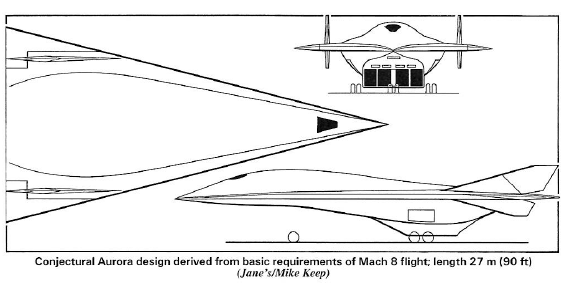
Aurora - a Famous Speculative Project

If I may ask - all these years later, do you feel you have come across any credible theories/info about what you saw from the oil rig in 1989? Or is the whole thing still just as much of a mystery now as it was back then?
Very much so. Never had a credible (to me) explanation
A) UK MoD - Vulcan - laughable. They should know better.
B) US DoD - F-117 - plausible but goes counter to the USAF's dates for F-117s in Europe, plus it didn't look like one
C) Curtis Peebles - swept F-111 - plausible, but according to F-111 pilots I contacted, AAR-type manoeuvers in fully swept configuration are not recommended and in fact unsafe. I have yet to see a photo of a fully swept in-service F-111 on the boom, but happy to be corrected. Your mission, should you chose to accept it...
D) Belgian triangles (first I heard of this was in the post above) - cobblers.

Chris
 
The F-117 was revealed in November of 1988, a whole year before the invasion of Panama. I think you may be correct about the Libya statement though.
You're right of course, I got my dates mixed up here.
 
I go back to the story in the local newspaper, when I worked as an engineer in Pasadena during the early 90s. In response to reports of repetitious earthquakes in the inland empire, Cal-Tech responded that theses were not earthquakes, but the sonic boom of air vehicles headed in the general direction of Nevada. Cal-Tech also said they could identify specific vehicle types by their seismic signature, make a estimate of their size and track them with their multiple sensing sites in the region. The signature did not match any type previously identified. The story never had a follow-up and my gut level evaluation was the story was true and accurate. I also believe that whatever agency operating the vehicle was totally blindsided by seismic tracking capabilities and moved quickly to silence that story's source. Not a nut case, that incident was rational, and had a real feel of truth. I made a post in this thread some time ago, can't remember how it was taken. Just saying, whatever was involved may not have been Aurora, but I cannot remember any program that would fit the parameters of the vehicle reported.

ArtieBob (PEME, Pilot 50 years, MA History)
 
AARS / QUARTZ was the "official" SR-71 successor. Imagine a B-2 like big stealth drone, equally eye watering expensive except worse, because drone with 1980's guidance systems.
That thing was to fly ahead of the B-2s and loiter subsonically inside USSR airspace to pin down all the mobile ICBMs - SS-16, SS-20, SS-24. Then it would beam the coordinates to B-2s coming for the kills, via Milstar (military comsats).

The Soviets had learned how to move the mobile missiles using gaps in KH-11 coverage, driving the NRO and spysats crazy. So back to aerodynamic vehicles which can loiter subsonically like a plain old U-2R / TR-1 - except inside USSR airspace.

Now the annoying rub with AARS QUARTZ was where to base it, since it was super dupper secret. Put that in Mildenhall, the home nest of SR-71s, and spotters but also Air Traffic (it's a stealth drone, but airliners are still there too) would aks "hey, what's that ?" So base it in the USAs like the B-2s, except it would take a lot of time and fuel (or tankers) to ferry it to Europe if WWIII blew up.

So my understanding ( well I red that on this very forum) was there was an ultrafast platform to complement AARS / QUARTZ, flying to Europe and the WarPac airspace much more quickly.

I don't think Aurora ever flew but if it ever had a mission to drive it, seems to be that one.

Back in the 1960's the NRO, CIA and USAF already had big battles between post- SR-71 (ISINGLASS / RHEINBERRY) spysats, and early drones (147 lightning bugs vs COMPASS ARROW vs TAGBOARD) The CIA and NRO archives are crammed with memos exploring manned spyplanes vs drones vs spysats vs "wild alternatives".
 
So my understanding ( well I red that on this very forum) was there was an ultrafast platform to complement AARS / QUARTZ, flying to Europe and the WarPac airspace much more quickly.
But if it could do the same job faster, wouldn't that kill the need for AARS/QUARTZ, then?!
 
AARS / QUARTZ was the "official" SR-71 successor. Imagine a B-2 like big stealth drone, equally eye watering expensive except worse, because drone with 1980's guidance systems.

Actually it's a bit more nuanced than that.

What an "SR-71 successor" is depends on who is talking and when. Does it mean a high-speed or "crisis" capability? Does it mean the ability to penetrate defended airspace? Both?

During the 1980s there were many mentions of a "TR-1 replacement" that was unmanned and able to penetrate. This was QUARTZ (and in some cases other UAVs). There was also mention of an "SR-71 replacement". In some cases these were clearly separate things, in others they may have been referring to the same thing.

Around 1990-1992 the language around this changed, and the unmanned aircraft was now also the "SR-71 replacement". This could have been based solely on its ability to penetrate. Or not, who knows! But the "TR-1/U-2 replacement" language mostly disappeared around this time. Notably, in 1989 a classified reconnaissance program was cancelled alongside the SR-71, while QUARTZ continued for several more years.
 
Very much so. Never had a credible (to me) explanation
A) UK MoD - Vulcan - laughable. They should know better.
B) US DoD - F-117 - plausible but goes counter to the USAF's dates for F-117s in Europe, plus it didn't look like one
C) Curtis Peebles - swept F-111 - plausible, but according to F-111 pilots I contacted, AAR-type manoeuvers in fully swept configuration are not recommended and in fact unsafe. I have yet to see a photo of a fully swept in-service F-111 on the boom, but happy to be corrected. Your mission, should you chose to accept it...
D) Belgian triangles (first I heard of this was in the post above) - cobblers.

Chris
I think I've seen some pics/videos of F-111s sweeping their wings fore and aft while on the boom, but that's about it. Definitely not lingering fully swept.
 
I think it is likely… because reasons

At the risk of sounding a bit naive, is it beyond the realms of possibility that we may ever learn more about this high speed demonstrator @quellish?

I’ve seen fleeting references to this floating around for a long time from multiple sources (well summarised by @Ninja a few pages back)…would assuming this is related to a component of AARS be in the right ballpark? And would being contained in this broader program wrapper make it more difficult to detect from a funding/budget perspective versus a self-contained effort like TACIT BLUE, for instance?
 
2024/2025 would see the papers for that time period declassified under the 30 years rule, but I wouldn’t hold my breath being as some papers can remain classified for 50 or even 100 years in the U.K.

I suspect this has already been posted here as it’s quite old.

https://www.dreamlandresort.com/black_projects/boscombe.htm

Well, here we are in 2025…has anybody tried to see if anything relating to this event was ever declassified?
 
Well, here we are in 2025…has anybody tried to see if anything relating to this event was ever declassified?

Maybe. But don’t assume anything was classified.
 
In 1997 John Greenewald made a request to the USAF for AURORA, and he was met with a Glomar denial.

I have recently made a targeted FOIA request to determine the rationale behind his 1997 denial.

If I am lucky, this will provide documentation behind the determination/coordination for the denial of his request as well as routing and tasking information so we can see where the request was routed.

Greenewald’s most recent request was reportedly met with a denial because CAPE couldn’t locate the responsive records. If we are able to figure out which USAF component is the custodian of records related to AURORA, it will make it easier to file a better-targeted FOIA request.

This is a request under the Freedom of Information Act, 5 U.S.C. § 552, for the administrative and processing records associated with a prior, closed FOIA case.

On January 2, 1997, the 11th Wing FOIA office (11 CS/SCSR (FOIA)) issued a final response, signed by FOIA Manager Patricia D. Grace, to a Freedom of Information Act request dated October 4, 1996, submitted by Mr. John Greenewald. The response bears case number 96-1719. It stated that the Air Force could neither confirm nor deny the existence of responsive records, cited 5 U.S.C. § 552(b)(1) and Executive Order 12958, and identified the denial authority as Eugene F. Boesch Jr., Director, Security and Special Program Oversight (SAF/AAZ). A copy of that response letter is attached for reference.

I request copies of the following records constituting or documenting the agency’s processing of case 96-1719 (i.e., the FOIA case file or administrative file), as distinct from any substantive records that were the subject of the original request:

1. The original FOIA request letter dated October 4, 1996, and any accompanying correspondence from the requester.

2. All intra- and inter-agency correspondence, routing slips, tasking memoranda, and search taskings generated in processing case 96-1719, including records reflecting which offices or components the request was referred or tasked to (for example, any tasking to or coordination with SAF/AAZ).

3. All records reflecting the dates and sequence of processing actions in case 96-1719, including date of receipt, date(s) of tasking, date(s) of response from tasked offices, and date of final determination.

4. The final determination or coordination memoranda documenting the decision to issue a “neither confirm nor deny” (Glomar) response, and any legal review or concurrence associated with that decision.

5. Any acknowledgment letters, extension notices, fee correspondence, or appeal-related records in the case file.

6. The case file index, control log entry, or equivalent record describing the case and its disposition

I am requesting the administrative and processing records of this closed case. I am not, through this request, seeking the substantive records that were the subject of the 1996 request, nor any classified national-defense information. To the extent the agency contends that any portion of the processing file is exempt because its disclosure would itself confirm or deny the existence of the underlying records, I ask that the agency:

(a) release all reasonably segregable non-exempt portions, including purely administrative and procedural material (dates, control numbers, generic routing, and non-substantive correspondence), pursuant to 5 U.S.C. § 552(b);

(b) apply redaction rather than withholding entire documents where segregation is possible; and

(c) for any record or portion withheld, cite the specific exemption claimed and explain its applicability, rather than withholding the processing file in its entirety.

I note that the agency’s own 1997 response already officially disclosed the case number, the processing dates, the exemption relied upon, the denial authority, and the fact that the request was processed—so the existence and administrative contours of case 96-1719 are themselves a matter of official record.
 
In 1997 John Greenewald made a request to the USAF for AURORA, and he was met with a Glomar denial

Unfortunately the records for a 1997 FOIA request have likely been destroyed long ago. I would suggest recreating the original request (a new request that replicates his original Aurora request), optionally attach Greenewald’s original request to give the RSC a starting point (so they know what offices to contact etc).
 
For want of a better thread to post in, from AIRFORCE Magazine Jan 1986 :

In Focus: The Swarm Option

The Advanced Aerospace Vehicle

Senior Administration officials recently told a congressional panel that the White House plans to decide in January 1986 whether or not to launch a comprehensive $500 million effort to establish the feasibility of an Advanced Aerospace Vehicle (AAV), also known as the aerospace plane. If the technical feasibility of such a vehicle is established at the end of the program’s first phase, the Air Force—in concert with other Defense Department elements and NASA—would, about three years from now, start the development of a prototype flight research vehicle, the X-31 (sic) , at an estimated cost of between $2 billion and $3 billion. Flight testing of the AAV might begin in the early 1990s, if the current schedule is maintained.

The initial funding approach to the AAV project, whose military portion is code-named “Copper Canyon,” envisions a cost-sharing arrangement involving the Defense Department—which would pay for about eighty percent of the cost—and NASA, whose share would cover the remaining twenty percent.

General Skantze credits AAVs with meeting a host of potential future requirements by SAC, TAC, MAC, and the unified Space Command. The US Navy has also formally expressed a long-term interest in the aerospace plane program. The central traits that attract the Pentagon to AAV, according to General Skantze, are that it responds “with the speed of an ICBM and the flexibility and recallability of a bomber.” In fact, the AAV is a “plane that can scramble, get into orbit, and change orbit so the Soviets can’t get a reading accurate enough to shoot at it. It offers strategic force survivability, [because a fleet of AAVs] could sit alert like B-52s.” Among the host of potential missions that such a vehicle could perform, one stands out from the military point of view, according to the AFSC Commander: “It could mean low-cost, reliable access to space—precisely what’s needed to open up the space frontier for routine operations.”

Forecasts about just how much AAVs might be able to lower the cost of delivering payloads to orbit vary at this time, but in general envision reductions from current levels that extend from twentyfold to about a hundredfold. According to James Tegnelia, acting director of DARPA, an air-breathing AAV could shed about 4,000,000 pounds compared to the rocket-propelled Space Shuttle’s 4,500,000-pound takeoff weight and still deliver roughly the same payload to orbit. The Shuttle carries along its own oxydizer; the AAV, by contrast, burns the oxygen in the air.

The AAV project, White House Science Advisor Dr. G. A. Keyworth II told the Congressional Aviation Forum recently, could serve a range of national interests that extends on the civil side from future hypersonic transports to space transports and in the military sector from vehicles serving in tactical and strategic missions to space launchers. Recent work by NASA, DARPA—the latter involving several Air Force laboratories—and industry has led to the realization that, in the civil transportation sector, AAV technology “may allow us to … literally skip a generation of aircraft and spacelaunch technology.”

According to DARPA’s Mr. Tegnelia, AAV technology is likely to branch out into two basic areas: vehicles that come under the heading of hypersonic aircraft—nicknamed the “Orient Express,” that would operate in the Mach 12 range at altitudes between 120,000 feet and 150,000 feet—and aerospace planes that reach speeds of Mach 26 and operate at altitudes of about 350,000 feet. The hypersonic transport sector might be subdivided into a lower-speed regime—below Mach 10—that uses methane as a fuel and systems that operate above that speed and that use liquid hydrogen.

Fanning the technical community’s optimism with regard to AAV technology are recent advances in three generic areas. One is the advent of such advanced materials as carbon/carbon composites that get stronger as they get hotter rather than weaker. That is the bane of metals, including even titanium. The new composites, which are used in ballistic missile reentry vehicles and the Space Shuttle, can withstand temperatures well above 3,000 degrees on a sustained basis.

Secondly, new approaches to ramjet/scramjet propulsion have been tested out, with encouraging results at speeds of about Mach 10. Lastly, revolutionary advances in simulating aerodynamic flowfields in three dimensions with the help of recent dramatic advances in computer capability virtually eliminate the need to design such advanced aerodynamic shapes on a trial-and-error basis.​
 
Last edited:
To this day the explanation that the Aurora name was somehow linked to the B-2 program I will never know the reason why as the B-2 was known as project Senior CJ after the then secretary at the stealth program office in the Pentagon according to Bill Sweetman's book inside the stealth bomber.
 
To this day the explanation that the Aurora name was somehow linked to the B-2 program I will never know the reason why as the B-2 was known as project Senior CJ after the then secretary at the stealth program office in the Pentagon according to Bill Sweetman's book inside the stealth bomber.

As I understand it, Col. Adelbert "Buz" Carpenter came up with the AURORA name, which was for was funding to support B-2 developmental testing and getting the B-2 Combined Test Force stood up.

Similarly, the B-21 Raider CTF at Edwards initially stood up under the name STINGRAY.
 
Thanks Whisperstream. At least that clears up that issue with AURORA, fascinating about the B-21 Raider being known as STINGRAY.
 
Thanks Whisperstream. At least that clears up that issue with AURORA, fascinating about the B-21 Raider being known as STINGRAY.

Before the B-21 had an official name, the Stingray CTF was stood up in a vault within the 412th Test Wing Special Projects Branch at Edwards. I used to hassle them for swag (patches, coins, etc.) every now and then. The CTF became the 420th Flight Test Squadron on October 4, 2019.

When the Air Force held a competition to name the B-21, Stingray was one of the suggestions. Frankly, I preferred it to Raider.
 
Even calling it "the Aurora" is inadequate considering "Aurora" was probably a codename for the program, not the actual name of the aircraft itself. (some source claims that the actual aircraft is nicknamed "Gaspipe" by the pilots... but even this has not been verified).

Gaspipe came from an alleged radio transmission concerning an aircraft at very high altitude contacting Edwards Joshua Control for landing.
 
Gaspipe came from an alleged radio transmission concerning an aircraft at very high altitude contacting Edwards Joshua Control for landing.

Yeah, GASPIPE would be a radio call sign rather than a nickname. The term AURORA was an unclassified nickname of the less common single-word variety.
 

Similar threads

Back
Top Bottom