Should have bought Barracuda SSNs from France.

Not too late to change course. With double crews and some hull modules and components built in AUS, Barracuda SSNs would lead to an immediate operational impact (more deployed sea days than the Virginia option), would cost less, and yield more work for Australian industry without the strings attached by the US.
 
Should have bought Barracuda SSNs from France.

Not too late to change course. With double crews and some hull modules and components built in AUS, Barracuda SSNs would lead to an immediate operational impact (more deployed sea days than the Virginia option), would cost less, and yield more work for Australian industry without the strings attached by the US.
The reassessment of AUKUS is a slap in the face to Australia & UK IMHO.
Trump will of course try to extract as much money as possible from Australia.
They need to decide if they continue with the US in its efforts to become an ever less reliable ally?
Or do the Aussies look to cut a deal for UK only subs, or even go back to french with cap in hand.
 
With double crews and some hull modules and components built in AUS, Barracuda SSNs would lead to an immediate operational impact (more deployed sea days than the Virginia option), would cost less, and yield more work for Australian industry without the strings attached by the US.
Any proposal of double crews when it comes to Australian submarines is not a serious suggestion. The RAN cannot man the existing vessels in the sub fleet today even with two in a non deployable state at any one time.

Should have bought Barracuda SSNs from France.
SSNs from France was never an option, France does not have the political sway to move the needle on Australia gaining access to nuclear propulsion. What most people don't understand is the international relations work that is and has been going on in the background to get international agreement on Australia operating nuclear vessels. Additionally France could not provide a timeframe, continued to back away from domestic production commitments. and was seeking to renegotiate the contract.

A far better option would be to continue with SSN-AUKUS but take an interim boat in the meantime with the Taigei class the obvious candidate. Retire the Collins as Taigei come online, which could be done very quickly given Japan's keenness to export to Australia, and then continue with domestic build of the SSN-AUKUS as planned.
 
Any proposal of double crews when it comes to Australian submarines is not a serious suggestion. The RAN cannot man the existing vessels in the sub fleet today even with two in a non deployable state at any one time.

SSNs from France was never an option, France does not have the political sway to move the needle on Australia gaining access to nuclear propulsion. What most people don't understand is the international relations work that is and has been going on in the background to get international agreement on Australia operating nuclear vessels.
There will be only a handful of subs left to man by ~2035 at the current rate… given both the risk of Collins LOTE not working out and the first 2 Virginia SSNs not being delivered.

So excess manning for double crews may well exist especially if the current recruiting and training efforts are maintained.

As for nuke propulsion no international agreement is needed as the Barracudas only have LEU fuel (ie. civilian grade), as used by 30+ countries with nuke reactors around the world. Not HEU fuel.
 
I'll ask the potentially dumb question then: Does the new sub *have* to be nuclear? Why couldn't it be of a different propulsion?
 
Or Unmanned Underwater Vehicles (UUVs).

Low-cost, mass production capability and no need to keep a whole pile of humans alive in a big tube.

Regards,
 
Or Unmanned Underwater Vehicles (UUVs).

Low-cost, mass production capability and no need to keep a whole pile of humans alive in a big tube.
UUVs are better at patrolling chokepoints or in front of ports. They don’t have the energy to operate effectively in open ocean against fast moving task forces. Also very slow to deploy.

Nukes are the exact opposite. Which makes both highly complementary.
 
There will be only a handful of subs left to man by ~2035 at the current rate… given both the risk of Collins LOTE not working out and the first 2 Virginia SSNs not being delivered.

So excess manning for double crews may well exist especially if the current recruiting and training efforts are maintained.
Just don't think it is going to happen. Recruitment will struggle to overcome long standing trends.

As for nuke propulsion no international agreement is needed as the Barracudas only have LEU fuel (ie. civilian grade), as used by 30+ countries with nuke reactors around the world. Not HEU fuel.
Interesting info thank you. I expect some diplomatic effort would still be required, but I suspect the door to French nuclear is closed.

I'll ask the potentially dumb question then: Does the new sub *have* to be nuclear? Why couldn't it be of a different propulsion?
If basing remains in the south of Australia then nuclear transit speeds make all the difference. If Australia were to build sufficient infrastructure in the north or even just operate submarine tenders, as the US nukes are supported with at Guam, then the distance concerns are less of an issue.
 
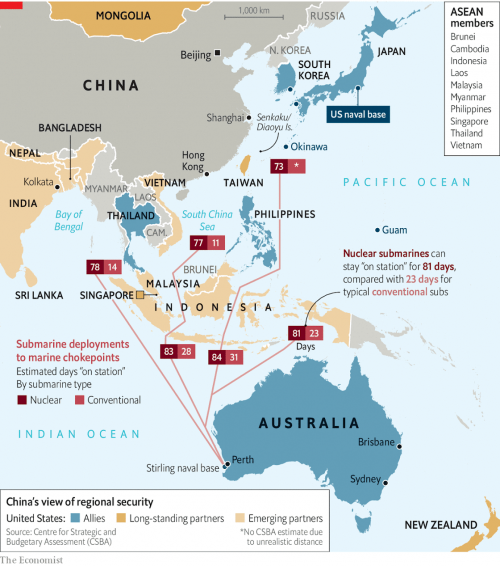
Nuclear vs conventional On station times comparison from the CSBA via The Economist. The reasons why extended patrols off Taiwan, in the SCS, and blockading the straits of Malacca, are requirements are not included in this diagram.

Interestingly, the CSBA chose not to provide an estimate of time on station for an Australian conventional sub on patrol off Taiwan 'due to unrealistic distance' but neglected to consider the possibility of resupply from USN bases in Japan, Korea, the Philippines, and most obviously at Okinawa or even possibly at Guam.

Also note that Korea and Japan both run their sub fleets in those areas.

EDIT: Possibly the CSBA estimates reflect a scenario where a war has already started and the bases in Korea, Japan, the Philippines and Guam are no longer available.

Indo-Pacific-From-Fleet-Base-West-Subs.png
 
Last edited:
USN infrastructure isn't set up to support sustained operations by conventional subs. The number of sub tenders, which is already way too low, would need to jump up to support boats that need more frequent replenishment (and refueling!) in theatre and Guam would need to expand its refueling capacity. Partner nations who operate SSKs would be a better bet, if they have the capacity to support Aussie boats without shorting their own.
 
If there was a conflict with China, refuelling in Taiwan would be suicidal, well within mainland fighter coverage. Singapore would be the only viable allied base for resupply with suitable facilities though as a small nation it would be vulnerable to political pressure from China to remain neutral.
 
I'll ask the potentially dumb question then: Does the new sub *have* to be nuclear? Why couldn't it be of a different propulsion?
The performance levels are that different. Even a Lithium battery sub like the Taigei-class can only spend about 5-6 hours on full speed before having to slow to a crawl for a significant time to recharge the batteries (possibly hours). I know someone has posted a Japanese MoD comment about how quickly the Taigei-class can recharge to a decent level.

A Nuclear sub can spend months at full speed if required, and subs regularly spend a week or so sprinting across the Atlantic or Pacific to get from the East/West Coast to their patrol area.

Hell, even my missile boat once spent 3 weeks at flank speed and only slowing down every 8 hours to get radio messages on/off (we had a dude blocked both sides with kidney stones, poor bastard).

It's the difference between a 20-knot speed of advance and a 5-10 knot speed of advance.

USN infrastructure isn't set up to support sustained operations by conventional subs. The number of sub tenders, which is already way too low, would need to jump up to support boats that need more frequent replenishment (and refueling!) in theatre and Guam would need to expand its refueling capacity. Partner nations who operate SSKs would be a better bet, if they have the capacity to support Aussie boats without shorting their own.
They could handle fueling them. Reloading all the torpedoes needed is something I doubt the USN is ready for. I mean, all it takes to load torpedoes onto a sub at the pier is a 5ton crane. But you need the physical torpedoes to load onto the subs at your refueling points.
 
USN infrastructure isn't set up to support sustained operations by conventional subs. The number of sub tenders, which is already way too low, would need to jump up to support boats that need more frequent replenishment (and refueling!) in theatre and Guam would need to expand its refueling capacity. Partner nations who operate SSKs would be a better bet, if they have the capacity to support Aussie boats without shorting their own.
My suggestion is rather that Australia operate submarine tenders themselves. Just two vessels would likely be able to provide a single vessel available to the RAN at all times. Give the USN probably needs to replace their two anyway, both are approaching 50 years, a joint order would make a lot of sense.
 
My suggestion is rather that Australia operate submarine tenders themselves. Just two vessels would likely be able to provide a single vessel available to the RAN at all times. Give the USN probably needs to replace their two anyway, both are approaching 50 years, a joint order would make a lot of sense.
Very much agree here!

Getting the USN at least 3x sub tenders (Guam, Diego Garcia, and La Maddalena) and the RAN 1-2x (Singapore and New Guinea?) would be ideal.

The operational tempo of a sub tender can best be described as "minimal", they're more a repair slip that has the capability of moving than an operational ship.

That said, a joint order of sub tenders and double that many supply ships would probably be ideal.
 
There is still a massive boost to the USN in AUKUS but it will not prevent some folk stirring the pot. Not sure who benefits from all this talk of cancalation and negativity directly
 
I'll ask the potentially dumb question then: Does the new sub *have* to be nuclear? Why couldn't it be of a different propulsion?
Crunch the numbers.
For X days of food, at Y days deployment speed how many days of operations be available?

30 days of food, and it takes 5 days to get there equals 20 days available. Because total deployment time is 10 days.

But if it takes 10 days to get there, you get 10 days operations.
Because total deployment time is 20 days.

So speed of deployment counts.

Irrespective of fuel it's rate of use for a given speed, either on the surface or by snorkeling.

SSN deployment speed is all below snorkeling depth at speeds an SSK cannot compete with for more than a few hours at best.
 
Missed this earlier:
They supply the same system to South Korean submarines.

https://www.navalnews.com/event-new...ck-supports-south-korean-submarine-programme/
Babcock-supports-South-Korean-submarine-programme-1-scaled.jpg
Holy crap how many tubes is that?!? 6 (4 over 2)? 7 (5 over 2)? 8 (5 over 3)?

Red thing in the picture is the Impulse Tank, not a torpedo tube, but the light blue things in the picture are torpedo tubes. And it looks like there are at least 3 tubes visible across the top, evenly spaced with no gap where the loading skid happens to be, so it looks like there's at least one tube on the centerline, if not 2.

It'd be mechanically simpler to only have one centerline tube, as that way the loading skid only needs to pivot and not raise up or down. You'd only have one reload for the centerline pair of tubes regardless, assuming that you loaded the tube and then took on another torpedo on the skid. Oh, and assuming that you're using full-length torpedoes like Mk48s or Spearfish, not half-length like Mk37s or the short DM2A4s.
 
Missed this earlier:

Holy crap how many tubes is that?!? 6 (4 over 2)? 7 (5 over 2)? 8 (5 over 3)?

4 over 2

KSS-III Batch 1's have six 21" torpedo tubes and six K-VLS medium range ballistic missile cells, batch 2's expand the K-VLS to 10 ballistic missiles. They carry six heavyweight torpedoes or Harpoon's preloaded and 8 reloads in the torpedo room.

Batch 2's I think take the crown for the most heavily armed diesel submarines in the world by stores and matching the nuclear powered Suffren and Victor III's (though its weighted more towards VLS than torpedo armament).
 
Last edited:
Geelong Treaty has been signed by the UK and Australia which creates the technical, regulatory and personnel framework for the technology transfer between the two countries. This enables formal training of Australian shipyard workers in the UK to begin and the transfer of the technology from the UK to Australia for the construction and equipping of the new Osborne shipyard to proceed.

https://www.gov.uk/government/news/...ubmarine-partnership-and-collaboration-treaty
 
And now the lock in... Australia signs a 50 year treaty with the UK - to deepen our combined commitment to the AUKUS alliance.

Public opinion has been steadily turning against the AUKUS treaty as the true scale of the fiasco comes into focus.

Now the US is unable to keep their end of the arrangement but still want the maintenance and sustainment facilities at HMAS Stirlig for Submarine Rotational Force - West, plus all the rest.

The Geelong Treaty is a historic agreement, the commitment for the next 50 years of UK-Australian bilateral defence cooperation under AUKUS Pillar I. The Geelong Treaty will enable comprehensive cooperation on the design, build, operation, sustainment, and disposal of our SSN-AUKUS submarines.

https://www.abc.net.au/news/2025-07...aukus-submarine-pact-50-year-treaty/105571618
 
Washington: The incoming chief of US Navy operations has warned the US will not be able to fulfil its AUKUS obligations without doubling its submarine-building capacity, in a fresh sign of the doubts over whether the agreement can be honoured.

Meanwhile, this masthead can confirm Australia’s second $800 million payment to help the US build nuclear-powered submarines was made in June, when the Australian government was already aware of the Pentagon’s review of AUKUS.
Admiral Daryl Caudle, President Donald Trump’s nominee as chief of navy operations, told his confirmation hearing it was not yet certain the US defence industrial base was capable of producing enough Virginia-class nuclear-powered submarines to sell three to Australia.
“As you know, the delivery pace is not where it needs to be to make good on Pillar 1 of the AUKUS agreement, which is currently under review by our defence department,” he said last week.

“I think rightly so. We do have to understand whether the industrial base can produce the submarines required so that we can make good on the actual pact that we’ve made with the UK and Australia.”
Across the two US shipyards that build the submarines, the current delivery rate is about 1.2 boats a year, but needs to reach 2.2 to 2.3 a year.
“That’s going to require a transformational improvement. Not a 10 per cent improvement, not a 20 per cent improvement – a 100 per cent improvement,” Caudle told the hearing.

“We need a transformational improvement and the ability to deliver twice the capacity that we’re currently delivering.”
In a sign of the broad and bipartisan support AUKUS enjoys in Congress, Caudle was pressed by Senate Armed Services Committee chairman Roger Wicker – a long-serving Mississippi Republican – on the need to meet the benchmark and fulfil the AUKUS demands.

Caudle agreed. “There needs to be some creativity, some ingenuity, some outsourcing improvements,” he said. “We need an all-hands-on-deck approach to this to get to the 2.3 submarines per year.”


In his written testimony, Caudle told the committee: “Current trends are worrying, and should I be confirmed, this issue will have my utmost attention and priority to ensure a productive outcome.”
Last week, this masthead revealed Australia had paid a second instalment of about $800 million into the US maritime industrial base, following an initial cheque in February. Prime Minister Anthony Albanese said the payments followed an agreed schedule.

The Pentagon subsequently confirmed to this masthead that the second payment was made in June. Defence Minister Richard Marles has said Australia was aware of the Pentagon’s AUKUS review “weeks” before it was publicly revealed on June 11.

The Pentagon also declined to reveal how the money would be spent. “The Department of Defence will stay in close contact with Australia about any planned expenditure of these funds,” a US defence official said. “We will not comment otherwise on the status or planned allocation of these investments.”

Uncertainty about the future of AUKUS under the Trump administration’s America First agenda has prompted some allies of Australia in Congress to increase the pressure on senior officials.
Democratic congressman Joe Courtney, who co-chairs the Friends of Australia caucus, said Australia’s second $800 million payment underscored the depth of its commitment to AUKUS.

“If there are improvements that the review is going to put forward, I think we would embrace them,” he said.
“But to sort of stop it or retard it would be a huge mistake.”
Courtney is also spearheading a push to boost the US’s own spending on Virginia-class submarines by $US1 billion ($1.54 billion) next year, saying it would address a shortfall in Trump’s proposed budget. The measure is yet to pass through Congress.
In April, Trump signed an executive order aimed at “restoring American maritime dominance”. However, the shipbuilding unit moved from the National Security Council to the Office of Management and Budget, and its exact role is still unclear.

The unit’s new co-ordinator, retired navy captain Jerry Hendrix, has called Australia “fickle” and suggested the US should “more heavily leverage” AUKUS to secure a submarine base in Western Australia that can maintain US vessels as well as Australian ones.

Another link may work.

https://www.facebook.com/theageAust...he-us-will-not-be-able-to-f/1153589440139244/
Interesting that the pentagon declined to say how the money would be spent. Over 2 bill and counting and what are we getting again.

Regards,
 
Last edited:
https://insidestory.org.au/aukuss-missing-price-tag/
Defence minister and deputy prime minister Richard Marles acknowledged this fact at his first meeting with Hegseth in Washington in February, describing AUKUS as “a very significant increase of the American footprint on the Australian continent.”

Australia has quietly become an increasingly crucial staging post for US and other forces in the event of military conflict in the Indo-Pacific. The current acceleration of that process, acknowledged in the Pentagon’s summary of the private talks between Hegseth and Marles on the Shangri-La sidelines, reflects Washington’s concern that such circumstances may be coming soon.

Just great news, the beachhead is fully in motion. NOT

Action or no, the AUKUS objective is to develop Australia’s capacity to maintain and sustain those US submarines in Western Australia long before Australia gets any subs of its own.

All of this is by way of saying that AUKUS isn’t just about Australia buying submarines. It is about Australia becoming an increasingly integrated part of the US military industrial and warfighting machine in this region.

Regards,
 
https://www.defenceconnect.com.au/n...-withdraw-from-ssn-aukus-confirms-risk-report
The US could never provide enough Virginia subs to fulfill the entire Australian requirement. The only obvious solution is to purchase two off the shelf submarine types from two different countries. I think Australias submarine requirement could be satisfied with a couple nuke subs operated in deep water and conventional subs operating closer to Australia. A high-low mix.

The obvious solution is Japanese conventional subs paired with US nuke subs as they are both being produced at a rate of 1 submarine per year. This means a smaller production rate increase for every additional submarine produced.

A Taigei-class submarine is approximately 20% of the cost and has 30% of the displacement of a Block V Virginia-class submarine. To replace the 6 Collins-class subs Australia would only need 1 Virginia and 3 Taigei subs. These could easily be delivered by 2040 from the current US and Japanese production lines. No refurbishment of the existing Collins-class subs would be needed.

A final fleet size of 3 US nuke subs and 6 Japanese conventional could be achieved by 2050.
 

Similar threads

Back
Top Bottom