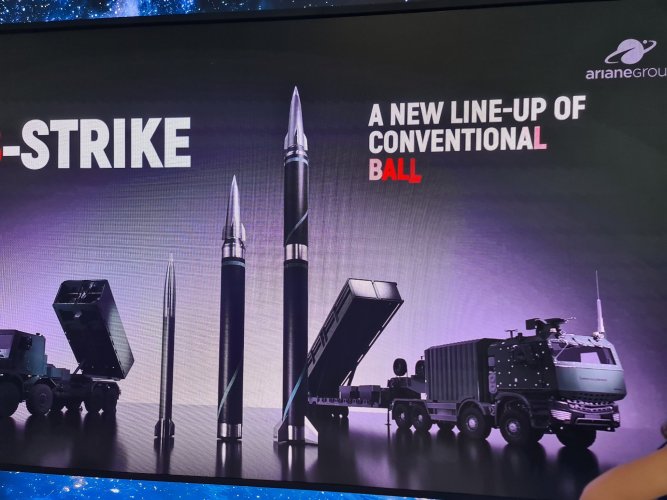
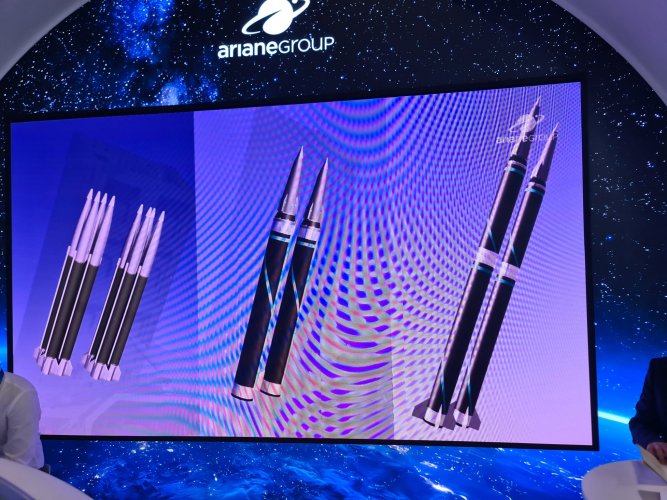
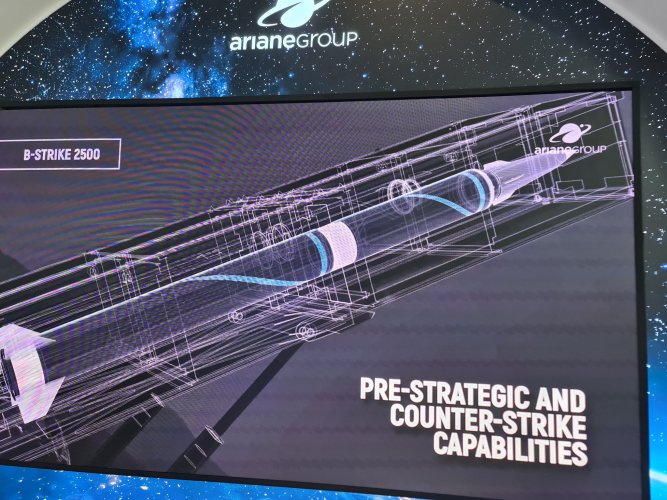
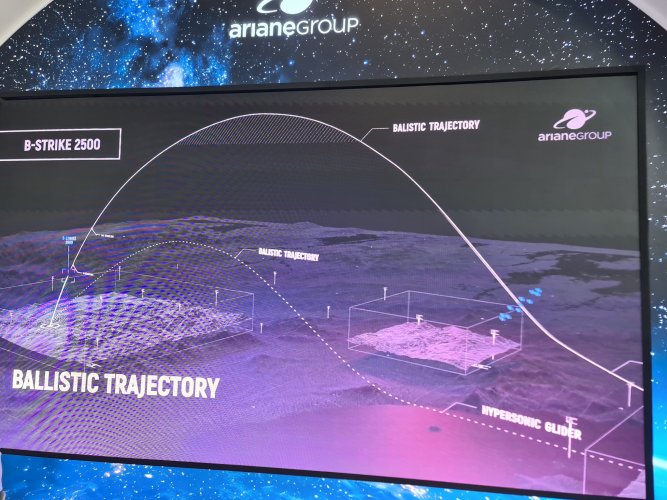
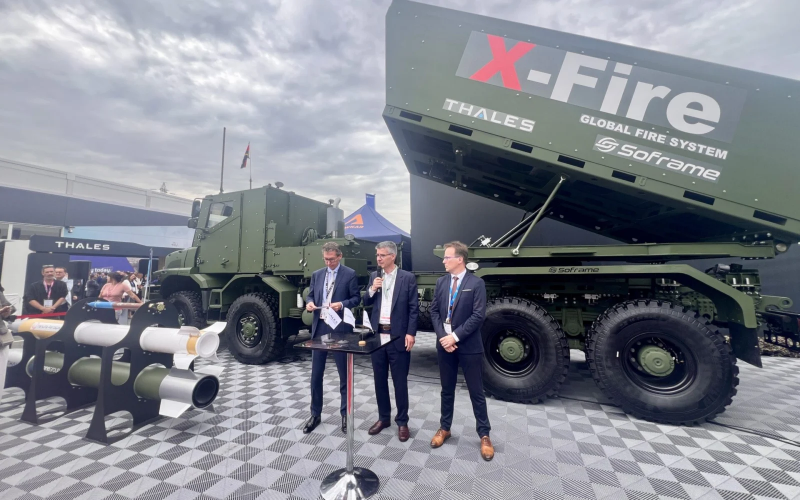
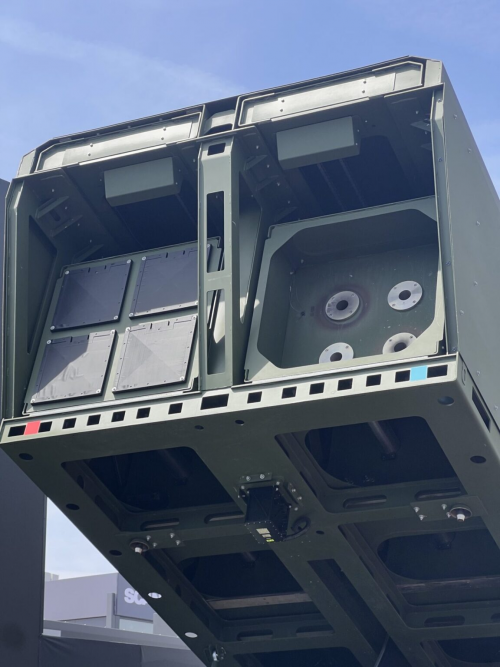
Ariane Group Missile Ballistique Terrestre / Missile Ballistique de Theatre (MBT)

A critical issue here is that there are no more build slots left for Suffren's. That program is in its final stages, with only two boats left to launch. They cut steel on the last boat (Casabianca) five years ago, and French nuclear submarine production has already shifted to SSBN production (first steel was cut for the first SNLE 3G in 2024). Any new attack submarine builds would come at the expense of the SSBN build schedule, and SSBNs have absolute priority over all other programs - just as is the case in the US.

You will probably not see French SSN construction start up again until the mid to late 2030s.
Hrm.

Guess they make some SNLE-3G SSGNs, then.
 
So the Kinzhal is just an Iskander fitted on an aircraft, and you want me to believe one costs more than the other, and they both have the same range?

Something in what you're saying doesn't add up.
The Kinzhal and Iskander-M are theorized to be related systems, yes. And air launch certainly requires extensive modifications, especially with regards to launch and guidance. It's quite easy to see why the missile you launch from an aircraft at Mach-Fuck and at high altitude would require more complex adaptations than the one that's positioned vertically by a truck and then already starts the launching process.

Kinzhal and Iskander-M are the clostest in-service example we have of a ground and air launched ballistic missile of roughly similar design and performance. And this example does not back up your theoretical assumptions.
 
It's a very israeli view. Granted, verified just today(and embraced with success by some customers), but still rather unique in modern world.
Other nations tend to be rather patchy about ALBMs; only Israel made it into a cornerstone of its stand off capability sets.
I think it's a very bad approach to see it as uniquely Israeli (and now Indian) approach.
Ballistic Missile Defense is more expensive and more complex than defeating ABTs.
And ABTs really lost their edge recently. That's why many are investing in creating a hi-lo mix of cruise missiles.
ALBMs are one way of getting the edge back, but with some of the advantages an aircraft provides (e.g. guidance and BDA) and at lower cost per effect than ground launched BMs.

The US is also exploring putting the PrSM on an aircraft, for example.

Unsurprising view, as their AF is the only properly developed branch.
The only branch of the IDF I'd say is under-developed is the navy, but one look at the geography and you'll see why.
The IAF is the only branch that's really professional, but it's a pretty universal thing that you can only create pockets of excellence in an armed force and not make the entire force excellent. And usually the air forces are picked for that.

The Kinzhal and Iskander-M are theorized to be related systems, yes. And air launch certainly requires extensive modifications, especially with regards to launch and guidance. It's quite easy to see why the missile you launch from an aircraft at Mach-Fuck and at high altitude would require more complex adaptations than the one that's positioned vertically by a truck and then already starts the launching process.

Kinzhal and Iskander-M are the clostest in-service example we have of a ground and air launched ballistic missile of roughly similar design and performance. And this example does not back up your theoretical assumptions.
Extra and Rampage ; Lora and Air Lora are rather similar. But there are no cost figures for them.
I certainly don't know of any modifications required to make one air launched. Given the velocities they are said to achieve from ground launch I don't see how an air launch at a lower speed than their max is in any way a particularly stressful event.
And does guidance really need to be much different? I don't see a reason for that either.

The way I see it, you're either:
  • Taking a munition as-is and giving it a longer range and possibly terminal impact velocity which in turn gives it more effect for the same cost. (Same cost | More effect).
  • Or removing an expensive first stage to give it similar capabilities as the ground launched. (Lower cost | Same effect).
So if the Kinzhal suddenly costs a lot more, it could be either that the Iskander's cost figure just hasn't been updated in a long time, or the Kinzhal received modifications that go beyond simple air launch capability.

 
I think it's a very bad approach to see it as uniquely Israeli (and now Indian) approach.
Ballistic Missile Defense is more expensive and more complex than defeating ABTs.
Well, it is more of a statement of fact at the moment. We see rampage sufas and adirs with strategically hidden opposite side every day, in every Iranian girl school government building.
No other nation does anything similar at a similar doctrinal scale, their ballistic options are special purpose at best.

It's indeed true it should be evaluated in context... though part of context is that honestly we're yet to see even a single ABM engagement by Iran ever. We even saw Arman running away from drones, but it doesn't appear this system is operational in ABM capacity.
Though not like Iranian AA does much against anything else beyond prop drones.
The US is also exploring putting the PrSM on an aircraft, for example.
It's same thing as Kinzhal(and whatever mini-version of it they promised for su-57), Korean ALBM and some Chinese options. They're hi to very hi. Israel goes from Lo to very Hi, fully operational at all levels.
 
Last edited:
Well, it is more of a statement of fact at the moment. We see rampage sufas and adirs with strategically hidden opposite side every day, in every Iranian girl school government building.
No other nation does anything similar at a similar doctrinal scale, their ballistic options are special purpose at best.

It's indeed true it should be evaluated in context... though part of context is that honestly we're yet to see even a single ABM engagement by Iran ever. We even saw Arman running away from drones, but it doesn't appear this system is operational in ABM capacity.
Though not like Iranian AA does much against anything else beyond prop drones.

It's same thing as Kinzhal(and whatever mini-version of it they promised for su-57), Korean ALBM and some Chinese options. They're hi to very hi. Israel goes from Lo to very Hi, fully operational at all levels.
Rampage at least is not a high or very high end part of the mix. It's like strapping a GMLRS-ER to a plane.

Its use in almost every arena (Syria, Lebanon, Yemen, Iran, Pakistan) implies about its cost efficiency. It has much more presence on Israeli aircraft in media at least than the SPICE bombs equivalent to SDBs and JDAM-ER.

Aside from long standoff range, they also have very good penetration power, especially compared to cruise missiles. That's an important capability to have. Even in Europe.
 
Rampage at least is not a high or very high end part of the mix. It's like strapping a GMLRS-ER to a plane.

Its use in almost every arena (Syria, Lebanon, Yemen, Iran, Pakistan) implies about its cost efficiency. It has much more presence on Israeli aircraft in media at least than the SPICE bombs equivalent to SDBs and JDAM-ER.

Aside from long standoff range, they also have very good penetration power, especially compared to cruise missiles. That's an important capability to have. Even in Europe.
Yes, we're very much in agreement.
Btw, after thorough search, it isn't strictly Israel. And who would've guessed - it's also...
...Turkey and Iran.
Same region. I wonder, whether it's region, or just arms race pushing cart forward?
 
Yes, we're very much in agreement.
Btw, after thorough search, it isn't strictly Israel. And who would've guessed - it's also...
...Turkey and Iran.
Same region. I wonder, whether it's region, or just arms race pushing cart forward?
The BM does not care for your puny geography.
Just ask yourself who is seriously arming themselves and you'll see.
 
The BM does not care for your puny geography.
Just ask yourself who is seriously arming themselves and you'll see.
But again - it's just a matter of fact!
Everyone could design such a rocket, moreover it won't even take much efforts for any country with their own heavy MLR. They just don't bother.
Tbh i am not even sure anymore that Iranian claim on air strikes in Iraq is propaganda lie anymore - it would explain neatly how few missiles appeared out of nowhere in Arbil. Coming at low latitude through Zagros right to the launch point isn't exactly incomprehensible.
9ee782e153759a3a985c52246e64e68c.Screen-Shot-2020-05-11-at-9.53.45-AM.png
 
But again - it's just a matter of fact!
Everyone could design such a rocket, moreover it won't even take much efforts for any country with their own heavy MLR. They just don't bother.
Tbh i am not even sure anymore that Iranian claim on air strikes in Iraq is propaganda lie anymore - it would explain neatly how few missiles appeared out of nowhere in Arbil. Coming at low latitude through Zagros right to the launch point isn't exactly incomprehensible.
9ee782e153759a3a985c52246e64e68c.Screen-Shot-2020-05-11-at-9.53.45-AM.png
If your rocket has proper guidance that can take the extra range then sure. But making a cost effective ALBM that retains pinpoint accuracy isn't easy.

I don't have a strong opinion about short range systems. I just think MRBMs start getting really expensive so if you can drop a stage by launching from an aircraft and save that money - it's a plus.
So it's less of merits of an ALBM as a standalone weapon class, and more about how you save money in a war economy.

With "most nations" remember that most nations don't really have a balanced and capable force. Most have some serious gaps, are of improper size, are not modernizing, or don't have a reference enemy around which to build a force.
 
If your rocket has proper guidance that can take the extra range then sure. But making a cost effective ALBM that retains pinpoint accuracy isn't easy.
It's Fadjr-4, same story with Rampage more or less. 333mm MLR rocket(one of the most numerous in Iranian arsenal), adapted for aircraft drop.
 
Hrm.

Guess they make some SNLE-3G SSGNs, then.

I doubt this would be the case, tbh. An SSBN-based SSGN is a very inefficient way of doing things and not particularly viable for a force as small as France's.

If France really wants to expand strike options from their submarine force going forward, I would tend to assume that they would simply design their next SSN class with vertical launch cells. Something similar to Virginia Payload Module - but probably more in the region of 1-2 silos rather than four - could make sense, in order to allow for a mix of conventional cruise missiles or hypersonic strike, if France is interesting in going in that direction.

It would arrive in the same amount of time as a prospective fifth SNLE-3G built as an SSGN (and it would only ever be the fifth hull - the absolute priority is getting the SSBNs into service on schedule), and allow for a more distributed and regularly available force for such enhanced conventional strike capabilities.
 
I doubt this would be the case, tbh. An SSBN-based SSGN is a very inefficient way of doing things and not particularly viable for a force as small as France's.
Depends on how many missiles you want per sub.

An SSGN based on the SNLE can pack up to 7*16=112 (maybe even 10*16=160) 21"/53cm weapons. But those big M51 tubes can also take bigger diameter weapons if you have them designing.

I would honestly expect an SNLE-SSGN to be built somewhat similarly to the Ohio-SSGN, so it'd lose 2 tubes for diver lockout and maybe a couple more if France built a dry deck shelter to stick on top of the hull. So you're still talking 84ish 21" weapons.

While an SSN with a VLS and/or a couple of VPMs is only carrying a dozen or two 21" weapons.


If France really wants to expand strike options from their submarine force going forward, I would tend to assume that they would simply design their next SSN class with vertical launch cells. Something similar to Virginia Payload Module - but probably more in the region of 1-2 silos rather than four - could make sense, in order to allow for a mix of conventional cruise missiles or hypersonic strike, if France is interesting in going in that direction.
Yes, I expect that to happen as well.
Side note, US Virginia block Vs have 6x VPMs/silos. 2 forward, 4 amidships.​


It would arrive in the same amount of time as a prospective fifth SNLE-3G built as an SSGN (and it would only ever be the fifth hull - the absolute priority is getting the SSBNs into service on schedule), and allow for a more distributed and regularly available force for such enhanced conventional strike capabilities.
Yes, I was assuming that the SSGN would be the 5th SNLE hull built (and maybe the 6th).

I disagree that you'd get a new-design SSGN sooner than the SNLE-SSGN, or even the same time. To make an SNLE-SSGN, you'd need to redesign the Missile Control Center from the gear for M51 to that needed for the smaller missiles. If you're also making it a special ops boat you will need space for mission planning, which for the Ohios meant completely rearranging the Navigation Center. I have no clue how the SNLE is set up, but I assume there is a decently large space for the navigation equipment that could be converted.

But that's 2 spaces to redesign instead of designing a whole new ship.

Unless France's production system is so strained that just designing their SSNs and SSBNs alternating takes up their entire capacity?
 
Depends on how many missiles you want per sub.

An SSGN based on the SNLE can pack up to 7*16=112 (maybe even 10*16=160) 21"/53cm weapons. But those big M51 tubes can also take bigger diameter weapons if you have them designing.

I would honestly expect an SNLE-SSGN to be built somewhat similarly to the Ohio-SSGN, so it'd lose 2 tubes for diver lockout and maybe a couple more if France built a dry deck shelter to stick on top of the hull. So you're still talking 84ish 21" weapons.

The problem with this approach is that you're putting together a ton of firepower - non-trival for a nation with France's budget - and cramming it into a single hull that can only ever be in once place at a time (in fact, that SSGN would require twice number of submarine-launched MdCN as France has procured in general). And now also competes with the SSBNs for access to Doc No.8 at Brest for overhauls.

These kind of SSGNs only really make sense when you have to deactivate an existing SSBN, i.e. exactly how the US Navy found itself with the four Ohio SSGNs.

Side note, US Virginia block Vs have 6x VPMs/silos. 2 forward, 4 amidships.
Four. The bow installations on Block V and VI are still VPT's, which each pack six Tomahawks. Only the amidships hull insert (VPM) has the larger tubes that can septuple pack Tomahawk or triple pack CPS.

I disagree that you'd get a new-design SSGN sooner than the SNLE-SSGN, or even the same time.

I think you're misunderstanding the timing on this?

They will be starting the design work on their next generation SSN in the not too distant future, to make sure its production can start right off the tail of their SSBN's. That's how their nuclear submarine design/production cycle works - all parts are kept constantly in motion so the capabilities do not degrade through pauses, and they are able to replace their boats on the required timeline to ensure continuous operations.

If they want to design a larger and more capable submarine with expanded strike options for their future SSN, they will factor that into the schedule, so they can still start production at the desired cadence. But they're going to be designing a whole new submarine anyways - there's no reason to add to the workload for one or two submarines when they can more effectively just distribute the capability across the SSN force, thus ensuring it is always available and can be in more than one theater at a time.
 
The problem with this approach is that you're putting together a ton of firepower - non-trival for a nation with France's budget - and cramming it into a single hull that can only ever be in once place at a time (in fact, that SSGN would require twice number of submarine-launched MdCN as France has procured in general). And now also competes with the SSBNs for access to Doc No.8 at Brest for overhauls.
Agreed that it does take up SSBN logistics, at least somewhat. And obviously can only be in one place at one time. But if it's running on the US-style patrol and refit cycle, there's only about 1 month every 3 the ship is in port at all.


Four. The bow installations on Block V and VI are still VPT's, which each pack six Tomahawks. Only the amidships hull insert (VPM) has the larger tubes that can septuple pack Tomahawk or triple pack CPS.
Last I heard those tubes in the bow are also VPMs. The difference between holding 6 and 7 cells is access to an umbilical on the Tomahawks. The bow tubes don't have access outside the tube so some poor weaponeer has to climb down the center to plug in those umbilicals, but the midships tubes do have access outside the tube so they unbolt an access panel and send a weaponeer in that way.


I think you're misunderstanding the timing on this?

They will be starting the design work on their next generation SSN in the not too distant future, to make sure its production can start right off the tail of their SSBN's. That's how their nuclear submarine design/production cycle works - all parts are kept constantly in motion so the capabilities do not degrade through pauses, and they are able to replace their boats on the required timeline to ensure continuous operations.

If they want to design a larger and more capable submarine with expanded strike options for their future SSN, they will factor that into the schedule, so they can still start production at the desired cadence. But they're going to be designing a whole new submarine anyways - there's no reason to add to the workload for one or two submarines when they can more effectively just distribute the capability across the SSN force, thus ensuring it is always available and can be in more than one theater at a time.
If they have already started the design process for the next generation SSN and it's going to be done on schedule for when the last SNLE is in the water then it would probably be better to go on and start building that sub as an SSN with VLS.

IMO, the ideal would be 1 or 2 SNLE-SSGNs and the Suffren-replacement class gets a couple of big tubes in the bow like Flight 2 and on Virginias.


The more truly indigenous completely independent tactical and strategic weapon systems Western Europe develops and fields, the better.
Absolutely agreed here.
 
The MBT is expected to have a range in the 2,500 km class.
Studies for the development of a Deep Precision Strike (DPS) capability will be launched as early as 2026, with the aim of fielding a conventional ground-to-ground ballistic missile with a range in the 2,500 km class before the end of the next decade. Cooperation with our German and British allies is being prioritized.

Initial capability expected by 2035–2036.
 

Similar threads

Back
Top Bottom