Ariane Group Missile Ballistique Terrestre / Missile Ballistique de Theatre (MBT)

The way the french nuclear deterrent and submarines work
-M51 tubes are 100% nuclear deterrent, boomers, and, well - M51 SLBMs with nuclear warheads.
-Now the Barracudas are different, they already do conventional strike with SCALPs, through their 533 mm torpedoes launch tubes.
-What I mean: there will no additional Barracudas with M51 tubes to launch the MBT.
-I think that if the French Navy ever use the the MBT it will be from Rafale M out of CdG.
-Or - maybe - from surface ships.
-Now, if there ever is a Barracuda variant of the MBT, much like SCALP it will have to launch through the torpedo tubes, 533 mm diameter.

Bottom line: France won't build additional M51 launch tubes outside the 3gen boomers to launch the the MBT

The Force de frappe is kinda sacro-sanct, for the sake of its credibility and discretion it can't mix with conventional weapons.
-Hades was 100% nuclear warheads: no chemical / bio / cluster warheads
-M51 / tubes / boomers: same story.
-ASMP, same story - this is why SCALP exists even if much slower, Apache too.
 
Last edited:
The ground launched version would be all-around cheaper as a system. As air launch has to take the cost per flight hour, maintenance and dedicated training into account.
Cheaper than what?
An ALBM? No. Not at all. No chance. Not in the slightest. Nopeity nope.

An aircraft + ALBM? Definitely. Yeah. But unless you're talking about some kamikaze pilot, it's safe to say the plane returns.

You don't spend millions of dollars on the flight. You spend tens of thousands.
France took a look at what China and Russia (as well as DPRK and Iran) are rolling out and rightfulky realized that in this day and age you need a serious theater ballistic missile or pack up.
Wanna ask Iran how that went for them?
 
The way the french nuclear deterrent and submarines work
-M51 tubes are 100% nuclear deterrent, boomers, and, well - M51 SLBMs with nuclear warheads.
-Now the Barracudas are different, they already do conventional strike with SCALPs, through their 533 mm torpedoes launch tubes.
-What I mean: there will no additional Barracudas with M51 tubes to launch the MBT.
-I think that if the French Navy ever use the the MBT it will be from Rafale M out of CdG.
-Or - maybe - from surface ships.
-Now, if there ever is a Barracuda variant of the MBT, much like SCALP it will have to launch through the torpedo tubes, 533 mm diameter.

Bottom line: France won't build additional M51 launch tubes outside the 3gen boomers to launch the the MBT

The Force de frappe is kinda sacro-sanct, for the sake of its credibility and discretion it can't mix with conventional weapons.
-Hades was 100% nuclear warheads: no chemical / bio / cluster warheads
-M51 / tubes / boomers: same story.
-ASMP, same story - this is why SCALP exists even if much slower, Apache too.
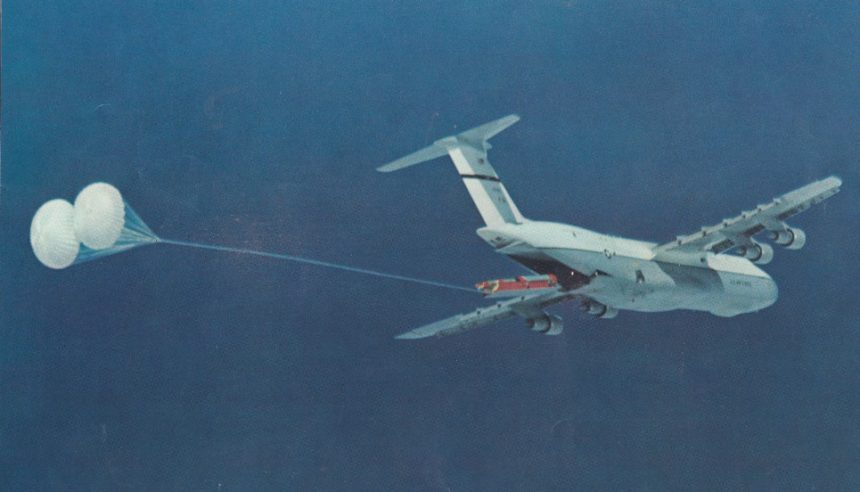
I doubt MBT will see any air launched capabilitys considering thats like hughe
 
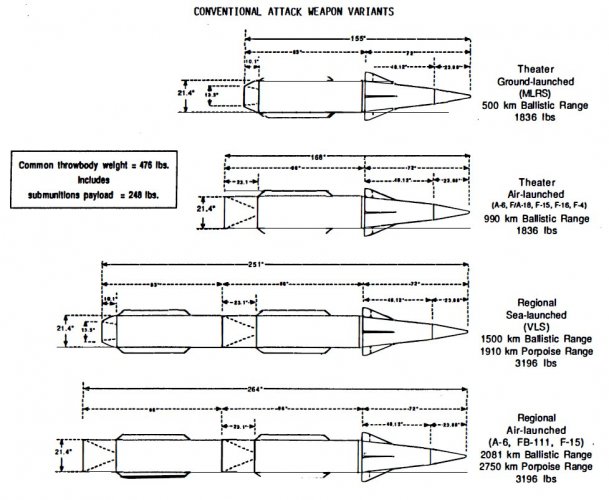
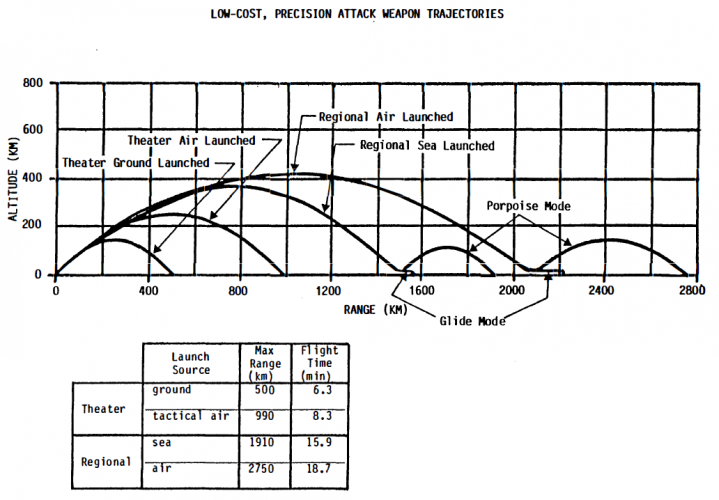
The US Navy Low-Cost Precision Attack Weapons study from 1988 might be of interest here, because it considered a 21 inch diameter ballistic missile with a "Range Extending MaRV", reaching, in the two stage surface launched configuration, a range of 1900 km.
Source
 

Attachments

  • media_ER4vUpnWkAAoRiv.jpg
    media_ER4vUpnWkAAoRiv.jpg
    111.1 KB · Views: 61
  • media_ER4vvBOXsAAQD3i.png
    media_ER4vvBOXsAAQD3i.png
    93.9 KB · Views: 57
Last edited:
Cheaper than what?
An ALBM? No. Not at all. No chance. Not in the slightest. Nopeity nope.

An aircraft + ALBM? Definitely. Yeah. But unless you're talking about some kamikaze pilot, it's safe to say the plane returns.

You don't spend millions of dollars on the flight. You spend tens of thousands.

Wanna ask Iran how that went for them?
Cheaper than an ALBM + Launch System over the complete lifetime. And that's not even a debate. Acquistion, maintenance and training with and for a TEL are infinitely cheaper than the acquistion, maintenance and training of an aircraft that launches an ALBM. Even if the initial purchase cost isn't a factor, as in this instance the Rafale already exists. The cost with regards to personelle, training, cost per flight hour and maintenance exceeds that of a TEL easily. We're not talking about these super heavy ICBM TELs that are purpose build and developed machines. We're talking about adapting a most likely already avilaible platform to use.

But if you can show me a modern jet fighter in French service that's cheaper to operate than a modified truck, I'd love to see it.

As for Iran, ignoring the fact that their missiles still overcame the ultimately not-so-impressive israeli (plus allied) defenses. Counter argument is the Scud, Iskander-M and to a degree the less capable ATACMS. Not even the US solely relies on air launched missiles, you know, the country with the most well equipped and powerful air force in the world. They still procure and upgrade their land based launch platforms for the likes of PrSM and Dark Eagle.

But surely, the US, China and Russia investing into land based launch platforms for their ballistic missiles next to air and ship launched versions have no idea what they're doing. I'd be thankful if you could enlighten them about their folly, I'm sure they'd listen.

So, womp womp.
 
Arguably if the missile is 0.5m diameter, it should be possible to fit 4 missiles into the space held by one M51 silo at 2.3m diameter or Trident missile silo at 2.11m diameter. Though when taken into consideration of sleeve cell diameter, Trident silos might only hold 3 such missiles.
Crud, you can fit 7 533mm tubes into a Trident tube. You might even be able to fit 10 into the M51 tube.


The way the french nuclear deterrent and submarines work
-M51 tubes are 100% nuclear deterrent, boomers, and, well - M51 SLBMs with nuclear warheads.
-Now the Barracudas are different, they already do conventional strike with SCALPs, through their 533 mm torpedoes launch tubes.
-What I mean: there will no additional Barracudas with M51 tubes to launch the MBT.
-I think that if the French Navy ever use the the MBT it will be from Rafale M out of CdG.
-Or - maybe - from surface ships.
-Now, if there ever is a Barracuda variant of the MBT, much like SCALP it will have to launch through the torpedo tubes, 533 mm diameter.

Bottom line: France won't build additional M51 launch tubes outside the 3gen boomers to launch the the MBT

The Force de frappe is kinda sacro-sanct, for the sake of its credibility and discretion it can't mix with conventional weapons.
-Hades was 100% nuclear warheads: no chemical / bio / cluster warheads
-M51 / tubes / boomers: same story.
-ASMP, same story - this is why SCALP exists even if much slower, Apache too.
But France could build a few Suffrens either stretched like the Virginia Block V or with a couple of "Suffren Payload Modules" in the bow like the VPMs in the Blocks 2-4.

Still dedicated conventional strike.
 
But France could build a few Suffrens either stretched like the Virginia Block V or with a couple of "Suffren Payload Modules" in the bow like the VPMs in the Blocks 2-4.
Technically, you are right. The real problem however is money. The french navy will never, ever get the budget to built additional boomers or SSNs for conventional strike. The number of nuclear submarines that can be afforded and (almost importantly) manned is limited. It is essentially : 10 or bust.

The SSN & boomer fleet format has been capped since the 1980's (if not shrunk)
Boomers
- https://en.wikipedia.org/wiki/Redoutable-class_submarine_(1967) (6 submarines)
- https://en.wikipedia.org/wiki/Triomphant-class_submarine (4 submarines)
- https://en.wikipedia.org/wiki/SNLE_3G (4 submarines)
SSN
- https://en.wikipedia.org/wiki/Rubis-class_submarine (6 submarines, 8 wanted initially)
- https://en.wikipedia.org/wiki/Suffren-class_submarine (6 submarines)

There is no way the 4 / 6 format of nuclear submarines will ever be expanded for conventional strike.
 
Last edited:
Cheaper than an ALBM + Launch System over the complete lifetime.
Complete lifetime of what? Of an MRBM? For one use?

If I envision a peacetime-only force that will never fire a shot - Yes, an MRBM is cheaper than a jet + ALBM.
But I don't actually replace jets with MRBMs. So I'm still buying jets + MRBMs.
So then, for the same amount of jets, my consideration is between an MRBM and ALBM. And an ALBM is cheaper.

But let's say just for the sport that we DO replace jets with MRBMs. My force of 200 jets is now 200 MRBMs.
So yes it is cheaper.
But it's only cheaper for as long as you never fire your MRBMs.
If you fire and replenish, within just a few salvos you're way past the cost of these jets.

A force structure that hinges on never being used is vaporware.

And I'll repeat something that apparently needs repeating:
MRBMs are by far the most expensive way to deliver a warhead. Not only do they need a whole extra stage, but their guidance system must account for a much longer travel.
7 to 8 digit price to deliver a (5 digit cost) JDAM.

Acquistion, maintenance and training with and for a TEL are infinitely cheaper than the acquistion, maintenance and training of an aircraft that launches an ALBM.
The Rafale's maintenance and training costs are already accounted for in the Rafale program. Adding an ALBM to its arsenal doesn't magically double these costs.
Unless you want to use MRBMs to replace fighter jets which is exactly Iran's mistake.
On the other hand, when using MRBMs, you're creating a new array with new personnel and logistics and TTPs that do need a unique, not pre-existing training and infrastructure.

The cost with regards to personelle, training, cost per flight hour and maintenance exceeds that of a TEL easily.
Fighter jet CPFH is ~ 1-2e4.
ALBM is ~ 0.5-2e6.
MRBM is ~ 3-10e6.

We're not talking about these super heavy ICBM TELs that are purpose build and developed machines. We're talking about adapting a most likely already avilaible platform to use.
Sure. You still need to store and maintain them, do drills and so on.
Most nations that use any quantity of ballistic missiles typically build robust under-ground networks for them, and these are expensive constructions that need to be connected to national C2 and assets, and fortified against wartime disruptions of said connections.
Not to be confused with under-ground launch sites. I mean just storage for now.

But if you can show me a modern jet fighter in French service that's cheaper to operate than a modified truck, I'd love to see it.
Asking the wrong questions. You're comparing a pre-existing jet who'd otherwise also exist for many other missions, that's leveraged to fire yet another munition type in addition to the dozens it already does, to an organization that you think is summed up via only a truck.

As for Iran, ignoring the fact that their missiles still overcame the ultimately not-so-impressive israeli (plus allied) defenses.
Iran fired 533 missiles, of which 35 are confirmed hits, resulting in 31 deaths.
Yes, it's very unimpressive that air defenses don't get 100%. But that is by all means a massive Iranian operational failure.
The biggest damage their missile strikes have caused is the financial damage of restocking on interceptors.

Counter argument is the Scud, Iskander-M and to a degree the less capable ATACMS. Not even the US solely relies on air launched missiles, you know, the country with the most well equipped and powerful air force in the world. They still procure and upgrade their land based launch platforms for the likes of PrSM and Dark Eagle.
These systems exist for rapid response against very high value targets. A very niche capability to have for when you cannot get an air strike in time but you don't mind the cost for that specific target.
They are also SRBMs, which puts them in a lower cost category than MRBMs, and of course their range also means a lower operational level controls them. This matters for response times.
The exception is Dark Eagle which is not in service yet and whose mode of employment is not yet known.
 
Technically, you are right. The real problem however is money. The french navy will never, ever get the budget to built additional boomers or SSNs for conventional strike. The number of nuclear submarines that can be afforded and (almost importantly) manned is limited. It is essentially : 10 or bust.

The SSN & boomer fleet format has been capped since the 1980's (if not shrunk)
Boomers
- https://en.wikipedia.org/wiki/Redoutable-class_submarine_(1967) (6 submarines)
- https://en.wikipedia.org/wiki/Triomphant-class_submarine (4 submarines)
- https://en.wikipedia.org/wiki/SNLE_3G (4 submarines)
SSN
- https://en.wikipedia.org/wiki/Rubis-class_submarine (6 submarines, 8 wanted initially)
- https://en.wikipedia.org/wiki/Suffren-class_submarine (6 submarines)

There is no way the 4 / 6 format of nuclear submarines will ever be expanded for conventional strike.
So complete some of the Suffrens with a couple of tubes for conventional strike, and work out a refit to install the capability into the finished Suffrens. Just another tool they have available, use them like a normal SSN that happens to have a VLS. Not like an Ohio-class SSGN or whatever.

Or find someone who might buy the completed Suffrens off you to allow construction of new-build Suffrens with VLS.
 
Or find someone who might buy the completed Suffrens off you to allow construction of new-build Suffrens with VLS.
AUKUS eeeeeeeeeeeeeearhmmmmm cough, cough

Outside Australia nobody buys nuclear subs, only AIP.
 
AUKUS eeeeeeeeeeeeeearhmmmmm cough, cough
Go get some honey-lemon chamomile tea, that cough sounds terrible. :D


Outside Australia nobody buys nuclear subs, only AIP.
I was going to suggest Israel, but the Israelis would need to install a couple big "torpedo" tubes for Popeye Turbos. (even assuming anyone in Europe will be willing to sell to Israel anytime soon)
 
I was going to suggest Israel, but the Israelis would need to install a couple big "torpedo" tubes for Popeye Turbos. (even assuming anyone in Europe will be willing to sell to Israel anytime soon)
Germany is technically in Europe.

But good luck convincing Israel to buy anything French. That's a big no no.
Also there's really no need for a nuclear sub. AIPs are more than enough given no ocean-going needs.
 
So complete some of the Suffrens with a couple of tubes for conventional strike, and work out a refit to install the capability into the finished Suffrens. Just another tool they have available, use them like a normal SSN that happens to have a VLS. Not like an Ohio-class SSGN or whatever.
At the risk of driving you crazy (lol) : SCALP is already there. That's the Barracuda conventional strike capability, out of their torpedo tubes.
There will be no VLS and even less M51 tube on Barracuda. It's torpedo tube or nothing.

Basic reasoning: if MBT can't adapt to Barracuda tubes, we don't care; as SCALP is already in that place, giving the subs conventional strike the cruise missile way.
 
Last edited:
I really don't see a good reason to waste energy on a ground launched variant, but ok.
The air launched one is the main event IMO. As well as the naval one.
Hades legacy, except non-nuclear. It was a very refined system, plus France has a stupendous highway network (albeit damn expensive since in the 2000s successive dumbarse governments, left and right altogether, privatized the highways: from government to Vinci, a frucking scandal)
 
What does a ballistic missile give that a cruise missile doesn't?
Speed.

But ground and air launch with potential ship basing is likely 'good enough'.
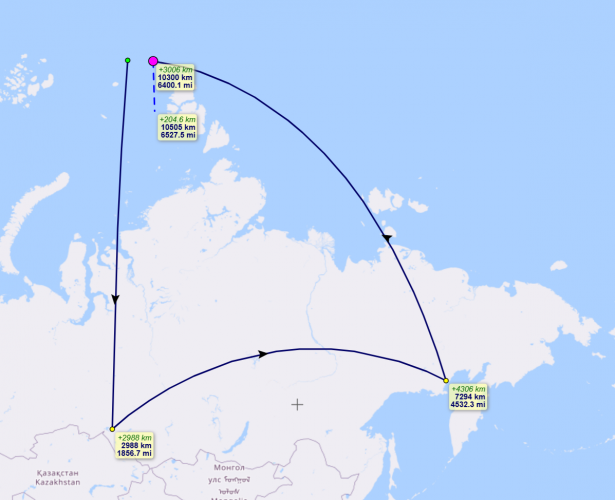
You need to place an asset close enough to the target. A sub can get to where it needs to be undetected. Take a look where Russian fighter manufacturing factories are. No ground for Europe to launch from that gets there even with 3,000km range and do you really want to put a ship there? Air-launch? What aircraft does Europe carry a 6-7 ton ballistic missile on that gets out there without getting shot down? A sub is the only option for a full-scale conventional deterrent.

1771078559465.png
 
Forest Green
What system be you on about?
 
Careful please ! This thread, as so many others, is going from its clearly set theme to a general, and more and more political discussion ...
 
A 3,000km European MRBM with sub-launch option.
I don't see that the system we're talking supposed to be talking about in this thread matches such a requirement.

MBT is clearly a more Pershing II type system and European Russia is amongst the sort of targets it would be aimed at. As presumably the likes of coastal China or various bits of the Middle East from other parts of the Middle East.

Striking Russia's deep infrastructure, is the realm of true strategic weapons. Which is generally nuclear armed ICBMs.
 
It is more a tit for tat capability against Iskander - 1000 km - but probably not for Oreshnik, since that one is a Putin wunderwaffen idiocy.

Fact is, in the "west" since the 1950's most TBM / SRBM / MRBM have been "nuclear or nothing".

That included Hades (whatever english Wikipedia says, no bio / chemical / cluster warheads for that missile). Conventional long range strike was left to cruise missiles.

My understanding was: ballistic missiles smelled too much "nuclear warhead" and made the Soviet nervous. And if you think that's silly, check that scary incident. https://en.wikipedia.org/wiki/Norwegian_rocket_incident

One turning point was Iraq firing Scud at Iran during the 1980s but that remained a short range missile. Seems the russo-ukrainian war has lowered the ballistic missile "treshold" again.
 
It is more a tit for tat capability against Iskander - 1000 km - but probably not for Oreshnik, since that one is a Putin wunderwaffen idiocy.
IMO adversaries should not seek symmetry. Force structure should be mission-driven.

My understanding was: ballistic missiles smelled too much "nuclear warhead" and made the Soviet nervous. And if you think that's silly, check that scary incident.
It's good then. Because BMs are mega expensive compared to how much firepower they deliver.
They relied on the notion that air superiority was not a given, which isn't the case anymore today.
 
The way the french nuclear deterrent and submarines work
-M51 tubes are 100% nuclear deterrent, boomers, and, well - M51 SLBMs with nuclear warheads.
-Now the Barracudas are different, they already do conventional strike with SCALPs, through their 533 mm torpedoes launch tubes.
-What I mean: there will no additional Barracudas with M51 tubes to launch the MBT.
-I think that if the French Navy ever use the the MBT it will be from Rafale M out of CdG.
-Or - maybe - from surface ships.
-Now, if there ever is a Barracuda variant of the MBT, much like SCALP it will have to launch through the torpedo tubes, 533 mm diameter.

Bottom line: France won't build additional M51 launch tubes outside the 3gen boomers to launch the the MBT

The Force de frappe is kinda sacro-sanct, for the sake of its credibility and discretion it can't mix with conventional weapons.
-Hades was 100% nuclear warheads: no chemical / bio / cluster warheads
-M51 / tubes / boomers: same story.
-ASMP, same story - this is why SCALP exists even if much slower, Apache too.
That's sad, especially when taken into account that India uses two types of ballistic missiles at its Arihant-class boomers, 12xK15x1,500 km or 4xK4x3,500 km for the first two; and 24xK15x1,500 km or 8xK4x3,500 km for the ones to follow.

 
I don't see that the system we're talking supposed to be talking about in this thread matches such a requirement.

MBT is clearly a more Pershing II type system and European Russia is amongst the sort of targets it would be aimed at. As presumably the likes of coastal China or various bits of the Middle East from other parts of the Middle East.

Striking Russia's deep infrastructure, is the realm of true strategic weapons. Which is generally nuclear armed ICBMs.
Well it would be useful. I mean Russia can hit any defence manufacturing facility in Europe with conventional SRBMs/MRBMs from safe ground, Europe can't do the same against Russian defence industries in the far East (namely the 3 fighter production hubs). A sub-launched MRBM would change that.
 
Well it would be useful. I mean Russia can hit any defence manufacturing facility in Europe with conventional SRBMs/MRBMs from safe ground, Europe can't do the same against Russian defence industries in the far East (namely the 3 fighter production hubs). A sub-launched MRBM would change that.
Only if fired from the Pacific or Indian Ocean.
 
So then, for the same amount of jets, my consideration is between an MRBM and ALBM. And an ALBM is cheaper.
It isn't, even when the missile is fired the cost of the ground based launch is cheaper than the air based launched, because on top of the expenditure of the missile comes the cost per flight hour for that specific launch mission, the following maintenance and re-arment etc. etc. The idea that air launch is cheaper than ground launch already falls apart at the most fundamental level when you compare the cost of a liter diesel vs jet fuel. Every opertional cost of an air launch, from the jet to the missile is increased over an equivalent ground based usage. Because adaptations are necessary and because the whole system is inherently more expensive. Or is you driving your car for 100km more expensive than flying the same distance? Of course not. That point is done. And to truly bring closure, countries that can afford it have sea, air and land based launch platforms. Because especially air launch provides a lot of flexibility albeit at a vastly increased cost per launch. The ground based TEL cuts back cost, especially for smaller missiles as the vehicle needs to be less specialized and mechanically complex, but is in theory less flexible (cannot quickly relocate like a jet) and more vulnerable. If a country cannot afford to have both (at which point one starts to question if that country can even afford a conventional ballistic missile force like China, Russia or the US), then it becomes a matter of weighing the lower cost of the ground launch versus the increased tactical mobility and flexibility of the air launched version.

You're comparing a pre-existing jet who'd otherwise also exist for many other missions, that's leveraged to fire yet another munition type in addition to the dozens it already does, to an organization that you think is summed up via only a truck.
And that's where your point falls apart. You compare a mechanically relatively simple platform, which can be procured in bulk by utilizing existing off-the-shelf designs, which barely need dedicated infrastructure and require comparatively cheap and basic maintenance to having to expand the fleet of an already expensive aircraft (you need to buy additional jets because thanks to the new mission profile you'll burn through the lifespan of the airframe faster as you have now an additional set of drills, training, exercises and combat missions) as you otherwise might risk not having enough aircraft available for previously established mission profiles. You think this is simply summed up by sticking a big fucking missile on any rusty old Rafale and get done with it. When in fact all the maintenance, acquistion cost, storage, handling etc. of the missiles already requires a pretty sum, which is it's own seperate thing. You then think it's more expensive, in the long run especially, to acquire a handful of trucks to launch the already paid for missiles (you have been very adamant about mentioning when something is already paid for), having training, drills and maintenance for 8x8 Diesel trucks. Than it is to make up for increased flight hours, possible purchase of additional aircraft, possible modifications down the line to more effectively utilize the weapon, the cost per flight hour, maintenance and dedicated training everytime the aircraft goes up specifically to do something with that missile.

Is math not taught in Israel? Because what you said quite literally doesn't add up. I'd like to reiterate, show be the advanced jet aircraft that's cheaper to operate than an 8x8 diesel, both of which able to carry and launch a properly sizes ballistic missile after the necessary modifications.
 
They relied on the notion that air superiority was not a given, which isn't the case anymore today.
Ballistic Missiles, especially non-intercontinental ones, are more prevalent and capable than ever. Because establishing air superiority has become more uncertain than ever. Which is exactly why France seeks to secure that capability themselves, quite rightly so. Because they know that they cannot entirely rely on the Rafale and subsonic cruise missiles today, let alone in the next decades. While a ballistic missile is more likely to bypass adversary defenses. And that from a comfortable range without anyone immediately endangered by SAM systems. A capability that justifies increased cost, because there's no substitute for it.
 
It isn't, even when the missile is fired the cost of the ground based launch is cheaper than the air based launched, because on top of the expenditure of the missile comes the cost per flight hour for that specific launch mission, the following maintenance and re-arment etc. etc.
The following maintenance is accounted for in the CPFH (Cost Per Flight Hour).
I'll quote the cost ranges which it seems you did not contest:

Fighter jet CPFH is ~ 1-2e4.
ALBM is ~ 0.5-2e6.
MRBM is ~ 3-10e6.

So 3-10e6 - (0.5-2e6 + 1-2e4) = 1e6 to 9.5e6.

"1e6" means 1 times 10 to the power of 6. So 1 million. And 9.5e6 is then 9.5 million. All figures in dollars.

We get, through numbers you chose to not contest, that an MRBM is anywhere from 1 million to almost 10 million dollars more expensive than the total sum of an ALBM launch plus a jet's flight hour cost and its associated maintenance and all.

The idea that air launch is cheaper than ground launch already falls apart at the most fundamental level when you compare the cost of a liter diesel vs jet fuel. Every opertional cost of an air launch, from the jet to the missile is increased over an equivalent ground based usage. Because adaptations are necessary and because the whole system is inherently more expensive. Or is you driving your car for 100km more expensive than flying the same distance? Of course not. That point is done. And to truly bring closure, countries that can afford it have sea, air and land based launch platforms. Because especially air launch provides a lot of flexibility albeit at a vastly increased cost per launch. The ground based TEL cuts back cost, especially for smaller missiles as the vehicle needs to be less specialized and mechanically complex, but is in theory less flexible (cannot quickly relocate like a jet) and more vulnerable. If a country cannot afford to have both (at which point one starts to question if that country can even afford a conventional ballistic missile force like China, Russia or the US), then it becomes a matter of weighing the lower cost of the ground launch versus the increased tactical mobility and flexibility of the air launched version.
And that's where your point falls apart. You compare a mechanically relatively simple platform, which can be procured in bulk by utilizing existing off-the-shelf designs, which barely need dedicated infrastructure and require comparatively cheap and basic maintenance to having to expand the fleet of an already expensive aircraft (you need to buy additional jets because thanks to the new mission profile you'll burn through the lifespan of the airframe faster as you have now an additional set of drills, training, exercises and combat missions) as you otherwise might risk not having enough aircraft available for previously established mission profiles. You think this is simply summed up by sticking a big fucking missile on any rusty old Rafale and get done with it. When in fact all the maintenance, acquistion cost, storage, handling etc. of the missiles already requires a pretty sum, which is it's own seperate thing. You then think it's more expensive,
You are intentionally ignoring the existence of the missile's first stage.
For the ground launched variant you will need an extra stage for a given range. And large rocket motors are expensive.
in the long run especially, to acquire a handful of trucks to launch the already paid for missiles (you have been very adamant about mentioning when something is already paid for), having training, drills and maintenance for 8x8 Diesel trucks.
A fighter jet is reusable. So it makes sense to count only its operation costs.
A munition is not reusable. So it makes sense to count its acquisition costs.

Ballistic Missiles, especially non-intercontinental ones, are more prevalent and capable than ever. Because establishing air superiority has become more uncertain than ever. Which is exactly why France seeks to secure that capability themselves, quite rightly so. Because they know that they cannot entirely rely on the Rafale and subsonic cruise missiles today, let alone in the next decades. While a ballistic missile is more likely to bypass adversary defenses. And that from a comfortable range without anyone immediately endangered by SAM systems. A capability that justifies increased cost, because there's no substitute for it.
Ballistic missiles are more prevalent because anti-western nations have access to increasingly cheap and accurate COTS INS equipment and support elements like satellites.
Another reason is that ballistic missiles are more difficult for an air defense system to handle, so they are considered a more capable alternative to cruise missiles.
And of course the niche of prompt long range strike organic to the tactical operational level, is one that still exists and likely to continue existing for a long time.
 
So complete some of the Suffrens with a couple of tubes for conventional strike, and work out a refit to install the capability into the finished Suffrens. Just another tool they have available, use them like a normal SSN that happens to have a VLS. Not like an Ohio-class SSGN or whatever.

Or find someone who might buy the completed Suffrens off you to allow construction of new-build Suffrens with VLS.

A critical issue here is that there are no more build slots left for Suffren's. That program is in its final stages, with only two boats left to launch. They cut steel on the last boat (Casabianca) five years ago, and French nuclear submarine production has already shifted to SSBN production (first steel was cut for the first SNLE 3G in 2024). Any new attack submarine builds would come at the expense of the SSBN build schedule, and SSBNs have absolute priority over all other programs - just as is the case in the US.

You will probably not see French SSN construction start up again until the mid to late 2030s.
 
The following maintenance is accounted for in the CPFH (Cost Per Flight Hour).
I'll quote the cost ranges which it seems you did not contest:

Fighter jet CPFH is ~ 1-2e4.
ALBM is ~ 0.5-2e6.
MRBM is ~ 3-10e6.

So 3-10e6 - (0.5-2e6 + 1-2e4) = 1e6 to 9.5e6.

"1e6" means 1 times 10 to the power of 6. So 1 million. And 9.5e6 is then 9.5 million. All figures in dollars.

We get, through numbers you chose to not contest, that an MRBM is anywhere from 1 million to almost 10 million dollars more expensive than the total sum of an ALBM launch plus a jet's flight hour cost and its associated maintenance and all.
I'm curious for where you got these fantasy numbers (also I study aerospace engineering, no explanation needed), because let's just look at the real life implementation of the theoretical we're discussing here: the Iskander-M and Kinzhal systems.

The two missiles are roughly comparable in performance, the Kinzhal is launched by the MiG-31K, the Iskander-M is launched by a MZKT-79306 8x8 truck. Some sources cite the unit cost of a single 9M723K1 as roughly two million USD. The cost of a Kh-47M2 on the other hand is usually cited in the realm of four to five million per missile, some more extreme claims being that the missile approaches ten million per unit. Meaning the two missiles per TEL are actually cheaper than a single Kinzhal. And the TEL is vastly cheaper to operate and maintain than the MiG-31K.

So with this real life example we can determine that the combination of TEL + Ballistic missile will ultimately end up being cheaper than Jet + ALBM. And it's worth noting that there is no chance that France is able to produce missiles cheaper, even though the Rafale is cheaper to operate than the MiG-31, the point remains that ground launch is the cheaper option for ballistic missile deployment, air launch being more expensive but more flexible.
 
I'm curious for where you got these fantasy numbers (also I study aerospace engineering, no explanation needed), because let's just look at the real life implementation of the theoretical we're discussing here: the Iskander-M and Kinzhal systems.

The two missiles are roughly comparable in performance, the Kinzhal is launched by the MiG-31K, the Iskander-M is launched by a MZKT-79306 8x8 truck. Some sources cite the unit cost of a single 9M723K1 as roughly two million USD. The cost of a Kh-47M2 on the other hand is usually cited in the realm of four to five million per missile, some more extreme claims being that the missile approaches ten million per unit. Meaning the two missiles per TEL are actually cheaper than a single Kinzhal. And the TEL is vastly cheaper to operate and maintain than the MiG-31K.

So with this real life example we can determine that the combination of TEL + Ballistic missile will ultimately end up being cheaper than Jet + ALBM. And it's worth noting that there is no chance that France is able to produce missiles cheaper, even though the Rafale is cheaper to operate than the MiG-31, the point remains that ground launch is the cheaper option for ballistic missile deployment, air launch being more expensive but more flexible.
So the Kinzhal is just an Iskander fitted on an aircraft, and you want me to believe one costs more than the other, and they both have the same range?

Something in what you're saying doesn't add up.
 
I really don't see a good reason to waste energy on a ground launched variant, but ok.
The air launched one is the main event IMO. As well as the naval one.
It's a very israeli view. Granted, verified just today(and embraced with success by some customers), but still rather unique in modern world.
Other nations tend to be rather patchy about ALBMs; only Israel made it into a cornerstone of its stand off capability sets.
 

Similar threads

Back
Top Bottom