
You are using an out of date browser. It may not display this or other websites correctly.
You should upgrade or use an alternative browser.
You should upgrade or use an alternative browser.
Alternative new rifle cartridges
- Thread starter CastleBravo
- Start date
This is true of NGSW as a whole, IMO.Yeah, fully understand that. The M250 is better than the M249, but it has strange design decisions.
The F-35 has an F-16's empty weight in internal fuel capacity!I think CAS is (finally) going to end up as an Army responsibility again where it always belonged. Army operated drones and helos providing air support for troops in contact.
With F-35s doing the deeper battlefield air interdiction because F-35s can't loiter for crap.
Though that does lead me to a question about escorting the Combat Search and Rescue operations. This was one of the major missions for the A-10 back in concept phase, it really requires loitering around and basically being a distraction in the air from the poor bastard on the ground. There's currently no aircraft of any type that has the loitering and armament needed.
CSAR these days, AIUI still involves A-10 but also a lot of other fast jets to get the A-10s in and out.
jsport
what do you know about surfing Major? you're from-
- Joined
- 27 July 2011
- Messages
- 8,596
- Reaction score
- 6,898
The US Army claims it needs to operate 1000km into the battle space but it must also be concerned w both the far & close.
Operating munition/missiles at the "mid-range" (100-150km) seems to the latest trend. The US Army should focus on ground launched capabilities which also provide SEAD which supports attack helicopter infiltration. Atk hellos r needed to execute even higher number of tgts engaged. These higher numbers of engagements can force culmination. Drones won't replace atk helicopters.
The US Army will need high numbers of these mid-range drone/missiles to inact wide area interdiction. Dispersion & mobility of launchers will also be key. Attempt to largely 'finish the battle before it begins'-an ancient Chinese writer once exclaimed.
Operating munition/missiles at the "mid-range" (100-150km) seems to the latest trend. The US Army should focus on ground launched capabilities which also provide SEAD which supports attack helicopter infiltration. Atk hellos r needed to execute even higher number of tgts engaged. These higher numbers of engagements can force culmination. Drones won't replace atk helicopters.
The US Army will need high numbers of these mid-range drone/missiles to inact wide area interdiction. Dispersion & mobility of launchers will also be key. Attempt to largely 'finish the battle before it begins'-an ancient Chinese writer once exclaimed.
CastleBravo
ACCESS: Confidential
- Joined
- 21 January 2026
- Messages
- 197
- Reaction score
- 181
Helicopters will be vulnerable to man portable battery electric drones with ranges in excess of most mobile SAM systems today, so no, SEAD isn't going to keep them safe. This vulnerability will likely extend to slower jets (like A-10) in the near future as the interceptors get faster. Persistent sensor coverage over the entire battlespace 30-100km deep using long endurance drones is what is required. Effects can be launched from anything, but the drones will have the quickest response time.
Everything old is new again! This was one of the roles for FOG-M/EFOG-M back in the day. It's why it was supposed to end up under Air Defense Artillery.Helicopters will be vulnerable to man portable battery electric drones with ranges in excess of most mobile SAM systems today, so no, SEAD isn't going to keep them safe. This vulnerability will likely extend to slower jets (like A-10) in the near future as the interceptors get faster. Persistent sensor coverage over the entire battlespace 30-100km deep using long endurance drones is what is required. Effects can be launched from anything, but the drones will have the quickest response time.
I think one thing to keep in mind is that "drones" and "Missiles" are converging as capability sets and have been filling many of the same missions for years now. There's a false dichotomy in the terminological distinction between the two.
Helicopters will start looking like B-17s from WW2, with AI aimed self defense turrets. The AI bristling with multidomain sensors will probably be able to hit gnats with any caliber. That is until the AI steered drones attack in complex maneuvers a human operator could never perform. By then maybe lasers will replace guns altogether. Humans won't even be on the battlefield at that point. That should be doable by like 2096.
CastleBravo
ACCESS: Confidential
- Joined
- 21 January 2026
- Messages
- 197
- Reaction score
- 181
You'd be far better off with a MALE drone armed with the laser. The man portable AA drones will be have a harder time reaching a turboprop doing 200kn at FL250, and when they do shoot one down its no big deal. Any enemy dug in enough that the drones arent the answer get smoked out by airdropped flamethrower robot dogs.
Squad level drones will certainly take up some CAS role especially "danger close" ones. As long as they have sufficient "ammo" that is.
I imagine logistic drones to be the more important key here for the troops. As they can keep them supplied on time and lower lugging burden. Also lets not forget the accompanying support "pony" robots/drones carrying most of their stuff.
The question is ofc how many of these will actually be on hand for the frontline troops and or in contact.
Sorry, but I don't think today's exoskeletons are the answer. Because what people don'T tell you and what the public doesn't realize is that these rely on the wearer's skeleton to deal with the stress. Some is migitated but not all, and mainly leading to backpain in people that are weak on this to begin with.
Now back on topic.
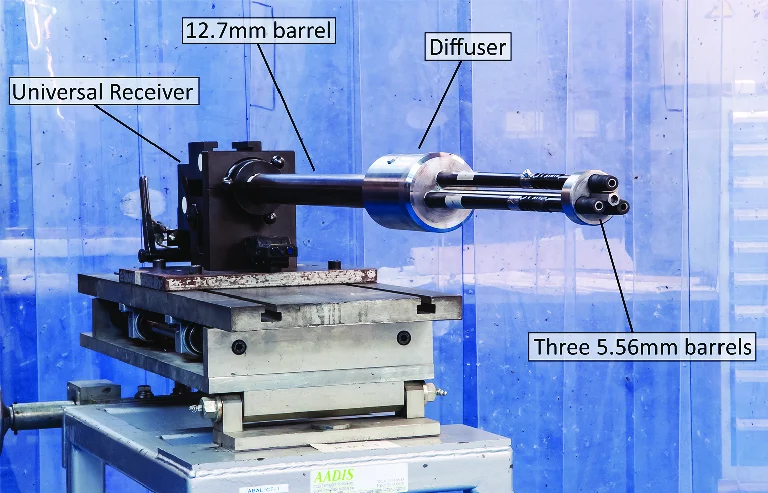
Future dreams of guns, the road not taken: universal receiver / casing.

I imagine logistic drones to be the more important key here for the troops. As they can keep them supplied on time and lower lugging burden. Also lets not forget the accompanying support "pony" robots/drones carrying most of their stuff.
The question is ofc how many of these will actually be on hand for the frontline troops and or in contact.
Sorry, but I don't think today's exoskeletons are the answer. Because what people don'T tell you and what the public doesn't realize is that these rely on the wearer's skeleton to deal with the stress. Some is migitated but not all, and mainly leading to backpain in people that are weak on this to begin with.
Now back on topic.
Future dreams of guns, the road not taken: universal receiver / casing.
Madrat -“ Humans won't even be on the battlefield at that point. “
Have you read the book of “ Revelation “ ?
With regards,
357Mag
Scott Kenny
ACCESS: USAP
- Joined
- 15 May 2023
- Messages
- 19,511
- Reaction score
- 27,956
How do the bullets get into the chambers of the 5.56mm barrels?Now back on topic.
Future dreams of guns, the road not taken: universal receiver / casing.
View attachment 812772
The magic diffuser.How do the bullets get into the chambers of the 5.56mm barrels?
It's actually an airgun test rig for demining. https://www.intechopen.com/chapters/54088
jsport
what do you know about surfing Major? you're from-
- Joined
- 27 July 2011
- Messages
- 8,596
- Reaction score
- 6,898
counter-measures (ATIRCM et al)wiil continue to evolve into full DEW defensive measures which will negate missile threats. Hellos w SPEAR 3 for instance, will afford far anti- tank against enough armor to stiffle whole offensives way backHelicopters will be vulnerable to man portable battery electric drones with ranges in excess of most mobile SAM systems today, so no, SEAD isn't going to keep them safe.
Air launched effects (ALE) will need to be launched from anything especially A-10s & Apaches. The best way to stretch range is high altitude, but forward & low also works especially for SEAD.Persistent sensor coverage over the entire battlespace 30-100km deep using long endurance drones is what is required. Effects can be launched from anything, but the drones will have the quickest response time.
jsport
what do you know about surfing Major? you're from-
- Joined
- 27 July 2011
- Messages
- 8,596
- Reaction score
- 6,898
Yes. If ..reading you correctly, exoskeleton r not for augmenting but riding in. The human should ride inside the mobility & lifting vehicle. These exo-vehicles could be smaller than tech folks r presenting though. The south Koreans may be ahead on reactive exos.Squad level drones will certainly take up some CAS role especially "danger close" ones. As long as they have sufficient "ammo" that is.
I imagine logistic drones to be the more important key here for the troops. As they can keep them supplied on time and lower lugging burden. Also lets not forget the accompanying support "pony" robots/drones carrying most of their stuff.
The question is ofc how many of these will actually be on hand for the frontline troops and or in contact.
Sorry, but I don't think today's exoskeletons are the answer. Because what people don'T tell you and what the public doesn't realize is that these rely on the wearer's skeleton to deal with the stress. Some is migitated but not all, and mainly leading to backpain in people that are weak on this to begin with.
There goes my gatlin gun scam.The magic diffuser.
Claustrophobic alarm!Yes. If ..reading you correctly, exoskeleton r not for augmenting but riding in. The human should ride inside the mobility & lifting vehicle. These exo-vehicles could be smaller than tech folks r presenting though. The south Koreans may be ahead on reactive exos.
That said I would prefer these over most everything as long as they do have creature comfort. There's no point riding without that and get yourself nauseatic and unfit for combat when it counts.
Realistically, small size is better for mechanical stress issues and power requirement as well as keeping a low profile. But being this valueable it will always be a magnet for enemy fire. Defense is key for it being military economical. To keep weigth low it would have to be an active defense system.
jsport
what do you know about surfing Major? you're from-
- Joined
- 27 July 2011
- Messages
- 8,596
- Reaction score
- 6,898
Am nor an engineer but an exovehicle, thought of here (probably this whole discussion belongs in a different thread) would still be focused on limb enhancement w the lowest body worn profile.There goes my gatlin gun scam.
Claustrophobic alarm!
That said I would prefer these over most everything as long as they do have creature comfort.
.
Agree that ride is an issue, as faster than normal running would be necessary to justify the cost. Armored actuation is not enough.There's no point riding without that and get yourself nauseatic and unfit for combat when it counts.
As conformal aa possible, and as always the power source is the major issue. Cost prevails again as it must main afixed even w/o power as it can't be readily discarded. The individual w the exovehicle must be able self evacuate in extremis when there is no power. An extreme requirement, a show stopper.Realistically, small size is better for mechanical stress issues and power requirement as well as keeping a low profile.
IMHO almost every exposed vehicle will need an ADS/APS, another huge prevalent cost. In the future wo it everything dies quick though.But being this valueable it will always be a magnet for enemy fire. Defense is key for it being military economical. To keep weigth low it would have to be an active defense system.
Since the exo vehicle must be quite conformal it would be visible enough to be fire magnet. External gear & the armored exo vehicle need be seamlessly melded as that appearance.
Development is so difficult that I predicted the Talos program would fail from the start. It seemingly did fail. This vehicle will require Manhattan project focus & resource. There are tons on artistic renderings out there which certainly conceptualize. Such a program would involve many derivations & iterations..
jsport
what do you know about surfing Major? you're from-
- Joined
- 27 July 2011
- Messages
- 8,596
- Reaction score
- 6,898
It is ironic that muscle enhancement is likely required to enable a power expended exoskeleton to be recovered. The exovehicle will not be expendable and need a recovery vehicle ie human carrier.
Scott Kenny
ACCESS: USAP
- Joined
- 15 May 2023
- Messages
- 19,511
- Reaction score
- 27,956
A human can carry their own body weight in armor etc if it is evenly distributed across their body.It is ironic that muscle enhancement is likely required to enable a power expended exoskeleton to be recovered. The exovehicle will not be expendable and need a recovery vehicle ie human carrier.
Can't move fast while walking with an extra 200lbs, but you can move with it. Also, if your design is good with the achilles tendons in the armor, it will recover a huge chunk of the energy used to walk with every step and put that back into the next step.
Plus, you can condition the wearers to be used to walking around wearing their own body weight in armor. I think it'll take 6-8 months before they're conditioned to be able to handle that much weight. Then you turn on the muscle enhancements and let the grunts see what they can do when they aren't pushing 200+lbs of fat suit around without help. This conditioning can likely be done as part of the 12 months training to get "new recruit" up to "ready to be assigned to first combat unit", even though it will take another 12 months training before the combat unit is ready to fight.
CastleBravo
ACCESS: Confidential
- Joined
- 21 January 2026
- Messages
- 197
- Reaction score
- 181
IMO, by the time we have viable exoskeletons/power-armor, robot soldiers will be a better solution.
jsport
what do you know about surfing Major? you're from-
- Joined
- 27 July 2011
- Messages
- 8,596
- Reaction score
- 6,898
Robotic dogs will need a nearby master & the master will need robotic bodyguards.IMO, by the time we have viable exoskeletons/power-armor, robot soldiers will be a better solution.
yeetmahboi
ACCESS: Top Secret
- Joined
- 6 April 2022
- Messages
- 1,025
- Reaction score
- 1,434
https://sam.gov/workspace/contract/opp/b1a57529aa574e8ba220e0311434733e/view
Cajun for thought.
Special Operations Forces (SOF) require the ability to provide effective fire on targets with their primary 5.56mm carbine out to 600 meters and beyond. This weapon system will allow an operator to effectively engage targets at extended distances while maintaining the portability and ergonomics of a lightweight carbine.
White papers should include information on how the vendor’s proposal is specifically optimized to function with current hypervelocity ammunition as well as engineered to accommodate future ammunition in excess of 82kpsi
Cajun for thought.
This is the line of development I've been hammering on from the start, though I think that flatter shooting in the 0-300 (500)m range band is more important than reaching out to or past 600m for standard infantry rifles, with that 600+ range band better suited to the infantry squad machine gun. That said, flat shooting is flat shooting.
One bullet won't necessarily end any threat. Being able ti get multiple bullets on a target is the goal. This is why I think they move to a smaller diameter, higher speed bullet. They probably move away from lead and move towards a bullet that mechanically reshapes on impact. Lead just flies apart on impacts at over 2800 fps. Not a terrible characteristic but probably is a war crime. Rhino tips are a bit of an expensive niche but the concept can be probably be expanded upon with a competition driven bid process. The tip needs to be hardened in my opinion, as not everything is soft flesh. You might need to break robot dogs.
jsport
what do you know about surfing Major? you're from-
- Joined
- 27 July 2011
- Messages
- 8,596
- Reaction score
- 6,898
Inside SOCOM's Search For New Machine Guns, Rifles And Ammo https://share.google/9mmdCfRw9JwI40Dqm
The pressures needed for flat shooting is counterproductive to high rates of sustained fire found in a dedicated machine gun. Doesn't make it inappropriate for bursts, just sustained fire. So you would not want to carry a .177 (4.5 mm) to use as both a flat shooter and a sustained high rate of fire. Utilizing 3-5 round bursts at a time using flat shot it would be pretty deadly. Maybe drop to semiautomatic when down to your last rounds in the clips.
The goal of a smaller common round is less overall gun carry weight to allow the infantry to carry more rounds for combat. You just cannot get too small or its all done for nothing. We do not want our guys getting whooped by a bunch of primitive warrior types carrying wooden shields knowing our rounds cannot get through.
Of course having a heavy slug attachment would negate that situation.
The goal of a smaller common round is less overall gun carry weight to allow the infantry to carry more rounds for combat. You just cannot get too small or its all done for nothing. We do not want our guys getting whooped by a bunch of primitive warrior types carrying wooden shields knowing our rounds cannot get through.
Of course having a heavy slug attachment would negate that situation.
Last edited:
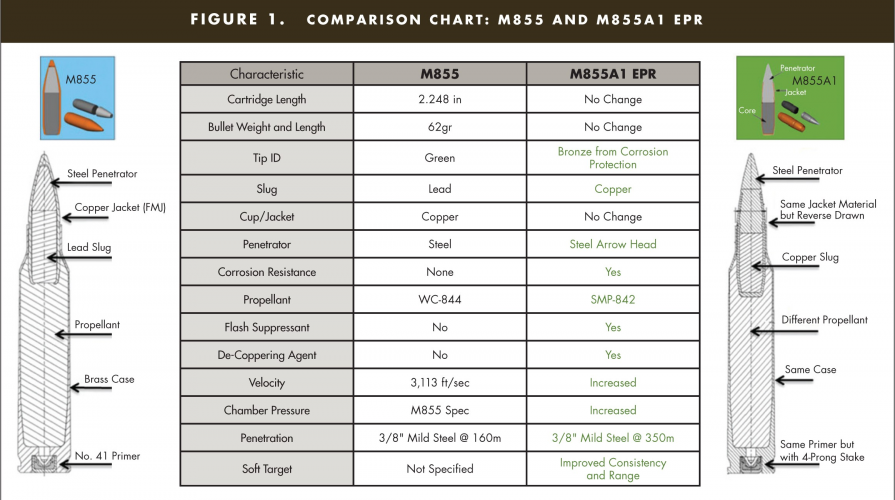
That's a pretty good description of the EPR type construction as used in M855A1 (see also FN PERMAX).One bullet won't necessarily end any threat. Being able ti get multiple bullets on a target is the goal. This is why I think they move to a smaller diameter, higher speed bullet. They probably move away from lead and move towards a bullet that mechanically reshapes on impact. Lead just flies apart on impacts at over 2800 fps. Not a terrible characteristic but probably is a war crime. Rhino tips are a bit of an expensive niche but the concept can be probably be expanded upon with a competition driven bid process. The tip needs to be hardened in my opinion, as not everything is soft flesh. You might need to break robot dogs.
Also, the 1899 convention prohibits bullets which expand not those which incidentally fragment like M855A1 (or almost any other ball projectile, M855A1 is just designed to do so more reliably).
Scott Kenny
ACCESS: USAP
- Joined
- 15 May 2023
- Messages
- 19,511
- Reaction score
- 27,956
Still doesn't loiter for anything, because that big F135 engine is a lot thirstier than an F110. Not TSFC, I mean fuel consumption in lbs/hr.The F-35 has an F-16's empty weight in internal fuel capacity!
While I hope that is true, I don't expect it will be true.IMO, by the time we have viable exoskeletons/power-armor, robot soldiers will be a better solution.
I don't know where you get that from. F-35s have much lower drag and wing loading numbers combined with an engine with much tighter fuel control than an F110 engine. Once you load up an F-16 it loses any edge an empty airframe might have appeared to hold. The F-35 range numbers are all posted for data obfuscation, not for public accuracy. They are fully capable of extending raw range at lower speeds. The truth is they move fast for survival not efficiency.Still doesn't loiter for anything, because that big F135 engine is a lot thirstier than an F110.
The Army propaganda sheet does not mention the 'green-no lead' M855A1 is a more expensive round, pressure is 20% plus which was higher than what the M4 was designed for, NATO standard, but does give approx. additional 200 fps and a higher rate of fire leading bolt breakages etc, barrels wear out much faster as bullet core no longer soft lead but the harder copper, different magazines needed as bullet different shape for very marginal gains, but money for Army no problem.That's a pretty good description of the EPR type construction as used in M855A1 (see also FN PERMAX).
Also, the 1899 convention prohibits bullets which expand not those which incidentally fragment like M855A1 (or almost any other ball projectile, M855A1 is just designed to do so more reliably).
View attachment 813268
https://smallarmssolutions.com/home/the-m855a1#:~:text=I see this as a,destroying an entire fleet of
yeetmahboi
ACCESS: Top Secret
- Joined
- 6 April 2022
- Messages
- 1,025
- Reaction score
- 1,434
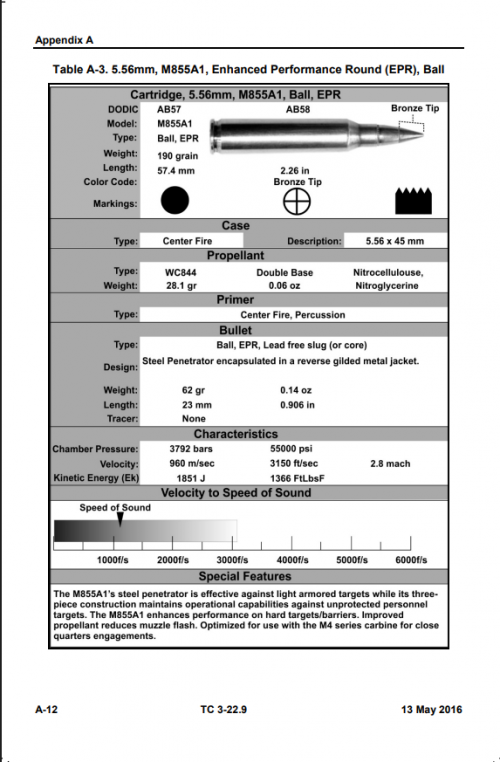
The Army propaganda sheet does not mention the 'green-no lead' M855A1 is a more expensive round, pressure is 20% plus which was higher than what the M4 was designed for, NATO standard, but does give approx. additional 200 fps and a higher rate of fire leading bolt breakages etc, barrels wear out much faster as bullet core no longer soft lead but the harder copper, different magazines needed as bullet different shape for very marginal gains, but money for Army no problem.
https://smallarmssolutions.com/home/the-m855a1#:~:text=I see this as a,destroying an entire fleet of
The confusion is because Small Arms Solutions has been lying to everybody about M855A1 this entire time and made a mountain out of a molehill consisting of extremely low quality, outdated, or misrepresented information.
All of the bunk about M855A1 chewing up feed ramps or breaking bolts can ultimately be traced back to him. Basically every story you've heard on reddit or youtube or arfcom about M855A1 being a piece of shit round is somebody regurgitating what SAS said about M855A1 in 2014 or whenever he first started talking about it.
SAS made an oopsie when reporting about M855A1 and instead of owning up to it, he doubled-down on it and got the whole internet to believe his lie.
Now that we have that out of the way, M855A1 has exactly the same chamber pressure as M855A1 according to the May 2016 (10 years ago!!!) edition of TC 3-22.9, Rifle and Carbine.
Those tests SAS showed on his website are from a 2010 lot ("LC10G371-044") aka the first problematic lots of M855A1 before the issues were resolved.
His demonstration that M855A1 is not sufficiently improved in lethality over M855 casually omits the fact that M855A1 will fragment at significantly lower velocities than M855. The actual fragmentation effect is about the same, but M855A1 will fragment more reliably, and at longer range or from shorter barrels.
Jeff Gurwitch shot a lot of M855A1 as a Green Beret and his words do not corroborate the claim that M855A1 was breaking bolts, chewing up feed ramps, or otherwise destroying guns in an accelerated manner. (text article from 2018)
Vet your sources people.
Attachments
This has already been addressed by the yeet but all of the fixes these would require would still be cheaper than M7.The Army propaganda sheet does not mention the 'green-no lead' M855A1 is a more expensive round, pressure is 20% plus which was higher than what the M4 was designed for, NATO standard, but does give approx. additional 200 fps and a higher rate of fire leading bolt breakages etc, barrels wear out much faster as bullet core no longer soft lead but the harder copper, different magazines needed as bullet different shape for very marginal gains, but money for Army no problem.
https://smallarmssolutions.com/home/the-m855a1#:~:text=I see this as a,destroying an entire fleet of
jsport
what do you know about surfing Major? you're from-
- Joined
- 27 July 2011
- Messages
- 8,596
- Reaction score
- 6,898
Too much is being asked of an old design. M855A1 jump from 67,000 psi to M855A1+ at over 80,000 psi was another big leap. I can see where they will need to manufacture different rifles for both.
A new gun will need to be designed and made for surviving another leap in the future. Also seems like progressive rifling will help solve barrel wear. The bolt endurance will be a liability.
IMO there's a lot of room for improvement, especially when you look at the steel specs that are actually used in the barrel and bolt. It is... not impressive or modern. Hell, I have yet to find anyone who actually autofrettages small arms barrels. IMO the objective should be a new barrel and bolt, with a drop in upper receiver group being the threshold. But I'm not SOCOM so who knows.Too much is being asked of an old design. M855A1 jump from 67,000 psi to M855A1+ at over 80,000 psi was another big leap. I can see where they will need to manufacture different rifles for both.
A new gun will need to be designed and made for surviving another leap in the future. Also seems like progressive rifling will help solve barrel wear. The bolt endurance will be a liability.
Scott Kenny
ACCESS: USAP
- Joined
- 15 May 2023
- Messages
- 19,511
- Reaction score
- 27,956
There's some tweaks that can be done with the steel. For example, the steel used in the x39 bolts is stronger than that used in the 5.56 or .30 Remington bolts, since there's more bolt thrust in an x39-based case. More load on each locking lug. Which resulted in early 6.5 Grendel bolts shearing locking lugs.IMO there's a lot of room for improvement, especially when you look at the steel specs that are actually used in the barrel and bolt. It is... not impressive or modern.
But those better steels are more expensive. Harder to machine.
Is it viable to autofrettage bores that small? I'm only aware of it in terms of 100+mm bores, not even 76mm.Hell, I have yet to find anyone who actually autofrettages small arms barrels.
I mean, the barrel and bolt are wear items anyways. You don't replace them often, but after any extended firefight the grunts would stick their rifle into a jig at the field armory and they'd get told, "you're getting a new barrel." Barrel droop caused by overheating.IMO the objective should be a new barrel and bolt, with a drop in upper receiver group being the threshold. But I'm not SOCOM so who knows.
All -IMO there's a lot of room for improvement, especially when you look at the steel specs that are actually used in the barrel and bolt. It is... not impressive or modern. Hell, I have yet to find anyone who actually autofrettages small arms barrels. IMO the objective should be a new barrel and bolt, with a drop in upper receiver group being the threshold. But I'm not SOCOM so who knows.
The modular design of the M-16/AR-15 itself could potentially negatively impact final rifle/carbine “ platforms “ chosen.
In the civilian rifle shooting marketplace, the AR platform over more-recent decades…has become the sales darling of a whole host of firearms producers; and more especially…. suppliers of after-market components that can be added to the rifle. More so than than for bolt action rifles, the firearms aftermarket has become dominated by the presence of after-market do-dads for ARs. Just pick up as “ Shotgun News “, a take a look. Gunstore’ sales cases are filled w/ AR uppers, lowers; and a bewildering array of accoutrements for the gun. The mantra seems to have become….
Keep the “ lowers“, swap-out “ uppers “; and life is all sunshine & roses.
Some of the appeal of the “ keep the lowers “ mind set certainly has valid benefits for MIL applications of the M-16 design and its production. Potential cost savings of this approach aside, there comes a point where the horse can no longer be flogged further;
and ballistics producible by the platform become constrained by the original design of the upper/lower modular approach, and of course the rifle’s tolerance for significantly elevated chamber pressures… to name a few.
In the civilian U.S. AR shooting world, a seemingly endless array of “ wildcat “ cartridges have been tried for use w/ this platform….. I dare say, more so than the many additional experimental cartridges MIL rifle armories and vendors have tried.
And as this thread shows…. the MIL-side of the equation is itself not yet done with its quest for realizing rarified levels of ballistics performance from the basic M-16 design…and its progeny.
It will be interesting to finally see the when and how that this this merry-go-round at last comes to an end.
With regards,
357Mag
Scott Kenny
ACCESS: USAP
- Joined
- 15 May 2023
- Messages
- 19,511
- Reaction score
- 27,956
A big chunk of that has to do with US law.Keep the “ lowers“, swap-out “ uppers “; and life is all sunshine & roses.
The lower receiver on an AR is the "firearm" and has to be sold through the licensed gun dealer.
Everything else is just parts and can be sent to your door.
AIUI it factors into military procurement too, the lower reciever is the thing that is the gun, so if you have to replace lowers it's a new gun but new uppers are only parts. This is useful if you're trying to tell congress how much money you're saving. Kinda F-18E/Fing the M4A1.A big chunk of that has to do with US law.
The lower receiver on an AR is the "firearm" and has to be sold through the licensed gun dealer.
Everything else is just parts and can be sent to your door.
Similar threads
-
-
-
Divergence on the Runway: An Alternate History of Military Aviation (1956-1982)
- Started by kpuscas
- Replies: 6
-
Design Study: MBTP-170 "MAUS-II LEVIATÃ" - Modern Heavy Tank Concept (2026)
- Started by Bulle
- Replies: 6
-
Roter Rhein , Krasnyy Reyn - What If The Axis Members Called It Quits In Early 1943?
- Started by TheRejectionist
- Replies: 36