Alternate Australian Defence Force 1970s Procurements?

Yes, ADF should buy or build a couple of those!

Crud, the USN should look at that design for a smaller landing ship. It's effectively a Ro-ro LSD!

Getting instead of Tobruk would be a major step up, new-build LSDs were the preserve of major powers during the Cold War, teamed with 4 LSM-2s the ADF would have a much greater amphibious capability than historically.

The USN has the Whitby Island LSDs, the most resent of a long line of LSD classes in USN service.
 
4 x LCVPs were acquired in 1993 for the Tobruk, that would likely occur in this scenario, perhaps some more would be bought as Tobruk could only carry 2. With 4 LSM-2 I think the Army wouldn't get it's 4 long-range LCM-8s as well as the 8 LCHs to compensate.

Therefore the small landing craft in the 70s would be 11 LCM-8s and 8 LCM-6s tha would be available for the Ouragan in 1981. IIUC an Ouragan with the shortened well dock could carry 4 LCM-8s or 6 LCM-6 or 2 and 3 of each. I think 4, 5 or 6 landing craft would be plenty for an Australian amphibious operation in the 80s onward, although I don't think a few LCVPs would go astray.
 
I'm beginning to think to think that the Ouragan was one those golden missed opportunities. Which we tend to come across in this forum to a surprising degree.
Then again there's nothing clearer than hindsight .
 
I'm beginning to think to think that the Ouragan was one those golden missed opportunities. Which we tend to come across in this forum to a surprising degree.
Then again there's nothing clearer than hindsight .

To be clear, the Ouragan was not looked at by the RAN and rejected. It just occured to me to be the next logical step if the ADF got the 4 LSM-2 the way historically the Tobruk was the next logical step after the 8 LCH.
 
To be clear, the Ouragan was not looked at by the RAN and rejected. It just occured to me to be the next logical step if the ADF got the 4 LSM-2 the way historically the Tobruk was the next logical step after the 8 LCH.
I mean, the idea of mortars as the ships guns is very weird. It's also very poorly defended from AShMs.

But for a 1950s/60s colonial intervention ship it's not a bad design at all.
 
To be clear, the Ouragan was not looked at by the RAN and rejected. It just occured to me to be the next logical step if the ADF got the 4 LSM-2 the way historically the Tobruk was the next logical step after the 8 LCH.
Perhaps I wasn't clear, my apologies. The members of this forum have probably spent a great deal of time on various subjects rebuilding the the super tiger for example into a completely new aircraft for example
Not too mention rebuilding vessels some of them out of all recognition !
I agree with you that the Ouragan would have been a great fit for the RAN .
It's a pity that they don't share our genius!
It's been a great deal of fun observing this thought exercise. I've learned a great deal.
 
Last edited:
I mean, the idea of mortars as the ships guns is very weird. It's also very poorly defended from AShMs.

But for a 1950s/60s colonial intervention ship it's not a bad design at all.

Yeah, the mortar would likely be a delete option and there aren't many AShMs in our region in the 80s, in fact air opposition in general would be small and likely easily dealt with by F111-SAS action.

But for unopposed (or extremely lightly opposed) landings in concert with LSM-2s and the Jervis Bay to open a medium intensity 'theatre' (overly generous use of the word theatre) it would be great.
 
Perhaps I wasn't clear, my apologies. The members of this forum have probably spent a great deal of time on various subjects rebuilding the the super tiger for example into a completely new aircraft for example
Not too mention rebuilding vessels some of them out of all recognition !
I agree with you that the Ouragan would have been a great fit for the RAN .
It's a pity that they don't share our genius!
It's been a great deal of fun observing this thought exercise. I've learned a great deal.

I'm catching what you're throwing.

Over the years my interest has gone from the kit itself to the story behind it and its use in service, and once you go to the story then other potential characters become apparent. Therein lies my interest in alternative history, like when you hear some other actor could have starred in a famous movie.

As for the Ouragan, that spins out of a story that begins with a 1958 investigation into the 6 Defence 'family' of Government departments and how the recommendation to combine them was on partially undertaken. If that decision was different, then all sorts of Government decisions can be affected.
 
I'm doing something about the ADF for an ASB thread on alternatehistory.com which includes the 24 F-4Es that were leant to the RAAF 1970-73. If they'd been kept, would they have replaced the Canberras in No. 2 Sqn or the Mirage IIIs in one of the four Mirage squadrons or both?
 
I'm doing something about the ADF for an ASB thread on alternatehistory.com which includes the 24 F-4Es that were leant to the RAAF 1970-73. If they'd been kept, would they have replaced the Canberras in No. 2 Sqn or the Mirage IIIs in one of the four Mirage squadrons or both?

The documents on the topic earlier in this thread state a Mirage sqn would have to be disbanded if the F4Es were retained, and even without the F4Es 76 sqn was disbanded in about 1973 anyway. 2 sqn kept flying Canberras in the aerial survey role until 1980-81 or so.

The actual squadron number might not be 76 sqn, the F4Es would be the premier fighter sqn in the RAAF so would likely get the most prestigious fighter sqn number: 3, 75, 76 or 77.
 
Yeah, the mortar would likely be a delete option and there aren't many AShMs in our region in the 80s, in fact air opposition in general would be small and likely easily dealt with by F111-SAS action.

But for unopposed (or extremely lightly opposed) landings in concert with LSM-2s and the Jervis Bay to open a medium intensity 'theatre' (overly generous use of the word theatre) it would be great.
No, you'd want the mortars for lightly opposed landings. At least for any opposition that doesn't really have a way to hurt the ships above of mortars and RPGs.
 
No, you'd want the mortars for lightly opposed landings. At least for any opposition that doesn't really have a way to hurt the ships above of mortars and RPGs.

An Ouragan in the RAN would be a Capital Ship, as important to the amphibious flotilla as the Melbourne was to the surface fleet, so shouldn't intended to be within mortar range of danger. I'd take the mortars off specifically to avoid the temptation that they might be used; there are surface warship guns, carrier aircraft and attack helicopters, plus the 40mm Bofors guns on the LSM-2s to deal with any resistance. If the resistance requires some big mortars on the only LSD in the RAN as well as all the other stuff then the campaign is lost before it starts.
 
An Ouragan in the RAN would be a Capital Ship, as important to the amphibious flotilla as the Melbourne was to the surface fleet, so shouldn't intended to be within mortar range of danger. I'd take the mortars off specifically to avoid the temptation that they might be used; there are surface warship guns, carrier aircraft and attack helicopters, plus the 40mm Bofors guns on the LSM-2s to deal with any resistance. If the resistance requires some big mortars on the only LSD in the RAN as well as all the other stuff then the campaign is lost before it starts.
I keep forgetting how tiny the RAN actually is.
 
I keep forgetting how tiny the RAN actually is.

I'm a bandit for it!

The other thing is to not underestimate the RAN, the old 3:1 rule: if you don't have 3 of something then you don't have anything. 3:1 applies to prolonged deployments a long way from home, closer to home 2:1 is realistic and in a national emergency 3:2 or even 4:3 can be achieved with some notice for a short period.
 
The documents on the topic earlier in this thread state a Mirage sqn would have to be disbanded if the F4Es were retained, and even without the F4Es 76 sqn was disbanded in about 1973 anyway. 2 sqn kept flying Canberras in the aerial survey role until 1980-81 or so.

The actual squadron number might not be 76 sqn, the F4Es would be the premier fighter sqn in the RAAF so would likely get the most prestigious fighter sqn number: 3, 75, 76 or 77.
FWIW (1) and according to Wikipedia, No. 2 Squadron was disbanded in late July 1982 and No. 76 Squadron disbanded on 24th August 1973.

Wikipedia also says that the disbanding of No. 76 Squadron was part of the post-Vietnam defence cuts. However, I recently read elsewhere that when No. 76 disbanded the number of Mirages in the three remaining squadrons was increased proportionally, so the actual number of front-line aircraft was the same. Is the latter the correct reason?

FWIW (2) my guess is that the Phantoms would have gone to No. 3 Squadron because AIUI that's the RAAF's premier fighter squadron due to its service in the Middle East in World War II.
 
Off the top of my had 2 sqn was flying a full compliment of ~8-10 Canberras until 1980 but that number dropped off a cliff, so by disbanding in 1982 it only had 2 aircraft.

I suspect when 76 sqn disbanded it's aircraft went into the general pool for fleet management and likely the other 3 sqns were bumped up a bit. 1973 was also the year when the 2 Mirage flying programmes (fighter and attack) were merged into a single programme.

3 sqn makes sense, it was formed in 1916 whereas 75, 76 and 77 were formed in 1942.
 
FWIW (1) and according to Wikipedia, No. 2 Squadron was disbanded in late July 1982 and No. 76 Squadron disbanded on 24th August 1973.

Wikipedia also says that the disbanding of No. 76 Squadron was part of the post-Vietnam defence cuts. However, I recently read elsewhere that when No. 76 disbanded the number of Mirages in the three remaining squadrons was increased proportionally, so the actual number of front-line aircraft was the same. Is the latter the correct reason?

FWIW (2) my guess is that the Phantoms would have gone to No. 3 Squadron because AIUI that's the RAAF's premier fighter squadron due to its service in the Middle East in World War II.
My understanding is that the decision to disband 76 Sqn was primarily to create a pool of airframes to extend the Mirages effective service life following the decision to delay the replacement program.
 
I know it's outside the time period of the topic, but a couple of Jeanne d'Arc class cruisers could have been a very interesting and extremely versatile acquisition for the RAN.

Specifically, in the originally intended CG configuration, or perhaps a modified version with US weapon systems.

This gives the RAN its area air defence capability, its task force command capability, ASW helicopter carrier capability and amphibious assault capability.

Three bought or built instead of buying the Perth Class DDGs, replacing Sydney as a transport and training ship and using the Wessex acquired for Melbourne's cancelled helicopter carrier conversion.

When Australia was shopping for a DDG in the early 60s, the RN recommended that an Escort Cruiser would better fit the RAN's requirements than a destroyer. The Escort Cruiser never eventuated, but Jeanne d'Arc did, as did Italy's Andrea Doria and later Vittorio Veneto.
 
Do you have a plausible pathway for the acquisition of a Jeane de Arc?
Real World
Australia was looking at converting the cruiser Hobart into a CG in the mid 50s.

The decision to acquire DDGs was in part due to the realisation that Melbourne and Sydney couldn't operate modern fighters, as well as the need to increase destroyer numbers. This is also when the RAN looked at buying Hermes as well as the Essex proposal.

The Wessex fleet was ordered when it was planned to convert Melbourne into a helicopter carrier.

When Australia approached the UK regarding a modified County Class Destroyer with two or three Wessex and Tartar, they responded that they could only offer a standard County and that the proposed Escort Cruiser was a better fit for Australian requirements.

Australia was also looking at Tartar conversions of the Darings and the Battles

Alt History
Everything plays out as above, but the unified defence department results in a more holistic engagement with France during the Mirage acquisition.

RAN staff engage with the MN and become aware of the key features of Jeane de Arc, informal discussions reveal that France is receptive to developing a version with US and UK systems for Australia, including Australian production if desired. French experience in modernising destroyers with Tartar also inspires greater cooperation as this option becomes more desirable for Australia and the brand new Darings and near new Battles.

A plan is evolved with two modified ships to be built in succession (only two DDGs were initial orders, followed by a third and a fourth proposed). The first enters service as fleet flagship and an escort to Melbourne, the second follows three or four years later, replacing Sydney as training ship, and a third is eventually ordered to support the first two.

In the 70s as the third ship is under construction, it is determined that Australia cannot afford a CTOL carrier to replace Melbourne and a fourth, heavily modified Jeanne de Arc is ordered instead.

Concurrently, both the Daring's and Battles received DDG conversions with Mk 22 Tartar and Ikara, while modified Type 21 frigates with US systems are ordered for the patrol frigate role in the 70s.
 
Some dates for your timeline @Volkodav

1959 it was decided Melbourne would be disposed of n 1963 when her major refit wad due.
1961 deiced Melbourne would be ASW carrier in 1963, 27 Wessex helicopters ordered
1963 decision to extended Gannet and Sea Venom to 1967, Wessex begin delivery
1964 RAN look at strike carrier, recommend updated Essex, recommendation rejected S2 ordered and Melbourne mid-life refit scheduled for 1967
1965 RAN orders A4s
1967 Melbourne goes to US to collect A4s and S2, enters 15 month partial mid-life refit in December
1968 RN offers HMS Hermes to RAN as part of Pound Devaluation withdrawal EoS, offer rejected
1971 Melbourne goes for rest of mid-life refit, including catapult extension and bridle catcher fitment

1960 RAN decides on Charles F Adams class DDG
1962 RAN ordered 2 DDGs from US yards
1963 RAN orders 3rd DDG
1964 recommendation to buy 4th DDG rejected
1965 2 DDGs commissioned into RAN
1967 3rd DDG commissioned into RAN

1964 Daring Tartar conversion plan cancelled due to cost, Ikara conversion proposed

1959 Jeanne de Arc laid down
1961 Jeanne de Arc launched
1964 Jeanne de Arc commissioned int Marine Nationale

 
Last edited:
1964 RAN look at strike carrier, recommend updated Essex, recommendation rejected S2 ordered and Melbourne mid-life refit scheduled for 1967

1963 RAN orders 3rd DDG
1964 recommendation to buy 4th DDG rejected
1964 Daring Tartar conversion plan cancelled due to cost, Ikara conversion proposed

1959 Jeanne de Arc laid down
1961 Jeanne de Arc launched
1964 Jeanne de Arc commissioned int Marine Nationale

Based on the above, 1963-64 would seem like the best window for the RAN to buy an escort cruiser. Ideally with Terrier for area air defence and helicopters for ASW. It could replace the 3rd or 4th DDG.

Jeanne d’Arc could certainly make a compelling case as she started sea trials in June 1963 (still named La Résolue in those early days).

Key systems could include Terrier (later SM-1ER), Wessex (later Sea King), later Exocet or Harpoon, and 4x medium guns (French 100mm or equivalent). The only major change I would consider would be the propulsion: replace the steam plant with a CODAG plant like on the Koln class, which had just entered service. This should be more efficient and also would save manpower.
 
IIUC JdA's original armament was 4 x 100mm guns and later 6 box launcher Exocets. Fitting Terrier, with its horizontal magazines, would require major redesign as would changing the engines to GTs. All of this would have to be done within the £200m budget cap.
 
IIUC JdA's original armament was 4 x 100mm guns and later 6 box launcher Exocets. Fitting Terrier, with its horizontal magazines, would require major redesign as would changing the engines to GTs. All of this would have to be done within the £200m budget cap.
Jeanne d’Arc was originally designed with Masurca SAMs in a horizontal magazine very similar to Terrier. But Masurca wasn’t ready and was never fitted.

https://www.secretprojects.co.uk/threads/original-french-masurca-ship-program.26845/post-275997
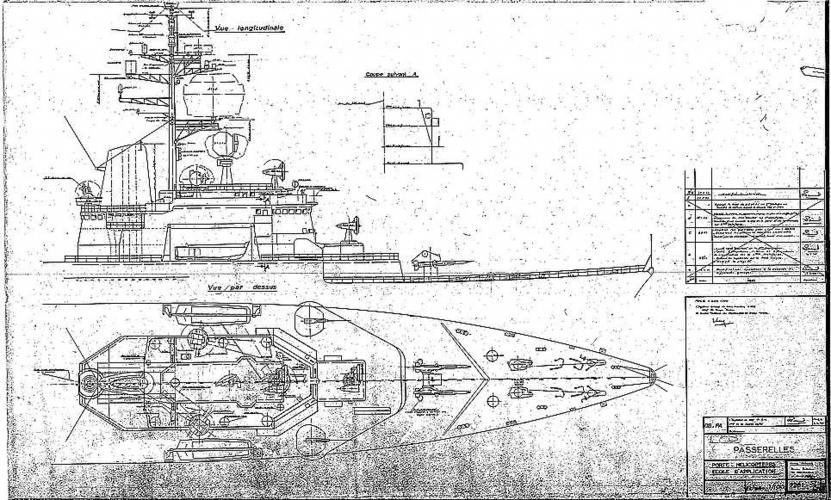
Here are pics from the original ship plans:
230236-190e759cfd48078990df0b8f634bb544.jpg

Compartment D-0310 behind the SAM launcher is the missile prep room and compartment D-0111 below that is the missile magazine.
jda-masurca-2-jpg.551970
 
Yes, the original concept was for a missile cruiser, and this is what I am speculating about. Ideally, it would have Terrier, although Masurca would do, the other option would be Tartar, either a single Mk-11 or 13 forward or multiple Mk-11, 13 or 22 distributed, perhaps in place of the 100mm.
 
Tartar brings it's own fire control system, which would have to be fitted alongside the already hefty Terrier system, so I doubt it would be fitted even in Mk22 form. Seacat would be more likely I'd suggest, as well as lighter guns for last-ditch defence.

Any idea of the cost? I can't imagine it would be cheap, and we're talking out the era of the £200m overall budget cap, with the RAN's slice being a fraction of that.
 
They wouldn't be cheap but would have been cheaper than the carrier options considered.

Much less capable too.

I still think the RANs best bet would have been to refit Melbourne to Karel Doorman standard in the early 60s. It provides a lot of capability for the money and maximises the existing investment in Melbourne.
 
Last edited:
Much less capable too.

I still think the RANs best bet would have been to refit Melbourne to Karel Doorman standard in the early 60s. It provides a lot of capability for the money and maximises the existing investment in Melbourne.
You could do both.

As I suggested, the first CGH is an escort for Melbourne, also taking the flag staff and most of the helicopters from Melbourne.
 
You could do both.

As I suggested, the first CGH is an escort for Melbourne, also taking the flag staff and most of the helicopters from Melbourne.

I doubt that would fit in with budget and manning in the early 60s. Crew was one reason the Adams were chosen over the County, and JdA has double the crew of an Adams. And as you say it would't be cheap in the years where Melbourne would be getting a major rebuild and 3 new fleets of aircraft.
 
I doubt that would fit in with budget and manning in the early 60s. Crew was one reason the Adams were chosen over the County, and JdA has double the crew of an Adams. And as you say it wouldn't be cheap in the years where Melbourne would be getting a major rebuild and 3 new fleets of aircraft.
For what it's worth @Volkdav wrote in Message 819.
I know it's outside the time period of the topic, but a couple of Jeanne d'Arc class cruisers could have been a very interesting and extremely versatile acquisition for the RAN.

Specifically, in the originally intended CG configuration, or perhaps a modified version with US weapon systems.

This gives the RAN its area air defence capability, its task force command capability, ASW helicopter carrier capability and amphibious assault capability.

Three bought or built instead of buying the Perth Class DDGs, replacing Sydney as a transport and training ship and using the Wessex acquired for Melbourne's cancelled helicopter carrier conversion.

When Australia was shopping for a DDG in the early 60s, the RN recommended that an Escort Cruiser would better fit the RAN's requirements than a destroyer. The Escort Cruiser never eventuated, but Jeanne d'Arc did, as did Italy's Andrea Doria and later Vittorio Veneto.
According to:
  • Their Wikipedia entries.
    • The Australian Adams class had a crew of 333.
    • Andrea Doria had a crew of 485.
    • Vittorio Veneto had a crew of 557.
  • Editions of Jane's from the middle 1960s to the early 1980s Jeanne d'Arc originally had a crew of 920, which had reduced to 809 by the early 1980s, but both figures included 192 cadets. So her crew without cadets was originally about 730 and by the early 1980s about 620.
  • According to editions of Jane's from the middle 1960s to the early 1970s Sydney had a crew of 550 or 608 depending upon whether she was operating as a training ship or a fast transport.
So for what it's worth a Jeanne d'Arc or a Vittorio Veneto could have been purchased to replace Sydney. I'd have gone for the latter as her crew was smaller than Jeanne d'Arc's and closer to Sydney's, plus her weapons & electronics had more in common with those on the Adams and Perry classes than Jeanne d'Arcs did with those ships.
 
P.S.

Sydney and the 3 Adams had a combined crew of 1,607, which is enough to crew 2 Jeanne d'Arcs or 3 Andrea Dorias or 3 Vittorio Venetos.
 
Editions of Jane's from the middle 1960s to the early 1980s Jeanne d'Arc originally had a crew of 920, which had reduced to 809 by the early 1980s, but both figures included 192 cadets. So her crew without cadets was originally about 730 and by the early 1980s about 620.

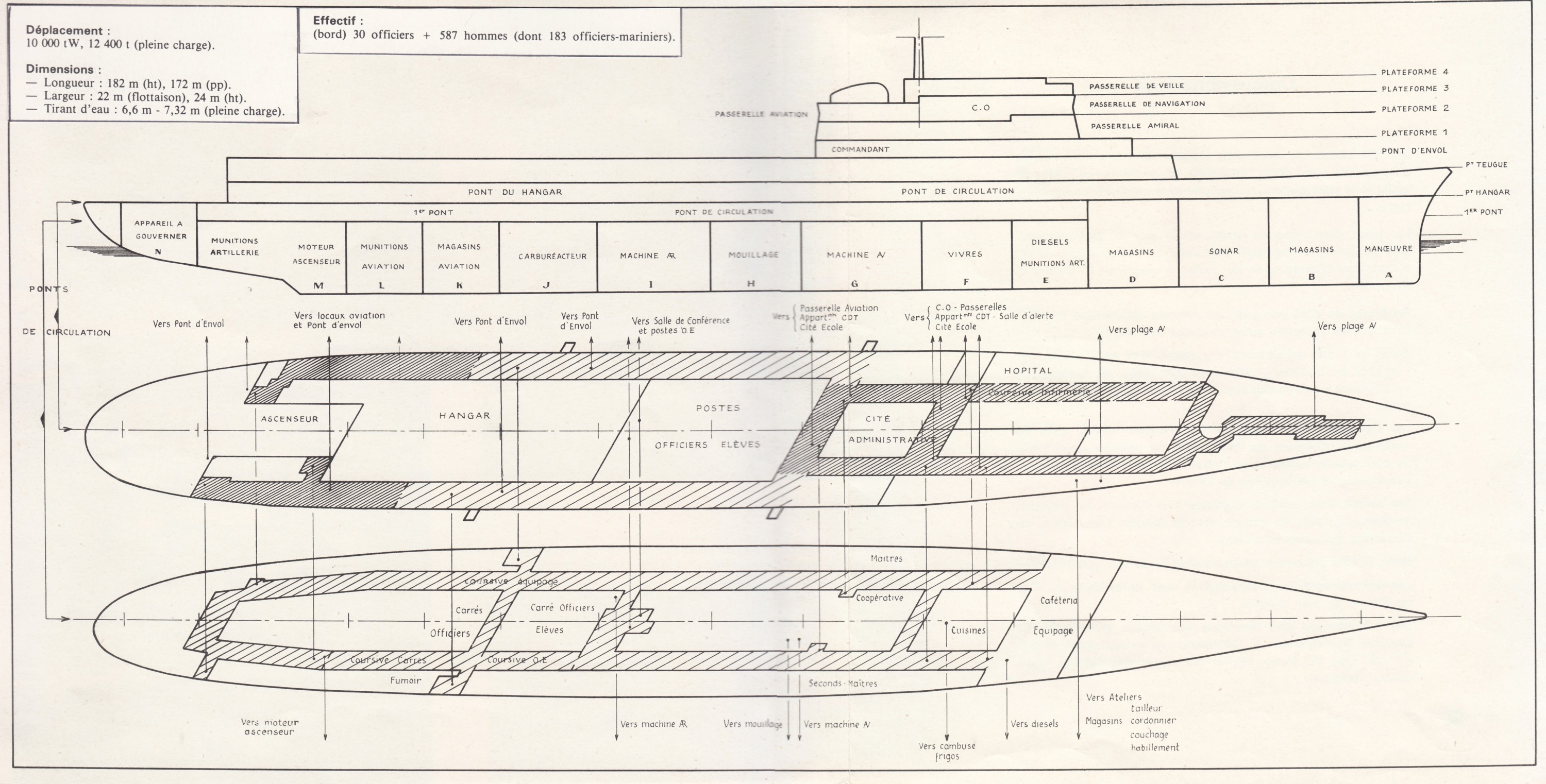
Official Jeanne d’Arc documents from the 1960s give a ship’s crew of 617 (30 officers, 183 senior rates, 404 sailors), not including cadets, instructors or aviation.

Note however that several functions were oversized due to the ship’s specific missions, with long deployments and frequent visitors on board. This included 31 cooks, 35 stewards, 10 medical staff, and 200 engineers (85 for the steam plant and turbines, 110 for the rest of the ship’s equipment including electrical plant). I wouldn’t be surprised if the crew could have been cut by 10% or more in RAN service.

ph_la_resolue_0005_panorama.jpg
 
Last edited:
Official Jeanne d’Arc documents from the 1960s give a ship’s crew of 617 (30 officers, 183 senior rates, 404 sailors), not including cadets, instructors or aviation.

Note however that several functions were oversized due to the ship’s specific missions, with long deployments and frequent visitors on board. This included 31 cooks, 35 stewards, and 200 engineers (85 for the steam plant and turbines, 110 for the rest of the ship’s equipment including electrical plant). I wouldn’t be surprised if the crew could have been cut by 10% or more in RAN service.
I'm having another blond moment, that is, I don't know whether you're supporting me or contradicting me.

FWIW the exact figures from Jane's from the middle 1960s to the early 1980s (which I presume came from official sources too) are as follows:
  • 1965-66 to 1967-68 - 920 - 40 officers, 690 ratings and 190 cadets.
    • The 690 ratings were 200 petty officers & 490 men.
    • That's a total of 730 without the cadets.
  • 1968-69 to 1975-76 - 906 - 44 officers, 670 ratings and 192 cadets.
    • That's a total of 714 without the cadets.
  • 1976-77 to 1981-82 - 809 - 30 officers, 587 ratings and 192 cadets.
    • That's a total of 617 without the cadets.
Therefore, your official figures from the 1960s equal Jane's figures for the late 1970s and early 1980s. What's your official source? I'm not being sarcastic, I'm genuinely interested.

For completeness, every edition of of Jane's for those years says.
In wartime, after rapid modification, she would be used as a commando ship, helicopter carrier or troop transport with commando equipment and a battalion of 700 men.
 
I realise the JdA is a left-field thought experiment, and I'm a bandit for wanting a highly muscular Australia with heaps of cool stuff, indeed coolness is as good a reason as any to get items of kit. However, a couple of steps down that path and Australia has it's own nuclear armed Space Stations which is why I always revert to 'Captain Killjoy, imagination slayer!'

My issue isn't with the JdA, in fact I'm very impressed that she was designed for the Masurca that eventually went into the Colbert conversion. My issue is that she is too big, expensive and crew intensive to replace the DDGs but replacing Melbourne's and/or Sydney means retiring these expensive ships with valuable service lives ahead of them for a less capable ship. It's not good procurement policy or fleet management compared to alternatives.
 
I'm having another blond moment, that is, I don't know whether you're supporting me or contradicting me.

FWIW the exact figures from Jane's from the middle 1960s to the early 1980s (which I presume came from official sources too) are as follows:
  • 1965-66 to 1967-68 - 920 - 40 officers, 690 ratings and 190 cadets.
    • The 690 ratings were 200 petty officers & 490 men.
    • That's a total of 730 without the cadets.
  • 1968-69 to 1975-76 - 906 - 44 officers, 670 ratings and 192 cadets.
    • That's a total of 714 without the cadets.
  • 1976-77 to 1981-82 - 809 - 30 officers, 587 ratings and 192 cadets.
    • That's a total of 617 without the cadets.
Therefore, your official figures from the 1960s equal Jane's figures for the late 1970s and early 1980s. What's your official source? I'm not being sarcastic, I'm genuinely interested.
I don't fully trust Janes' numbers, so that's why I went looking for official ships' documents. The 1974-75 cruise book gives the exact numbers for that cruise:
  • 687 crew (34 officers + 214 petty officers + 439 junior rates) and 139 cadets
Note that this 687 crew includes the aviation detachment with ~60 men and 6 helicopters (4 HSS + 2 Alouette III in 1974) and ~20 instructors... subtract those 80 and you get a "ship's crew" of ~617, same as in the ship's document I posted (year unknown). This still includes an oversized ship's aviation support team of ~35 men, a medical support team of 10 doctors and nurses, ~30 cooks and ~35 stewards, a padre, 2 full time photographers etc... so one could argue the true "core crew" would be significantly less than that and closer to 550 men.
 
Last edited:
I don't fully trust Janes' numbers, so that's why I went looking for official ships' documents. The 1974-75 cruise book gives the exact numbers for that cruise:
  • 687 crew (34 officers + 214 petty officers + 439 junior rates) and 139 cadets
Note that this 687 crew includes the aviation detachment with ~60 men and 6 helicopters (4 HSS + 2 Alouette III in 1974) and ~20 instructors... subtract those 80 and you get a "ship's crew" of ~617, same as in the ship's document I posted (year unknown). This still includes an oversized ship's aviation support team of ~35 men, a medical support team of 10 doctors and nurses, ~30 cooks and ~35 stewards, a padre, 2 full time photographers etc... so one could argue the true "core crew" would be significantly less than that and closer to 550 men.
I don't think you'd lose that many cooks. On an Ohio-class (crew of up to 180), we had at least 8 cooks. And that's with 1.5 kitchens (Crew's Mess and Wardroom as the 0.5). Night baker, Galley Watch Captain and a couple assistants that would rotate around.

IIRC the skimmers like to split things into Officer's Wardroom, Chief's Mess, 1st Class Mess, 2nd Class Mess, and then 3rd class and below. Wardroom and Chief's Mess need a couple of people each (cook and steward each), 1st class mess needs about 2-3x what the Chief's Mess does, 2nd Class mess needs about 2x the 1st Class mess, and then you need a lot of people to feed the junior ratings. Junior Rating's mess is probably 10 cooks plus 10 stewards to be able to feed some 500 bodies. And that gets us up to around 25 during the day. Then you need 5 night bakers to feed 700 people, for a total of 30 cooks.
 
Official Jeanne d’Arc documents from the 1960s give a ship’s crew of 617 (30 officers, 183 senior rates, 404 sailors), not including cadets, instructors or aviation.

Note however that several functions were oversized due to the ship’s specific missions, with long deployments and frequent visitors on board. This included 31 cooks, 35 stewards, 10 medical staff, and 200 engineers (85 for the steam plant and turbines, 110 for the rest of the ship’s equipment including electrical plant). I wouldn’t be surprised if the crew could have been cut by 10% or more in RAN service.

ph_la_resolue_0005_panorama.jpg
I believe JdA was in many ways a traditional cruiser with significant machine shops and self-support capability, imagine mills, lathes, precision ginders etc. basically an integral tool room able to manufacture precision components.

She was a training ship, as well as a presence asset, these roles required larger crews. Also, remember, the Perth Class DDGs had a nominal crew of 333, the various DLGs having more again.

If we were talking cool stuff and fantasy fleets, I would go the UK GW Series missile cruiser with either Terrier and Tartar or Talos and Tartar. ;)
 
My issue isn't with the JdA, in fact I'm very impressed that she was designed for the Masurca that eventually went into the Colbert conversion. My issue is that she is too big, expensive and crew intensive to replace the DDGs but replacing Melbourne's and/or Sydney means retiring these expensive ships with valuable service lives ahead of them for a less capable ship. It's not good procurement policy or fleet management compared to alternatives.
I partially agree as I can’t see replacing HMAS Melbourne & Sydney. But how about replacing the 3rd Perth class DDG ordered in 1963 and delivered in 1968?

Perhaps the increase in crew (~200 men) could have been absorbed by retiring the last obsolete Battle class DD (HMAS Anzac) and taking over her training role.
 
Back
Top Bottom