Alternate Australian Defence Force 1970s Procurements?

The from empire defence to the long haul document, mentions having fremantle as a naval base so there were plans post war for base out west, so.it is possible for an earlier FBW.

The USN based subs in Freo in WW2, the sea floor make sit a good spot for subs as there is deep water close to the coast for subs to hide as soon as the leave port. In contrast Darwin for example has no deep water until a trench just south of East Timor, which is too far to get to in a single night, and in shallow water even submerged subs can be seen from the air.

Agrees you don't need an equal navy, though in an ideal world you wpuld have as close as possible to equal so you don't have to wait for assest to transfer from one coast to the over for cases like the Chinese warships off the coast
Thats why I think Australia needs
12 subs with 6 on east coast
A fighter sqn in Perth
MPA sqns in Darwin, Perth, Townsville & Adelaide
But it's unlikely to happen

FBW should have all the 'operational' subs, ie those that aren't in refit or needed for ASW training, so maybe 4 of the 8 and maybe half of the 'operational' escorts that aren't training and working up, maybe 2 or 3 of the 11 or 12. The reason is that Perth isn't a great posting and prolonged stints there accelerate personnel separation. As such half the 'operational' escort, the Melbourne and all of the training and most refits should be done from Sydney in order to retain personnel in peacetime. FBW should have it's own oiler though, that's a must.

The MPA fleet was based in Townsville and various NSW bases until the arrival of the P3B in the late 60s, when 11 sqn moved to Edinburgh SA, followed by 10 sqn when it got it's P3Cs in the late 70s. The reasoning is that Adelaide is a 'central' position where the fast and long-ranged P3 can get to either coast in 4 or 5 hours.

Perth had had jet advanced trainers since the late 50s and if FBW is established it will likely get rotations of A4s for fleet cooperation tasks. That should suffice for Perth's defence, especially since it is the worlds most isolated city and therefore not very vulnerable.
 
Last edited:
Talk of Fleet Base West make me think of other things.

While RAAF Base Tindal was ready by 1968 and Learmonth by 1973 Curtin near Derby wasn't ready until 1988 and Scherger in FNQ until 1998!

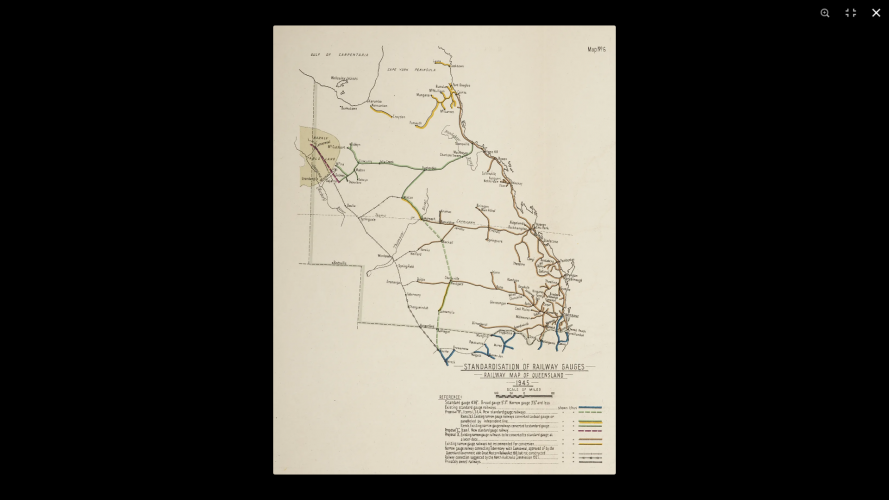
Perhaps even a higher priority would be the Adelaide to Darwin railway. Despite Adelaide to Alice opening in 1929 and the line from Darwin stretching 300 miles south in 1929 this wasn't completed until 2004! There were other rail link to Darwin proposals from Queensland, these would be good to complete as well to strengthen the logistics in the North.
 
The USN based subs in Freo in WW2, the sea floor make sit a good spot for subs as there is deep water close to the coast for subs to hide as soon as the leave port. In contrast Darwin for example has no deep water until a trench just south of East Timor, which is too far to get to in a single night, and in shallow water even submerged subs can be seen from the air.


FBW should have all the 'operational' subs, ie those that aren't in refit or needed for ASW training, so maybe 4 of the 8 and maybe half of the 'operational' escorts that aren't training and working up, maybe 2 or 3 of the 11 or 12. The reason is that Perth isn't a great posting and prolonged stints there accelerate personnel separation. As such half the 'operational' escort, Melbourne and all of the training and most refits should be done from Sydney in order to retain personnel in peacetime.

The MPA fleet was based in Townsville and various NSW bases until the arrival of the P3B in the late 60s, when 11 sqn moved to Edinburgh SA, followed by 10 sqn when it got it's P3Cs in the late 70s. The reasoning is that Adelaide is a 'central' position where the fast and long-ranged P3 can get to either coast in 4 or 5 hours.

Perth had had jet advanced trainers since the late 50s and if FBW is established it will likely get rotations of A4s for fleet cooperation tasks. That should suffice for Perth's defence, especially since it is the worlds most isolated city and therefore not very vulnerable.
That's why 12 subs probably makes more sense for australia that way you could have 8 in Perth & 4 in sydney for refit and ASW training. Though i don't think 12 subs would be possibly until the collins class most likely.
Maybe not Sqns but more permeant MPA detachments would be better just so you have more operational capability in that area.
Currently the RAN has the escorts split evenly between the FBE & FBW but with melbourne in service i would say better split for escorts would be 8 (FBE) & 4 (FBW)
A-4s probably would get rotated but if the RAAF can stay at 5 fighter Sqns it would make sense to base on in perth
its not so much for defending the city but to allow quick movement of defence assets into the pilbara and kimberley in time of war
 
Talk of Fleet Base West make me think of other things.

While RAAF Base Tindal was ready by 1968 and Learmonth by 1973 Curtin near Derby wasn't ready until 1988 and Scherger in FNQ until 1998!

Perhaps even a higher priority would be the Adelaide to Darwin railway. Despite Adelaide to Alice opening in 1929 and the line from Darwin stretching 300 miles south in 1929 this wasn't completed until 2004! There were other rail link to Darwin proposals from Queensland, these would be good to complete as well to strengthen the logistics in the North.
I would think the bare bases would get set up earlier and Tindal becoming the main base earlier as well
I think the best thing would to build Adelaide to Darwin line in the 60s and the Mt Isa to Tennant creek Line as well as the Mt isa to bourke line in the 60s/70s.
Agreed this would strengthen logistics in the north massively, ive still got no idea why the goverment hasnt built the QLD line yet
 

Attachments

  • Alternate ADF 1970s Procurements_ _ Page 7 _ Secret Projects Forum - Google Chrome 16_10_2025 ...png
    Alternate ADF 1970s Procurements_ _ Page 7 _ Secret Projects Forum - Google Chrome 16_10_2025 ...png
    759.7 KB · Views: 42
With the 2nd P-3C buy i agree it would be good to also buy P-3 AEW aswell but what about an electonic warfare version of the P-3?
 
Aditionally would there be any chance of additional F-111C say 12 - 18 more aircraft be brought in 73. 74 or 75?
 
With the 2nd P-3C buy i agree it would be good to also buy P-3 AEW aswell but what about an electonic warfare version of the P-3?
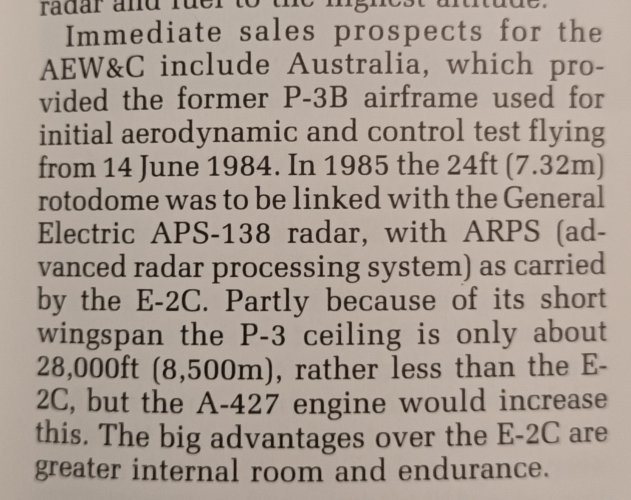
I've always liked the sensible aspect of a P-3 MP/ASW and P-3 AEW. But what's the ceiling performance of the P-3 like in general, given that altitude is king when it comes to AEW?

Regards
Pioneer
 
I've always liked the sensible aspect of a P-3 MP/ASW and P-3 AEW. But what's the ceiling performance of the P-3 like in general, given that altitude is king when it comes to AEW?

Regards
Pioneer
Bit over 28,000 ft I believe
 
I've always liked the sensible aspect of a P-3 MP/ASW and P-3 AEW. But what's the ceiling performance of the P-3 like in general, given that altitude is king when it comes to AEW?

Regards
Pioneer
Ok, so I found this, with the following statistics:
 

Attachments

  • 250429_FY24_AMO_08_Lockheed_Martin_P-3_Airborne_Early_Warning.pdf
    316.1 KB · Views: 13
Thanks to Bill Gunston, 1986 Warplanes of the Future: The most exciting combat aircraft being designed today to face the threat of wars tomorrow, which underlines my concern about the detrimental effect on the legacy P-3 Orion and it's shortish wingspan on it's altitude performance,:
 

Attachments

  • Lockheed P-3 AEW (Bill Gunston 1985).jpg
    Lockheed P-3 AEW (Bill Gunston 1985).jpg
    534 KB · Views: 46
Thanks to Bill Gunston, 1986 Warplanes of the Future: The most exciting combat aircraft being designed today to face the threat of wars tomorrow, which underlines my concern about the detrimental effect on the legacy P-3 Orion and it's shortish wingspan on it's altitude performance,:
So basically just needs an engine swap to improve service ceiling than
 
So basically just needs an engine swap to improve service ceiling than
So it would appear Caryina2642.
Does anyone recall when the six-blade propellers of the C-130J were devised and cleared for use? I'm surmising that these six-blade propellers would perform better at high altitude, as opposed to the legacy four-blade paddle-like propellers of the legacy P-3 Orion?

Regards
Pioneer
 
So it would appear Caryina2642.
Does anyone recall when the six-blade propellers of the C-130J were devised and cleared for use? I'm surmising that these six-blade propellers would perform better at high altitude, as opposed to the legacy four-blade paddle-like propellers of the legacy P-3 Orion?

Regards
Pioneer

The first C130J customer was the RAAF in 1999, but they used a different engine, not the T56 of the C130H, P3 and E2.
 
The first C130J customer was the RAAF in 1999, but they used a different engine, not the T56 of the C130H, P3 and E2.
Thanks for the clarification Rule of cool!
In which case, that rules out that potential performance gain.....

So, Lockheed was well into the P-3 AEW by mid-1985....
The Lockheed P-3 AEW entered U.S. Customs and Border Protection service in 2006.....
So would anyone have information as to the time frame in which Lockheed might have quoted it's P-3 AEW to be operational, between these two known time frames?

Saying this, if Australia's aviation industry was still vibrant, do you think the likes of a CAC/GAF, with the assistance of either Grumman or Lockheec, could have initiated a hybrid E-2 Hawkeye's rotodome and APS-138 radar onto/into a P-3B Orion earlier - say early to mid 1980's?

Regards
Pioneer
 
Yep agree there mate.
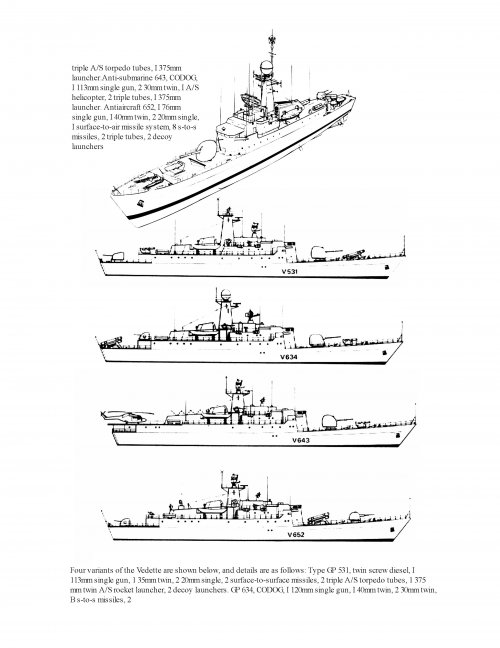
For an attack class replacement i would've gone with the vicketes vedette type 633.
And the tenix jpv would have been such a handy vessel and 100% better than the armidales
Yes Caryina2642, I see your point in the Vicketes Vedette Type 633 design, given the various configurations offered.
I particularly like the versatility of the helicopter equipped variant, although I'd opt for the OTO Melara 76mm gun mount. Any larger gun than that would be mission creep, or compensating for something!


Regards
Pioneer
 

Attachments

  • Vicketes Vedette Type 633.jpg
    Vicketes Vedette Type 633.jpg
    425.2 KB · Views: 46
Last edited:
Saying this, if Australia's aviation industry was still vibrant, do you think the likes of a CAC/GAF, with the assistance of either Grumman or Lockheec, could have initiated a hybrid E-2 Hawkeye's rotodome and APS-138 radar onto/into a P-3B Orion earlier - say early to mid 1980's?

Hell no, AEW is the hardest thing in aviation. 1986 was he year the British finally cancelled he Nimrod AEW after almost a decade of trying.
So basically just needs an engine swap to improve service ceiling than

Not really, it only needs to fly high enough that it's fighter detection range is on the horizon. Flying at 28,000' the radar horizon is 380km for a target flying at 200'. My guess this goes close enough to the fighter detection range of the E2Cs radar in the mid 80s.
 
Hell no, AEW is the hardest thing in aviation. 1986 was he year the British finally cancelled he Nimrod AEW after almost a decade of trying.
No i agree let the yanks do it, though we could have done the engine swap.
Not really, it only needs to fly high enough that it's fighter detection range is on the horizon. Flying at 28,000' the radar horizon is 380km for a target flying at 200'. My guess this goes close enough to the fighter detection range of the E2Cs radar in the mid 80s.
I would say with the engine swap, allowing the p3 to have a higher service ceiling would more flexibility. Though the RAAF may not decide it needs it
 
Yes Caryina2642, I see your point in the Vicketes Vedette Type 633 design, given the various configurations offered.
I particularly like the versatility of the helicopter equipped variant, although I'd opt for the OTO Melara 76mm gun mount. Any larger gun than that would be mission creep, or compensating for something!


Regards
Pioneer
I dont mind the 5 inch gun on it cause it allows for greater anti surface fire power and better NGFS than the 3 inch. Plus it allows for better logistics making all the combat ships have the same main gun
 
FWIW apparently 10 sqn Neptunes flying from Thailand during the Vietnam era used their APS20 radars, same as those on Gannet AEW, gave missile warning to USAF B52s on occasion.
 
FWIW apparently 10 sqn Neptunes flying from Thailand during the Vietnam era used their APS20 radars, same as those on Gannet AEW, gave missile warning to USAF B52s on occasion.
Didn't know that. So you probably don't need the engine swap.
We would get 6 aircraft?
One good thing about the p3 AEW is that it won't stop or delay project wedgetail like the e3 would
 
Hell no, AEW is the hardest thing in aviation. 1986 was he year the British finally cancelled he Nimrod AEW after almost a decade of trying.
Although, wasn't the Nimrod AEW failure because of the complex issues with its GEC Marconi radars and computer systems failing to integrate.

In Australia's case, it would literally be a case of combining two proven off-the-shelf products - the E-2 Hawkeye's rotodome and APS-138 radar incorporated on to a P-3B Orion. In which case, the biggest concern would be the initial unknown aerodynamics of the rotodome on the P-3.....

Not really, it only needs to fly high enough that it's fighter detection range is on the horizon. Flying at 28,000' the radar horizon is 380km for a target flying at 200'. My guess this goes close enough to the fighter detection range of the E2Cs radar in the mid 80s.

Ok, that makes sense. I guess a AEW capability is a force multiple regardless.


Regards
Pioneer
 
Last edited:
Didn't know that. So you probably don't need the engine swap.
We would get 6 aircraft?
One good thing about the p3 AEW is that it won't stop or delay project wedgetail like the e3 would
Thanks Caryina2642, you just answered my intended question - how many P-3 AEW's do you think the RAAF would need to be effective?

Also, no swapping of engines would save a lot in cost and ensure logistical compatibility with the RAAF's P-3 Orion fleet.

Regards
Pioneer
 
Last edited:
Thanks Caryina2642, you just answered my intended question - how many P-3 AEW's do you think the RAAF would need to be effective?

Also, no swapping of engines would save a lot in cost and logistical compatibility with the RAAF's P-3 Orion fleet.

Regards
Pioneer
No probs mate, I only said 6 cause that's how many e7s we got.
Indeed it would keep.the logistics easy keeping the same engine
 
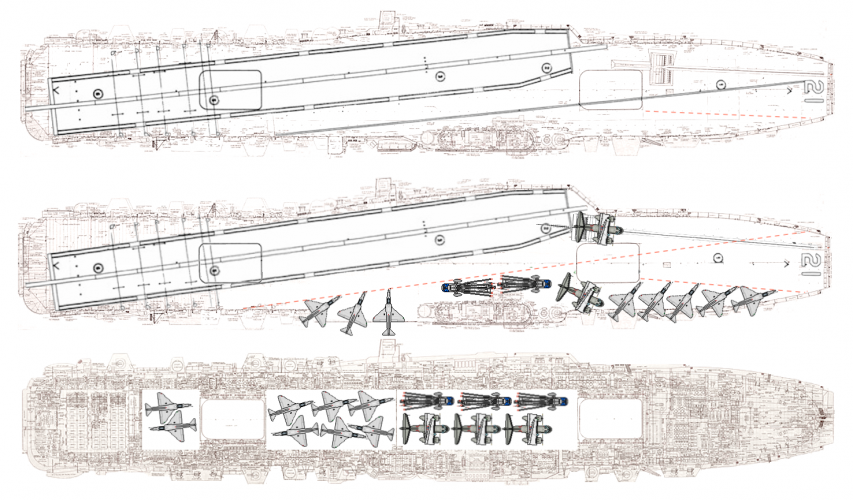
Revisiting the RAN S2 and A4 numbers, the RAN wanted 24 S2 and 18 A4, in order to have 6 and 4 on Melbourne. Presumably with about 10-12 of the 27 Wessex, which itself is a drop from what they expected when Melbourne was to be an ASW helicopter carrier only. They then dropped these numbers to 14 S2s and 8 (+2) A4s as sufficient to embark 6 and 4.

IIUC USN calculations were that 9 ASW helicopters were needed for 24-7 coverage with a spare for a sub hunt. I also suspect that 6 S2s, with their 8+ hour endurance (although I heard the crew was knackered after 6 hours), is what's needed for 24-7 coverage with a spare for a sub hunt.

On a rebuilt Melbourne with 6 S2s, 10 helicopters (9 ASW + 1 SAR with an ASW for SAR backup) there's room for 6-8 A4s rather than 4. I think 24 S2s and 27 Wessex is excessive, probably 20 S2 and 20-22 Wessex would be enough which reduces the cost and frees up money for the more extensive Melbourne refit and/or all 18 (12+6 or 14+4) A4s.
 
Revisiting the RAN S2 and A4 numbers, the RAN wanted 24 S2 and 18 A4, in order to have 6 and 4 on Melbourne. Presumably with about 10-12 of the 27 Wessex, which itself is a drop from what they expected when Melbourne was to be an ASW helicopter carrier only. They then dropped these numbers to 14 S2s and 8 (+2) A4s as sufficient to embark 6 and 4.

IIUC USN calculations were that 9 ASW helicopters were needed for 24-7 coverage with a spare for a sub hunt. I also suspect that 6 S2s, with their 8+ hour endurance (although I heard the crew was knackered after 6 hours), is what's needed for 24-7 coverage with a spare for a sub hunt.

On a rebuilt Melbourne with 6 S2s, 10 helicopters (9 ASW + 1 SAR with an ASW for SAR backup) there's room for 6-8 A4s rather than 4. I think 24 S2s and 27 Wessex is excessive, probably 20 S2 and 20-22 Wessex would be enough which reduces the cost and frees up money for the more extensive Melbourne refit and/or all 18 (12+6 or 14+4) A4s.
In H_K post
You could probably have 10 a4s, 6 s2s and 10x Wessexs
I wonder if we swap the a4s to 24 and s2s to 18 and also drop the Wessex to 20 would be better
1760649072507.png
 
No probs mate, I only said 6 cause that's how many e7s we got.
Indeed it would keep.the logistics easy keeping the same engine
So, potentially six Wedgetail's could be the bare minimum number of aircraft in terms of aircraft vs capabilities deemed by the RAAF, when purchasing them...
Where as, I'm surmising, the P-3 AEW would be relatively cheaper to purchase, but it's inherent transit time to station, speed and altitude performance might necessitate more aircraft to deliver coverage/capabilities?

Better ensure flight refuelling is incorporated into these RAAF P-3 AEW's, during their manufacturing.
Well, for that matter, I'd incorporate flight refuelling into the manufacturing of RAAF's P-3C Orion's as well.

Regards
Pioneer
 
Although, wasn't the Nimrod AEW failure because of the complex issues with its GEC Marconi radars and computer systems failing to integrate.

In Australia's case, it would literally be a case of combining two proven off-the-shelf products - the E-2 Hawkeye's rotodome and APS-138 radar incorporated on to a P-3B Orion. In which case, the biggest concern would be the initial unknown aerodynamics of the rotodome on the P-3.....


Ok, that makes sense. I guess a AEW capability is a force multiple regardless.


Regards
Pioneer

Yes, the Nimrod was overly ambitious and poorly spec'd, but the British aviation industry is/was vastly more capable than the Australian industry, so it evens out more or less.

The E2 has 2 consoles/operators and a coordinator, most of the radar take is datalinked back to the controlling ship's CIC and the ship controls engagements arising from the radar's info.

Going from E2 to a medium AEW like the Nimrod or P3 AEW means taking the datalink to ship and ship CIC involvement in battle management into the aircraft itself. This means going from 2 operators and a datalink to the ship (and maybe F14s) to 6+ operator consoles and sufficient battle management computers and communications to handle as many contacts/engagements as a modern DDG. The Nimord AEW was going to have 4 radar, 1 ESM and 1 communications console, the USAF and NATO E3s had 14 consoles, RAF E3s started out with 6 consoles and added more over time, standard E7s have 8 consoles and RAAF E7s have 10 with room for 12 in total.

That's the big challenge for making a P3 AEW&C, sufficient onboard processing of radar, IFF and ESM takes to keep ~8 consoles fed with information and the communications to allow these ~8 operators plus a couple of battle commanders to control the battle. Compared to that tacking the E2 radar onto the roof of a P3 is child's play.
 
So, potentially six Wedgetail's could be the bare minimum number of aircraft in terms of aircraft vs capabilities deemed by the RAAF, when purchasing them...
Where as, I'm surmising, the P-3 AEW would be relatively cheaper to purchase, but it's inherent transit time to station, speed and altitude performance might necessitate more aircraft to deliver coverage/capabilities?

Better ensure flight refuelling is incorporated into these RAAF P-3 AEW's, during their manufacturing.
Well, for that matter, I'd incorporate flight refuelling into the manufacturing of RAAF's P-3C Orion's as well.

Regards
Pioneer
Agreed there mate about the refuelling you might see the all 6 707s converted to tankers in the scenario
 
You could probably have 10 a4s, 6 s2s and 10x Wessexs
I wonder if we swap the a4s to 24 and s2s to 18 and also drop the Wessex to 20 would be better

Certainly 24 S2s and 27 Wessex is too many, 14 S2s (+ 2 S2As) seems sufficient for 6 embarked and I wonder if the RAN didn't have ulterior motives wanting so many S2s, perhaps having an operational sqn ashore as well as afloat.

Given the great cost of a KD or MG rebuild on the Melbourne, enough to turn away the pollies, I can't help but think the best place for the savings on less Wessex and S2 is in the Melbourne's refit. After all, Melbourne is still going to be an ASW carrier even if she carries 6 not 4 A4s.

FWIW I think the disjointed approach to the FAA between 1959 and 1965 is a major part of the problem. I don't know if a single Defence Minister from 1958 would have changed the assumptions that led to the FAA going helicopter only in 1959 then reversing this decision in 1963, but I'm pretty sure a single Defence Minister would have knocked on the head the ludicrous 150m pound carrier talk from the very start.
 
Last edited:
The C-130 was also seen as a suitable AEW platform.

In the 80s the base P-3C had a unit price of about $42m, it was the most expensive type in ADF service. In fact, the cabinet papers on the carrier replacement identified the desire to buy an additional ten P-3Cs to replace the P-3Bs, was so expensive that it would preclude the acquisition of a carrier.

The deputy chief scientist went on to claim the Orion's were a more critical capability than the Trackers, Sea Kings and Ikara, or even fleet air defence. It was acknowledged that failing to replace the carrier would effectively turn the RAN into a coastal force that could not hope to survive outside of the range of land-based fighters.

The argument was that ASW was the most critical capability, that the best way to achieve it was the Orion deploying Barra sonar buoys. A carrier replacement that could operate supersonic fighters and fixed-wing ASW was unaffordable, so it was basically not worth proceeding with.
 
Yes, the Nimrod was overly ambitious and poorly spec'd, but the British aviation industry is/was vastly more capable than the Australian industry, so it evens out more or less.

The E2 has 2 consoles/operators and a coordinator, most of the radar take is datalinked back to the controlling ship's CIC and the ship controls engagements arising from the radar's info.

Going from E2 to a medium AEW like the Nimrod or P3 AEW means taking the datalink to ship and ship CIC involvement in battle management into the aircraft itself. This means going from 2 operators and a datalink to the ship (and maybe F14s) to 6+ operator consoles and sufficient battle management computers and communications to handle as many contacts/engagements as a modern DDG. The Nimord AEW was going to have 4 radar, 1 ESM and 1 communications console, the USAF and NATO E3s had 14 consoles, RAF E3s started out with 6 consoles and added more over time, standard E7s have 8 consoles and RAAF E7s have 10 with room for 12 in total.

That's the big challenge for making a P3 AEW&C, sufficient onboard processing of radar, IFF and ESM takes to keep ~8 consoles fed with information and the communications to allow these ~8 operators plus a couple of battle commanders to control the battle. Compared to that tacking the E2 radar onto the roof of a P3 is child's play.
Ok, when you put it like that Rule of cool, I appreciate more where you're coming from re indigenous Australian industry capabilities - thanks mate.

Regards
Pioneer
 
The C-130 was also seen as a suitable AEW platform.

In the 80s the base P-3C had a unit price of about $42m, it was the most expensive type in ADF service. In fact, the cabinet papers on the carrier replacement identified the desire to buy an additional ten P-3Cs to replace the P-3Bs, was so expensive that it would preclude the acquisition of a carrier.

The deputy chief scientist went on to claim the Orion's were a more critical capability than the Trackers, Sea Kings and Ikara, or even fleet air defence. It was acknowledged that failing to replace the carrier would effectively turn the RAN into a coastal force that could not hope to survive outside of the range of land-based fighters.

The argument was that ASW was the most critical capability, that the best way to achieve it was the Orion deploying Barra sonar buoys. A carrier replacement that could operate supersonic fighters and fixed-wing ASW was unaffordable, so it was basically not worth proceeding with.
Thanks, Volkodav.
I must admit, I've always liked the notion of dispersed operations, incorporating the C-130's austere capabilities, factored into a C-130 AEW platform, adding to it's flexibility and survivability.....

Aerodynamically/performance, I would think the P-3 would be more efficient in flight regime terms in the AEW role?

Regards
Pioneer
 
The C-130 was also seen as a suitable AEW platform.

In the 80s the base P-3C had a unit price of about $42m, it was the most expensive type in ADF service. In fact, the cabinet papers on the carrier replacement identified the desire to buy an additional ten P-3Cs to replace the P-3Bs, was so expensive that it would preclude the acquisition of a carrier.

The deputy chief scientist went on to claim the Orion's were a more critical capability than the Trackers, Sea Kings and Ikara, or even fleet air defence. It was acknowledged that failing to replace the carrier would effectively turn the RAN into a coastal force that could not hope to survive outside of the range of land-based fighters.

The argument was that ASW was the most critical capability, that the best way to achieve it was the Orion deploying Barra sonar buoys. A carrier replacement that could operate supersonic fighters and fixed-wing ASW was unaffordable, so it was basically not worth proceeding with.

This where I think the RANs reluctance to deploy Melbourne to Vietnam in 1966 & 67 came back to bite them.

Melbourne was famous for never firing a shot in anger, so we had all this money and effort tied up in a capability that was subject to never ending debate about its usefulness, even as far back as 1959, that we never actually used in 25 years despite being in several wars.

A single 4–6-month cruise of Vietnam in 1966 or 67 would change all of that, especially if she attacked some WBLCs while doing her ASW duties. Indeed, even if Melbourne had entered the Market Time AO during her 3 escort missions to Vietnam and perhaps flew missions in support of Operation Hardihood and the deployment of 1ATF to Phuoc Tuy in 1966 that would count as something.

If Melbourne had done something Vietnam that would be a feather in its cap and strengthen the case for replacement.
 
Talk of Fleet Base West make me think of other things.

While RAAF Base Tindal was ready by 1968 and Learmonth by 1973 Curtin near Derby wasn't ready until 1988 and Scherger in FNQ until 1998!

Perhaps even a higher priority would be the Adelaide to Darwin railway. Despite Adelaide to Alice opening in 1929 and the line from Darwin stretching 300 miles south in 1929 this wasn't completed until 2004! There were other rail link to Darwin proposals from Queensland, these would be good to complete as well to strengthen the logistics in the North.
Yes, adding that railway is pretty much required. Best way to move lots of materials is by rail. Means you can have hardware built or repaired on one side of the country and then delivered to the other side of the country with a lot more security than delivery by ship.
 
Certainly 24 S2s and 27 Wessex is too many, 14 S2s (+ 2 S2As) seems sufficient for 6 embarked and I wonder if the RAN didn't have ulterior motives wanting so many S2s, perhaps having an operational sqn ashore as well as afloat.

Given the great cost of a KD or MG rebuild on the Melbourne, enough to turn away the pollies, I can't help but think the best place for the savings on less Wessex and S2 is in the Melbourne's refit. After all, Melbourne is still going to be an ASW carrier even if she carries 6 not 4 A4s.

FWIW I think the disjointed approach to the FAA between 1959 and 1965 is a major part of the problem. I don't know if a single Defence Minister from 1958 would have changed the assumptions that led to the FAA going helicopter only in 1959 then reversing this decision in 1963, but I'm pretty sure a single Defence Minister would have knocked on the head the ludicrous 150m pound carrier talk from the very start.
RAN s2s did do patrol flights out of Broome in the 70s and 80s
I mean an operational ashore sqn does allow flexibility and free up the RAAF MPA sqns. You could have sw detachments patrolling out of Broome or Manus Island
Another reason for the big Wessex order could be to allow shore base sar and asw patrols in places like Sydney harbour
 
This where I think the RANs reluctance to deploy Melbourne to Vietnam in 1966 & 67 came back to bite them.

Melbourne was famous for never firing a shot in anger, so we had all this money and effort tied up in a capability that was subject to never ending debate about its usefulness, even as far back as 1959, that we never actually used in 25 years despite being in several wars.

A single 4–6-month cruise of Vietnam in 1966 or 67 would change all of that, especially if she attacked some WBLCs while doing her ASW duties. Indeed, even if Melbourne had entered the Market Time AO during her 3 escort missions to Vietnam and perhaps flew missions in support of Operation Hardihood and the deployment of 1ATF to Phuoc Tuy in 1966 that would count as something.

If Melbourne had done something Vietnam that would be a feather in its cap and strengthen the case for replacement.
Agree big time, if Melbourne does 1 or 2 war cruisers off Vietnam a replacement is even more likely
 
RAN s2s did do patrol flights out of Broome in the 70s and 80s
I mean an operational ashore sqn does allow flexibility and free up the RAAF MPA sqns. You could have sw detachments patrolling out of Broome or Manus Island
Another reason for the big Wessex order could be to allow shore base sar and asw patrols in places like Sydney harbour

That's all fine and dandy, but when money and manpower are scarce spending on that most likely comes at the expense of Melbourne's 145' cat and 8 degree deck rebuild.
 
Back
Top Bottom