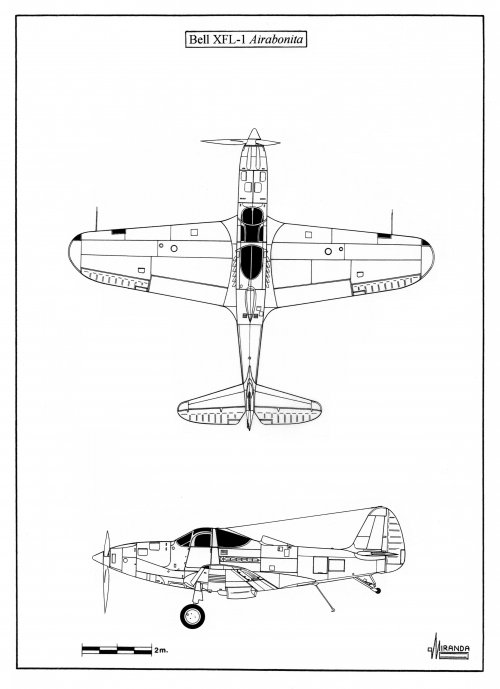
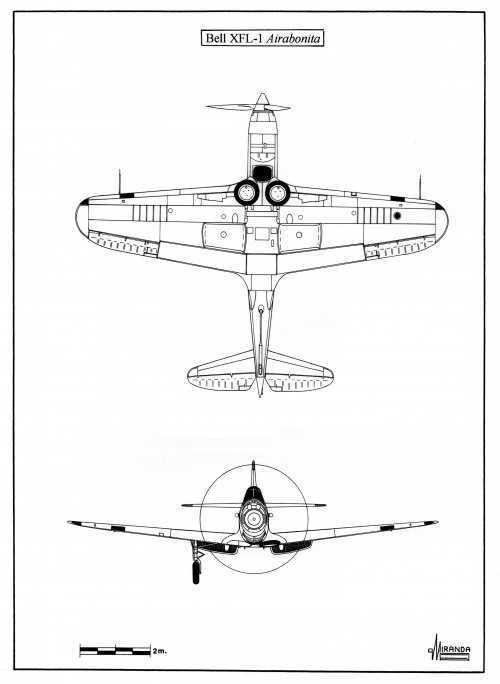
Bell XFL-1 Airabonita
On November 8, 1938, the U.S. Navy placed a development contract for the navalized version of Bell XP-39 Airacobra fighter.
The original concept had to be extensively modified to adapt it to carrier operations:
-The undercarriage nose leg was removed, to prevent it from getting caught in the cable arresters during the carrier landing and was replaced by a conventional tailwheel and one retractable tailhook.
-To compensate for the center of gravity (c.g.) displacement, the main landing gear was extended to the front wing spar.
-When retracted into the wing, the oleo legs occupied the space of the Prestone radiators and these were installed externally under the wings, generating additional drag that penalized the performances.
-All airframe was re-stressed for carrier take-off and landing operations, and the rear fuselage was shortened.
-The wing area was increased with greater span and chord; five small bombs were housed in underwing compartments on each side and inflatable ditching cylinders were housed in the external wing panels.
-The pilot’s seat was lifted and moved forward, the canopy was also modified.
-One ventral window was installed ahead the wing to facilitate visibility during landing.
-The V-1710-17 turbo-supercharged engine used in the Airacobra prototype It was replaced in the naval version by an experimental engine Allison XV-1710-6, fitted with mechanical supercharger, driving a 3.16 m diameter Curtiss Electric airscrew by means of an extension shaft. In theory the mid-fuselage mounted engine provided good maneuverability in combat.
The XFL-1 prototype (Bu Aer nº 1588) was flown on May 13, 1940, experiencing so many problems with the new engine that the U.S. Navy carrier qualification trials they did not begin until July.
During the tests the new aircraft showed longitudinal instability and insufficient airflow to the carburetor due to deficient design of the dorsal air intake.
The altitude performance was inferior to the Grumman F4F.
The poor design of shock absorbers led to the aircraft jumping after touching the deck.
In December 1940 the plane was returned to the manufacturers to make modifications suggested by the U.S. Navy.
-The landing gear was reinforced.
-The vertical surface of the tailfin increased.
-The dorsal air intake was redesigned.
But naval pilots disliked the car-type doors with crank-down windows, because they were considered safer to have the conventional canopies open during carrier operations.
The Allison XV-1710-6 was the first in-line mounted in a naval fighter since 1928, the U.S. Navy was interested in the high-altitude performance of such engines, but when Bell decided to eliminate the General Electric B-5 turbo-supercharger from the Airacobra pre-production series in September 1940, the decision was made to cancel the Airabonita project in favor of the Vought XF4U-1 Corsair.
The XFL-1 prototype was scraped in 1942.
Painting scheme: Overall Light Grey (FS 36440, ANA 602) with wing upper surfaces Orange Yellow (FS 13538, ANA 506), oversized meatball roundels in wings only and the “U.S. Navy” legend applied in the rear fuselage sides in black characters.
Bell XFL-1 technical data
Wingspan: 10.668 m, length: 9.068 m, height: 3.9 m, wing area: 21.55 sq. m, max weight: 3,271 kg, max speed: 544 km/h, service ceiling: 9,430 m, climb rate: 804 m/min, range: 1,725 km, power plant: one Allison XV-1710-6 liquid cooled V-12 engine rated at 1,166 hp, proposed armament: two nose mounted 0.3-in machine guns, one 0.5-in heavy machine gun firing through the propeller hub and ten small bombs housed into the wings.