AIM-7 Sparrow

They also decelerate quite a bit as the air density goes up.
All warheads do, so the best way to reduce that is to spend as little time/distance as possible at low altitudes and make sure gravity is on your side, which implies a vertical descent, which MaRVs and HGVs can do.

Wait, isn't this thread about AIM-7s?
 
All warheads do, so the best way to reduce that is to spend as little time/distance as possible at low altitudes and make sure gravity is on your side, which implies a vertical descent, which MaRVs and HGVs can do.

Wait, isn't this thread about AIM-7s?
The RV discussion started as AIM/RIM-7s for ABM work...
 
Not necessarily, there is a pdf somewhere demonstarting this. Manoeuvring RVs can stay in the upper atmosphere and come down vertical, which allows higher impact speeds. Does seem to depend on range and initial velocity though.

Found it (see ballistic DT lifting body):

https://scienceandglobalsecurity.org/archive/sgs28tracy.pdfView attachment 801602


Think you probably mean Mach 6-8. 8km/s is faster than a LEO orbit. ;)
No I do not. Even the source you attach here states 7 km/s as an average. Are these speeds this difficult to comprehend ;)

https://www.nasic.af.mil/LinkClick.aspx?fileticket=F2VLcKSmCTE=&portalid=19
You can also find it as the 16th citation of this Wikipedia page. https://en.wikipedia.org/wiki/Ballistic_missile

Per 2017 NASIC defense on ballistic missiles committee in Dayton Ohio.

Something is missing in your link.

I suspect its confusing ground impact speeds with the velocity at the beginning of terminal velocity. Not saying they cannot design such weapons, but maneuvering re-entry vehicles slow more than dumb warheads, much more so. This is why endo-interceptors can get by using much slower velocities than their targets.

Quote: “RVs enter the atmosphere at 6-8 km per second.”

Yes they will slow down from the atmosphere, but we are talking about hypersonic region not supersonic. The graphic above shows exactly how much can slow down.

The only ones impacting significantly less then 3 km/s in the graphic above is a hypersonic glide vehicle and a ballistic missile with a “lifting body” on a shalllow trajectory.

And as the source says, these two types of missiles are made for a flatter more shallow trajectory and to be able to maneuver on terminal, and the flatter trajectory is shown compared to MET ballistic trajectory.

If you read the paper attached by Forest Green, you will see the green line, “ballistic-MET” in the figures is for “minimum energy trajectory” which is a traditional ballistic trajectory. Every other single item in the charts is for a shallow descent investigating hypersonic maneuverable missiles. So the green line “ballistic-MET” is most indicative of your average ballistic missile.

The “ballistic-MET” is shown entering atmosphere above 6 km/s and by the time it impacts at sea level it is just below 3 km/s . What is 2.8 km/s in Mach at sea level? Mach 8.5.

The original question is would a sparrow or an amraam be better at ballistic missile defense? In which case, you are going to need radar lock and launch the missile well before impact.

I say neither would ever work as a ballistic missile defense, there is good reason S-400/500 and Patriot need specific variants of missiles for this that focus on speed agility and precision.
 
Last edited:
The original question is would a sparrow or an amraam be better at ballistic missile defense? In which case, you are going to need radar lock and launch the missile well before impact.

I say neither would ever work as a ballistic missile defense, there is good reason S-400/500 and Patriot need specific variants of missiles for this that focus on speed agility and precision.
Agreed that the Sparrow, ESSM, SLAMRAAM or AMRAAM are absolutely NOT the right weapon for engaging ballistic missiles.

In fact, I'm not sure there's any way for those missiles to work as ABMs. Fuzes not fast enough being the single biggest problem.
 
I said Sparrow was fused for Mach 3 targets. I am not aware if AMRAAM is fused to handle such high speeds. They had to tweak AIM-7F to handle MiG-25. Sky Flash and Asphide were said to have advanced fusing for doing the same. We know that several AIM-7s found MiG-25s in the early 1990s, hitting even the elusive MiG-25RB. The first AMRAAM.kill of a MiG-25 was shooting a missile at one already wounded by a hawk.
 
In fact, I'm not sure there's any way for those missiles to work as ABMs. Fuzes not fast enough being the single biggest problem.

Could they handle an SRBM such as the SS-26 Stone or an ALBM such as the AS-24 Killjoy?
 
You stated an impact speed of 6-8km/s. Impact speeds are clearly around 2-3km/s. Coming into the atmosphere speeds can easily be 6-7km/s, if that's what you meant.
Well to be precise, it states impact for a regular ballistic missile at around 3 km/s. What I said was 6-8 km/s on terminal.

3 km/s or 7 km/s, it is a very far cry from Mach 3 that someone claimed with such confidence, and Mach 6-8 would be an unusually low low end according to this study on the ballistic-MET data.

Either way, no air to air missile is fusing on them. Even R-40RD back in the day, designed for SR-71 and built to use its huge size to have a massive distance between the fuse and warhead to make timing my easier, wouldn’t have been able to fuse against a Head on SR-71 at very close range (atleast until it slowed down a bit it would be a hit to kill missile only). This is atleast what MiG-25PD manual states about it with something like a 7,000 kmh closure limit.
 
Well to be precise, it states impact for a regular ballistic missile at around 3 km/s. What I said was 6-8 km/s on terminal.

3 km/s or 7 km/s, it is a very far cry from Mach 3 that someone claimed with such confidence, and Mach 6-8 would be an unusually low low end according to this study on the ballistic-MET data.

Either way, no air to air missile is fusing on them. Even R-40RD back in the day, designed for SR-71 and built to use its huge size to have a massive distance between the fuse and warhead to make timing my easier, wouldn’t have been able to fuse against a Head on SR-71 at very close range (atleast until it slowed down a bit it would be a hit to kill missile only). This is atleast what MiG-25PD manual states about it with something like a 7,000 kmh closure limit.
You got me. You found some things classified as ballistic missiles that do impact higher than Mach 3. Sparrow probably isn't the best missile against a ballistic missile, and nobody said it was. But plenty of ballistic missiles from the Cold War did impact at or below that velocity and fit within its believed performance parameters. The Navy used multiple offshoots of the program for ship defense and it would have been tasked with hitting targets that exceeded Mach 3. Ideally you intercept with a collision, which AMRAAM is designed to do. But it lacks the mass to provide enough kinetic energy to even deflect its target. Sparrow was more potential but they had to grow it and literally make a new missile that no longer resembles the original to ensure adequate performance.
 
You got me. You found some things classified as ballistic missiles that do impact higher than Mach 3. Sparrow probably isn't the best missile against a ballistic missile, and nobody said it was. But plenty of ballistic missiles from the Cold War did impact at or below that velocity and fit within its believed performance parameters. The Navy used multiple offshoots of the program for ship defense and it would have been tasked with hitting targets that exceeded Mach 3. Ideally you intercept with a collision, which AMRAAM is designed to do. But it lacks the mass to provide enough kinetic energy to even deflect its target. Sparrow was more potential but they had to grow it and literally make a new missile that no longer resembles the original to ensure adequate performance.
There are not a lot of Soviet antiship missiles doing more than Mach 3.
 
There are not a lot of Soviet antiship missiles doing more than Mach 3.
There were a few...

AS-1 Kennel KS-1 Komet Mach 0.9 (Tu-4/Tu-16KS)
AS-2 Kipper K-10S Mach 1.7 at 39,000 feet, Mach 1.2 at low altitude (Tu-16K)
AS-3 Kangaroo Kh-20 Mach 2.0 at 66,000 feet (Tu-95K)
AS-4 Kitchen Kh-22 Storm Mach 4.6 at 89,000 feet, Mach 3.5 at terminal dive (Tu-22K/Tu-22M3)
AS-5 Kelt KSR-2 Mach 0.9–1.2 at 30,000 feet (Tu-16KSR-2)
AS-6 Kingfish Kh-26N / KSR-5 Mach 2-3 (Tu-16/Tu-22M/Tu-95M)
AS-7 Kerry Kh-23 Grom Mach 1.9-2.2 (Yak-38/MiG-21/MiG-23/MiG-27/Su-17/Su-24/Su-25)
AS-9 Kyle Kh-28 Mach 3.0-3.5 (MiG-25/MiG-27/Su-17M/Su-20/Su-22M/Su-24M/Tu-22M)
AS-10 Karen Kh-25/Kh-25M Mach 2.7-3.0 (Yak-130/MiG-21/MiG-23/MiG-27/MiG-29/Su-17M/Su-20/Su-22/Su-24/Su-25/Su-27)
AS-11 Kilter Kh-58 Mach 3.6 (MiG-25BM/Su-22M4/Su-25TK/Su-30MK/Su-57E)
AS-13 Kingbolt Kh-59 Mach 0.72–0.88 (MiG-27/Su-17M3/Su-22M4/Su-24M)
AS-14 Kedge Kh-29 Mach 1.0-1.8 (MiG-27K/MiG-29/Su-17/Su-22/Su-24/Su-25/Su-27/Su-30MK/Su-35)
AS-15 Kent Kh-55 Mach 0.6-0.78 (Su-34/Tu-95MS/Tu-160)
AS-16 Kickback Kh-15 Up to Mach 5 (Su-33/Su-34/Tu-22M3/Tu-95MS-6/Tu-160)
AS-17 Krypton Kh-31 Mach 3.5 at 30,000 feet, Mach 2.7 at sea level (MiG-29/Su-24/Su-27/Su-30MK/Su-33/Su-34/Su-35)

 
Well to be precise, it states impact for a regular ballistic missile at around 3 km/s. What I said was 6-8 km/s on terminal.

3 km/s or 7 km/s, it is a very far cry from Mach 3 that someone claimed with such confidence, and Mach 6-8 would be an unusually low low end according to this study on the ballistic-MET data.

Either way, no air to air missile is fusing on them. Even R-40RD back in the day, designed for SR-71 and built to use its huge size to have a massive distance between the fuse and warhead to make timing my easier, wouldn’t have been able to fuse against a Head on SR-71 at very close range (atleast until it slowed down a bit it would be a hit to kill missile only). This is atleast what MiG-25PD manual states about it with something like a 7,000 kmh closure limit.
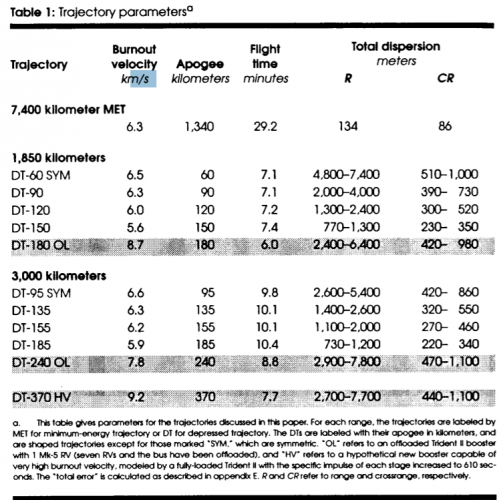
Mach 3 is ~1km/s, so 2-2.75km/s is ~Mach 6-8. 2km/s would be a depressed trajectory and 2.75km/s an MET for the given range of 8600km. Interestingly I've seen documents stating that a Trident D5 carrying 3 warheads on a depressed trajectory over a 2,000km range can reach up to 9.3km/s on descent. DT is the only way of exceeding LEO orbit speed.

I correct myself, it was 8.7km/s with a single Mk5 RV (W88) over 1,850km with a 180km apogee. 9.2km/s is for a theoretical new booster. The accuracy is poor for a DT with a standard RV, but a MaRV would change that.

Page 110
https://www.nuclearinfo.org/wp-cont...vid_C_Wright_Science_Global_Security_1992.pdf 1770912660599.png

I would agree on the A2A missile intercept point. An SA-2 over the DPRK couldn't even fuse on a Mach 3.2 SR-71 in the 1970s on a head-on intercept.
 
Last edited:
I remember reading somewhere back in the 90s in a book about the F-4 that when it fired one of its' AIM-7s from their recessed belly-stations after it was ejected its' rocket-motor was fired by an electrical lanyard (~3ft long) just before it disconnected (No doubt some sort of quick disconnect clip) from the AIM-7. Does anyone here know any details about this and are there any links to any technical information concerning this?​
 
I remember reading somewhere back in the 90s in a book about the F-4 that when it fired one of its' AIM-7s from their recessed belly-stations after it was ejected its' rocket-motor was fired by an electrical lanyard (~3ft long) just before it disconnected (No doubt some sort of quick disconnect clip) from the AIM-7. Does anyone here know any details about this and are there any links to any technical information concerning this?​
Not for the phantom but the weapons delivery manual of the F15 has a description of the umbilical.
The problem the f15 had with the sparrows was the umbilical chord between them. When the f15 fired the missile. Target info/doppler/reference signal was sent to the missile. It was then ejected by the plane. To prevent plane damage by the rocket motor, the motor was supposed to ignite after enough separation, this was commanded by an umbilical chord between sparrow-f15. It then flew to target. What happened was that when the sparrow got ejected, the umbilical was jolted from the plane too and the missile got wasted. You can look up the detailed story on 10% true tales, its explained by one of the f15 pilots that chased down an f1 as it escaped to iran. And also on the -34 and the armament handbook.
^^from 10%true podcast, a pilot talked about it when his sparrows failed

Skip to 29:30 for it but I recommed all of it

For the phantom specifically I'd have to run through the manuals
 
Last edited:
Does anyone know how actually DL works w/ AIM-7P?
Like on R-27R/ER it works only before missile achieve its seeker's range and turning off completely (no DL if seeker loses target with active lock thru "homing-plane"). Im curious is it the same for 7P or not
 
Last edited:
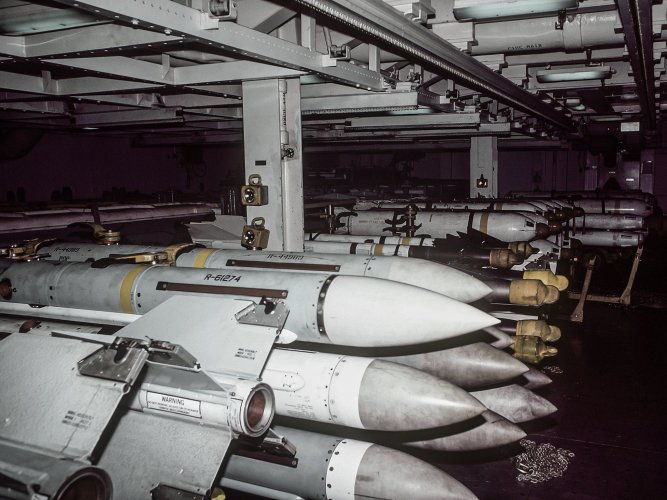
There seems to be an aim-9x in the picture so it’s probably aim-7p
Where abouts is the 9X? The ones behind the sparrows are AIM-9D/G/Hs (those three are basically impossible to tell apart externally), so it would be odd to have those and AIM-9Xs in service at the same time.
 
View attachment 818236
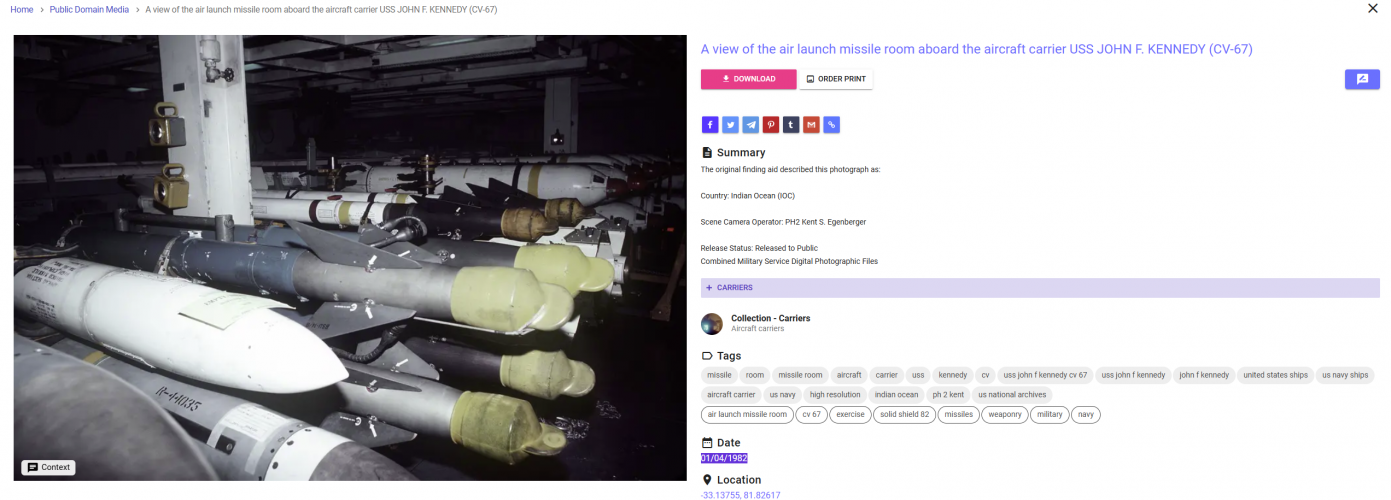
anybody know what sparrow variants these are? looks like AIM-7F/Ms with the shorter white radome maybe some Es with the darker ones
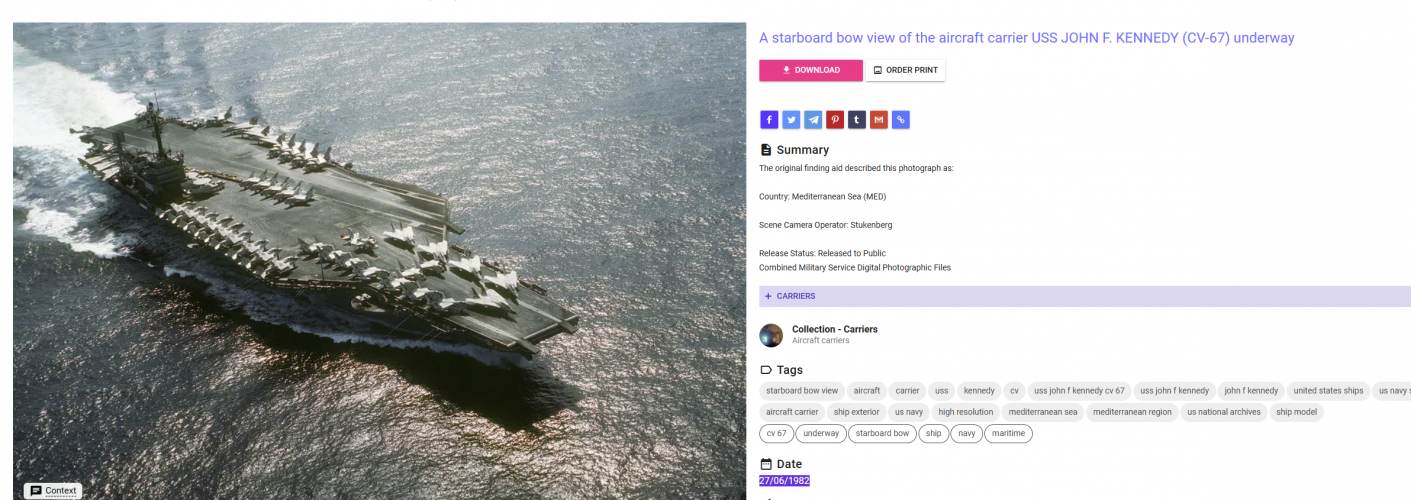
i see different information about this. Maybe its AIM-7F with high vision paint? Or AIM-7E4. but in June 1982 CV-67 operated by F-14 only. original photo with sparrow and aim-9 dated by april 1982. Im not going to say this is definitely true. I came across the information I mentioned by chance, and it reminded me of your post on this forum.
 

Attachments

  • 1786214672577.png
    1786214672577.png
    1.1 MB · Views: 61
  • 1786214729088.png
    1786214729088.png
    2.2 MB · Views: 58
Last edited by a moderator:
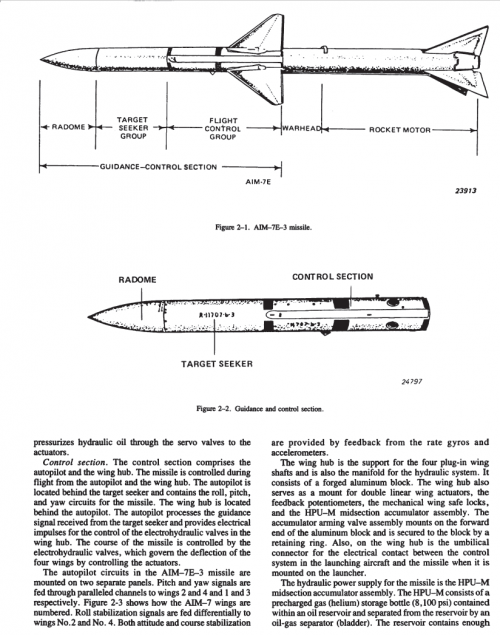
How exactly different was the AIM-7E4 form previous AIM-7E variants I know that it was created specifically for the F-14's AN/AWG-9 fire control system.
 
How exactly different was the AIM-7E4 form previous AIM-7E variants I know that it was created specifically for the F-14's AN/AWG-9 fire control system.
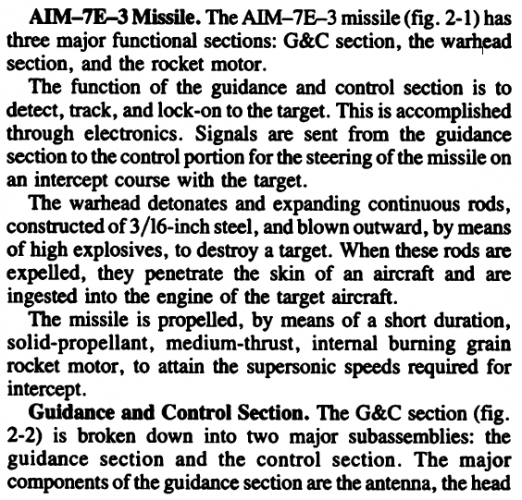
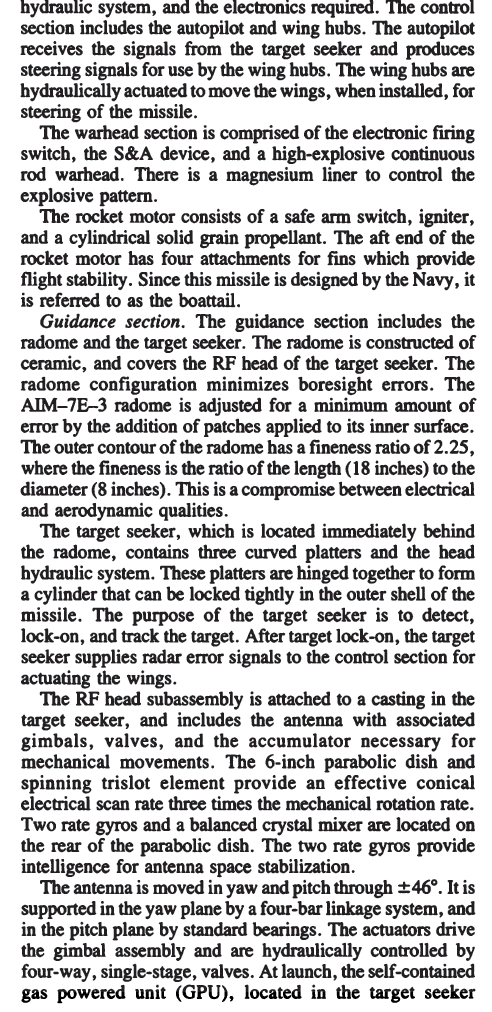
I've read that the AIM-7E-3 received a new seeker "
The RF head subassembly is attached to a casting in the
target seeker, and includes the antenna with associated
gimbals , valves , and the accumulator necessary for
mechanical movements . The 6- inch parabolic dish and
spinning trislot element provide an effective conical
electrical scan rate three times the mechanical rotation rate",

and it seems logical to me that the E-4 has an identical seeker, with the firmware merely optimizing it for the high-power emissions of the AWG-9 radar. The creator of this thread points this out.

But I haven't found any information online about the AIM-7E4 that would confirm that this is the case. Still, it seems to make sense.
1786631830778.png 1786631845518.png 1786631865918.png

Even if photos of the AIM-7E-3/4 seeker exist online, I don't have access to such information, and I lack the skills to search for such rare photos
 
https://discovery.nationalarchives.gov.uk/details/r/C11282234
https://www.mediafire.com/file/t4cn7eoxtv3jlxz/Skyflash.pdf/file
I got this document from the UK national archives. It goes into great detail on Skyflash but also AIM-7F. Lots of good info
Do you have a smaller file than almost 600 megabytes? I’m on an IPad and a file that size can crash a lot if you try and read it.
Oh, and does anyone know what Sidewinder variants are in the pic a few posts above? Thanks.
 
Last edited:
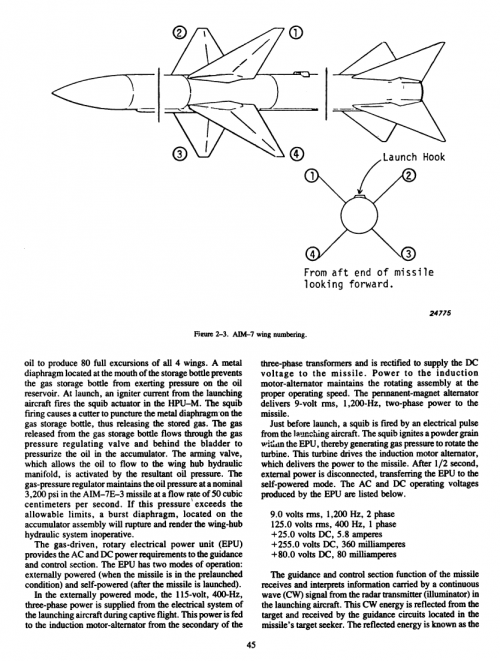
@LuckyBobi Do you have the next page that describes the rest of the hydraulic power supply?
Hi! Sure, here you go. Sorry for not mentioning the source earlier. But if you're interested, you can find this information in this source: Munitions_Systems_Specialist_AFSC_46150 (2)


i attached a file. You can find more details about AIM-7E-3 in it
1788534298946.png
 

Attachments

  • Munitions_Systems_Specialist_AFSC_46150 (2).pdf
    13.6 MB · Views: 5
So the AIM-7E3's servo-system and power-system were a more complex version of the AIM-9's hot-gas energised servo and generator systems, I suppose that thermal batteries were introduced in the AIM-7F.
 

Similar threads

Back
Top Bottom