https://www.airandspaceforces.com/8th-air-force-commander-final-b-1-b-2-retirements/

You are using an out of date browser. It may not display this or other websites correctly.
You should upgrade or use an alternative browser.
You should upgrade or use an alternative browser.
AFGSC strategic bombers retirement plans
- Thread starter flateric
- Start date

FighterJock
ACCESS: Above Top Secret
- Joined
- 29 October 2007
- Messages
- 7,237
- Reaction score
- 8,549
So will that mean that the B-1Bs will only be retired when there is enough B-21s in production? Either way it is going to be a sad day when the last B-1B gets retired eventually.
Congress passed a law requiring 45 B-1s in service until their replacement. Current schedule is Ellsworth, Whiteman, then Dyess for B-21 base modifications, so it appears half the Bones go, then B-2s, then remaining Bones. USAF has not explicitly stated this; that’s just going by the base update schedule.So will that mean that the B-1Bs will only be retired when there is enough B-21s in production? Either way it is going to be a sad day when the last B-1B gets retired eventually.
jsport
what do you know about surfing Major? you're from-
- Joined
- 27 July 2011
- Messages
- 8,599
- Reaction score
- 6,904
thank you for posting this.
I would love to see a replacement for the B-1 developed, as something less exquisite has a better chance of being procured in numbers and actually used, but it doesn't seem that's in the cards.
https://www.airandspaceforces.com/article/risking-americas-long-range-strike-capability/
https://www.airandspaceforces.com/article/risking-americas-long-range-strike-capability/
I would love to see a replacement for the B-1 developed, as something less exquisite has a better chance of being procured in numbers and actually used, but it doesn't seem that's in the cards.
https://www.airandspaceforces.com/article/risking-americas-long-range-strike-capability/
The B-52 fills the same space. I doubt we will see a replacement until those are up for retirement. In the meantime, launch from cargo planes might supplement the bomber force.
Sentimentally, I agree with you. Over half of my AF career was working on or around them. That said there isn't a mission set that they now perform that can't otherwise be covered except the ability to fly unrefueled 1-2,000 nm, loiter for hours, and strike anywhere within a country in 15 min. For that mission set I'd much prefer we develop a medium bomber in the vein of the FB-23. 200 of those would be far more useful than 75-100 direct B-1 replacements and unit cost would be far more tolerable.I would love to see a replacement for the B-1 developed, as something less exquisite has a better chance of being procured in numbers and actually used, but it doesn't seem that's in the cards.
https://www.airandspaceforces.com/article/risking-americas-long-range-strike-capability/

- Joined
- 21 April 2009
- Messages
- 14,357
- Reaction score
- 9,446
https://www.realcleardefense.com/ar...4939.html?mc_cid=36e98d3a27&mc_eid=307947a252Wow has to mean B-21 will be available in equal numbers by then?
- Joined
- 21 April 2009
- Messages
- 14,357
- Reaction score
- 9,446
Link was 7/25/25 don’t see where it said 2018.This is an article from 2018.
Link was 7/25/25 don’t see where it said 2018.
Apologies, I must have double clicked on the link and been taken to an article referenced by the first one.
I very much doubt that B-21 lacks the ability to carry MOP. If nothing else, fuel can be sacrificed for warload. The B-2 likely does this as well, as two GBU-57s is well in excess of its nominal warload of 45,000 lbs.
I personally do not believe the 20,000 lb figure being thrown around either. If we assume AGM-181 has about the same mass as AGM-86 and that eight weapons would be carried on a rotary launcher as on every other in service US bomber, that is already ~25,000 lbs plus the weight of the rack.
I also specifically remember a USAF render of the B-21 that listed the payload as “30,000+ lbs”, though when I tried to relocate it in 2023 I could fine no link to it.
Last edited:

Grey Havoc
ACCESS: USAP
- Joined
- 9 October 2009
- Messages
- 24,500
- Reaction score
- 18,175
Hopefully, but they cut a lot of corners on it though.I very much doubt that B-21 lacks the ability to carry MOP.
Ainen
I really should change my personal text
- Joined
- 25 August 2011
- Messages
- 2,830
- Reaction score
- 4,937
Still, bombers are normally designed around bomb bay, not the other way around.Hopefully, but they cut a lot of corners on it though.
Grey Havoc
ACCESS: USAP
- Joined
- 9 October 2009
- Messages
- 24,500
- Reaction score
- 18,175
https://www.airandspaceforces.com/no-slowdown-in-demand-for-air-force-bombers-4-star-says/
How the wheel has turned.The demand for Air Force bombers to conduct joint exercises, show-of-force operations, or actual combat missions has reached record-high levels—prompting the four-star in charge of their operations to consider resurrecting more bombers from the boneyard to sustain that effort.
There are only two more B-1s specifically being held for regeneration, though I think two more are also held in a state where parts are not removed such that they could potentially return to service. Two already were used as attrition replacements since the last retirement of 17 airframes. I believe there are ten B-52s in storage though I do not know their condition off the top of my head.
I do not see any of these returning to service except as attrition replacements since, and within a few years B-21s likely serve that purpose instead for B-1.
I do not see any of these returning to service except as attrition replacements since, and within a few years B-21s likely serve that purpose instead for B-1.
thefrecklepuny
ACCESS: Confidential
- Joined
- 19 January 2008
- Messages
- 131
- Reaction score
- 124
300 B-21's! Would that include retiring the B-52 "prematurely"?
300 B-21's! Would that include retiring the B-52 "prematurely"?
No, the DoD has plans to keep the B-52s around for quite a while, for one thing the B-52Hs are going through a re-engining programme (They'll become B-52Js).
No. They represent capacity B-21 doesn’t have.300 B-21's! Would that include retiring the B-52 "prematurely"?
Scott Kenny
ACCESS: USAP
- Joined
- 15 May 2023
- Messages
- 19,539
- Reaction score
- 27,990
I would not expect so. A single B-52 carries 2.5x the cruise missile load of a B-21, and frees up B-21s for penetration missions.300 B-21's! Would that include retiring the B-52 "prematurely"?

- Joined
- 21 January 2015
- Messages
- 14,997
- Reaction score
- 24,212
I still think there’s something special about the idea of having aircraft still in active service possibly up to 100 years old.No, the DoD has plans to keep the B-52s around for quite a while, for one thing the B-52Hs are going through a re-engining programme (They'll become B-52Js).
FighterJock
ACCESS: Above Top Secret
- Joined
- 29 October 2007
- Messages
- 7,237
- Reaction score
- 8,549
Put it this way the last B-52 pilot to go through training will not have been born yet.
Scott Kenny
ACCESS: USAP
- Joined
- 15 May 2023
- Messages
- 19,539
- Reaction score
- 27,990
It might even last longer, IIRC the last time I did the math the B-52s ran out of upper wing skin life at about 37,000 hours. InI still think there’s something special about the idea of having aircraft still in active service possibly up to 100 years old.
Last edited:
FighterJock
ACCESS: Above Top Secret
- Joined
- 29 October 2007
- Messages
- 7,237
- Reaction score
- 8,549
2070 Scott Kenny? That would be good going for the B-52 if it does reach that age. 
Scott Kenny
ACCESS: USAP
- Joined
- 15 May 2023
- Messages
- 19,539
- Reaction score
- 27,990
The average age of the B52 fleet was about 21k hours in IIRC 2016, and the upper wing skins need to be replaced at about 37k hours. Assuming 350 hours per year, that gives you 45 more years of flying. So I guess it's only till 2060, not 2070.2070 Scott Kenny? That would be good going for the B-52 if it does reach that age.
350 hours per year is about what the BUFFs were flying during GWOT.
FighterJock
ACCESS: Above Top Secret
- Joined
- 29 October 2007
- Messages
- 7,237
- Reaction score
- 8,549
Thanks for the info Scott Kenny.
Frankly at this rate I'd be looking at reactivating some out of the boneyard and bringing them up to J standard just because they're handy. Growing the fleet to ~100 B-52J would be sporty. IMO the ideal bomber fleet is something like ~100 B-52J, 250 B-21 and 150 of a next generation B-1 type (ideally with two of the 375" modular bays and the external pylons). God only knows how or when we'd get there, but I think that would be much healthier for being able to maintain nuclear deterrence and do theater conventional warfighting.The average age of the B52 fleet was about 21k hours in IIRC 2016, and the upper wing skins need to be replaced at about 37k hours. Assuming 350 hours per year, that gives you 45 more years of flying. So I guess it's only till 2060, not 2070.
350 hours per year is about what the BUFFs were flying during GWOT.
There’s all of ten, and they are reserved for attrition replacements.Frankly at this rate I'd be looking at reactivating some out of the boneyard and bringing them up to J standard just because they're handy. Growing the fleet to ~100 B-52J would be sporty. IMO the ideal bomber fleet is something like ~100 B-52J, 250 B-21 and 150 of a next generation B-1 type (ideally with two of the 375" modular bays and the external pylons). God only knows how or when we'd get there, but I think that would be much healthier for being able to maintain nuclear deterrence and do theater conventional warfighting.
VishnuOsiris
ACCESS: Confidential
- Joined
- 1 December 2024
- Messages
- 164
- Reaction score
- 290
350 hours per year is about what the BUFFs were flying during GWOT.
Mr. Kenny, might you have any comparative metrics for B-52 v. B-1 ops during GWOT? How many hours/year for the B-1, etc.?
Scott Kenny
ACCESS: USAP
- Joined
- 15 May 2023
- Messages
- 19,539
- Reaction score
- 27,990
Unfortunately, no I don't.Mr. Kenny, might you have any comparative metrics for B-52 v. B-1 ops during GWOT? How many hours/year for the B-1, etc.?

- Joined
- 16 April 2008
- Messages
- 10,590
- Reaction score
- 18,129
The only thing is aren’t the B-52’s a bit like ‘Trigger’s Broom’? See how many of you get that reference.
That's the broom they use to sweep up the debris from rebuilding the Ship of Theseus, right?
I'm including the ones they sliced up for arms control treaties. I think those could probably be repaired, albeit it wouldn't be as easy.There’s all of ten, and they are reserved for attrition replacements.
they have been sitting in the open torn to pieces for decades. They are aluminum scrap. The only reason they aren’t recycled is because the treaty is still in force.I'm including the ones they sliced up for arms control treaties. I think those could probably be repaired, albeit it wouldn't be as easy.
I'll have to disagree until I've seen someone study the costs and challenges of reactivating them.they have been sitting in the open torn to pieces for decades. They are aluminum scrap. The only reason they aren’t recycled is because the treaty is still in force.
I don’t need to raise the Yamato to know that it would not be cost effective to put it back into service.I'll have to disagree until I've seen someone study the costs and challenges of reactivating them.
Not James Stockdale
ACCESS: Secret
- Joined
- 29 August 2025
- Messages
- 242
- Reaction score
- 459
Every major structural component on those chopped up B-52s has been destroyed. There is no way to put it back together. You would have to CT scan and x-ray every frame and spar to determine how the shearing stresses altered the metallic structure before you could even think about how much welding and reinforcing you would have to do to restore your structural margins. That is the whole reason why they were guillotined like that. The only pieces of any value there are small components and parts.
At that point, the best answer is just to build another cruise missile carrier. There are a lot of 20 year old 777-200ERs that the Air Force could probably get their hands on that they could convert to tankers, CMCAs, or both. About 400 of them were delivered between 1997 and 2007 and they can carry 137 tons of fuel in their passenger configuration (diff between OEW and MTOW is about 160 tons). There are more 777-300ERs, and they are newer and would be better for both roles (10 m extra means another stack of missiles and +50 ton boost to MTOW means MTOW-OEW=200 tons), but they are slightly more expensive on the used market.
At that point, the best answer is just to build another cruise missile carrier. There are a lot of 20 year old 777-200ERs that the Air Force could probably get their hands on that they could convert to tankers, CMCAs, or both. About 400 of them were delivered between 1997 and 2007 and they can carry 137 tons of fuel in their passenger configuration (diff between OEW and MTOW is about 160 tons). There are more 777-300ERs, and they are newer and would be better for both roles (10 m extra means another stack of missiles and +50 ton boost to MTOW means MTOW-OEW=200 tons), but they are slightly more expensive on the used market.
No need to "study" this. This is a textbook example of "intuitively obvious to the most casual observer".I'll have to disagree until I've seen someone study the costs and challenges of reactivating them.
If this isn't convincing enough, then nothing else is going to change a person's mind much like a flat eather or moon hoaxer.
Last edited:
I think you're being unreasonably aggressive given that there are multiple kinds of treaty compliant dismantlement.No need to "study" this. This is a textbook example of "intuitively obvious to the most casual observer"
View: https://www.youtube.com/shorts/C-F_WlvDMnc
If this isn't convincing enough, then nothing else is going to change a person's mind much like a flat eather or moon hoaxer.
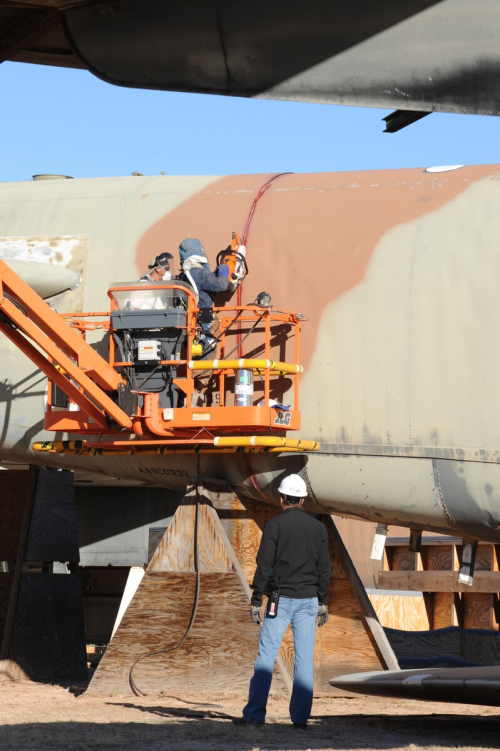
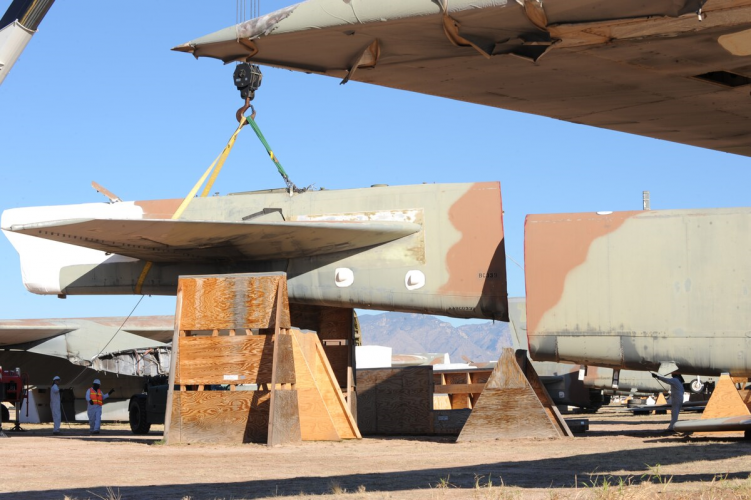
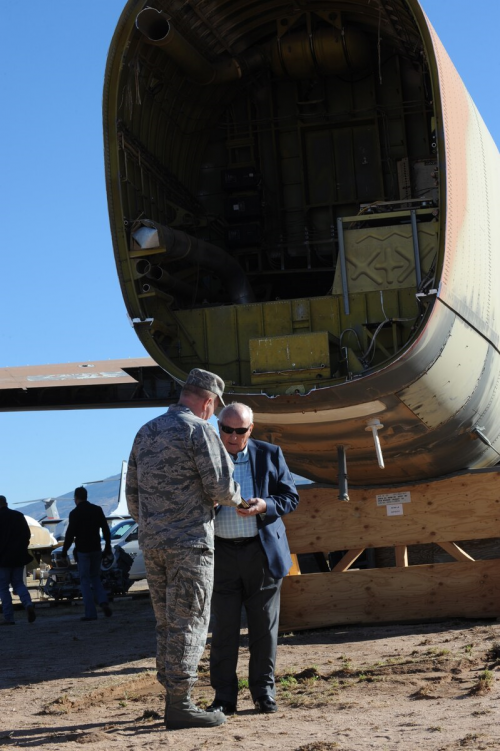
As of the most recent google earth imagery there's about 36 B-52 in the boneyard with a single major fuselage cut (generally saw cut), about 9 with no major structural slices, and about 50 with the tail and wings and fuselage cut off (generally guillotine).
Now, I do agree that the guillotine cut early START-1 bombers are almost certainly unsalvageable, but the later START-1 and NEW START bombers were cut with circular saws and look reasonably recoverable? Obviously not turn key, but probably cheaper and faster than a new heavy bomber design!
To be clear, I'm not opposed to the latter, I just think that avoiding the bomber shortfall would be nice, and the B-1 fleet is running a little ragged.
Though, I suspect in the long run it'd be a better use of the money to start a B-1 style modern non-VLO heavy bomber program sooner rather than later.
Attachments
I'm including the ones they sliced up for arms control treaties.
That would be the B-52Gs.
Similar threads
-

-
-
New Heavy Bomber Alternatives study FY'27 - news only
- Started by GeorgeA
- Replies: 1
-
-