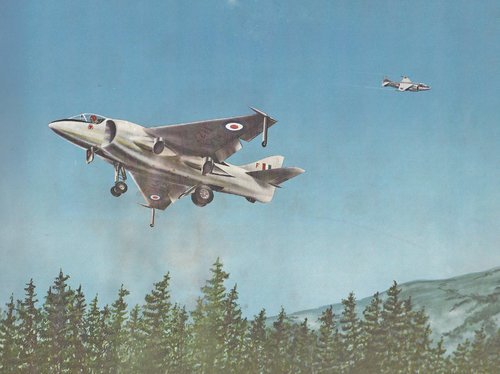
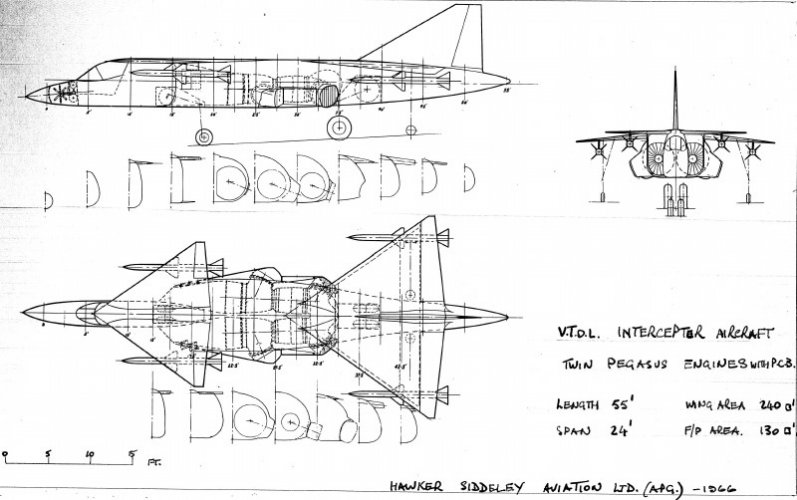
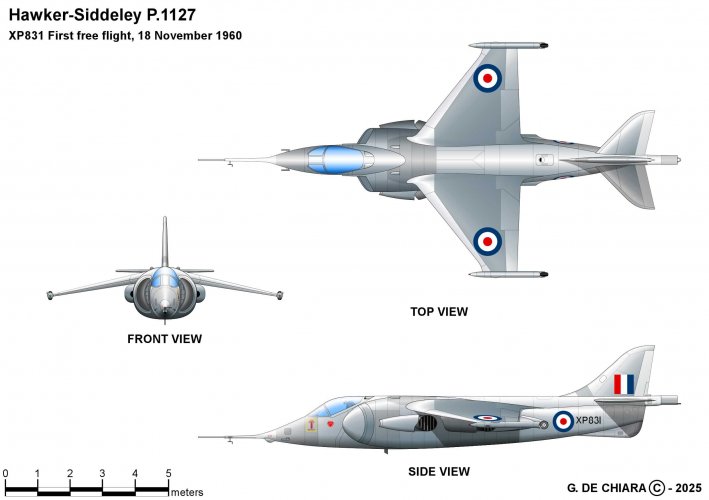
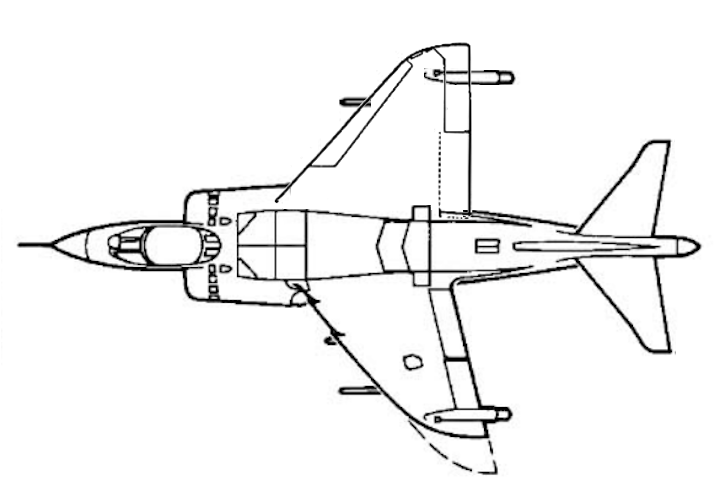
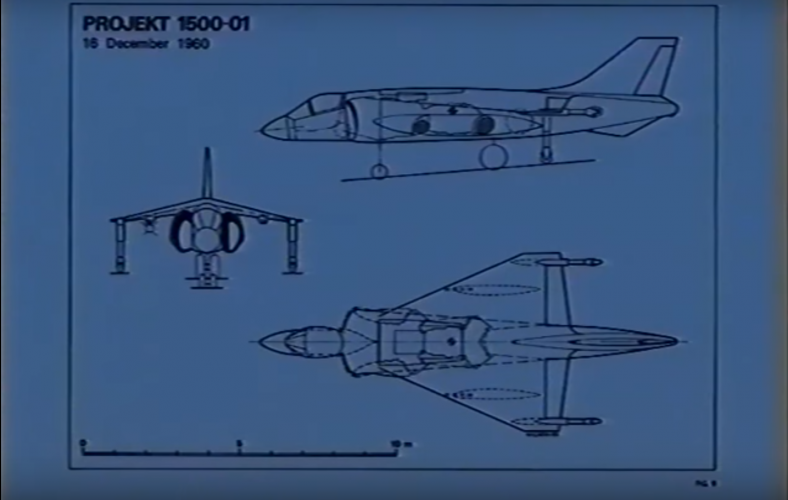
A small what-if: delta-wing Harrier as designed?

tomo pauk

ACCESS: Top Secret
Joined
1 May 2011
Messages
1,121
Reaction score
889
As it says on the lid - what if the Kestrel/Harrier was made with delta wing instead of the 'normal' wing? Looking from afar like a high-wing Mirage III with a smaller wing? Wing are being perhaps 180-200 sq ft on the prototypes, then about 250 sq ft on the alternative Mk.I, and last at about 300 sq ft on the latest models (LERX? or possibly addition of small canards for the 250 sq ft wing?)? Wing can also be thinner, not the 10% t-t-c type as used on the Harrier.

What might've been advantages and disadvantages?
 
I think one issue would be engine exhaust
with normal wing distributed better the Engine exhaust
So the pegasus engine not choke on own engine exhaust and flame out

with delta wing could have less favourable distributed of the Engine exhaust
the pegasus engine would choke on own engine exhaust and flame out.

also has Harrier a stabilisation system were air comes out Wingtips (and Nose Tail)
with Delta wing the wingtips are out center of gravity of this Harrier.
 
I think the main disadvantages would be additional mass from the bigger wing so it wouldn't be able to take off vertically, and lower control power so it then couldn't transition to forward flight even if it got airborne.

Higher wing sweep = lower drag at high Mach, but this is dominated by the engine/fuselage anyway.

More internal volume for fuel, but it's mass limited anyway so this isn't usable (and cg)
 
I think the main disadvantages would be additional mass from the bigger wing so it wouldn't be able to take off vertically, and lower control power so it then couldn't transition to forward flight even if it got airborne.
We get rid of the horizontal tail and it's mechanism, that should've cancel out a good deal of the increased weight due to the bigger wing. I have no worries about the transition from vertical to the horizontal flight and vice-versa.

Higher wing sweep = lower drag at high Mach, but this is dominated by the engine/fuselage anyway.

Wing thickness of 10% did no favors to the streamlining of the Harrier, either. For comparison, Jaguar was under 5% t-t-c at root.

More internal volume for fuel, but it's mass limited anyway so this isn't usable (and cg)
Greater internal volume can be used up once the ski-ramp usage is in the cards.
 
In my professional opinion I disagree

It's worth looking at the Fokker-Republic D-24 for comparison. Without the massive thrust boost from PCB and without the variable sweep wing to lower the stall speed and provide more control power.
 
I do not believe that the roll posts on the wingtips would be an issue. You could just mix in a bit of air from the nose puffer if the wingtips tended to push the nose down, and it'd give you a bit more lift in the process. Kinda like how doing a pedal turn in a helicopter while climbing at max load gives you a little bit more lift.

My concern would be weight growth and CG.

The Delta Wing means that the CG is farther aft because of the fuel tanks in the wing, so the engine needs to be moved aft.
 
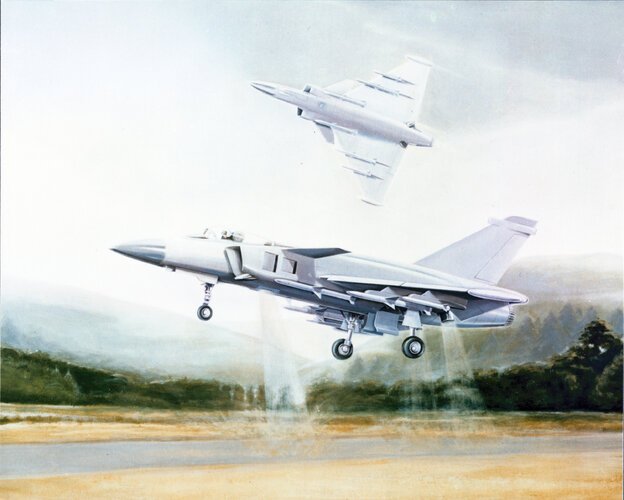
A wing with a long root chord, like a delta with a highly-swept leading edge, will also increase jet outwash-induced 'suckdown', i.e. lift loss, in vertical flight. Mounting the wing higher helps offset it. With a low delta wing the lift loss can be as high as 30%, as found when testing a model of the BAe P.112. 1764331040890.jpeg
 
Last edited:
I think the main disadvantages would be additional mass from the bigger wing so it wouldn't be able to take off vertically, and lower control power so it then couldn't transition to forward flight even if it got airborne.
It's easy to forget that the Harrier had such a small wing that even in horizontal flight it wouldn't so much glide as fall with style. With the big fan, really high Mach numbers aren't on the cards - so I don't see the advantages of a delta being applicable here.
 
With the big fan, really high Mach numbers aren't on the cards - so I don't see the advantages of a delta being applicable here.
How do you feel about the ability of the bigger wing - that delta wing in this case - enabling the aircraft to have more internal fuel? And another pair of ordnance racks?
Is the lower wing loading something that pilots might appreciate?
 
Those advantages don't really apply unless the aircraft has a higher thrust engine to maintain the overall Thrust/Weight ratio in the hover - this is still the case for Vertical Landing at the end of mission.

The historic Big Wing Harrier concepts had larger swept wings in order to increase all those attributes, but also improved aerodynamic efficiency in cruise/loiter. Increased thrust from the later Pegasus engines was the key to this.
 
Those advantages don't really apply unless the aircraft has a higher thrust engine to maintain the overall Thrust/Weight ratio in the hover - this is still the case for Vertical Landing at the end of mission.

The historic Big Wing Harrier concepts had larger swept wings in order to increase all those attributes, but also improved aerodynamic efficiency in cruise/loiter. Increased thrust from the later Pegasus engines was the key to this.

Note that this what-if is about the single, tail-less delta wing for the initial Kestrel & Harriers. Pegasus development can carry on as it was historically the case.
 
How do you feel about the ability of the bigger wing - that delta wing in this case - enabling the aircraft to have more internal fuel? And another pair of ordnance racks?
Is the lower wing loading something that pilots might appreciate?
Would require more power out of Pegasus sooner.

Or just jumping to BS100, which means a 4" bigger diameter fan.
 
Because Thrust > Weight for VTOL
I'm not convinced that a delta wing would weigh more. The improved structural efficiency should reduce weight keeping all other things equal, with the extra internal volume being potentially useful in at least 2 ways:

- Housing the 30mm Aden guns in the wings (similar to Skyhawk) would eliminate the draggy (and heavy) underfuselage gun pods, improving range by ~10% (if you look at the AV-8B SAC and compare gunpods vs strakes)

- The extra wing fuel (+ ~100 US gallons if you look at a Skyhawk) would allow you to eliminate at least one external tank... i.e. additional weight & drag savings

Here's the Skyhawk wing (top) scaled down by ~10% to match the Harrier GR3 wing (bottom). Now optionally take that to the extreme with a fully swept delta wing and eliminate the tail stabilizers... probably weight neutral IMHO (though personally I would stick with the Skyhawk style wing for a subsonic aircraft).
 

Attachments

  • Harrier with A-4 wing 50px=1m.png
    Harrier with A-4 wing 50px=1m.png
    98.3 KB · Views: 39
I'm not convinced that a delta wing would weigh more. The improved structural efficiency should reduce weight keeping all other things equal, with the extra internal volume being potentially useful in at least 2 ways:
It's worth a look at the likes of parametric wing mass estimation methods (e.g. Raymer) to get a feel for the importance of the various factors. Raymer calls out a single factor for delta Vs swept wing but this is much smaller impact than some of the other parameters e.g. thickness/chord, aspect ratio, wing area, wing sweep. And mass is really critical for VTOL.

For later Harriers then there's a lot more margin due to the higher thrust Pegasus variants then available. I'm thinking back to the likes of 1127/Kestrel where this sort of change would have to be incorporated. T/W was really marginal so it's very sensitive to extra mass.

Your illustration looks pretty workable for later Harriers with more thrust. Not necessarily better than just a bigger swept wing though like Harrier II.

A high sweep tailless delta would be quite another thing, where I'd really worry about control in the hover and transition.
 
A high sweep tailless delta would be quite another thing, where I'd really worry about control in the hover and transition.
As far as I can see , the problem with a highly swept delta is the large angle of attack needed for flight at low speeds , which is going to make transition difficult . From a vertical take-off with the aircraft in a horizontal attitude , the aircraft will need to pitch nose-up to allow the wing to generate lift at low speed , before pitching nose-down again as it accelerates , then during landing , it will have to pitch nose -up again , before pitching nose-down as it becomes supported by jet lift , all without today's modern autostability systems .
cheers ,
Robin .
 
@robunos Would be interesting to know more about how Dassault handled the transition to/from vertical flight in its Mirage Balzac and Mirage IIIV prototypes. It seems that the problem was solvable with 1960s technology.
 
A high sweep tailless delta would be quite another thing, where I'd really worry about control in the hover and transition.
As long as overall wingspan is about the same, control in the hover via puffer jets will be fine.

It's the transition that will be problematic.
 
As long as overall wingspan is about the same, control in the hover via puffer jets will be fine.
That would give the same moment arm for the controls, but the moments of inertia will be different. So you'd expect the delta to have a quicker roll response. This seems to matter from previous experience.

A high sweep delta with the same wingspan will have much larger area, mass and drag than an equivalent moderate sweep wing as per Harrier.
 
Somewhere, I was told that a big (delta) wing would reduce airflow past the wing from above. That could reduce available thrust for vertical flight.
 
As far as I can see , the problem with a highly swept delta is the large angle of attack needed for flight at low speeds , which is going to make transition difficult . From a vertical take-off with the aircraft in a horizontal attitude , the aircraft will need to pitch nose-up to allow the wing to generate lift at low speed , before pitching nose-down again as it accelerates , then during landing , it will have to pitch nose -up again , before pitching nose-down as it becomes supported by jet lift , all without today's modern autostability systems .
cheers ,
Robin .
Ah , I'd forgotten about them . . . :mad:

cheers ,
Robin .
 
Back
Top Bottom