Easter Island prints
https://phys.org/news/2025-11-kind-3d-explore-easter-island.htmlYou can now explore Rano Raraku, one of the major quarries on Easter Island, from the comfort of your home. A research team including faculty at Binghamton University, State University of New York has created the first-ever high-resolution 3D model of the quarry, providing people worldwide with a glimpse of the island, including almost 1,000 of its iconic moai statues.

3D model aids
https://hackaday.com/2025/12/11/iteration3d-is-parametric-python-in-the-cloud/Going back to the problem in the introduction, if Iteration3D doesn’t have what you need and you still have an STL you need to change the dimensions of, we can help you with that.

https://hackaday.com/2025/12/10/production-kicad-template-covers-all-your-bases/Ever think about all the moving parts involving a big KiCad project going into production? You need to provide manufacturer documentation, assembly instructions and renders for them to reference, every output file they could want, and all of it has to always stay up to date. [Vincent Nguyen] has a software pipeline to create all the files and documentation you could ever want upon release – with an extensive installation and usage guide, helping you turn your KiCad projects truly production-grade.
View: https://www.youtube.com/watch?v=63R6Wnx44uY
 
Last edited:

Only someone who never built a boat would even remotely consider a 3d printed hulls. Expensive and slow as fuck to make and heavy to boot . The most compeling case for 3d printing in boatbuilding is in making plugs and molds .

55h
View: https://www.youtube.com/watch?v=1PXze574q08


Rotomolder can likely make between 8-10 hulls in same time and for cost of 1 printed one.
Rotomolding itself only takes 90 minutes ,rest is cooling and demolding
View: https://www.youtube.com/watch?v=1ChhNb4s50Y


View: https://www.youtube.com/watch?v=e9FSV3IxP20
 
Last edited:
Aluminum prints
https://techxplore.com/news/2025-12-3d-stronger-vehicle-aluminum-high.html
Even smaller prints available
https://www.rdworldonline.com/llnl-team-hits-1000x-speed-boost-in-3d-nanofabrication/https://phys.org/news/2025-12-team-shatters-3d-nanofabrication-limits.htmlResearchers at Lawrence Livermore National Laboratory and Stanford University say they have built a two-photon lithography system that could push 3D nanofabrication toward manufacturing scale, boosting throughput by more than 1,000 times compared with commercial tools while maintaining minimum feature sizes of 113 nanometers.

MetaLitho3D
https://www.llnl.gov/article/53341/lab-scientists-win-four-2025-rd-100-awardsMetaLitho3D is a one-of-a-kind, high-precision additive manufacturing platform that addresses the limitations of conventional optical systems when scaling up the production rate of 3D nano-architectures to perform wafer-scale, two-photon lithography.

Bad 3D print causes crash
https://hackaday.com/2025/12/10/failed-3d-printed-part-brings-down-small-plane/
Back in March, a small aircraft in the UK lost engine power while coming in for a landing and crashed. The aircraft was a total loss, but thankfully, the pilot suffered only minor injuries. According to the recently released report by the Air Accidents Investigation Branch, we now know a failed 3D printed part is to blame.

The part in question is a plastic air induction elbow — a curved duct that forms part of the engine’s air intake system.


Tiny 3D print helixes
https://phys.org/news/2025-12-3d-helixes-thz-optical-materials.html
Printable electronics
https://phys.org/news/2025-12-framework-2d-materials-printable-electronics.html
Light driven deposits
https://phys.org/news/2025-12-driven-flexible-electrodes-skin-textiles.html
Ice tree
https://phys.org/news/2025-12-3d-christmas-tree-ice.html
Tech advances
https://phys.org/news/2025-12-acid-carbon-nanotubes-boost-efficiency.htmlhttps://phys.org/news/2025-12-dna-origami-lattices-silicon-possibilities.html
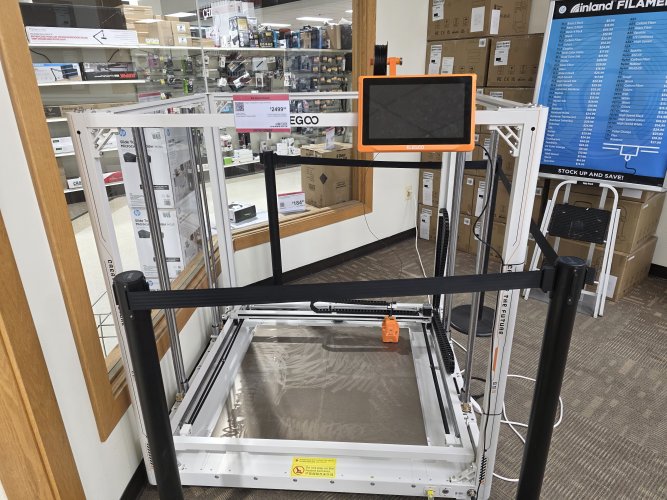
Massive printer
https://hackaday.com/2025/12/19/surplus-industrial-robot-becomes-two-ton-3d-printer/https://hackaday.io/project/204676-turning-a-2-ton-robot-into-a-3d-printer
Other uses
https://hackaday.com/2025/12/16/laser-cutter-plus-cymk-spraypaint-equals-full-color-prints/https://hackaday.com/2025/12/19/cheap-3d-printer-becomes-cnc-wood-engraver/
Combinations
https://hackaday.com/2025/12/15/3d-printing-and-metal-casting-are-a-great-match/
Freeze on
https://www.smooth-on.com/spotlight/freeze-cast-process-smooth-rubber-precision-casting/

A lovely build
https://hackaday.com/2025/12/19/windmill-desk-lamp-is-beautifully-soothing/
Non vacu-forms
This dear, charming man finds ways to combine 3d printing with vacu-forming. I wonder if that might me combined with wind tunnels with very high and low pressures:

https://hypersonics.tamu.edu/hypersonic-horizons-2025-the-high-speed-video-challenge/
Cutter

One project
 
Last edited:
Ostensibly to stop 3D printed guns, legislation is being proposed to put spyware on every printer and even CNC machines to watch for the making of guns. Another path is to develop revenue streams from fees for making parts that resemble claimed intellectual property like hero figures and space ships.

View: https://youtu.be/x0x1mQSkvmk?si=CMnoxYfFqAZcSZ3o

View: https://youtu.be/s6Iwoq2faMk?si=a-_6YUq_S3RJxbWa


View: https://youtu.be/cFWO8xXlGcw?si=HeaevU7ZzbG8JF3K


View: https://youtu.be/KC8viXze52U?si=Sb1z_GCR7jeQkMvs
 
Last edited:
Fix on the fly
https://techxplore.com/news/2026-02-ai-3d-defects-real.html
lignin prints
https://phys.org/news/2026-02-3d-ink-lignin-recycles.html
Weave prints
https://techxplore.com/news/2026-02-tool-3d-woven-metamaterials.html
Soft prints
https://techxplore.com/news/2026-02-rotating-nozzle-3d-air-powered.htmlhttps://techxplore.com/news/2026-02-regenerative-bioprinting-magnetic-mixer-enables.html
Brain print
https://medicalxpress.com/news/2026-02-3d-brain-medical.html
Fluidic prints
https://phys.org/news/2026-02-microfluidic-method-boosts-tiny-particles.htmlhttps://phys.org/news/2026-02-bioengineers-perfusable-kidney-ducts-3d.htmlhttps://phys.org/news/2026-02-inter-protofilament-gaps-pave-life.htmlhttps://techxplore.com/news/2026-02-microfluidic-chip-gases-motionless.html
Even smaller nozzles?
https://phys.org/news/2026-02-nanotubes-lids-mimic-real-biology.htmlhttps://phys.org/news/2026-02-automating-microfluidic-chip-hybrid-approach.html
plastic
https://phys.org/news/2026-02-quick-polymer-capacity.html
3D print of Tungsten carbide–cobalt (WC–Co)
https://techxplore.com/news/2026-02-successfully-3d-industry-hardest-materials.htmlThe results demonstrated this method to be effective in maintaining the hardness and mechanical integrity of conventionally manufactured WC-Co cemented carbides, achieving a base material with hardness of over 1400 HV (a unit representing resistance to penetration), without introducing any defects or decomposition.

Materials at this hardness level rank among the toughest used in industry, just below superhard substances such as sapphire and diamond. Producing the cemented carbide molds without defects does appear possible, which is the main goal of this study, though some results vary
.
https://www.sciencedirect.com/science/article/pii/S0263436825005906
Dragon

They call me Bruce

Machining
https://techxplore.com/news/2026-02-ai-micromachining-advances-generation-biocompatible.html
 
Last edited:
Sound-based 3D printing
https://techxplore.com/news/2026-02-based-3d-method-enables-finer.htmlConcordia researchers have developed a new 3D-printing technique that uses sound waves to directly print tiny structures onto soft polymers like silicone with far greater precision than before. The approach, called proximal sound printing, opens new possibilities for manufacturing microscale devices used in health care, environmental monitoring and advanced sensors. It is described in the journal Microsystems & Nanoengineering.

3D printing in space
https://phys.org/news/2026-02-rocket-science-3d-soft-gravity.html
What happens to soft matter when gravity disappears? To answer this, UvA physicists launched a fluid dynamics experiment on a sounding rocket. The suborbital rocket reached an altitude of 267 km before falling back to Earth, providing six minutes of weightlessness.
In these six minutes, the researchers 3D-printed large droplets of a soft material similar to the inks used for bioprinting—a developing technology that shows huge potential for regenerative and personalized medicine, tissue engineering and cosmetics. Bioprinting involves 3D-printing a mix of cells and bio-inks or bio-materials in a desired shape, often to construct living tissues.

The experiment was called COLORS (COmplex fluids in LOw gravity: directly observing Residual Stresses). Using a special optical set-up, the researchers could see where the printed material experienced internal stresses (forces) as the droplets spread and merged. Stressed regions stand out as bright colors in the experiment. Investigating how and where these stresses emerge is important because they can get frozen in a material as it solidifies, creating weak points where 3D-printed objects are most likely to break
.


3D print batteries
https://hackaday.com/2026/02/14/theres-always-room-for-3d-printed-batteries/
Thingiverse 2.0?
https://hackaday.com/2026/02/13/myminifactory-has-acquired-thingiverse-bringing-anti-ai-focus/https://hackaday.com/2026/02/13/3d-printing-pneumatic-channels-with-dual-materials-for-soft-robots/https://hackaday.com/2026/02/10/is-that-ancient-reel-of-pla-any-good/
Print flexibility
https://techxplore.com/news/2026-02-woven-nickel-titanium-flexibility-3d.html
Scanning and graphics
https://hackaday.com/2026/02/10/scanning-table-for-the-professional-maker/https://hackaday.com/2026/02/11/implementing-3d-graphics-basics/https://hackaday.com/2026/02/14/real-time-3d-room-mapping-with-esp32-vl53l5cx-sensor-and-imu/
Thermoforming
https://hackaday.com/2026/02/11/thermoforming-shaping-curvy-grilles-with-no-supports/https://hackaday.com/2026/02/09/a-new-and-strangely-strong-kind-of-plastic/
LEGO motor
https://hackaday.com/2026/02/14/building-the-most-simple-motor-in-mostly-lego/
Manufacturing
https://hackaday.com/2026/02/09/lessons-learned-after-a-head-first-dive-into-hardware-manufacturing/
 
Last edited:
TRELLIS 2
https://microsoft.github.io/TRELLIS.2/https://techxplore.com/news/2026-02-generative-ai-physics-personal-items.html
Controversy
https://techxplore.com/news/2026-02-3d-ghost-guns-untraceable-criminals.html
Sensors
https://phys.org/news/2026-02-sea-urchin-spines-powered-underwater.htmlTo see if they could recreate this effect, the team 3D-printed artificial spines from plastic and ceramics. And when water flowed through them, they produced electricity.

In space
https://phys.org/news/2026-02-3d-deploys-small-commercial-spacecraft.htmlWith a simple motion, a jack-in-the-box-like spring designed at NASA's Jet Propulsion Laboratory showed the potential of additive manufacturing, also known as 3D printing, to cut costs and complexity for futuristic space antennas. Called JPL Additive Compliant Canister (JACC), the spring deployed on the small commercial spacecraft Proteus Space's Mercury One on Feb. 3, 2026. An onboard camera captured a video of the spring popping out of its container as the spacecraft passed over the Pacific Ocean in low-Earth orbit.
 
Last edited:
For aviation
https://techxplore.com/news/2026-05-3d-enables-powder-metallurgical-hot.html
Scientists at the U.S. Department of Energy's (DOE) Oak Ridge National Laboratory (ORNL) have developed a method that uses additive manufacturing (AM)—3D printing—to fabricate custom canisters for powder metallurgical hot isostatic pressing (PM-HIP), streamlining production of large-scale metal components used in aerospace, energy and medical applications. Their work is published in the journal Powder Technology. PM-HIP is a process that consolidates metal powder into fully dense parts such as turbine components, pressure vessels and other large structural parts using high temperature and pressure inside a sealed container, or canister.

Beam milling
https://techxplore.com/news/2026-05-multiscale-residual-stress-reliability-aircraft.html
Researchers at Skoltech conducted a comparative study of two techniques for evaluating mesoscale residual stresses in the aerospace alloy VT6 (Ti-6Al-4V) used to manufacture fan and compressor blades in aircraft engines. The findings have practical implications for the aerospace industry, biomedical engineering, microelectronics, and additive manufacturing, where evaluating and controlling the residual stresses at the mesoscale is key to component integrity and durability.

Against defects
https://techxplore.com/news/2026-05-invisible-ai-framework-accounts-hidden.html
the team fabricated AlSi10Mg alloy, one of the most widely used aluminum alloys in 3D-printed aerospace and automotive components, under a variety of process conditions. The AI-based model successfully predicted the yield strength of components with a Mean Absolute Error (MAE) of just 9.51 MPa within seconds, eliminating the need for complex experimental procedures.

This represents more than a four-fold improvement in prediction accuracy compared to conventional approaches, demonstrating the framework's robustness and practical utility.

The research team envisions that this framework can serve as the basis for a "defect-aware design map," enabling the prediction and design of material performance based on process conditions in advance, thereby significantly reducing the trial-and-error typically associated with materials development.


For hobbies
https://hackaday.com/2026/05/15/using-a-nintendo-switch-to-speed-up-a-3d-printer/
https://hackaday.com/2026/05/15/preflight-slicer-brings-added-part-strength-feature-and-many-more/
https://www.therpf.com/forums/threads/purchased-3d-prints.365254/page-6

Drill press
https://hackaday.com/2026/05/16/a-precision-drill-press-for-tiny-bits/
Anyone who’s worked with even a 1 mm bit knows that while a drill press is all but essential, it isn’t proof against broken bits. Working with a 0.1 mm drill bit seems, therefore, all but impossible, which is why [Mike] of Chronova Engineering built this mechanism to simplify such drilling.

The mechanism is an attachment for a milling machine, and in principle it just needs to move the rotating drill bit up and down. It needs to be extremely precise, though. For context, a good-quality chuck normally has a runout of 30 to 50 microns, which is approaching half the diameter of the drill bit. The mechanism has a collet mounted in the milling machine’s spindle, which transfers rotation to a second spindle. The second spindle is mounted to a runout-compensating drill chuck, and is connected to a lever and counterweight which allow the user to make small, low-force movements. A dial indicator lets the user see how far the bit’s descended.


Die filer
https://hackaday.com/2026/05/15/building-a-die-filer-from-scratch/

View: https://m.youtube.com/watch?v=VXcuryyRGbo
 
Last edited:
Green prints
https://techxplore.com/news/2026-05-recyclable-resin-enables-high-precision.html
One of the biggest selling points is the ability to recycle a printed piece into something new, offering a potential pathway to more sustainable living. However, the highest quality 3D printing used to create extremely precise structures at the atomic scale—a method called stereolithography—uses a process that involves photocuring resin by exposing the material to ultraviolet (UV) light. This irreversibly chemically changes the resin, making it impossible to recycle.

Until now, that is. A team led by researchers based at Yokohama National University developed a new recyclable resin that could enable high-resolution and sustainable 3D printing. They published their approach in ACS Omega.


Error correction on the fly
https://techxplore.com/news/2026-05-error-tech-boosts-3d-big.html
Researchers at the U.S. Department of Energy's (DOE) Oak Ridge National Laboratory (ORNL) have created a new tool that can catch and correct potential mistakes in real time while 3D printing large plastic parts. The automated system could help U.S. manufacturers produce large, custom parts with fewer defects, potentially reducing waste, lowering costs, and strengthening domestic competitiveness in additive manufacturing, which includes 3D printing.

Metal prints
https://techxplore.com/news/2026-06-looping-lasers-whisk-molten-metals.html
Unveiling a new utensil for the metallurgical kitchen, researchers at the National Institute of Standards and Technology (NIST) have invented a way to whisk metal with a laser as it's 3D-printed, opening a new route for creating hard-to-make metal alloys. To verify their success, they also developed a way to watch changes in the metal using X-rays as they melted and solidified in a fraction of a second.
Instead of having the laser trace straight lines, Yeung and his team directed the laser to draw loop-the-loops as it moved, stirring the metal together as it was melting.

"Commercial 3D printer software can't make these patterns," explained Yeung. "They are very limited in how the laser's path can be adjusted, so we had to write the software from scratch." However, since this solution doesn't require any new major parts, existing metal 3D printers could be programmed to use this technique.


Moonlaser
https://phys.org/news/2026-06-laser-origami-astronauts-moon.html
University of Florida researchers are exploring how lasers could help astronauts build structures on the moon using materials already available there, including lunar soil transformed into glass. The work, led by Victoria M. Miller, Ph.D., an associate professor in the Herbert Wertheim College of Engineering and researcher with the UF Astraeus Space Institute, recently completed a research phase focused on laser forming, a manufacturing process that bends materials without physical contact.

Yeast Lords
https://techxplore.com/news/2026-06-yeast-based-materials-power-3d.html
Researchers at Chalmers University of Technology, Sweden, have developed a new, entirely bio-based material from a somewhat unexpected ingredient: yeast. The material is 3D printed and customized for use in architectural and interior design elements that are currently made from non-renewable or fossil-based materials, such as plaster, plastic or synthetic textiles. These may be daylight modulating and sunlight protecting screens, room partitions or wall systems. The paper "Novel 3D printable yeast-based materials for architectural applications" has been published in Frontiers of Architectural Research.

3D printing improvements for tissues
https://techxplore.com/news/2026-05-holographic-boosts-tissue-3d-efficiency.html
In 2025, EPFL scientists published an improved approach to tomographic volumetric additive manufacturing (TVAM): a 3D printing method that uses laser light to harden a rotating vial of photosensitive resin into a desired shape. In that work, the researchers used holograms to encode 3D forms by modulating the alignment (phase) of light waves rather than their brightness (amplitude), as previous methods had done, preserving far more of the laser's power.

For nerves
https://medicalxpress.com/news/2026-05-3d-trays-human-gut-organoids.html
Thanks to special 3D-printed scaffolding trays designed by experts at Cincinnati Children's, researchers can now produce larger versions of functional human gut organoids twice as fast as previous methods—and these organoids grow their own nerve cells.

Nozzles
https://phys.org/news/2026-06-3d-nozzle-array-production-drug.html
MIT researchers have demonstrated a low-cost design for specialized electronic nozzles, called triaxial electrospray emitters, that could be used to manufacture time-release drug-delivery particles or self-healing materials efficiently and at scale.
 
Last edited:
Printenstein
https://phys.org/news/2026-06-ocean-3d-gels-mechanical.html
The integration of biological organisms into synthetic structures offers a radical new pathway for developing intelligent, self-powered materials. Researchers have pioneered an innovative approach to biomanufacturing by using light-based 3D printing to engineer living material systems capable of localized environmental processing.
The paper, "Light-based 3D printing of mechanoluminescent living gels loaded with dinoflagellates," is published in Science Advances.

By embedding marine dinoflagellates (Pyrocystis lunula) into biocompatible hydrogels via Digital Light Processing (DLP), a collaborative team from the Complex Materials Group, the Laboratory for Nanometallurgy and the external page Cellulose and Wood Materials Laboratory at Empa successfully fabricated intricate geometries, including sponge-like gyroid architectures and porous robotic components that were previously impossible to manufacture
.

Adding weight
https://hackaday.com/2026/06/12/adding-weight-to-a-3d-print-with-plaster-of-paris-cleanly/
Sometimes it’s useful to add extra mass to a 3D print, and [Joe Fedewa] shared a simple and effective technique that uses plaster of Paris. Rather than pause the print and insert hardware or weighted bits inside, he designed the base as hollow. Not in the sense of zero infill, but in the sense of modeling a cavity into the open bottom of the object.

Similar use?
https://hackaday.com/2026/06/11/mechanical-stability-for-your-coils/
If you work with radio, the chances are that before too long you’ll be winding an inductor. At radio frequencies these won’t be big chunky transformer style chokes, but often air-cored affairs supported by their own rigidity. As grizzled old radio amateurs will tell you though, relying on such a coil for stability is a fool’s errand. It will shift inductance from the slightest movement, thermal expansion, or even sound. Luckily [SolderSmoke] is here to remind us of the trusty fix, in the form of Q-dope, or a polystyrene solution that dries to form a rigid low-dielectric coating.

Hinge
https://hackaday.com/2026/06/12/glue-in-hinge-design-tries-something-different/
Need a hinge in your 3D printed design and would prefer not to re-invent the wheel? You may find [Alex Krush]’s glue-in filament hinge useful.

Robby the Robot
https://hackaday.com/2026/06/09/print-your-own-robby-the-robot/
When it comes to robots, few are as iconic as Robby. [Ogrinz Labs] has wanted to build one and even examined a real one up for auction to get high-res photos of it. He also combined his designs with some other open-source designs, and it looks good. He’s released his design as a Creative Commons-licensed set of STL files that you, in theory, could print.

Phaser
https://hackaday.com/2026/06/11/3d-printed-hose-sprayer-sets-phasers-to-suds/
The weather is warming up, and for many of us that means more time spent working out in the yard. You probably won’t find any new life or new civilizations out there, but if you’ve spent the last few months indoors on your computer, the garden may as well be a strange new world. In that case, you’d do well to equip the members of your landing party with this Star Trek: The Original Series hose sprayer designed by [Curt Turner].
 
Nanoprinting
https://phys.org/news/2026-06-based-nanoprinting-metal-delicate-3d.html
A new technology allows metal circuits floating on water to be transferred directly onto any desired surface. A South Korean research team has introduced a novel technique capable of transferring ultra-fine nanocircuits onto plant leaves and fruits, as well as curved automotive surfaces and robot exteriors, all without causing any damage. This technology could be widely used across industries, including smart agriculture, wearable health care and bioelectronics.

OPENCAL
https://hackaday.com/2026/06/14/opencal-computed-axial-lithographic-3d-printing-for-everyone/

Bambuddy
https://hackaday.com/2026/06/13/bambuddy-says-bye-to-bambu-lab-cloud-services/

Electron beam curing
https://phys.org/news/2026-06-electron-tougher-faster-coatings-packaging.html
Nearly all radiation-cured coatings are cured using UV radiation. However, in thicker or more complex coatings, UV light does not always penetrate deeply and evenly enough. Although it is still used only to a limited extent in industry, electron beam radiation (EB) can also be used to cure coatings. According to Frison, this technology offers major advantages. His employer, technology and competence center Nemho Innovations, is one of the leading pioneers of EB technology in the Netherlands. To better understand how coatings cure under the influence of electrons—and how the process can be further optimized—Frison combined his work as a polymer chemist with a part-time Ph.D. track at TU/e over the past several years. On Thursday, June 11, he defended his dissertation at the Department of Chemical Engineering and Chemistry.
 
Last edited:
Glowing 3D prints
https://www.nanowerk.com/nanotechnology-news3/newsid=69629.php

Traditional manufacturing methods cannot readily achieve high resolution, 3D architectures, or the required crystalline purity, limiting their applicability.

To address this challenge, the researchers developed a new fabrication approach that combines chemical synthesis and advanced laser-based 3D nano-printing. First, a liquid precursor material is prepared via a sol–gel process, in which metal-containing compounds are mixed to form a light-sensitive resin. This resin is then shaped using multiphoton laser lithography. A tightly focused laser polymerizes the desired 3D structure inside the material, solidifying only the regions where the light is most intense, allowing extremely fine features to be created.

The study was published online in the journal of Opto-Electronic Advances ("Luminescent YAG:Ce3+ 3D micro-structures via multi-photon laser lithography")
.
 
Interesting outcome:

In a wrongful-death lawsuit, the family of Henry Willis said he was just 18 when he purchased the Glock G19 pistol “build kit” from Husky Armory’s website in 2023. He assembled the handgun in his garage — telling his father it was a transistor radio — and used it to end his life six days later.

Everytown Law, which represented the family, said the $104.2 million payout was the largest ever reached against a gun seller, surpassing the $73 million settlement awarded to the families of the Sandy Hook Elementary School shooting by the rifle maker Remington.

[...]

“A child in crisis should never be able to access a deadly weapon,” Herp said. “Companies like Husky Armory thrive off selling to folks who shouldn’t have access to firearms, and they didn’t care who Henry was. They didn’t even bother showing up to the trial.”

[...]

“This historic verdict sends a powerful message to ghost-gun sellers who set up businesses to profit by circumventing critical safeguards like background checks and age verification,” said Dana Mulhauser, an attorney for Everytown Law. “Henry should be home with his family today, and Laura deserved more time and opportunity to help her son heal.”

https://apnews.com/article/ghost-gu...r-gun-safety-dc26601061364915e09d4ff8abb68984
 
I have no idea whatsoever at all why I feel like any technologies openly discussed in this forum will not actually decide any potential future battles, but yet, he we are...
 
“A child in crisis should never be able to access a deadly weapon,” Herp said. “Companies like Husky Armory thrive off selling to folks who shouldn’t have access to firearms, and they didn’t care who Henry was. They didn’t even bother showing up to the trial.”

If a child has access to the internet, they already have access to a deadly weapon.

Regards,
 

Similar threads

Back
Top Bottom