
You are using an out of date browser. It may not display this or other websites correctly.
You should upgrade or use an alternative browser.
You should upgrade or use an alternative browser.
General Atomics YFQ-42 / FQ-42 Vengeance CCA

bring_it_on
I really should change my personal text
- Joined
- 4 July 2013
- Messages
- 4,225
- Reaction score
- 5,771
I wonder when they plan on starting IWB testing. One would think that would have been a priority before starting production or awarding contracts but looks like it has not yet begun on this platform.

EmoBirb
ACCESS: Top Secret
- Joined
- 18 January 2025
- Messages
- 2,726
- Reaction score
- 6,978
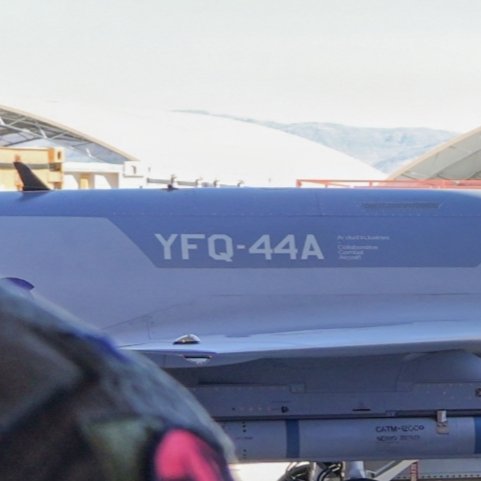
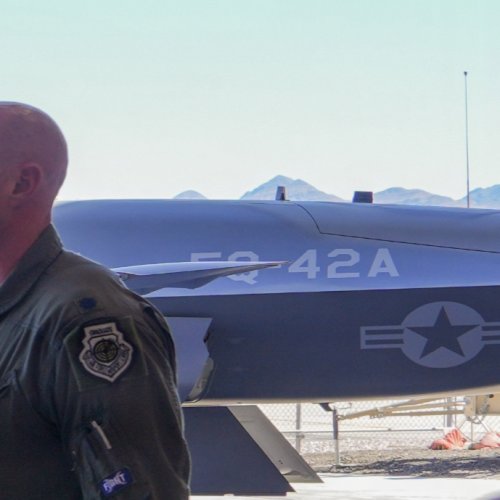
Has AndurilsSo it does look like GA and Anduril are beginning their respective 150 aircraft LRIP programs.
Attachments
Attachments

- Joined
- 29 November 2010
- Messages
- 2,308
- Reaction score
- 5,294
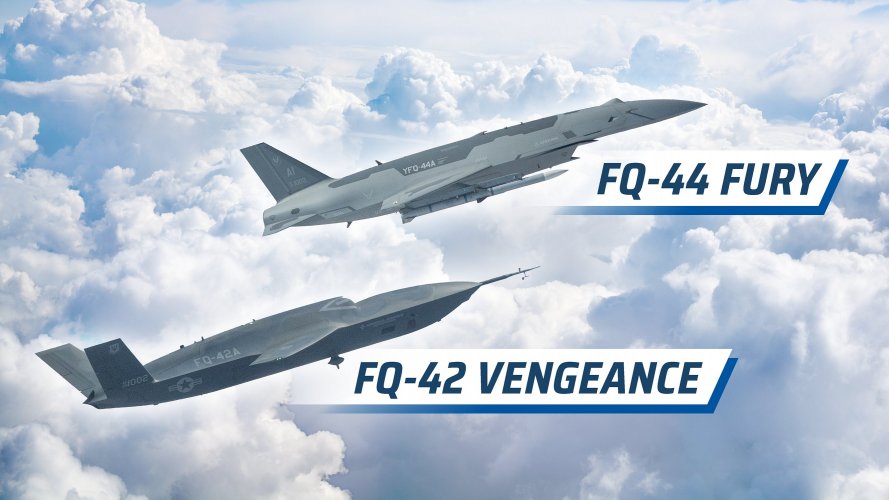
Thanks for the updates, will rename this thread with the new official name

Reddington777
ACCESS: Top Secret
- Joined
- 23 March 2025
- Messages
- 853
- Reaction score
- 2,837
https://www.ga.com/ga-asi-and-tacti...aircraft-close-kill-chains-versus-adversaries
Separately its worth noting that DARPA has started developing autonomous BVR capability for UAS.
The test paired a manned Tactical Air Support F-5 Advanced Tiger with an unmanned GA-ASI Collaborative Combat Aircraft (CCA) test aircraft...
Both the CCA test aircraft and the F-5 were equipped with GA-ASI’s TacACE® (Tactical Autonomy Ecosystem) software...
May or may not have been a FQ-42 or an avenger, but the technology is most certainly applicable to FQ-42.Each aircraft also carried an infrared search-and-track sensor. The live exercise proved that a CCA and a manned fighter can collaborate to fuse sensor data from AMS-GRA-compliant sensors to track, engage, and eliminate an airborne target while using a Beyond Line of Sight (BLOS) data link to accomplish seamless coordination between the two aircraft.
Separately its worth noting that DARPA has started developing autonomous BVR capability for UAS.

gojira007
ACCESS: Restricted
- Joined
- 17 November 2024
- Messages
- 21
- Reaction score
- 60
Shouldn't it technically be Fury II cause of the Navy Sabres back in the 50s ?
Or does it not carry over from F-XX to FQ-XX
Scott Kenny
ACCESS: USAP
- Joined
- 15 May 2023
- Messages
- 19,687
- Reaction score
- 28,173
I suspect that the USAF doesn't remember when the USN flew F-86s.Shouldn't it technically be Fury II cause of the Navy Sabres back in the 50s ?
Or does it not carry over from F-XX to FQ-XX
But yes IMO it should be a Fury II.
It's seems GA has been emphasizing the IWB of late - specifically at AFA, but not exactly saying what size weapon it can carry. Why is this so hush hush? When they started down the road of CCAs I thought it would be possible to build a CCA around a IWB which could carry two AMRAAM sized weapons. I wonder if the secrecy is more aimed competitors than China. But certainly it's competitors would have a good idea of what is possible with the FQ-42. I wouldn't be surprised if the IWB is limited to a few SDBs or a smaller form factor A2A missile.I wonder when they plan on starting IWB testing. One would think that would have been a priority before starting production or awarding contracts but looks like it has not yet begun on this platform.
bring_it_on
I really should change my personal text
- Joined
- 4 July 2013
- Messages
- 4,225
- Reaction score
- 5,771
They had not been emphasizing it earlier because, unlike their competition, they had not yet launched a weapon. They bring it up now because they are likely going to start doing that soon. The IWB has to be sized around the AIM-120. Most probably two. Has to be since that's what Inc 1 will carry initially.It's seems GA has been emphasizing the IWB of late - specifically at AFA
Last edited:
I’d assume that the YF-42 crash in April put a monkey wrench into that test schedule. Between the crash and return to flight was about 6-7 weeks depending on how you counted. So that put them basically into late May/early June for return to testing; and when you return to flight you ain’t testing weapons. You’d test the stuff that caused you to crash in the first place to make sure it’s fixed.I wonder when they plan on starting IWB testing. One would think that would have been a priority before starting production or awarding contracts but looks like it has not yet begun on this platform.
Given YFQ-42/44 testing was pretty much on parallel path before the crash we can use Andruil’s first AIM-120 shot in mid July as a bench mark for where they should have been if they didn’t crash. Since return to flight push the schedule back 1.5 months that puts us at the beginning of September. Given you’d have to do regression testing to make sure your fix fixed the problem and doesn’t produce new ones, if GA does an AIM-120 launch late September or October means they are pretty much track with how aggressive Andruil had been with their schedule.
Also with any test program, not every airplane is equipped or instrumented to do all of the test. Typically the first one checks out aerodynamics and air-data systems; you’d have one for structures; one instrumented for engine integration and one for weapons integration. If the plane that had crashed was instrumented for weapons integration then you’d have extra delay to reconfigure either an existing airplane or one on the production line to be the new weapons integration testing platform. Space reserved for weapons bay is a popular place to put telemetry and test equipment on vehicles assigned to test something other than weapons integration. It may not be practical to reconfigure an existing test aircraft into a weapons integration testing vehicle.
TL : DR Current paceof YFQ-42 testing is still seems with weapons integration being a priority given that GA lost a vehicle in April.
Edit: YFQ-42 weapons integration testing is also more complicated than YFQ-44 because of the internal weapons bay. You’d have to do more design reviews such as weapons bay door loads, vehicle stability with doors open, mechanisms kinematics (hydraulics maybe?). There are definitely a lot more steps you have to take to integrate a weapon into a weapons bay than simple rail launch or pylon release. So that can also affect weapons testing schedule on YFQ-42 compared to YFQ-44
Last edited:
Scott Kenny
ACCESS: USAP
- Joined
- 15 May 2023
- Messages
- 19,687
- Reaction score
- 28,173
Who's the forum flight test SME, was that @Byeman ?Edit: YFQ-42 weapons integration testing is also more complicated than YFQ-44 because of the internal weapons bay. You’d have to do more design reviews such as weapons bay door loads, vehicle stability with doors open, mechanisms kinematics (hydraulics maybe?). There are definitely a lot more steps you have to take to integrate a weapon into a weapons bay than simple rail launch or pylon release. So that can also affect weapons testing schedule on YFQ-42 compared to YFQ-44
How much extra stuff does dropping from an internal bay add to a flight test schedule. I know you're going to be flopping doors at all sorts of speeds and watching flutter, some basic test shapes with serious internal pucker the first drop hoping the computer was right and the store drops clear.
bring_it_on
I really should change my personal text
- Joined
- 4 July 2013
- Messages
- 4,225
- Reaction score
- 5,771
Yes, I think that's partly the reason. We have also not seen images of them loading and unloading weapons from the IWB to train crews / obtain feedback etc like Anduril has done through its deployments with the test unit. Anduril also beat GA-ASI as far as I can tell by flying flight autonomy sooner (first flight itself), and by flying the Shield AI developed mission autonomy suite (Shield is paired wiith Anduril while Collins is paired with GA-ASI though both are interchangeable) and also flying multiple autonomy suits on a single mission (Anduril flew Shield and its own set of autonomous behaviors in a single flight event). So while GA-ASI is most likely fine in terms of meeting or exceeding program's timelines for test, Anduril seems to be running ahead.YFQ-42 weapons integration testing is also more complicated than YFQ-44 because of the internal weapons bay. You’d have to do more design reviews such as weapons bay door loads, vehicle stability with doors open, mechanisms kinematics (hydraulics maybe?). There are definitely a lot more steps you have to take to integrate a weapon into a weapons bay than simple rail launch or pylon release. So that can also affect weapons testing schedule on YFQ-42 compared to YFQ-44
Last edited:

- Joined
- 3 June 2011
- Messages
- 20,998
- Reaction score
- 19,286
Scott Kenny
ACCESS: USAP
- Joined
- 15 May 2023
- Messages
- 19,687
- Reaction score
- 28,173
Thanks.
Hey, @mkellytx , how much time would a weapons bay add to a flight test protocol for weapons clearance. And this would be initial weapons bay clearance for weapons, so all the fun of door flutter and cycle times under high speed air flow, any weird wind blocks needed to shape the air flows around the bay opening, etc.
Who's the forum flight test SME, was that @Byeman ?
How much extra stuff does dropping from an internal bay add to a flight test schedule. I know you're going to be flopping doors at all sorts of speeds and watching flutter, some basic test shapes with serious internal pucker the first drop hoping the computer was right and the store drops clear.
If you limit the wording to “flight test schedule” then it ain’t much because a live fire is a live fire. You might for a few extra flights to characterize your flight dynamics with weapons bay doors opening and closing without dropping; you might do it on the same flight at a later test point. But IMO phrasing the question this way is somewhat disingenuous. Adding a weapons bay adds a huge chunk of engineering work and testing that needs to be done that you otherwise wouldn’t need to do. So it might not add to the “flight test schedule” by a lot, but it is going to affect the overall schedule.
How much it adds to the overall schedule depends on how much resource you decide to throw at it and how much of the work you can parallelize. You can compress some of the schedule by throwing more engineers at it but some of the stuff just can’t and must be done serially. But at the end of the day you will need to do a lot more engineering work and testing with a weapons bay vs not having one.
Some of the things you have to do with a weapons bay are things like captive trajectory (CTS) wind tunnel test to make sure your weapons clears the aircraft cleanly. You will also need to do a longer wind tunnel test because you have to get aero data with doors open and closed. After you’ve actually build some aircraft, you’d have to do a pit drop of stores from the weapons bay to ensure your mechanism for ejecting the payload works and ejects the store at the speeds you predicted. All of this is extra work you will have to do on the ground before doing a live fire test.
A rail launch doesn’t need a drop test because the missile flies itself off a completely passive rail. On a rail launch the missile is active on the rails and will start stabilizing it self as soon as it clears the rails. and the rail constraint the launch vector of the missile which generally ensure a high probability that the missile gets a clean separation.
For a drop launch, the missiles’s initial state is unconstraint. This means you have to do a lot more engineering work to make sure the missile will clear the aircraft when it is launch at different AoA/AoS, speed, and altitude (all of these things affects the initial trajectory of the missile). YouTube is full of store separation mishaps videos where the weapons comes back and hit the launching aircraft. This adds a lot more engineering work to the overall schedule.
Sure, Andruil will have to do pit drops and maybe additional wind tunnel tests to clear dropping bombs off Fury, but you can do that well after you’ve done your AIM-120 rail launch. Dropping bombs off increment 1 CCA is also a stretch goal of the program and not a critical feature that Andruil has to demonstrate (that we know of anyways).
Similar threads
-
-

-
-

-
 AFRL Low-Cost Attritable Aircraft Technology (LCAAT) Program
- Started by Triton
- Replies: 179