
Grey Havoc
ACCESS: USAP
- Joined
- 9 October 2009
- Messages
- 24,421
- Reaction score
- 17,891

 www.twz.com

 www.twz.com
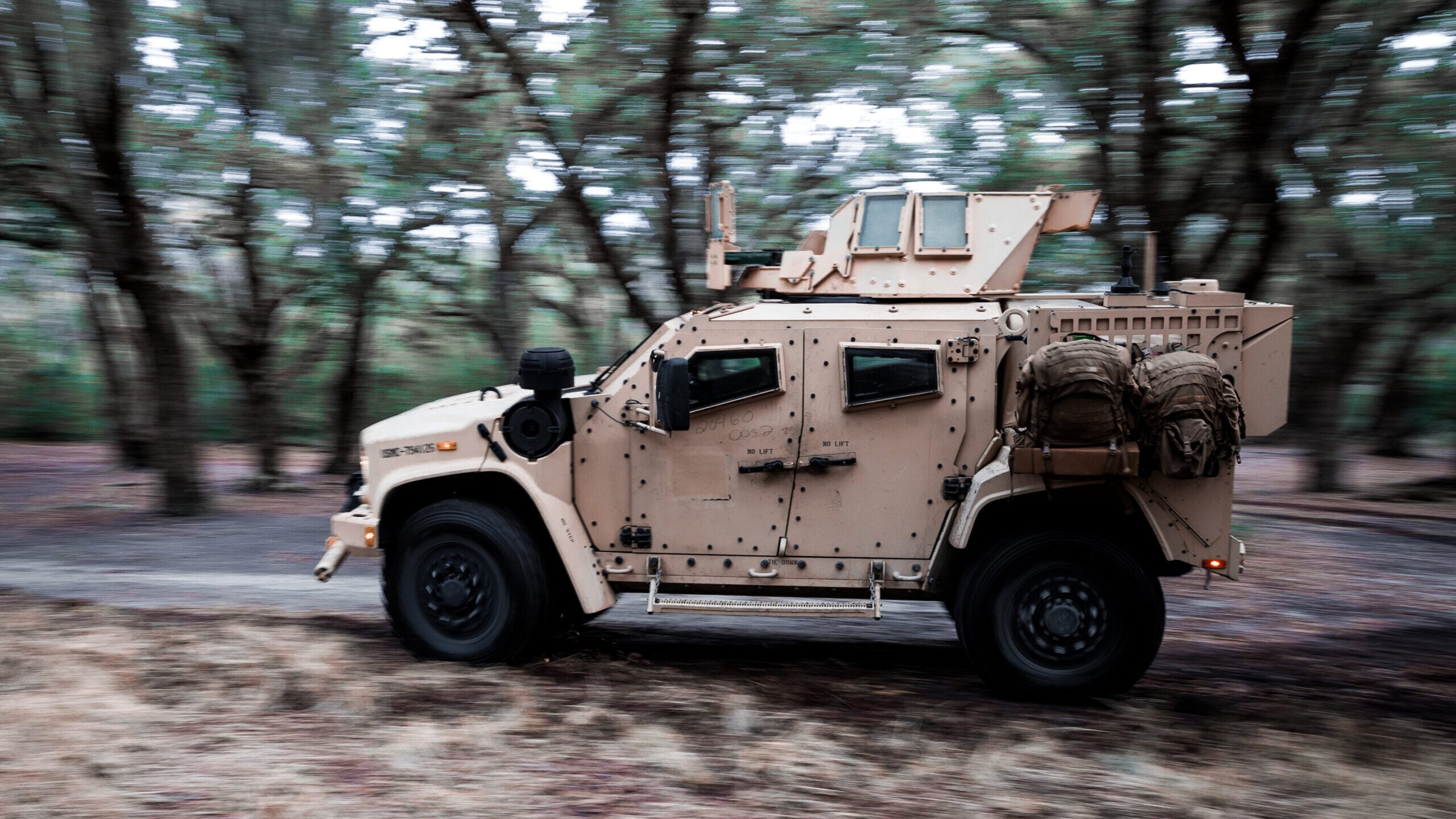
Marines 'committed' to JLTV despite Army divestment, expected price increase: Service chief - Breaking Defense
Rep. Betty McCollum said she was “dismayed” to find out the Army did not consult with the Marine Corps prior to making its decision.breakingdefense.com

 www.navalnews.com
Back in 2022, the Marine Corps called up Leidos looking for a discrete, unmanned surface vessel that could transport thousands of pounds of supplies without being seen.
Nine months later, II Marine Expeditionary Force had Sea Specter in hand for testing as part of the Corps’ Autonomous Low-Profile Vessel program. At 65 feet long and with a profile from inches to just a couple feet above the water, it’s reminiscent of the self-propelled semi-submersible boats drug traffickers have used to cross oceans in recent years.
“I think that it's OK to say that those narco subs inspired the concept, but that's where the similarities end,” Jeff Bowles, chief engineering officer at Gibbs & Cox, a Leidos company, told Defense One. “Narco subs are dirty. They're dangerous. They're not engineered. But in principle, their mission is the same—move a large volume of cargo with the minimal chance of being observed by anyone else, right?”
In the Defense Department’s shift from counterinsurgency in the Middle East to near-peer conflict in the Indo-Pacific, the concern that enemies will be able to shoot down planes or blow up supply ships is very real.
“So you might not be able to take something that's a big, high-value target, or something that's slow moving or highly observable, to deliver re-supplies to the troops, because it might give away their position,” Bowles said.
The Marines, who are training to fight from Pacific islands, are looking for a fleet of floating logistics drones that can fan out to multiple outposts at the same time.
Originally remote-controlled, the Marine Corps requested an autonomous feature, Bowles said, which is done with waypoints, or route markers the boat’s sensors can seek until it gets to its destination.
“And it'll try not to hit anything,” Bowles added. “If it's going to have a collision with another vessel or some other fixed object, it will stop and notify for help or do some basic maneuvers to avoid potential collision.”
The Marine Corps has three of them now, the third a second-generation prototype being tested by the 12th Marine Littoral Regiment in Japan.
With a sensor mounted 8 feet above the deck, the ALPV can see about 5 to 7 miles in front of it, and can carry 5 tons for 2,300 nautical miles, traveling at 8 knots. Tie-downs inside the boat are designed to hold pallets, so the vessels can be loaded down with ammunition, food, fuel, water, or anything else.
For example, from Guam to the Philippines is about 1,500 miles. Ideally, Bowles said, they’d send a couple dozen ALPVs loaded with gear, so if they lost half of them, there would still be adequate supplies to deliver.
With a different sensor package, they can also be used for communications.
“This thing could loiter in a prescribed area for a very extended duration,” he said. “It could also form a picket line to look for intruders. You could line these up, you know, and look for human trafficking, or any type of people encroaching on U.S. territory. These things have the endurance to sit there.”
It also has open architecture for navigation, so a customer can add whichever autonomy software they choose.
The company is anticipating more military interest if Congress passes the reconciliation bill, which includes over $1 billion for small unmanned vehicles. The Army and Special Operations Command have both reached out, Bowles said, but haven’t placed an order.
“So the ability to turn out individual variants very quickly, from an operational testing and evaluation perspective, we believe, is something that we're going to find our customers asking of us,” Bowles said.
Leidos is also exploring new materials for the Sea Specter, which is currently made of wood.
“And that's not the solution that we believe is right for the long-term, and we're looking to move into preparing for high-volume production out of a different material,” Bowles said.
Something like fiberglass would be lightweight and resistant to corrosion, but a metal like aluminum or steel are also options—though they add to the overall weight of the boats, which means it takes more effort to transport them.
For now, Leidos expects the Corps to make ALPV a program of record in 2027, “and we certainly hope that they select Sea Specter to work with,” Bowles said.
 www.zona-militar.com
 www.navalnews.com
 www.navalnews.com

The Marine Corps’ Force Design update released in October adds a new capability to the service’s light armored reconnaissance battalions: a “maritime reconnaissance company” equipped with new tactical boats, to aid the battalions’ planned transformation into agile mobile reconnaissance battalions.
With that new unit and new boat — the multi-mission reconnaissance craft — will likely come a new slate of training and even a tailor-made job specialty, said Brig. Gen. Christopher Haar, assistant deputy commandant for Marine Corps Combat Development and Integration.
The addition of boat-borne maritime reconnaissance companies further supported the goal of small Marine Corps units operating in coastal regions, as the Force Design strategy envisions, Haar said in a recent interview.
“Because we operate primarily in the littoral regions, having additional small craft that we can move around in is pretty important.”
The small craft are part of an evolution that began when light armored infantry battalions were converted to more agile recon battalions in the mid-1990s, he said.
Meanwhile, “how do we employ the Marines and the skill sets that they’ve gained using these combat vehicles ashore to be able to do similar actions in the littorals?” he said. “We’re going through and trying to figure out what exactly are all the requirements that we need in these crafts.”
The boats themselves will be based on those made by Australia-based company The Whiskey Project Group. The 30 or 40-foot open-water boat models boast a rugged hull, integrated ballistic protection, shock-mitigating seats, low-profile fenders and a side cutout for ease of ingress and egress. They’re intended to operate in open-ocean conditions as well as coastal shallows, according to the Marine Corps.
Officials have previously said they want up to 18 of the boats, largely fielded to the three active-duty reconnaissance battalions.
The full set of features and specifications is still to be determined, Haar added.
“We’re going through and trying to figure out what exactly are all the requirements that we need in these crafts. And then once we’ve settled on that, it will be over to our Marine Corps Systems Command, or [Program Executive Officer] Land Systems, to acquire the specific crafts,” he said.
With the acquisition process will come the development of new doctrine for how to employ the boats, Haar said.
While the Marine Corps has long maintained some small boats for special operations and reconnaissance — including the rigid-hull inflatable boat and the combat rubber raiding craft, typically called Zodiacs — the multi-mission reconnaissance craft will be larger and have different operating parameters.
“There will be, obviously, new training, which means that there will probably be a new [military occupational specialty] at the minimum — an additional MOS that someone will have to go to school to get trained in,” Haar said.
Some training may be repurposed. The coxswain’s course currently used for Zodiac operators may, he suggested, be adapted for the new maritime reconnaissance companies.
“There will be maintainers that have to be trained on how to maintain the boats. There will be some facility impacts, because we’ll have to build additional boat lockers and boat maintenance facilities, boat storage facilities,” he said.
Changes to regulations around training ranges will also be evaluated to ensure the Marines can use the boats as they’re intended.
“If I’m going to start operating boats off of Southern California, making sure that both those areas in the water that are designated for training now — do they have to be expanded, or are they good enough?” Haar said. “That’s the full … analysis that we go through to make sure that we’re ready for those craft.”
He did not immediately have information to share on when acquisition of the boats is formally expected to begin, or when the evolution of the new battalions to mobile reconnaissance battalions is expected to be complete.
The plan to convert the battalions was announced in a 2022 Force Design update that built on a 2021 briefing that “identified the likely utility of multi-domain Mobile Reconnaissance units possessing [organic precision fires for infantry], light-weight vehicles, unmanned air and surface systems, boats and other capabilities necessary to succeed in a contested information environment,” according to the 2021 update.


