So you'd (jokingly) suggest a solution similar to how ASW helicopters have sonar under their belly, but with radar on a flying wing?

I find this interesting
I thinking the ultimate solution they're aiming for is an AMTI satellite constellation with permanent coverage from above. RCS looking down at cockpits and planform is likely far higher than RCS from the front.
 
There's a difference between having a handful of satellites that are doing the job and having a couple hundred of satellites doing the job.
At the height these satellites orbit, and must orbit to function, a civilian (if high end) laser emitter combined with a computerised mount (such as those avaliable in even home telescopes) could conceivably blind if not significantly damage them (structurally). To say nothing of a dedicated military response by a nation that makes significant quantities of both.
 
At the height these satellites orbit, and must orbit to function, a civilian (if high end) laser emitter combined with a computerised mount (such as those avaliable in even home telescopes) could conceivably blind if not significantly damage them (structurally). To say nothing of a dedicated military response by a nation that makes significant quantities of both.
Just curious. What part of a notional radar satellite do you plan to blind with a laser?
 
Just curious. What part of a notional radar satellite do you plan to blind with a laser?
Blind was something of a mistake on my part (though not entirely, iirc the notional BAE/Hanwha multi sensor system constellation incoporates satelites that operate on the visual spectrum), but that doesnt change the fact a laser can severely degrade or destroy a radar from range.
 
At the height these satellites orbit, and must orbit to function, a civilian (if high end) laser emitter combined with a computerised mount (such as those avaliable in even home telescopes) could conceivably blind if not significantly damage them (structurally). To say nothing of a dedicated military response by a nation that makes significant quantities of both.
Now build hundreds of those, if not thousands. All of which will need a generator in the high hundreds of KW, plus a very fancy collimation mirror.

Also, the last laser I bought from China had a terrible "spot" size, something like 10m at 500m. You need a laser than can have a spot size of 10cm at 5000m.
 
Hardened Shelters don't cost that much, especially not compared to an AWACS or multiple fighters.

Or disperse them to commercial airports. At any one time about 3,000 737s are airborne, a few E-7s would vanish into that mass. Plus most airports globally can handle a 737.
 
The efforts the Ukrainians have made to eliminate Russian Mainstays suggests that full-capability battlespace management platforms are still relevant.

A couple of questions for the Hawkeye pushers (including myself, big fan, but there is a limit)

1) Can it refuel from A330 MRTT/KC-135 and KC-46 i.e. jet tankers?
2) Does it have a crew rest area/galley/toilet to allow the longer endurance operations the USAF will probably want?

Back on the late 60s and again in the 70s and finally in the 80s, the RAF concluded the answer to both question was 'No'.

More fast and break things. Including the USAF apparently.

Chris

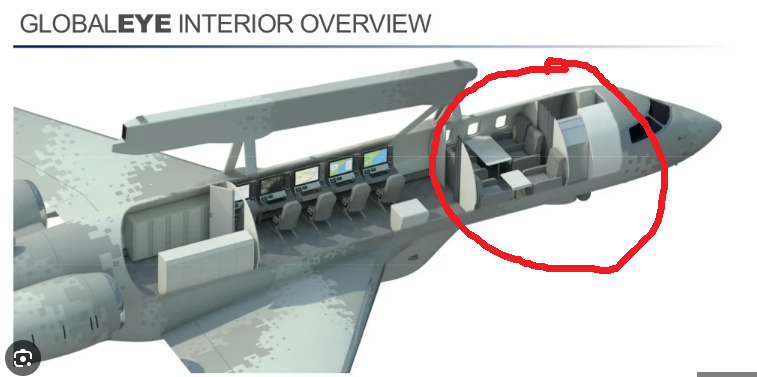
on that note, does other AEW aircraft, such as the GlobalEye (Sweden/UAE) and the G550 CAEW (Israel/Singapore/Italy/ Us Navy?) have a rest area/toilet?
I think the US Navy was planning to acquire some kind of variant of the latter
 
Of course! Swedes are a civilised people. The very idea of their crews munching on dried, curled-up corned beef sandwiches and touching cloth after the second refueling would be unthinkable!

1749883023042.png

SAAB via the Army Rumour Service.

Chris
 
How long will this system even take to be operational, IIRC I don't think space-based aircraft tracking technology has even been verified before.
 
Or disperse them to commercial airports. At any one time about 3,000 737s are airborne, a few E-7s would vanish into that mass. Plus most airports globally can handle a 737.
You're not going to successfully hide an E-7 at a civilian airport. On the ground, the net will light up with the local spotters saying 'did you see', and in the air as soon as it emits, it'll draw a big red arrow pointing at where it is for anyone with ESM.
 
Satellites have become invulnerable now?
I assume they'll go with a starlink like system with thousands of small satellites. It'll be near impossible to destroy the system and can provide constant coverage
 
on that note, does other AEW aircraft, such as the GlobalEye (Sweden/UAE) and the G550 CAEW (Israel/Singapore/Italy/ Us Navy?) have a rest area/toilet?
I think the US Navy was planning to acquire some kind of variant of the latter

The NC-37B is a missile range support aircraft, it's not an AEW platform.
 
You going to get that flake of paint in position with a $1000 plastic drone?
What's the cost per gram to lift stuff into orbit?

Paint flakes of the rockets, bits of metal off the stages. There is a lot of junk in orbit from all the launches.

Besides, anti-satellite systems exist.

And then is the US going to shoot down other countries satellites?
Otherwise they will put their own sensors....
More junk in orbit.
 
What's the cost per gram to lift stuff into orbit?

Paint flakes of the rockets, bits of metal off the stages. There is a lot of junk in orbit from all the launches.

Besides, anti-satellite systems exist.

And then is the US going to shoot down other countries satellites?
Otherwise they will put their own sensors....
More junk in orbit.
And aircraft engines can get FODed, "technically" anti-satellite systems exist, in reality a whole hell of a lot more cheap drones, SAMs, and AAMs, exist than anti-satellite weapons. And yes, if another country shoots down our satellites I would expect to return the favor.
 
What's the cost per gram to lift stuff into orbit?

Paint flakes of the rockets, bits of metal off the stages. There is a lot of junk in orbit from all the launches.

Besides, anti-satellite systems exist.

And then is the US going to shoot down other countries satellites?
Otherwise they will put their own sensors....
More junk in orbit.

Either side would have to fire dozens of kinetic interceptors to have a tangible effect, and that would create a huge collision hazard for both sides’ civilian and military satellites. It is certainly possible that happens, especially if one side perceives that the other will win otherwise (or just win in general), but I would lean towards both sides using non kinetic means to degrade or destroy satellites.
 
Satellites have become invulnerable now?
No, but an AWACS isn't exactly invulnerable against 6th gen fighters packing LRAAMs and it costs way more to shoot down satellites.

How long will this system even take to be operational, IIRC I don't think space-based aircraft tracking technology has even been verified before.
2029 - In testing now - Top link:

What's the cost per gram to lift stuff into orbit?
With RLVs (Falcon 9) it's ~$500/kg, with ELVs it was $30,000/kg even 20 years ago. There's also continuous mention of offensive space assets presumably with some ability to defend the system.
 
Last edited:
No, but an AWACS isn't exactly invulnerable against 6th gen fighters packing LRAAMs and it costs way more to shoot down satellites.
Satellites follow a mathematically predictable orbit.
You know where they be now and where they will be tomorrow.

Aircraft have a tendency to be far less predictable.
 
Satellites follow a mathematically predictable orbit.
You know where they be now and where they will be tomorrow.

Aircraft have a tendency to be far less predictable.

Exactly, aircraft are dynamic, they actively avoid threats and react to them in real time. Satellites can do so only in a limited way, if at all. There's so much space junk, out of commission satellites that can be turned into many, many, many projectiles that there are many things that can threaten satellites without any genuine countermeasures in place.

In any serious scenario satellites are gone pretty quickly. Not only are there dedicated anti-satellite systems already, these measures will improve and evolve further.

Satellites can be shot down, they can be deorbited, they can be neutralized through soft means, direct energy weapons, nuclear weapons. That doesn't even touch on things like deliberately producing large debris clouds or utilizing something like satellite-adequate birdshot.

The velocities in orbit turn everything into a destructive projectile. You just need a decent spread and let it cascade from there. You don't even need to destroy every satellite. You just have to seriously degrade the overall constellation to a degree where coverage becomes patchy or lower quality.

That is while redundancy with capable airborne, seaborne and land based radars in conjunction with satellites offer a far more robust framework for comprehensive coverage. Something that could definitely decide who loses less in a hot peer war.

TL;DR

DJTs and Elon Musks satellite obsession at the cost of other far more survivable, proven and reliable assets is kinda cringe tho

 
Last edited:
And how do you get it there?

Either by launching it or creating such a piece of debris deliberately with assets already in orbit.

How do you get a drone to a plane? You think it just spawns there? No, you have to conduct reconnaissance and target designation, then you engage in planning, choose a delivery method (given the range restraints imposed on "1000$ plastic drones") and execute the operation. Obviously you'd have to make sure beforehand that the AEW&C aircraft you're targeting aren't gutted parts bins though.

Taking out satellites requires plenty of planning and the necessary assets. So does anything involving drones though.
 
Satellites follow a mathematically predictable orbit.
Im 99 percent sure anyone who can right now is working on satellites that maneuver to different orbits. China already did something similar, the Space force expects to demonstrate it in 2026. Russia has done some similar stuff already too.
 
Im 99 percent sure anyone who can right now is working on satellites that maneuver to different orbits. China already did something similar, the Space force expects to demonstrate it in 2026. Russia has done some similar stuff already too.
The laws of physics generally disagree with that hypothesis. While change of orbital altitude and therefore eccentricity is quite cheap from an efficiency perspective, actually changing the orbital inclination is very expensive in terms of delta-v.

And before anyone quotes the X-37 experiment that used aerobraking to change inclination, please work out by how much you would need to scale up the extant Starlink/Starshield bus to have that capability.
 
Satellites have become invulnerable now?
No, but large constellations have made it difficult to make the entire constellation ineffective.

I suspect that final satellite spacing in the constellation will have 7+ satellites covering any given spot on earth, constantly.


The laws of physics generally disagree with that hypothesis. While change of orbital altitude and therefore eccentricity is quite cheap from an efficiency perspective, actually changing the orbital inclination is very expensive in terms of delta-v.
Just changing eccentricity will throw someone's attack calculations out the window.
 
The laws of physics generally disagree with that hypothesis.
Here's an article about the space force wanting this capability


Then there were reports of chinese satellites doing "dogfighting" - whatever that means.


Vice Chief of Space Operations Gen. Michael A. Guetlein said the operations involved “five different objects in space maneuvering in and out and around each other in synchronicity, and in control.”

At the very minimum, it would seem said "laws of physics" you state to be in disagreement may currently be questioned. Or it might not and its all just jargon gibberish hype. I wouldn't know the difference though.
 
Either by launching it or creating such a piece of debris deliberately with assets already in orbit.

How do you get a drone to a plane? You think it just spawns there? No, you have to conduct reconnaissance and target designation, then you engage in planning, choose a delivery method (given the range restraints imposed on "1000$ plastic drones") and execute the operation. Obviously you'd have to make sure beforehand that the AEW&C aircraft you're targeting aren't gutted parts bins though.

Taking out satellites requires plenty of planning and the necessary assets. So does anything involving drones though.
You can't just teleport it into space. A lot of things have to happen to get it there that, at this point, amounts to a lot of hand-wavium.
 
Here's an article about the space force wanting this capability


Then there were reports of chinese satellites doing "dogfighting" - whatever that means.


Vice Chief of Space Operations Gen. Michael A. Guetlein said the operations involved “five different objects in space maneuvering in and out and around each other in synchronicity, and in control.”

At the very minimum, it would seem said "laws of physics" you state to be in disagreement may currently be questioned. Or it might not and its all just jargon gibberish hype. I wouldn't know the difference though.
The article actually agrees with my position.

1) Significant on-orbit manoeuvres are expensive from a fuel perspective. To make it practical, you either have to carry a lot of fuel on launch, or provide for on orbit refuelling to extend the useful life.

2) This is something you are only really going to want to do for your large, infrequent, ‘exquisite” capabilities; this is not the kind of capability you want to put on low mass, high volume constellations, such as the type presumably hosting the AMTI payload.

3) The Chinese stalking is something the Russians have almost certainly deployed in an operational capacity, there are a series of small satellites “stalking” the large KH-11 imaging spy satellites. Again, this isn’t practical for targeting a low altitude constellation, which is more vulnerable to a ground based intercept approach.
 
Last edited:
Exactly, aircraft are dynamic, they actively avoid threats and react to them in real time. Satellites can do so only in a limited way, if at all. There's so much space junk, out of commission satellites that can be turned into many, many, many projectiles that there are many things that can threaten satellites without any genuine countermeasures in place.

In any serious scenario satellites are gone pretty quickly. Not only are there dedicated anti-satellite systems already, these measures will improve and evolve further.

Satellites can be shot down, they can be deorbited, they can be neutralized through soft means, direct energy weapons, nuclear weapons. That doesn't even touch on things like deliberately producing large debris clouds or utilizing something like satellite-adequate birdshot.

The velocities in orbit turn everything into a destructive projectile. You just need a decent spread and let it cascade from there. You don't even need to destroy every satellite. You just have to seriously degrade the overall constellation to a degree where coverage becomes patchy or lower quality.

That is while redundancy with capable airborne, seaborne and land based radars in conjunction with satellites offer a far more robust framework for comprehensive coverage. Something that could definitely decide who loses less in a hot peer war.

TL;DR

DJTs and Elon Musks satellite obsession at the cost of other far more survivable, proven and reliable assets is kinda cringe tho

I have no doubt both the U.S. and PRC will attempt to degrade each other’s constellations, but I think that is easier said then done: there are mid to high hundreds of targets already. China has launched about a hundred military or military adjacent satellites a year for several years now; the NRO has launched 180 in nine missions in the last year for its proliferated constellation alone. Kinetically engaging a significant number of a hundreds deep constellation (let’s say several dozen satellites to create a hole in coverage) is going to dramatically threaten both countries’ military and civilian satellite fleets in LEO.

I would expect some kind of non kinetic method would be adopted by both sides for that reason. Opponent satellites could physically screw with opposing platforms and use sprayers, netting, HPM, etc to neutralize without fragmentation, but that would take an a very large number of ASAT platforms on station to achieve a prompt effect. About the only thing I can think of that would allow for rapid engagement of huge numbers of targets is a ground based DEW of some kind that lit up the satellites as they came overhead. Not sure if lasers or other energy weapons are there yet, though it should be an area of future concern at least. Expect such an installation to be a very high profile target.
 
Im 99 percent sure anyone who can right now is working on satellites that maneuver to different orbits. China already did something similar, the Space force expects to demonstrate it in 2026. Russia has done some similar stuff already too.

All satellites can maneuver; the question is whether the platform or operators are sufficiently aware of a threat and whether the satellite has sufficient thrust/fuel to evade an attacker. But yes, there has been a lot of work in this field by all the relevant parties. I expect there will be ASAT satellites deployed shortly, and that their main target will be opponent ASAT satellites.
 
Kinetically engaging a significant number of a hundreds deep constellation (let’s say several dozen satellites to create a hole in coverage) is going to dramatically threaten both countries’ military and civilian satellite fleets in LEO.
Exactly. It then comes down to non-space assets and the remaining active space assets. Casualties are expected and unavoidable.

Also, when you're on the back foot against your rival super power who virtually prioritized space based systems above anything else, you're more than willing to induce a severe case of Kessler Syndrome. Mhmm, large debris clouds ripping through orbits repeatedly, cascading further and further.

And then imagine only being left with E-2s, lol couldn't be [Insert any air force who operates AEW&C aircraft].
 
The laws of physics generally disagree with that hypothesis. While change of orbital altitude and therefore eccentricity is quite cheap from an efficiency perspective, actually changing the orbital inclination is very expensive in terms of delta-v.

And before anyone quotes the X-37 experiment that used aerobraking to change inclination, please work out by how much you would need to scale up the extant Starlink/Starshield bus to have that capability.

The opponent ASAT satellite has the same limitations, though presumably is optimized for higher velocities and a shorter lifespan.
 
The opponent ASAT satellite has the same limitations, though presumably is optimized for higher velocities and a shorter lifespan.
Agreed - your best bet is arguably to manoeuvre enough in the prelude to war that maintaining the stalking capacity becomes prohibitively expensive.

This is also where the SPACECOM interview becomes interesting; there are certain orbits, that while not great for operational use (coverage, revisit, radiation environment) may be a useful storage area for on-orbit spares that could be used to replenish certain capacities - even as a limited capability gapfiller - rather than waiting for a ground launch. This is where the capability demonstrated by X37 may find a valid operational niche.
 
Exactly. It then comes down to non-space assets and the remaining active space assets. Casualties are expected and unavoidable.

Also, when you're on the back foot against your rival super power who virtually prioritized space based systems above anything else, you're more than willing to induce a severe case of Kessler Syndrome. Mhmm, large debris clouds ripping through orbits repeatedly, cascading further and further.

And then imagine only being left with E-2s, lol couldn't be [Insert any air force who operates AEW&C aircraft].

Kessler would not be a prompt effect, it would just be the slow moving train wreck that resulted from a large scale kinetic engagement. Ground to orbit engagements are not cheap anyway; you need two dozen rockets to launch individual kill vehicles to engage a batch of satellites that spit out of one reusable rocket like a pez dispenser, thereafter leisurely achieving their final orbit with ion thrusters. Even assuming a 100% success rate, it seems likely the attack is more expensive than satellite plus launch costs.

ETA: it certainly is possible one or both sides use kinetic weapons, but I think it more likely other methods will be/have been developed.
 

Similar threads

Back
Top Bottom