How deep will a hypervelocity penetrator go?

Scott Kenny

ACCESS: USAP
Joined
15 May 2023
Messages
19,748
Reaction score
28,301
This question popped up while I was thinking about space ships in combat, but it does apply to wet-navy ships as well.

I've heard that the basic APFSDS sabot round will do a through-and-through of a single MBT.

But what happens when you hit a ship with one? How many MBTs/ship compartments would a sabot round go though?

And what happens as you crank the sabot's speed up?
 
A quick google returned an article on fin-stabilized discarding sabot rounds. There's an interesting section on fluid penetration that says hardness, toughness and strength of the penetrator are the effective parameters for penetration (stop laughing at the back).

I suspect the short answer is that as speed increases, the likelihood of said penetrator fragmenting or becoming a jet of molten metal upon initial contact increases, potentially eliminating any benefit increased velocity has. I imagine similar to shooting at things underwater (Mythbusters looked at this), whereby lower velocity bullets can transition the air/water interface intact whilst higher velocity rounds fragment.

But I'm no expert and I'm sure someone who is will be along shortly to educate us all.
 
But what happens when you hit a ship with one? How many MBTs/ship compartments would a sabot round go though?

I suppose it would behave a lot like spaced armour? Just with greater spacing? The walls of modern ships are typically quite thin... I'd guess that deformation and yaw produced on the rod would actually slightly increase the hole size in each successive bulkhead, and that there would be quite a bit of spalling. It wouldn't have enough damage to reliably destroy heavy machinery or poke a hole large enough to sink the ship - but it would do a lot of damage to anything lighter in the way.

It makes me wonder how a CRV-7 with large Flechettes would do against smaller warships.
 
An APFSDS penetrator will probably deflect and fragment before it gets all the way through a ship. Each impact with a bulkhead is going to induce a slight yaw, and the length of the path through the ship will give plenty of time for the penetrator to start tumbling. The fragments are probably going to be fast enough to penetrate more bulkheads, so it might get through the beam. I would guess penetration stopping somewhere around 50 - 150 ft through the ship. Patching <3 inch holes in pipes and bulkheads is not usually a huge challenge, there wouldn't be much vertical extent to the fragmentation, and the holes would be above the waterline, so it would not be a significant threat to the ship.
 
This question popped up while I was thinking about space ships in combat, but it does apply to wet-navy ships as well.

I've heard that the basic APFSDS sabot round will do a through-and-through of a single MBT.

But what happens when you hit a ship with one? How many MBTs/ship compartments would a sabot round go though?

And what happens as you crank the sabot's speed up?
Kelly Johnson said a 2,000lb tool steel bomb, dropped from a Blackbird, would go through the flight deck of a carrier and come out the bottom of the hull.
 
It makes me wonder how a CRV-7 with large Flechettes would do against smaller warships.
The CRV-7's 13lb (5.8kg) RA-79 HE SAP warhead was designed for the anti-shipping role.
 
Even hypervelocity impactors are slower than the speed of sound in armour, so Newton's approximation for impact depth can be applied in solid materials. Very roughly, a DU penetrator will penetrate 2.5 times its length into steel.

Provided, of course, that the projectile isn't deflected or broken up. Modern protective schemes for armoured vehicles aim to do this, and the bulkhead structure of a ship would do something similar against an APFSDS projectile. In the latter case, you'd have devastating damage in the first compartment entered.
Kelly Johnson said a 2,000lb tool steel bomb, dropped from a Blackbird, would go through the flight deck of a carrier and come out the bottom of the hull.
And it would make a nice neat near-circular hole most of the way down. There's a reason solid shot went out of fashion in the middle of the 19th century.
 
And it would make a nice neat near-circular hole most of the way down. There's a reason solid shot went out of fashion in the middle of the 19th century.
You think it's going to get lucky enough to not hit anything important on the way through?
 
A quick google returned an article on fin-stabilized discarding sabot rounds. There's an interesting section on fluid penetration that says hardness, toughness and strength of the penetrator are the effective parameters for penetration (stop laughing at the back).

I suspect the short answer is that as speed increases, the likelihood of said penetrator fragmenting or becoming a jet of molten metal upon initial contact increases, potentially eliminating any benefit increased velocity has. I imagine similar to shooting at things underwater (Mythbusters looked at this), whereby lower velocity bullets can transition the air/water interface intact whilst higher velocity rounds fragment.

But I'm no expert and I'm sure someone who is will be along shortly to educate us all.
I'm pretty sure this is called the "shatter-gap" - the shell striking the armor will send a shockwave down through the shell caused by the instantaneous deceleration. If this shockwave generates forces too high for the tensile strength of the material, then it will shatter (instead of expanding). There's a nice simulation of on YouTube of a 76mm M62 (WW2 Era) shell being fired at 720 m/s and 783 m/s with the 720 m/s shell penetrating much more efficiently, whilst the faster shell shatters, but I don't think this is the case with modern APFSDS projectiles - I think they erode more like a self-sharpening pencil, where it's instead the length of the projectile (and speed) that determines the overall penetration. For the hypervelocity regime, then the internal strength of both the armor and a hypervelocity projectiles are completely overcome during impact, and they will instead behave like hypercompressed liquids (think of one liquid pushing the other away), and the penetration will best be described by hydrodynamics. One example of this is Hill-Mott-Pack equation:

D = L × √ (ρ_projectile/ρ_target)
​
where D is the depth of penetration, L is the length of the projectile, and ρ is the density, but there are of course other equations that describe the same phenomena in a better, albeit less simple manner.
 
The equations are neat but the devil is in the details ranging from material, body geometry, ballistics, and then armor & weapons effects.
So I won't bother to outline it all.
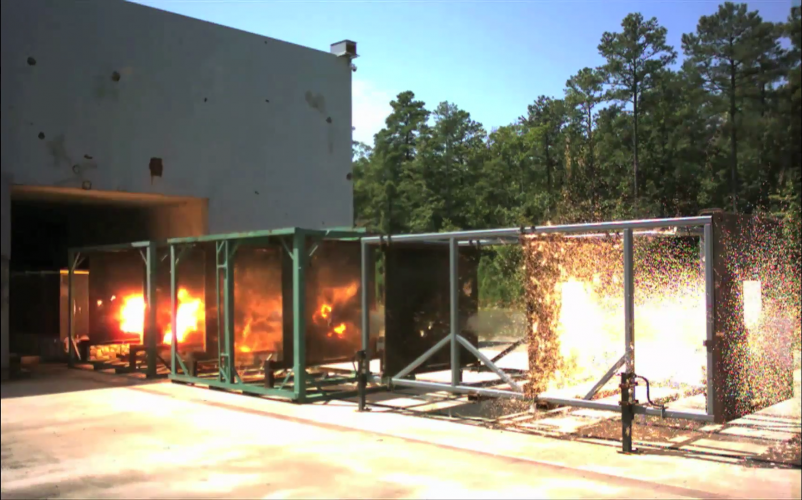
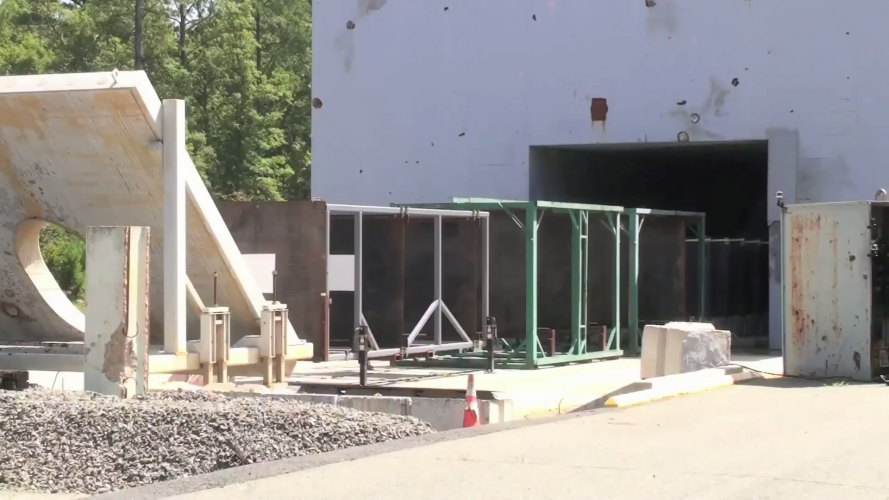
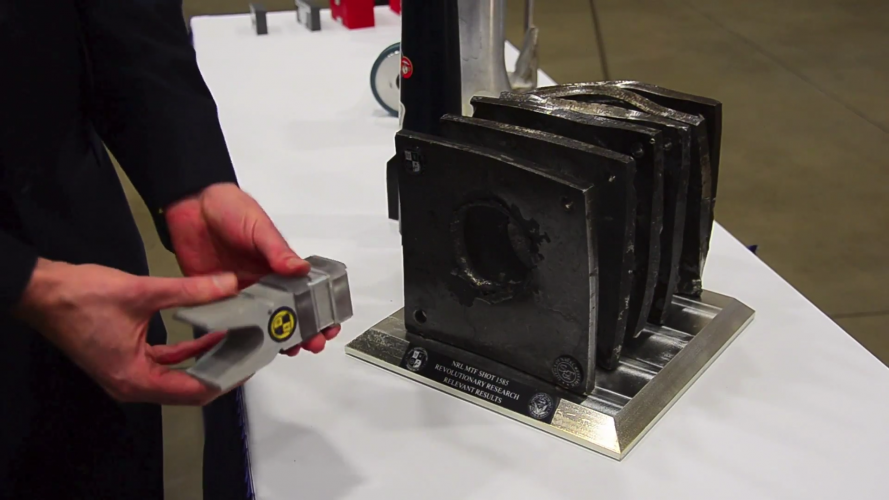
As for real world we do have footage of it from the Navy if you may recal from ~2008.


We can see the small projectile (2-3" long) penetrates 7 plates spaced about the beam size of a ship and we see at least 5 more plates hidden inside the hall downrange. We do see it hit the first plate inside but the blast hides the rest.
We are only presented with 6 plates, though.
 

Attachments

  • Electromagnetic Railgun_00.05.png
    Electromagnetic Railgun_00.05.png
    2.2 MB · Views: 2
  • The Navy's Giant New Electric Railgun_00.05.png
    The Navy's Giant New Electric Railgun_00.05.png
    1.7 MB · Views: 1
  • Electromagnetic Railgun_00.06.png
    Electromagnetic Railgun_00.06.png
    1.3 MB · Views: 2
  • The Navy's Giant New Electric Railgun_01.10.png
    The Navy's Giant New Electric Railgun_01.10.png
    1,013.6 KB · Views: 2
Probably not all that far. Unlike a tank, ships are full of 'stuff' that is at all different angles, hardnesses, types of material, etc. For instance, what happens with one when it goes into a tank say, two meters wide, full of liquid of some sort? From what I can tell, liquids are quite effective at stopping such a projectile in its tracks so-to-speak.

 
Last edited:
Back
Top Bottom