Dilandu
I'm dissatisfied, which means, I exist.
(a bit of my futuristic works...)
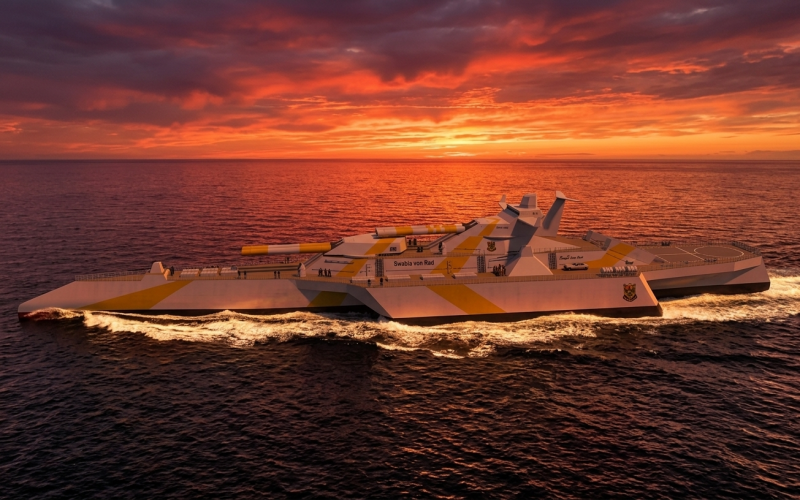
The «Simba wa Radi» were the first capital naval units ever build on African coninent. Designed at the period of massive economical boom of Panafrican Union - caused by global demographic collapse of mid-XXI century, which left Panafrican Union in control of the largest pool of young, capable manpower of the planet - it represented not merely a new generation of warships, but symbol of African nations new, stronger place in the world.

The battleships were designed by «Panafrica Heavy Industries» as massive trimaran units, with middle (main) hull housing main systems, and side hulls being used to store volative, highly-dangerous components. The main hull was divided by three longidutal and 24 tranverse bulkheads. The hull was made from high-tensile steel, supplemented in cricual parts by composite carbon-based ties.
The armor protection was provided by two-layer flat armored deck, of 40 mm steel plates, supported by dilatant liquid layer. The space between armor plates was filled by dielectric material, and used as element of vaporization-type electric armor (designed to disrupt the shaped charge jet or to destroy the hardened penetrator tip).

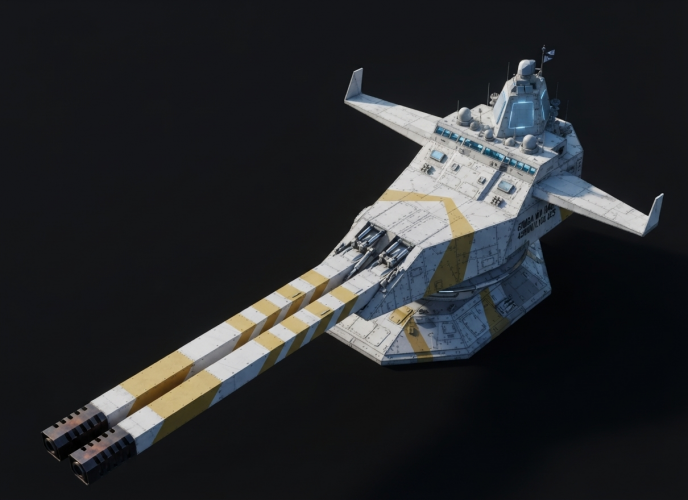
A somewhat unique architecture solution was the ship's bridge being build into superfiring main turret - as well as main radar tower over the bridge. The relatively low recoil of main artillery (of ram accelerator type) made such arrangement possible, despite being universally viewed as sub-optimal.
The battleship's powerplant was quite unique. The drive system was based on magnetohydrodynamic principle, with water as driving medium. To improve the drive efficiency, the MHD drive was of electrode-less, induction-pulse type; the water was pushed by magnetic fields, created by massive induction coils inside ship's hull, and contained salts were partially ionized by powerful microwave emitters at drive intake. Thus both drive efficiency was increased, and gas bubble erosion of drive components prevented.
But MHD drive system was only part of the ship's propulsion. Alongside the hull of «Simba wa Radi» a series of induction coils were placed, to provide laminar flow control. The UMTM system (swah. Udhibiti wa Mtiririko na Tabaka la Mpaka - Border Flow control ) was able to drastically reduce tubulence, optimize the laminar flow, and reduce the ship's acoustic signature by orders of magnitude.
The highly-advanced drive system came at cost, though. The enormous power consumption required installation of no less than six (!) thorium molten salt-type fission reactors. Based on commercial design, the reactors were of relatively low power, but generally reliable and efficient.
SENSOR EQUIPMENT:
The sensor systems of «Simba wa Radi» class was somewhat lacking. The ship was provided with standard-issue active phased array RTA-23F radar, designed by «Polystar International» in cooperation with Israel «Elta» corporation. Such radar was essentially a modernization of destroyer-grade RTA-23 radar, hardly optimal for 85.000 tons dreadnought:

The radar was capable of tracking air & space tarjets at 550 max range, track targets (including orbital and ballistic) at 450 km range, and simultaneously track up to 200 targets with firing solution provided against 50. The main antenna array was supplemented by several passive receiver antennas placed alongside hull sides, forming essentially a multistatic radar array - to increase the efficiency against small & stealthy targets.
MAIN ARMAMENT:
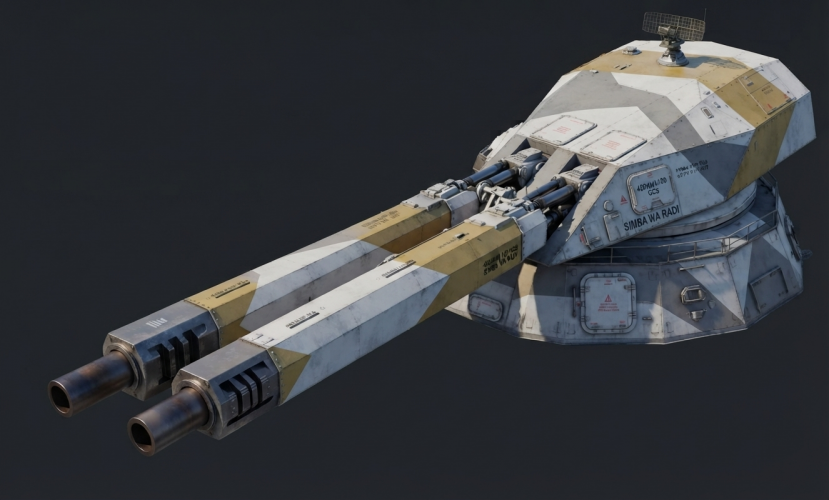
The main armament composed of four 45-cm/100-caliber ram accelerator cannons, designed by «Xanadu Aerosystems», adapting technological solutions from Kilimanjaro Space Accelerator project. The fifty-meter long barrels, filled with combustive gas mix, accelerate the scramjet-equipped shells to the muzzle velocity of 2.5 km/s - giving them a max range of about 580 km. To produce such velocity, four-stage approach is used:

* Zero stage - initial boost chamber, using liquid propellans to accelerate shell to 1.0 km/s starting velocity;
* First stage - methane-oxygen-nitrogen mix, accelerating the shell to 1.6 km/s;
* Second stage - ethane-oxygen-helium mix, accelerating the shell to 2.1 km/s;
* Third stage - hydrogen-oxygen mix, accelerating the shell to 2.5 km/s;
The stages are separated by iris hatches, which are opened & replaced by pressurized nitrogen "gas curtains". A one shell per 50 second fire rate could be achieved.

The ram shells are 1100-kg (800-kg after ramjet elements detaching) guided units, equipped with foldable rudders, autopilot and advanced sattelite/ground beacon narrow-beam navigation system. They are mostly kinetic type, relying on their impact velocity (over 1.3 km/s) to dealt with the target. A small "splattering" charge is installed mainly to ensure better kinetic energy transfer into the target bu shell fragmentation. Against soft area targets, a hypervelocity shrapnel shell, filled with tungsten rod bundles is used. A "special" shells with 50-kiloton linear fission bombs are rumored to exist.
The ammo supply is 250 shell per accelerator - 1000 shells per battleship. About 1200 tons of liquified gas mix is stored onboard, mainly in secondary hulls (to protect the vital parts in main hull in case of catastrophic explosion).
SECONDARY ARMAMENT:
The secondary armament consisted of three smaller 10-cm/100-caliber ram accelerator cannons, in dual-purpose mounts. Those cannons were intended for direct fire against enemy surface targets, aerial missiles & planes, as well as ballistic targets by sub-caliber hypersonic shells, accelerated to nearly 3 km/s:

Tetriary defense armament is provided by eight dual «Denel Land Systems» 35DPG mounts, equipped with time-fuzed shells.
ANTI-SHIP MISSILE ARMAMENT:
The anti-ship missile armament consisted of 24 heavyweight «Mkuki-Topido» MT-533 (swah. Spear-torpedo). Those torpedo-carrying missiles consisted of turbojet-powered flying module, carrying heavyweight DM2A6 torpedo (license production) toward the target. The core of concept was, that the low-flying missile would drop the torpedo into water while still staying below the target's horizon - thus avoiding close-range air defenses, especially energy-based ones.
After launch, MT-533 flew toward the target position at 50 meters cruising altitude. Coming into close proximity of the target, the missile detached sub-drone - a small foldable glided, equipped with imagining IR sensors. The sub-drone gained altitude and scanned for target, while missile descended to the 5 meters terminal altitude, relying on data stream of sub-drone. After the target was detected, the missile programmed the torpedo autopilot and dropped torpedo into water; torpedo dived at 200 meters depth, and proceeded to target position, after which activated its own seeker.
ANTI-AIR MISSILE ARMAMENT:
The anti-air missile armament consisted of 200 peripheral launch cells of MUM-K desing (swah. Mfumo wa Urushaji Makombora — Kiafrika - African Missile Launch System). Those cells were specifically developed to operate «Umkhonto-2/3» family of short- and medium-range SAM's, designed by Denel Dynamics».

ANTI-BALLISTIC MISSILE ARMAMENT:
Initially no area ballistic missile defense armament were planned, and self-defense were supposed to be provided by SAM's. But during design process, it was decided to add area defense anti-ballistic/anti-satellite missiles on battleship. A commercial lightweight sattelite booster, powered by liquid oxygen - liquid methane mix was adopted as the basic for long-range anti-missile missile; while normally use of liquid fuel rocket onboard warship would be unthinkable, the «Simba wa Radi» was already designed to operate hundreds of tons of liquid methane and oxygen for its main guns - so risk was deemed to be acceptable:

The commercial booster was topped by KMK-1XA exoatmospheric interceptor, designed by «Xanadu Aerosystems» (swah. Kizuia-makombora cha kujiendesha - autonomous missile interceptor). The interceptor itself was composed of three gimballed shperes connected by struts and frames: upper shpere contained IR telescope and guidance unit, middle sphere contained directed shrapnel charge (aimed toward target interception point), and lower shpere contained engine unit.
DIRECTED ENERGY ARMAMENT:
The directed energy armament was provided by «Asà ìmọ́lẹ̀ àìrí» (yorub. Shield of invisible light) AIA-1MW microwave cannons, designed by «Polystar International». The cannons used large phased array antenna to attack target with high-power microwave beam. In "widspread" mode, a fan-shaped beam could be used to swap out swarms of small drones in direct proximity of the ship. In "narrow beam" mode, a pencile-shape beam was generated to attack specific target - like cruise missile - at dozens of kilometer range.

For the characteristic shape, the antennas were nicknamed "Lion cub ears".
TORPEDO DEFENSE:
Torpedo defense of «Simba wa Radi» is mainly based on soft-kill acoustic decoys and hard-kill proximity mines with active depth control, deployed from automatic launchers in the direction of incoming torpedo. Additional protection is provided by UMTM laminar flow control system, which allowed battleship to greatly reduce and/or change its acoustic signature, as well as split the ship's wake, fooling wake-homing torpedoes.
AIR WING:
The rear part of «Simba wa Radi» hull is occupied by extensive flight deck, connected by build in superstructure elevators with under-deck hangars. The battleship is capable of operating up to six helicopters (including up to three heavy-load ones), and up to eight STOVL drone jets. A rather "classic" solution for drone launch was implemented in terms of turntable electromagnetic catapults, allowing drone to be launched regardless of wind direction.

Below the flight deck, the hangar-dock for twelve "Sea Serpent Mk.V" pilotless boats is placed. The drone boats are mainly used to form outside sensor perimeter around battleship, being equipped with low-altitude search radars & receiver antennas for RTA-23F battleship's radar.
The «Simba wa Radi» were the first capital naval units ever build on African coninent. Designed at the period of massive economical boom of Panafrican Union - caused by global demographic collapse of mid-XXI century, which left Panafrican Union in control of the largest pool of young, capable manpower of the planet - it represented not merely a new generation of warships, but symbol of African nations new, stronger place in the world.
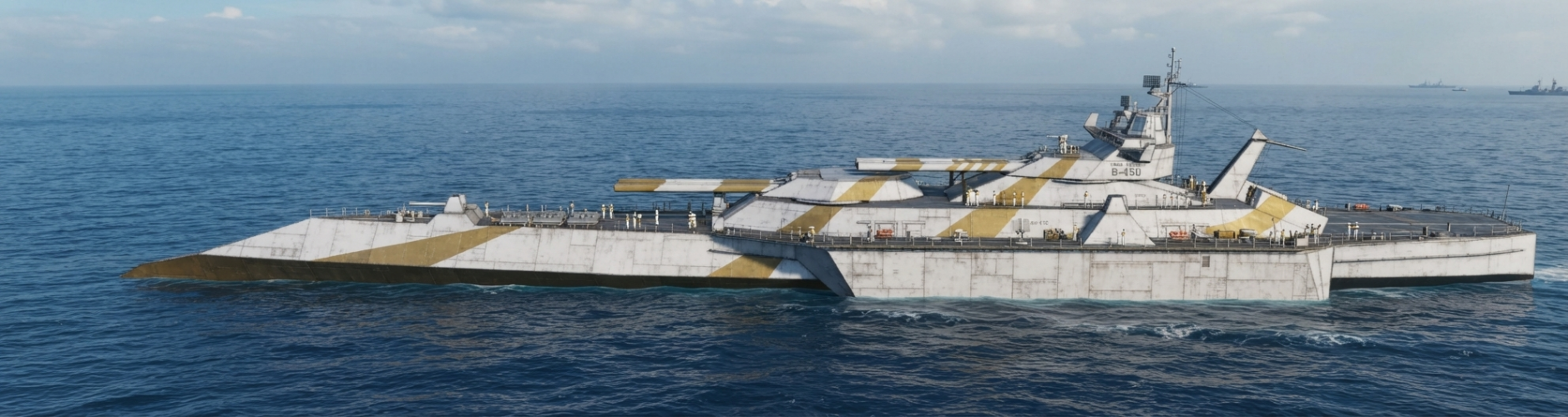
The battleships were designed by «Panafrica Heavy Industries» as massive trimaran units, with middle (main) hull housing main systems, and side hulls being used to store volative, highly-dangerous components. The main hull was divided by three longidutal and 24 tranverse bulkheads. The hull was made from high-tensile steel, supplemented in cricual parts by composite carbon-based ties.
The armor protection was provided by two-layer flat armored deck, of 40 mm steel plates, supported by dilatant liquid layer. The space between armor plates was filled by dielectric material, and used as element of vaporization-type electric armor (designed to disrupt the shaped charge jet or to destroy the hardened penetrator tip).
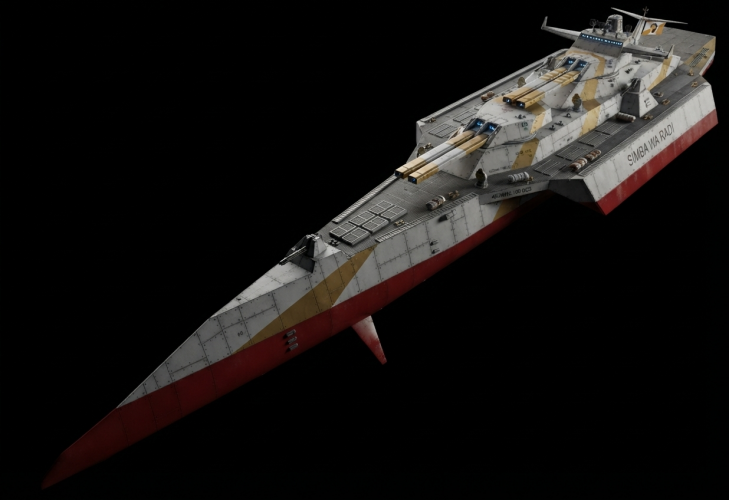
A somewhat unique architecture solution was the ship's bridge being build into superfiring main turret - as well as main radar tower over the bridge. The relatively low recoil of main artillery (of ram accelerator type) made such arrangement possible, despite being universally viewed as sub-optimal.
The battleship's powerplant was quite unique. The drive system was based on magnetohydrodynamic principle, with water as driving medium. To improve the drive efficiency, the MHD drive was of electrode-less, induction-pulse type; the water was pushed by magnetic fields, created by massive induction coils inside ship's hull, and contained salts were partially ionized by powerful microwave emitters at drive intake. Thus both drive efficiency was increased, and gas bubble erosion of drive components prevented.
But MHD drive system was only part of the ship's propulsion. Alongside the hull of «Simba wa Radi» a series of induction coils were placed, to provide laminar flow control. The UMTM system (swah. Udhibiti wa Mtiririko na Tabaka la Mpaka - Border Flow control ) was able to drastically reduce tubulence, optimize the laminar flow, and reduce the ship's acoustic signature by orders of magnitude.
The highly-advanced drive system came at cost, though. The enormous power consumption required installation of no less than six (!) thorium molten salt-type fission reactors. Based on commercial design, the reactors were of relatively low power, but generally reliable and efficient.
SENSOR EQUIPMENT:
The sensor systems of «Simba wa Radi» class was somewhat lacking. The ship was provided with standard-issue active phased array RTA-23F radar, designed by «Polystar International» in cooperation with Israel «Elta» corporation. Such radar was essentially a modernization of destroyer-grade RTA-23 radar, hardly optimal for 85.000 tons dreadnought:
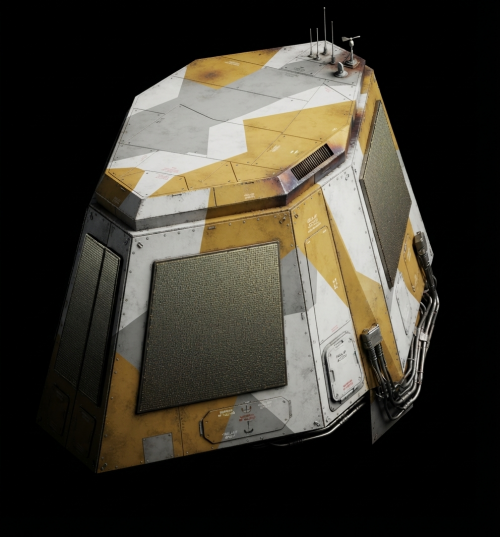
The radar was capable of tracking air & space tarjets at 550 max range, track targets (including orbital and ballistic) at 450 km range, and simultaneously track up to 200 targets with firing solution provided against 50. The main antenna array was supplemented by several passive receiver antennas placed alongside hull sides, forming essentially a multistatic radar array - to increase the efficiency against small & stealthy targets.
MAIN ARMAMENT:
The main armament composed of four 45-cm/100-caliber ram accelerator cannons, designed by «Xanadu Aerosystems», adapting technological solutions from Kilimanjaro Space Accelerator project. The fifty-meter long barrels, filled with combustive gas mix, accelerate the scramjet-equipped shells to the muzzle velocity of 2.5 km/s - giving them a max range of about 580 km. To produce such velocity, four-stage approach is used:
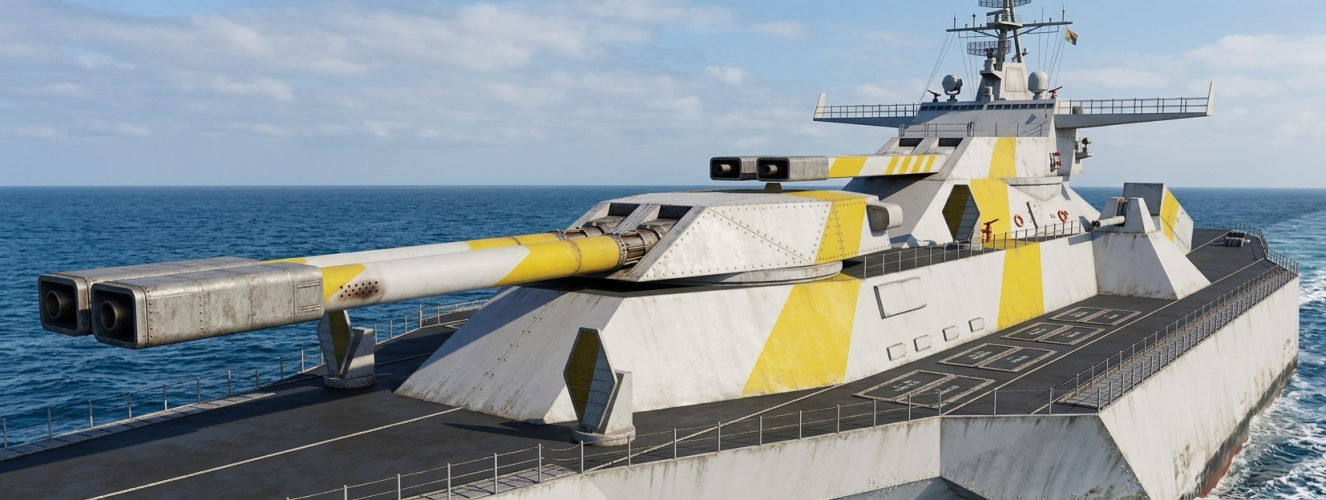
* Zero stage - initial boost chamber, using liquid propellans to accelerate shell to 1.0 km/s starting velocity;
* First stage - methane-oxygen-nitrogen mix, accelerating the shell to 1.6 km/s;
* Second stage - ethane-oxygen-helium mix, accelerating the shell to 2.1 km/s;
* Third stage - hydrogen-oxygen mix, accelerating the shell to 2.5 km/s;
The stages are separated by iris hatches, which are opened & replaced by pressurized nitrogen "gas curtains". A one shell per 50 second fire rate could be achieved.
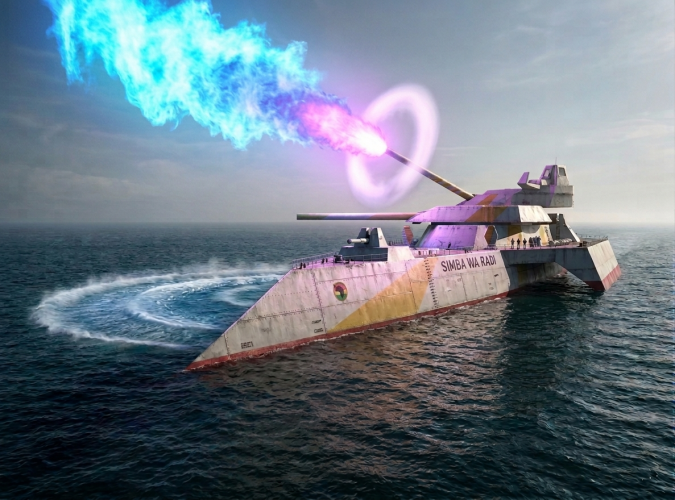
The ram shells are 1100-kg (800-kg after ramjet elements detaching) guided units, equipped with foldable rudders, autopilot and advanced sattelite/ground beacon narrow-beam navigation system. They are mostly kinetic type, relying on their impact velocity (over 1.3 km/s) to dealt with the target. A small "splattering" charge is installed mainly to ensure better kinetic energy transfer into the target bu shell fragmentation. Against soft area targets, a hypervelocity shrapnel shell, filled with tungsten rod bundles is used. A "special" shells with 50-kiloton linear fission bombs are rumored to exist.
The ammo supply is 250 shell per accelerator - 1000 shells per battleship. About 1200 tons of liquified gas mix is stored onboard, mainly in secondary hulls (to protect the vital parts in main hull in case of catastrophic explosion).
SECONDARY ARMAMENT:
The secondary armament consisted of three smaller 10-cm/100-caliber ram accelerator cannons, in dual-purpose mounts. Those cannons were intended for direct fire against enemy surface targets, aerial missiles & planes, as well as ballistic targets by sub-caliber hypersonic shells, accelerated to nearly 3 km/s:
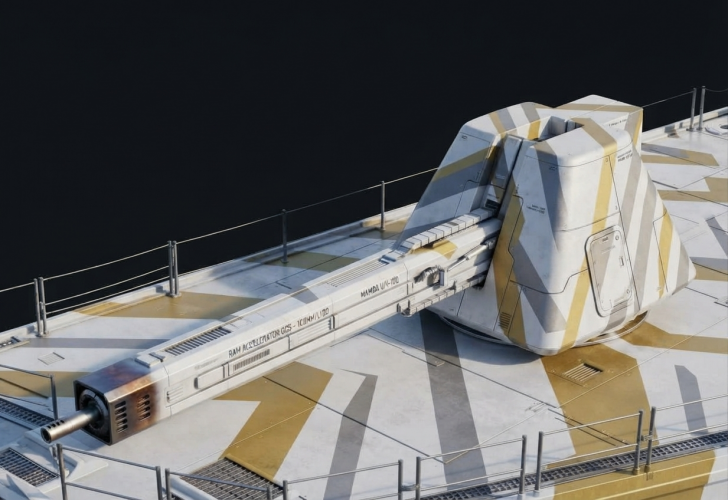
Tetriary defense armament is provided by eight dual «Denel Land Systems» 35DPG mounts, equipped with time-fuzed shells.
ANTI-SHIP MISSILE ARMAMENT:
The anti-ship missile armament consisted of 24 heavyweight «Mkuki-Topido» MT-533 (swah. Spear-torpedo). Those torpedo-carrying missiles consisted of turbojet-powered flying module, carrying heavyweight DM2A6 torpedo (license production) toward the target. The core of concept was, that the low-flying missile would drop the torpedo into water while still staying below the target's horizon - thus avoiding close-range air defenses, especially energy-based ones.
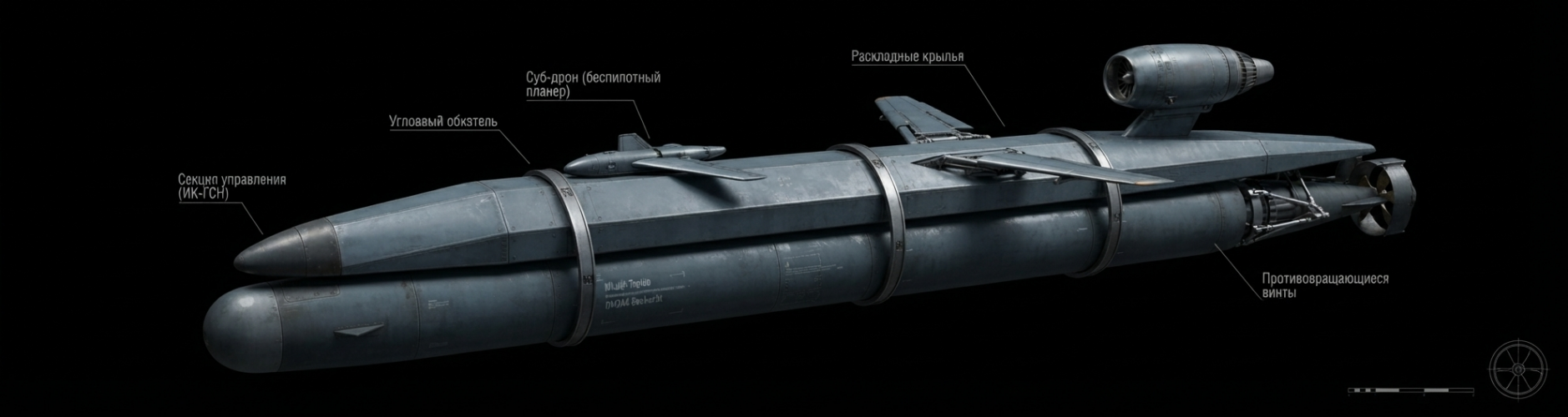
After launch, MT-533 flew toward the target position at 50 meters cruising altitude. Coming into close proximity of the target, the missile detached sub-drone - a small foldable glided, equipped with imagining IR sensors. The sub-drone gained altitude and scanned for target, while missile descended to the 5 meters terminal altitude, relying on data stream of sub-drone. After the target was detected, the missile programmed the torpedo autopilot and dropped torpedo into water; torpedo dived at 200 meters depth, and proceeded to target position, after which activated its own seeker.
ANTI-AIR MISSILE ARMAMENT:
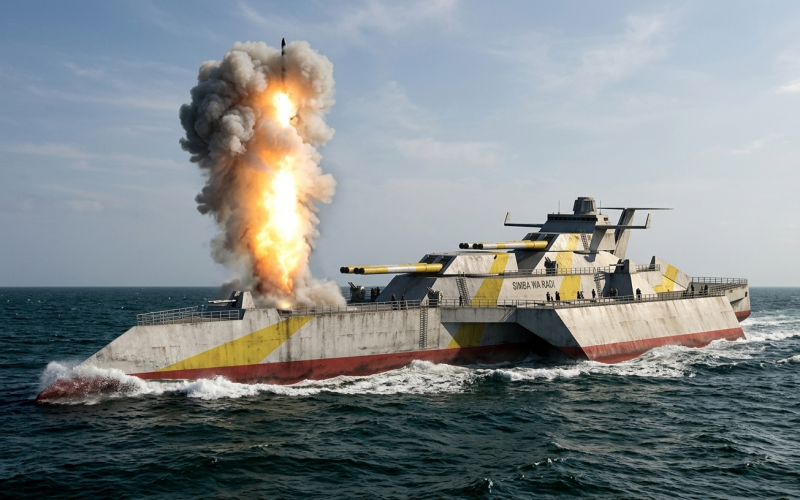
The anti-air missile armament consisted of 200 peripheral launch cells of MUM-K desing (swah. Mfumo wa Urushaji Makombora — Kiafrika - African Missile Launch System). Those cells were specifically developed to operate «Umkhonto-2/3» family of short- and medium-range SAM's, designed by Denel Dynamics».
ANTI-BALLISTIC MISSILE ARMAMENT:
Initially no area ballistic missile defense armament were planned, and self-defense were supposed to be provided by SAM's. But during design process, it was decided to add area defense anti-ballistic/anti-satellite missiles on battleship. A commercial lightweight sattelite booster, powered by liquid oxygen - liquid methane mix was adopted as the basic for long-range anti-missile missile; while normally use of liquid fuel rocket onboard warship would be unthinkable, the «Simba wa Radi» was already designed to operate hundreds of tons of liquid methane and oxygen for its main guns - so risk was deemed to be acceptable:
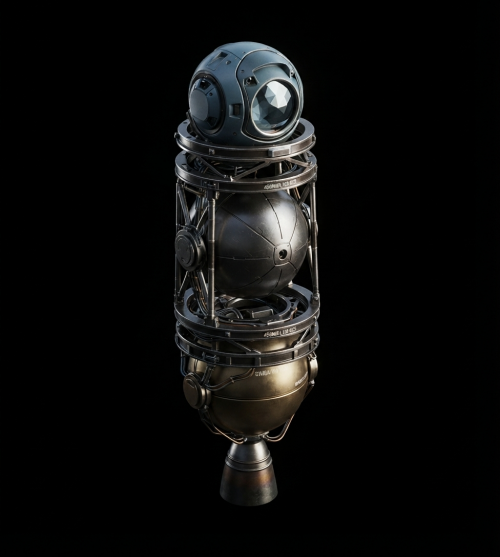
The commercial booster was topped by KMK-1XA exoatmospheric interceptor, designed by «Xanadu Aerosystems» (swah. Kizuia-makombora cha kujiendesha - autonomous missile interceptor). The interceptor itself was composed of three gimballed shperes connected by struts and frames: upper shpere contained IR telescope and guidance unit, middle sphere contained directed shrapnel charge (aimed toward target interception point), and lower shpere contained engine unit.
DIRECTED ENERGY ARMAMENT:
The directed energy armament was provided by «Asà ìmọ́lẹ̀ àìrí» (yorub. Shield of invisible light) AIA-1MW microwave cannons, designed by «Polystar International». The cannons used large phased array antenna to attack target with high-power microwave beam. In "widspread" mode, a fan-shaped beam could be used to swap out swarms of small drones in direct proximity of the ship. In "narrow beam" mode, a pencile-shape beam was generated to attack specific target - like cruise missile - at dozens of kilometer range.
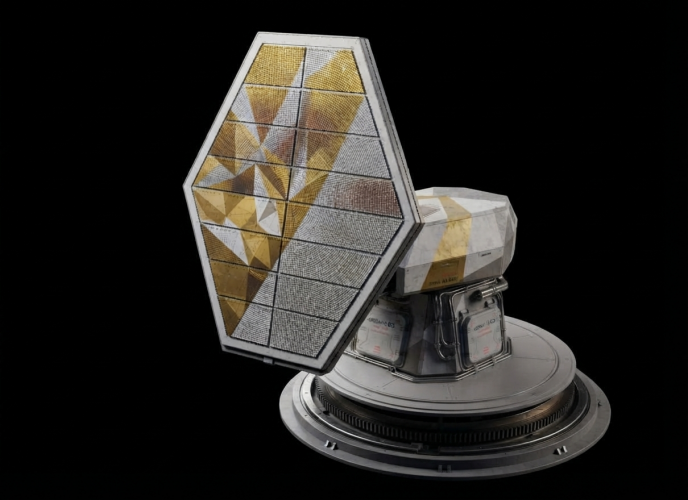
For the characteristic shape, the antennas were nicknamed "Lion cub ears".
TORPEDO DEFENSE:
Torpedo defense of «Simba wa Radi» is mainly based on soft-kill acoustic decoys and hard-kill proximity mines with active depth control, deployed from automatic launchers in the direction of incoming torpedo. Additional protection is provided by UMTM laminar flow control system, which allowed battleship to greatly reduce and/or change its acoustic signature, as well as split the ship's wake, fooling wake-homing torpedoes.
AIR WING:
The rear part of «Simba wa Radi» hull is occupied by extensive flight deck, connected by build in superstructure elevators with under-deck hangars. The battleship is capable of operating up to six helicopters (including up to three heavy-load ones), and up to eight STOVL drone jets. A rather "classic" solution for drone launch was implemented in terms of turntable electromagnetic catapults, allowing drone to be launched regardless of wind direction.
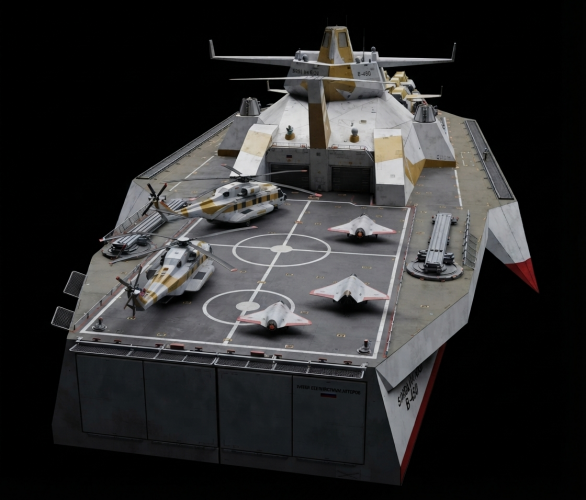
Below the flight deck, the hangar-dock for twelve "Sea Serpent Mk.V" pilotless boats is placed. The drone boats are mainly used to form outside sensor perimeter around battleship, being equipped with low-altitude search radars & receiver antennas for RTA-23F battleship's radar.