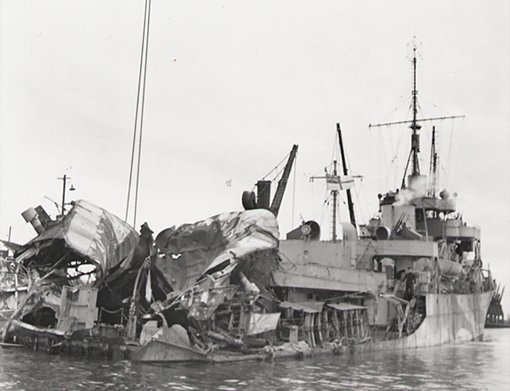
Is a modern Flower class corvette even realistic?

We are getting a bit too off topic on pushing it on commercial owners. Try to to get them to agree first. Historically, they don't because of expenses like insurance, making themselves a target and may not be allowed into port for political reasons etc. I've discussed this too often so let's skip this rabbid hole.
These civilian platforms would be acquired or at a bare minimum requisitioned for wartime duties. I doubt the owners would have much of a say.

There would have to be some kind of draft process for civilian crews who stay onboard, or (ideally) enough foresight to create a reserve pool of civilian mariners before any conflict.
 
These civilian platforms would be acquired or at a bare minimum requisitioned for wartime duties. I doubt the owners would have much of a say.

There would have to be some kind of draft process for civilian crews who stay onboard, or (ideally) enough foresight to create a reserve pool of civilian mariners before any conflict.
I mean they’d probably just man them with sailors…

Sr LT as CO, jr LT as XO, JGs as department heads, and sr ensigns as divos.

A sr chief, small chiefs mess, 1sts for enlisted leadership. Or whatever the model for the cyclones was if that’s pretty far off.
 
At least the weapons/sensors will have to be military.

You could arguably let civilians operate the ship.
Why would you have civilians operate a warship?
Civilians caught on an armed vessel can be treated as pirates.
Just man them with sailors.
 
Why would you have civilians operate a warship?
Civilians caught on an armed vessel can be treated as pirates.
Just man them with sailors.
If it's just a sonar ship, it's not an issue.

See the USNS SURTASS ships. Civilian ship operations, military sonar operators and comms.
 
If it's just a sonar ship, it's not an issue.

See the USNS SURTASS ships. Civilian ship operations, military sonar operators and comms.
It’s a warship meant to hunt, identify and possibly prosecute submarines.
 
It’s a warship meant to hunt, identify and possibly prosecute submarines.
Remove the "possibly prosecute submarines" part and you have a SURTASS ship.

Nevermind any/all of the various armed merchantmen that happened in WW2 with civilian crews and Navy or USCG gunners.
 
Remove the "possibly prosecute submarines" part and you have a SURTASS ship.

Nevermind any/all of the various armed merchantmen that happened in WW2 with civilian crews and Navy or USCG gunners.
Yes defensive armament for transports.

A corvette is not a transport.
 
An 18kt fishing boat or offshore support boat barely counts as a corvette.
The flower class corvette was literally a whaling ship with some guns and depth charges added on to it. Are you arguing it wasn’t a warship?

And depending on the support boat they can be quite fast. 30+ knots is not uncommon.

What I have described is a ship with sensors to detect and classify submarines, SVTT to prosecute the target, and a gun system to be able to defend against small boats, and subsonic air targets.

Literally just a modernized concept of the WWII flower class corvette.
 
The flower class corvette was literally a whaling ship with some guns and depth charges added on to it. Are you arguing it wasn’t a warship?

And depending on the support boat they can be quite fast. 30+ knots is not uncommon.

What I have described is a ship with sensors to detect and classify submarines, SVTT to prosecute the target, and a gun system to be able to defend against small boats, and subsonic air targets.

Literally just a modernized concept of the WWII flower class corvette.
The main problem is that a ship like that is both not enough and not needed. Without a standoff ASW weapon like a helicopter, it can be easily outranged by a heavyweight torpedo, or destroyed by submarine-launched AShMs. The Stalwart class SURTASS ships were operated by MSC, derived from civilian designs, and crewed by a mix of civilian mariners and Navy sensor operators, and they were expected to participate in World War III while entirely unarmed.

The real shortfall is in sea-based, standoff ASW platforms. Two options that could fill that role are a PSV with a helicopter deck and hangar to support an ASW helicopter, or a small USV (maybe an 11 m hull or even smaller) that can carry a single SVTT up to 100 miles from a parent frigate. Both would still require AAW coverage from a real warship, though you might be able to put a CIWS on the PSV. The USV would need to be too small or too numerous to easily target with submarine-launched torpedoes or AShMs, so they could threaten the enemy submarine with a swarm of torpedoes. Neither of these platforms would need their own sonars, and it would really be preferable to have all of the sensors and effectors spread across as many different platforms as possible.
 
Without a standoff ASW weapon like a helicopter, it can be easily outranged by a heavyweight torpedo, or destroyed by submarine-launched AShMs.

Yes, THOUGH one might define a modern Flower corvette as an escort that usually or mostly keeps the escorted convoy alive (if at least two escorts are present), NOT as a threat platform killer.

Keeping alive can be done by alerting the convoy in time about a probable submarine contact so said contact can be avoided (run away from) and possibly be dealt with by a MPA.
Add CAPTAS-2 or even only CAPTAS-1 (though that may be optimistic) and multicopters for delivery of LWT (preferably the most lightweight models) and more importantly of sonobuoys (mostly to weed out false contacts) and you should be fine.

Moreover, one might consider the ability to fend off a salvo of up to 40 AShMs with two such escorts as necessary regardless of how close a hostile sub may come. Sub-launched AShMs outrange even CAPTAS-4 and equivalent missiles could even be dropped from airliners.
Defence against said AShMs might - in absence of AEW - happen at no more than radio horizon distance. There's no point in having some 300 km range radar and 150 km range missile against 30k ft altitude targets when threat missiles would approach at 5-10 m and become visible at horizon only. So horizon range against threat missiles at 5-10 m, about double that against higher-flying supersonic missiles. A rotating Thales NS50 (a rotating radar for lower cost) and gimballed optronics sensor coupled with IRIS-T SLMs (relatively cheap horizon-ranged SAM with supposedly good ceiling) and lots and lots of decoy launchers (including containerised on the escorted ships) should work fine.


I think a "Flower corvette 2030" could be had at 2,500 tons and less than 500 million € (and much less than 300 million € if you build 50 in 10 years).

Its design would first and foremost be an exercise in restraint and in leaving trodden paths.
 
Moreover, one might consider the ability to fend off a salvo of up to 40 AShMs with two such escorts as necessary regardless of how close a hostile sub may come.
I don't think a salvo of 40 AShMs is realistic against a civilian convoy. Simply not a good use of a high-value SSGN's capability and expensive missile load... (Against a carrier task force certainly, but that's already a very well defended target)

A typical convoy with 2 corvette escorts (one each side) might be 15-18 ships (3 columns of 5-6). Even if each corvette had only a simple defensive SAM system with 8-12 ready-to-fire missiles (as small as Mistral or IRIS-T SLS/AIM-9X) that should be enough to deal with decent-sized salvos and significantly limit the attacker's ability to dent the convoy.
 
The main problem is that a ship like that is both not enough and not needed. Without a standoff ASW weapon like a helicopter, it can be easily outranged by a heavyweight torpedo, or destroyed by submarine-launched AShMs. The Stalwart class SURTASS ships were operated by MSC, derived from civilian designs, and crewed by a mix of civilian mariners and Navy sensor operators, and they were expected to participate in World War III while entirely unarmed.

The real shortfall is in sea-based, standoff ASW platforms. Two options that could fill that role are a PSV with a helicopter deck and hangar to support an ASW helicopter, or a small USV (maybe an 11 m hull or even smaller) that can carry a single SVTT up to 100 miles from a parent frigate. Both would still require AAW coverage from a real warship, though you might be able to put a CIWS on the PSV. The USV would need to be too small or too numerous to easily target with submarine-launched torpedoes or AShMs, so they could threaten the enemy submarine with a swarm of torpedoes. Neither of these platforms would need their own sonars, and it would really be preferable to have all of the sensors and effectors spread across as many different platforms as possible.
So…you think a submarine is going to 100% give away its position to launch a missile at a cheap low end ship, so it can then be engaged by helicopters from other larger ships that maybe nearby, or land based MPAs?
 
Yes, THOUGH one might define a modern Flower corvette as an escort that usually or mostly keeps the escorted convoy alive (if at least two escorts are present), NOT as a threat platform killer.

Keeping alive can be done by alerting the convoy in time about a probable submarine contact so said contact can be avoided (run away from) and possibly be dealt with by a MPA.
Add CAPTAS-2 or even only CAPTAS-1 (though that may be optimistic) and multicopters for delivery of LWT (preferably the most lightweight models) and more importantly of sonobuoys (mostly to weed out false contacts) and you should be fine.
If your corvette is escorting the convoy, then its sensors aren't actually involved in the hunt for the enemy submarine. The Northern Fleet only has about a dozen SSNs and SSGNs, and it would need most of those for bastion defense of its own SSBNs. Against a half dozen enemy submarines, a barrier patrol on the GIUK gap using aircraft and SURTASS ships is far more efficient than close protection of merchant shipping.

LWTs from surface ships are useless against modern submarines when the submarine can hear a container ship from 100 miles away. There's no reason to pretend that could be an effective tool for self-defense unless you use the LWTs to destroy incoming HWTs. Without a Mk 41 VLS for VL-ASROC or something larger like the Sea Lance, the only way to use them effectively is an offboard launch platform, which could be an ASW helicopter, a UAV (minimum size is likely to be something like the MQ-8 Fire Scout), or a USV carrying the torpedoes.

Moreover, one might consider the ability to fend off a salvo of up to 40 AShMs with two such escorts as necessary regardless of how close a hostile sub may come. Sub-launched AShMs outrange even CAPTAS-4 and equivalent missiles could even be dropped from airliners.
Defence against said AShMs might - in absence of AEW - happen at no more than radio horizon distance. There's no point in having some 300 km range radar and 150 km range missile against 30k ft altitude targets when threat missiles would approach at 5-10 m and become visible at horizon only. So horizon range against threat missiles at 5-10 m, about double that against higher-flying supersonic missiles. A rotating Thales NS50 (a rotating radar for lower cost) and gimballed optronics sensor coupled with IRIS-T SLMs (relatively cheap horizon-ranged SAM with supposedly good ceiling) and lots and lots of decoy launchers (including containerised on the escorted ships) should work fine.

I don't think a salvo of 40 AShMs is realistic against a civilian convoy. Simply not a good use of a high-value SSGN's capability and expensive missile load... (Against a carrier task force certainly, but that's already a very well defended target)

A typical convoy with 2 corvette escorts (one each side) might be 15-18 ships (3 columns of 5-6). Even if each corvette had only a simple defensive SAM system with 8-12 ready-to-fire missiles (as small as Mistral or IRIS-T SLS/AIM-9X) that should be enough to deal with decent-sized salvos and significantly limit the attacker's ability to dent the convoy.

I wouldn't be worried about a huge number of Oniks missiles. Using a Tsirkon or two from long range (100 - 200 miles) against the frigates (or corvettes) before closing to engage the cargo ships with torpedoes would be more efficient, and very few European frigates would have any defense against a quasi-ballistic missile. Unless you deploy AAW frigates and destroyers with every ASW group, then dispersing systems like ASW helicopters is going to preserve more capability during an attack.

Another problem with close escort is the speed. Container ships can sustain 20 - 25 knots, and the only ships both faster than that and large enough to carry helicopters are purpose-built warships (unless the convoy escort is a container ship converted like Atlantic Conveyor). Dropping that requirement by not escorting convoys gives you a lot more flexibility in designing and operating smaller ships and USVs for the ASW role.
So…you think a submarine is going to 100% give away its position to launch a missile at a cheap low end ship, so it can then be engaged by helicopters from other larger ships that maybe nearby, or land based MPAs?
If a submarine and an ASW asset run into each other, it's because one of them knows the other is there. Do you think a submarine attacking a convoy would just not bother engaging the escorts? If so, then there's no reason for the escorts because apparently they can't do anything. If it's not an escort scenario, then the appearance of a sonar-equipped enemy combatant means that the enemy already knows where the submarine generally is, so shooting the first enemy sonar as soon as possible will give the submarine the best odds of breaking contact and escaping before other assets show up. That being said, the first asset to respond to cueing from something like SURTASS is going to be an aircraft or helicopter, so the submarine will already be sunk or escaped by the time any surface ship shows up.
 
If your corvette is escorting the convoy, then its sensors aren't actually involved in the hunt for the enemy submarine. The Northern Fleet only has about a dozen SSNs and SSGNs, and it would need most of those for bastion defense of its own SSBNs. Against a half dozen enemy submarines, a barrier patrol on the GIUK gap using aircraft and SURTASS ships is far more efficient than close protection of merchant shipping.

LWTs from surface ships are useless against modern submarines when the submarine can hear a container ship from 100 miles away. There's no reason to pretend that could be an effective tool for self-defense unless you use the LWTs to destroy incoming HWTs. Without a Mk 41 VLS for VL-ASROC or something larger like the Sea Lance, the only way to use them effectively is an offboard launch platform, which could be an ASW helicopter, a UAV (minimum size is likely to be something like the MQ-8 Fire Scout), or a USV carrying the torpedoes.

Aside from any GIUK cordon depending on the concept that those quasi picket ships there survive - which is not for certain:

There are more gaps. A Russian SSN can go under Arctic ice and appear west of southern tip of Greenland. Chinese SSN can appear anywhere once they are silent enough to slip through the 1st island chain.

I did NOT mention torpedo tube-launched LWTs. I mentioned drone-delivered LWTs. Think Malloy T-650 with better batteries. Such multicopters can carry a LWT to 15 km and back now, in future effective radius will be greater than 21" torpedo range in tailchasing cargo 21 kts ships. That's cheaper than ASW missiles, requires no missile launcher and the same multicopter type can instead deploy sonobuoys and act as their radio relay.

MQ-8 is NOT the minimum size.
 
I don't think a salvo of 40 AShMs is realistic against a civilian convoy. Simply not a good use of a high-value SSGN's capability and expensive missile load... (Against a carrier task force certainly, but that's already a very well defended target)

A typical convoy with 2 corvette escorts (one each side) might be 15-18 ships (3 columns of 5-6). Even if each corvette had only a simple defensive SAM system with 8-12 ready-to-fire missiles (as small as Mistral or IRIS-T SLS/AIM-9X) that should be enough to deal with decent-sized salvos and significantly limit the attacker's ability to dent the convoy.

There are few escorts, so convoys might be very big, such as dozens of ships. Same OR thing as during WW2.
Remember the PQ convoys and how much effort was made in those PQ battles on both sides.

Mistral has totally insufficient range and I doubt its effectiveness/reliability for technical reasons. IRIS-T SLS and AIM-9X launched from surface at near-zero speed have a poor range as well.
Moreover, IRIS-T SLM appears to be CHEAPER than AIM-9X and has a stellar record against Russian cruise missiles at least over land. (Cheap cruise missiles à la Shaheeds are not to be expected at high seas, no submarine launches them.)

MICA is expensive, Aster even more so. ESSM is expensive as well, dunno for sure about CAMM, but IIRC it's way more expensive than IRIS-T SLM even in its basic version. Even RIM-116 RAM is MORE expensive (more than 2x !) than IRIS-T SLM. AIM-9X is apparently more expensive (and clearly less capable) than IRIS-T SLM as well.

So IRIS-T SLM appears to be the sweet spot for air defence out to horizon against 'proper' cruise missiles now, by a big margin. (This assumes that it's going to prove itself against sea skimmers and supersonic AShMs incl. in sea skimming mode during trials for the F125 upgrade).

For the record; what I saw indicated IRIS-T SLM prices of about 250k € to 650k €. I assume the cost per copy (kinda fly away, not all things included) is about 450 k €. Its competitors start at about 900k €, some are at 2 million €.
 
Aside from any GIUK cordon depending on the concept that those quasi picket ships there survive - which is not for certain:

There are more gaps. A Russian SSN can go under Arctic ice and appear west of southern tip of Greenland. Chinese SSN can appear anywhere once they are silent enough to slip through the 1st island chain.

I did NOT mention torpedo tube-launched LWTs. I mentioned drone-delivered LWTs. Think Malloy T-650 with better batteries. Such multicopters can carry a LWT to 15 km and back now, in future effective radius will be greater than 21" torpedo range in tailchasing cargo 21 kts ships. That's cheaper than ASW missiles, requires no missile launcher and the same multicopter type can instead deploy sonobuoys and act as their radio relay.

MQ-8 is NOT the minimum size.
The question of getting cargo ships across the Pacific is vastly different than the North Atlantic. The size of the Pacific makes it much easier for Chinese and Russian submarines there to avoid contact than the GIUK gap. The pickets can work better in relatively constrained waters like the gap and the Labrador Sea. I don't think it would be exceptionally difficult to extend the picket coverage to the Labrador Sea, though the sea ice situation would make surface and air prosecution much more complicated.

Out in the Pacific, your light corvette idea makes a lot more sense simply because you need a 2,000 ton ship that can carry a helicopter and keep up with container ships. If you're going to have a ship that can sustain 20 knots for trans-oceanic ranges, then ASW helicopters or large UAVs like the Fire Scout give you a lot more capability than something like the T-650. That would be a better application for a 40 - 60 meter mid-ocean picket that might only be irregularly manned. If the vessel is unmanned, you could have a multicopter armed and sitting in a weather-proof box on the deck of something like the XV Patrick Blackett. Maybe you would need to launch one with a torpedo and one with sonobuoys and a Starlink antenna to feed data back to a land station for final localization of the target.
 
In the case of a convoy, I'd think an SSN captain would want to sink the convoy and evade the escorts. Attacking from surprise is his best bet and the convoy is the target, not the escorts. Sinking an escort or two only gets the convoy trying to evade further attack while the remaining escorts are now all over you trying to find and sink you.

Better to get a couple of the convoy ships and then get the hell out of Dodge so-to-speak, than poke the hornet's nest and get an escort ship that can be replaced while missing out on the prize entirely.
 
(...) give you a lot more capability than (...)

That's not the topic. You display a lack of intellectual self-restraint and focus here.

This is a thread about modern Flower class corvettes/escorts, NOT for the all-too usual undisciplined thinking about gold plated stuff.

Its design would first and foremost be an exercise in restraint and in leaving trodden paths.
 
The question of getting cargo ships across the Pacific is vastly different than the North Atlantic. The size of the Pacific makes it much easier for Chinese and Russian submarines there to avoid contact than the GIUK gap. The pickets can work better in relatively constrained waters like the gap and the Labrador Sea. I don't think it would be exceptionally difficult to extend the picket coverage to the Labrador Sea, though the sea ice situation would make surface and air prosecution much more complicated.

Out in the Pacific, your light corvette idea makes a lot more sense simply because you need a 2,000 ton ship that can carry a helicopter and keep up with container ships. If you're going to have a ship that can sustain 20 knots for trans-oceanic ranges, then ASW helicopters or large UAVs like the Fire Scout give you a lot more capability than something like the T-650. That would be a better application for a 40 - 60 meter mid-ocean picket that might only be irregularly manned. If the vessel is unmanned, you could have a multicopter armed and sitting in a weather-proof box on the deck of something like the XV Patrick Blackett. Maybe you would need to launch one with a torpedo and one with sonobuoys and a Starlink antenna to feed data back to a land station for final localization of the target.
The big issue in the Pacific would be for the ship to have sufficient range to make the trip unrefueled--preferably.
 
That's not the topic. You display a lack of intellectual self-restraint and focus here.

This is a thread about modern Flower class corvettes/escorts, NOT for the all-too usual undisciplined thinking about gold plated stuff.
Before you try to blow up at me, why don't you figure out what escorting and anti-submarine warfare look like in the real world. The only reason to have a close convoy escort is for air defense. Using a passive sonar anywhere near a convoy of container ships going 20 knots is impossible and using an active sonar is only going to increase the signature even more. Barrier defense, either with seabed hydrophones or SURTASS ships backed up by frigates, MPAs, and USV pickets, is the best way to get cueing so targets can be localized, prosecuted, and engaged.

You already proposed a 2,500 ton, €500 million ship with a towed array and an air defense system. That is not a small, cheap combatant for any navy. Coincidentally, it is about the minimum size ship you would need to accompany container ships across a 4,000 nm transit at 20 knots. The idea that you would invest these kinds of resources in an anti-submarine focused ship that large and then cheap out by not providing the single most effective ASW tool that surface combatants can carry - a helicopter - is absurd beyond belief.

Based on the size and cost specifications you provided, you could be looking at ships like the Sigma 105, Gowind 2500, or Sa'ar 6. All of these are between 2,000 and 3,000 tons, cost around $500 million, have better air defense systems than what you talked about, and they all have hangars to carry a helicopter. You might get unit costs closer to €250 million with something closer in size and capability to a Type 056 corvette, but that smaller size starts to risk the ship's ability to keep up with container ships while still being large enough to accommodate an extensible hanger for something like a DASH. There is absolutely no reason to accept the degraded capability and range of battery-powered multicopters on a ship this large.

To make sure you didn't miss anything: ASW escorts aren't an actual requirement, hunter-killer tactics are superior to close escort, and your ideas about the size, cost, and capability of an escort corvette make little sense.

The big issue in the Pacific would be for the ship to have sufficient range to make the trip unrefueled--preferably.
You have great circle distances like 4,000 miles from Guam to Hawaii and 6,000 miles from Tokyo to California, and those distances don't include diversions, zigzagging, or maneuvering around the convoy at full speed. You don't want a warship to ever be running on fumes, so I don't think any modern warships can reasonably keep up with container ships over those distances. The closest I have seen would be the Asagiri class destroyers, which supposedly have a range of 6,000 nm at 20 knots.
 
In the case of a convoy, I'd think an SSN captain would want to sink the convoy and evade the escorts. Attacking from surprise is his best bet and the convoy is the target, not the escorts. Sinking an escort or two only gets the convoy trying to evade further attack while the remaining escorts are now all over you trying to find and sink you.

Better to get a couple of the convoy ships and then get the hell out of Dodge so-to-speak, than poke the hornet's nest and get an escort ship that can be replaced while missing out on the prize entirely.
Right when have subs ever targeted the small escorts? Sure if a cruiser or BB were in the escort historically a sub may target them, but not corvettes, frigates or destroyers
 
The big issue in the Pacific would be for the ship to have sufficient range to make the trip unrefueled--preferably.
That would be nice, but not not necessary there are several points where the convoy could come in close to places like Hawaii (from CONUS) midway, wake, Guam, etc. where an UNREP ship could sail out under protection of MPA and helicopters to conduct RAS with the escorts.
 
That would be nice, but not not necessary there are several points where the convoy could come in close to places like Hawaii (from CONUS) midway, wake, Guam, etc. where an UNREP ship could sail out under protection of MPA and helicopters to conduct RAS with the escorts.
Giving a "cheap" escort UNREP capacity means adding weight and complexity. I could see a situation where you have the escorts hand off convoys to other escorts as it advances, but unrepping means adding the unrep ship(s) and giving the escorts the ability to do it. More $$$ are then involved.

In WW 2, the British and US used the MOMP. That is there was a "Mid-Ocean Meeting Point" where convoys were handed over from US escorts to British escorts in part to avoid having to UNREP.

So, in the Pacific you might have escorts from the US West coast to Hawaii. Then new escorts from Hawaii to say, Guam or something, where the escorts change again. At each stage the escorts relieved return to port to refuel and replenish.
 
So, in the Pacific you might have escorts from the US West coast to Hawaii. Then new escorts from Hawaii to say, Guam or something, where the escorts change again. At each stage the escorts relieved return to port to refuel and replenish.
Agreed. I'd still push for enough range to cross the Pacific, but that's mostly because the escorts need to cover a lot more ground than any convoy over the same distance.

Better to hand off in deep ocean and have the escort group divert to wherever the naval base is.
 
Of the hundreds built, a dozen or two Flower-escorts were torpedoed by German subs. I would have to dig a bit for other types of escorts.
 
Before you try to blow up at me, why don't you figure out what escorting and anti-submarine warfare look like in the real world.

And now let's remember the world does not only consist of NATO and wars rarely look much like NATO militaries expect them to look ex ante.

Guam to Hawaii is not a reasonable trip in wartime.
It's Western CONUS - Hawaii - Tokyo Bay - Guam
Hawaii-Tokyo Bay need much less effective protection than anything closing in with Guam, so using Japan/Tokyo Bay as hub and changing escorts makes a lot of sense.

Pearl Harbor to Tokyo is about 3,350 nm.
 
And now let's remember the world does not only consist of NATO and wars rarely look much like NATO militaries expect them to look ex ante.
What significant submarine threat areas do you think there are outside the Western Pacific and the North Atlantic? The only countries this is relevant for are the US and NATO and then Japan and South Korea. Also, if nobody knows what the next war is going to look like, what makes you think your opinion is worth any more than mine?

Guam to Hawaii is not a reasonable trip in wartime.
It's Western CONUS - Hawaii - Tokyo Bay - Guam
Hawaii-Tokyo Bay need much less effective protection than anything closing in with Guam, so using Japan/Tokyo Bay as hub and changing escorts makes a lot of sense.

Pearl Harbor to Tokyo is about 3,350 nm.
Tokyo is a thousand miles closer to China than Guam is. That would be like a WWII convoy traveling from New York to Liverpool via the North Sea and the English Channel.
 
Tokyo is on the far side of Honshu, way better protected than the waters around Guam.

And guess what - that's how logistis work. Goods flow from South China north to Shanghai, then to south on a route to Rotterdam far to the west which requires a last leg of going eastward, then they are moved from there to destinations southwest of Rotterdam.
Hubs are about logistics efficiency, not about shortest routes. Few logistics schemes use direct connections (that is about shortest routes).

"Also, if nobody knows what the next war is going to look like, what makes you think your opinion is worth any more than mine?"
Unlike you, I'm not ruling out a historically well-known scenario (oceanic convoys for protection against subs) for the future.
Moreover, the thread here is literally about that. The Flower corvette was an oceanic anti-submarine escort, the thread started with asking about a cheap small ASW ship (on a civilian hull).
Any GIUK cordon ship would require much longer-ranged ASW protection than needed to keep sub torpedoes from sinking escorted ships. GIUK patrol requires survivability like a AAW picket ship due to the air threat.

So I'm trying to stay on-topic here, which requires self-restraint and focus of thoughts.
 
What significant submarine threat areas do you think there are outside the Western Pacific and the North Atlantic?
South China Sea, East China Sea, Yellow Sea, Sea of Japan...

Mediterranean Sea, Baltic Sea, potentially the Black Sea...


Tokyo is a thousand miles closer to China than Guam is. That would be like a WWII convoy traveling from New York to Liverpool via the North Sea and the English Channel.
The difference is that Hawaii-Tokyo can be done entirely in deep ocean, while Hawaii-Guam is dodging through dozens of island groups that would be really good places to ambush a convoy or place mines for a convoy to run into.


Unlike you, I'm not ruling out a historically well-known scenario (oceanic convoys for protection against subs) for the future.
You need to remember that modern container ships are as fast as LHDs, and even the ULCCs and LNG tankers are still able to do 15 knots. Once the next generation of oil tankers show up that can do 20(+?) knots, subs are really going to struggle to engage merchant ships with torpedoes.

So I'm not sure how long the idea of convoying up to protect against submarines is going to help.


Moreover, the thread here is literally about that. The Flower corvette was an oceanic anti-submarine escort, the thread started with asking about a cheap small ASW ship (on a civilian hull).
Any GIUK cordon ship would require much longer-ranged ASW protection than needed to keep sub torpedoes from sinking escorted ships. GIUK patrol requires survivability like a AAW picket ship due to the air threat.

So I'm trying to stay on-topic here, which requires self-restraint and focus of thoughts.
ASW sensor wise, you need a minimum of two sonars just to do the job. either a hull sonar or a surface towed array, and a VDS. The hull sonar is listening for subs doing a periscope approach (which is still basically required for torpedo attacks on surface ships), and the VDS is listening for subs going below 300ft and going fast to reposition. For ASW weapons, you're going to want UAV or helo-delivered lightweight torpedoes. LWT launchers on the ship itself are not much more than giving the crew a feeling of fighting back, so could be skipped if they take up too much space.

You're also going to need self-defense AA. For the Brits, a CAMM mushroom farm and whichever radar can cheaply provide the necessary tracking. For the US, a couple blocks of ESSM in vertical launchers plus RIM116 and Sea Giraffe or TRS-4D (if those can talk to ESSMs, else we gotta step up to 3x9RMA SPY6)

And now we're suddenly up to pretty expensive ships because they have ~100mil worth of sensors and weapons on them.

For the bare minimum capability.
 
Tokyo is on the far side of Honshu, way better protected than the waters around Guam.
Tokyo is still far closer to the Chinese coast, and the number of missiles available increases exponentially as you get closer.
And guess what - that's how logistis work. Goods flow from South China north to Shanghai, then to south on a route to Rotterdam far to the west which requires a last leg of going eastward, then they are moved from there to destinations southwest of Rotterdam.
Hubs are about logistics efficiency, not about shortest routes. Few logistics schemes use direct connections (that is about shortest routes).
There are two concerns for supplying Guam and the NMI. The first is food and other necessities for 250,000 people, and the second is military equipment. Right now, most of the civilian logistics in Guam come from Japan, but everything that the US military in Guam needs would come from the United States. Trying to send all of those ships through the Philippine Sea to get to Guam makes no sense when the approach could come from the east.
Unlike you, I'm not ruling out a historically well-known scenario (oceanic convoys for protection against subs) for the future.
Moreover, the thread here is literally about that. The Flower corvette was an oceanic anti-submarine escort, the thread started with asking about a cheap small ASW ship (on a civilian hull).
Even if you are going to assume that convoys with ASW escorts would exist, there is no civilian hull that can actually escort them. An ASW escort based on a civilian PSV/OSV or trawler is going to be much slower than a container ship and have much less range, so it could only be used on barrier operations. To escort a convoy of container ships with a civilian hull design, you would need something like a 20,000 ton container ship with ASW helicopters (set up like Atlantic Conveyor) just to keep up. Any towed arrays or hull-mounted sonars would be entirely out of the question.
Any GIUK cordon ship would require much longer-ranged ASW protection than needed to keep sub torpedoes from sinking escorted ships. GIUK patrol requires survivability like a AAW picket ship due to the air threat.
The best surface option for barrier operations would be a combination of frigates and USVs. A corvette like what you propose would be both too lightly equipped and too expensive.
South China Sea, East China Sea, Yellow Sea, Sea of Japan...
All in the Western Pacific. These areas would have such a severe air and missile threat that moving shipping through would be unsurvivable before you even consider submarines. You could think about moving CSGs into the Philippine Sea, but that would be risky with the number of DF-21s and H-6s the Chinese have, and anything less defended would be even more vulnerable.
Mediterranean Sea, Baltic Sea, potentially the Black Sea...
Modern SSKs are a very different threat profile compared to U-boats. In WWII, the U-boats could operate in the open Atlantic because they could run a 20 knots on the surface, but doing that would be suicide today. Kilos would have to operate on batteries and snorkels in chokepoints or coastal areas, which makes dealing with them more a matter of hunting in their operating areas and routing cargo ships other ways. The open-ocean U-boat threat is more similar to what we could see from SSNs because modern SSKs have, for the most part, had to sacrifice their range and speed for survivability compared to WWII-era submarines.
The difference is that Hawaii-Tokyo can be done entirely in deep ocean, while Hawaii-Guam is dodging through dozens of island groups that would be really good places to ambush a convoy or place mines for a convoy to run into.
The Hawaii - Tokyo route runs all the way down the Izu-Bonin-Mariana arc, which does have a lot of islands. While there are a lot of seamounts between Hawaii and Guam, there the only place they come above water is Wake Island and the vast majority are guyots with tops no higher than 3,000 to 4,000 feet below the surface. Detouring through the Marshall Islands would add 500 miles to the transit.
ASW sensor wise, you need a minimum of two sonars just to do the job. either a hull sonar or a surface towed array, and a VDS. The hull sonar is listening for subs doing a periscope approach (which is still basically required for torpedo attacks on surface ships), and the VDS is listening for subs going below 300ft and going fast to reposition. For ASW weapons, you're going to want UAV or helo-delivered lightweight torpedoes. LWT launchers on the ship itself are not much more than giving the crew a feeling of fighting back, so could be skipped if they take up too much space.

You're also going to need self-defense AA. For the Brits, a CAMM mushroom farm and whichever radar can cheaply provide the necessary tracking. For the US, a couple blocks of ESSM in vertical launchers plus RIM116 and Sea Giraffe or TRS-4D (if those can talk to ESSMs, else we gotta step up to 3x9RMA SPY6)

And now we're suddenly up to pretty expensive ships because they have ~100mil worth of sensors and weapons on them.

For the bare minimum capability.
A warship with enough machinery and fuel to keep up with a convoy of container ships over long ranges is going to be large enough to handle a standoff ASW system like a helicopter and expensive enough to be worth defending with SAMs.

Submarine-launched UAVs could be another target for convoy air defenses. If a submarine launches a UAV, it could communicate with a floating communications relay either via a fiber-optic line or acoustic communications while remaining under the thermocline. That could eliminate the need to come to periscope depth to identify sierras before a torpedo attack, while electric swim-out torpedoes could make it easier and safer to fire torpedoes while staying deep.

The fundamental difference between the threat environment that the Flower class corvettes saw in the Battle of the Atlantic and what we have today in the North Atlantic and Western Pacific is the air threat, both land-based ballistic missiles and anti-shipping bombers and submarine-launched anti-ship cruise and ballistic missiles.

 
I blogged years ago already about arming container ships to create a self-defending convoy. It's kinda my recommendation for between Azores (westward of it) and Hawaii (east of it), but it's not the topic. The topic is feasibility of a small cheap escort.

The speed limit for purposeful towed LFASS operation is somewhere around 15 kts, never exceed speed is about 30 kts for CPATAS-4 IIRC.
Cargo ships would have to slow down to about 13 kts cruise or the escort needs to be able to sprint ahead again and again to deploy the array temporarily. Third option if LFASS dipping sonar, but that's damn expensive (about 6 helos for 1 in the air 24/7 up to sea state 6 only) and not the topic, either. A pre-positioned line of ASW vessels may look good in OR once you reach a certain traffic volume, but sounds impractical to me even for a main lane.

The Flower corvettes faced air threat by Fw 200, were almost unarmed against it (and de facto unprepared to actually protect most of the convoy from it). Besides, my hypothetical 2500 ton escort's description included (small) area air defence.

The "small cheap civilian hull-based ASW escort" 's answer to ballistic IRBM with end phase anti-ship guidance should IMO be to trigger a shitton of soft kill measures, there's another recent thread on that. A reduction from say 90% chance of being hit to say 5% chance of being hit would be unacceptable for a CVN, but IMO in a major war be acceptable for a large container ship. Hence IMO no need for hard kill defence for such a logistics convoy.
 
The German guided torpedoes of WW2 were specifically designed to kill escorts.

also https://www.history.navy.mil/research/histories/ship-histories/danfs/d/dealey.html
And were anticipated by the Admiralty so able to be quickly countered by the "Foxer" towed noisemaker so casualties were limited. From Uboat.net.

"T4Electric7500m/20kts

Falke, the first homing torpedo, was fitted with a passive acoustic homing device. It was introduced in March, 1943 and used byU-603 (Oblt. Bertelsmann),U-758 (Kptlt. Manseck) andU-221 (Kptlt. Trojer) against convoys HX-229 and SC-122.Few were used as it was replace by the T5 which was faster, had a greater range and could be usedwith either magnetic or contact detonators.


G7sT5Electric5700m/24kts

The Zaunköning (Wren) came into service during the autumn of 1943. Intended to be an escort-killer, it achieved some early minor success only to be countered by the allied Foxer noise-making decoy. It was scoring hits against escort and merchants to the end of the war though.


The weapon was designed to lock onto the loudest noise after a run of 400m from its launch. This often proved to be the U-boat itself and standard issue-orders were to dive immediately to depth of 60m after launch froma bow tube while a stern shot was to be followed by a complete silence in the boat. Two U-boats were almost certainly lost when hit by one of their own T5 torpedoes, U-972 in Dec 1943 and U-377 in Jan 1944."

From another source, target speed had to be greater than 10knots for a T5 to work and as it only had a speed of 25 knots, ships, like destroyers able to run away fast could escape them. Also they tended not to sink escorts, just cripple them by blowing of their sterns which made depth charge crews rather nervous! By that stage of the war their were enough escorts being produced that ships damaged in this way could simply be paid off. HMCS Chebogue Oct 1944.

1790254920694.jpeg

The Allies introduced their own air-dropped homing torpedo in Spring 1943, the Mk.24 Mine aka "Fido". Described as a "Mine" as a security measure. It achieved its first U-boat kill on 12 May 1943 dropped from an RAF Liberator.
 
IIRC I read that German acoustic torpedoes could have been available much sooner if they had been built just to target cargo ships. The requirement that they shall be useful against (fast, high screw rpm) escorts delayed introduction a lot. IIRC the anti-cargo ship state of tech years earlier required the torpedo to be slower than the eventually introduced one.

Anyway, the Germans thought about multiple ways to fight escorts, including upward-firing rockets IIRC. CVEs (=kinda escorts) were highly prized targets 1943-1945.
 
IIRC I read that German acoustic torpedoes could have been available much sooner if they had been built just to target cargo ships. The requirement that they shall be useful against (fast, high screw rpm) escorts delayed introduction a lot. IIRC the anti-cargo ship state of tech years earlier required the torpedo to be slower than the eventually introduced one.

Anyway, the Germans thought about multiple ways to fight escorts, including upward-firing rockets IIRC. CVEs (=kinda escorts) were highly prized targets 1943-1945.
That strategy is flawed actually. Sinking the escorts, unless you get most or all of them, leaves the convoy intact. It is the merchant ships and their cargo in a guerre de course that are the important target. Better a U-boat sinks one or two merchants and spends time evading the escort's retaliation, than sinking an escort and facing that same retaliation having accomplished next to nothing for it.
 
Back
Top Bottom